Fluoropolymer Processing Aid Market Size & Opportunities Analysis - Growth Strategies, Competitiveness, and Forecasts (2026 - 2032)
This Report Provides In-Depth Analysis of the Fluoropolymer Processing Aid Market Report Prepared by P&S Intelligence, Segmented by Polymer Type (Polyethylene (PE), Polypropylene (PP), Polyvinyl Chloride (PVC)), Application (Blown Film & Cast Film, Pipes & Tubes, Wires & Cables, Fibers & Raffia), Form (Masterbatch, Neat/Additive), and Geographical Outlook for the Period of 2021 to 2032
Explore the market potential with our data-driven report
Fluoropolymer Processing Aid Market Outlook
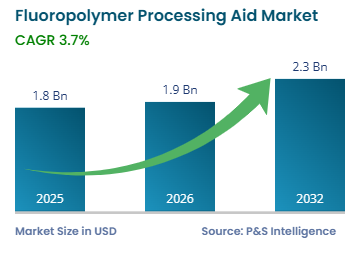
The fluoropolymer processing aid market size was estimated USD 1.8 billion for 2025, and it will grow by 3.7% during 2026–2032, to reach USD 2.3 billion by 2032.
The demand for high-performance polymers is increasing due to increased use of fluoropolymers in processing, within the packaging, automotive and electrical areas. Increased demand for improved flow and improved surface finish of fluoropolymer processing aids for polyethylene (PE), polypropylene (PP), and polyvinylchloride (PVC) formulations will support this trend. Increasingly, manufacturers are under intense pressure to produce products more efficiently with reduced energy consumption and lower defect rates. Fluoropolymer processing additives have been identified as key enablers to achieve higher throughput and product quality in extrusions and molding processes.
Industry data also indicates that fluoropolymer processing aids can be used to prevent die build-up, eliminate melt fracture, and allow processors to process materials at higher speeds than they would with un-modified polymer formulations. The benefits of using fluoropolymer processing aids are most pronounced in packaging applications, since packaging film producers need to maximize production while maintaining the optical clarity and mechanical integrity required for food-contact and industrial packaging films. According to the Organisation for Economic Co-operation and Development (OECD), packaging accounts for approximately 40% of total global plastic use, underscoring the importance of processing aids in high-volume polymer film manufacturing.
Fluoropolymer Processing Aid Market Emerging Trends
Sustainability and Regulatory ComplianceAre Key Trends
Increased scrutiny of fluoropolymers due to their content of fluorinated compounds and emerging regulatory frameworks to control per- and polyfluoroalkyl substances (PFAS), which are used as additives in many processes, is driving the need for new next generation processing aid formulations that balance performance and sustainability. Multiple jurisdictions have implemented or are implementing frameworks to evaluate and restrict chemicals. The European Union has enacted REACH regulations to require the registration of all chemicals, provide comprehensive safety data, and the U.S. EPA is working to address potential pathways for PFAS exposure.
Additionally, countries within the Asia-Pacific region are developing their own national chemical management programs based on international guidelines. As a result, these regulatory developments present significant technical challenges for processing aid suppliers, who must be able to support the same performance characteristics that include melting point flow enhancement and surface finish improvement while also providing evidence of acceptable environmental and health impacts across the full lifecycle of products.
The industry response to this regulatory pressure includes a number of different adaptations. Some of the most notable adaptations include developing new additive chemistries using modified fluoropolymer structures, optimizing dosages to minimize the amount of additive required while still providing the performance benefits of the current additives, and enhancing the ability to provide customers with information necessary to meet their obligations regarding regulatory compliance documentation and substance declarations.
The United Nations Development Programme indicate that approximately 430 million metric tonnes of plastic are produced globally each year. If the current production levels don’t come down, global plastic production could nearly triple by 2060. This indicates the magnitude of the polymer processing operations that are impacted by changing environmental regulations and the importance of processing aids in allowing companies to adopt sustainable manufacturing practices.
As the regulatory environment evolves there are indications of differing regional approaches to regulating the use of fluoropolymer processing aids. In Europe, the regulatory environment may be restrictive enough to limit the adoption of fluoropolymer processing aids in applications where alternatives are technically feasible. In North America, regulatory efforts will likely focus on restricting the use of fluoropolymer processing aids in specific use cases but will allow continued access to the industrial application base. In the Asia-Pacific region, regulatory bodies will seek to balance competing interests between environmental concerns and the desire to remain competitive in terms of manufacturing.
The regulatory environment presents both opportunities to invest in sustainable chemistry and offer product containing environment-friendly additives for suppliers looking for sustainable chemistries. This will allow market players to differentiate themselves based on their ability to support customers' environmental goals. Increasingly, the competitive landscape favors suppliers that demonstrate regulatory foresight, product stewardship capabilities, and innovation in alternative additive platforms that can satisfy performance requirements with better sustainability profiles.
Cost-Driven Efficiency Gains and Rising Polyolefin & Packaging Usage Are Biggest Drivers
The expansion of global polyethylene and polypropylene production capacity, combined with rising energy prices and increasing competitive pressure to lower manufacturing costs, is driving the increased adoption of fluoropolymer processing aids to optimize efficiency across polyolefin processing operations. FPAs provide a way to improve processing economics for film extruders, pipe manufacturers, and fiber spinners as they operate within energy constraints where 4–10% of their total operational costs are represented by energy consumption.
Thereby, providing an opportunity to significantly reduce specific energy consumption without having to make capital investments in new processing lines. According to the International Energy Agency, substantial industrial energy efficiency potential exists across energy-intensive manufacturing sectors, creating a strong economic incentive for polymer converters to adopt performance-enhancing additives that enable higher throughput with similar or lower energy consumption.
Fluoropolymer processing aids offer polyolefin converters a means of addressing their economic challenges through several different mechanisms that can enhance the economics of their manufacturing processes. Specifically, the ability of FPAs to lower melt viscosity and eliminate surface defects such as melt fracture and die buildup allows the converter to increase line speed by 20–40%, and reduce extruder backpressure by 10-15%, thereby lowering specific energy consumption. This dual benefit of increased throughput and decreased energy consumption presents a strong rationale for investing in additive technology in high volume applications where small incremental reductions in energy consumption and/or improved throughput can be translated into cost advantages in highly price sensitive commodity marketplaces.
The rate of adoption of fluoropolymer processing aids illustrates a rapidly accelerating trend in areas of the world including the Asia-Pacific region and Latin America where the cost pressure to manufacture is most intense, and where there exist opportunities for expanding manufacturing capacity and integrating efficiency enhancing additives in new equipment as it comes on-line.
The worldwide polymer market was valued at USD 666.1 billion in 2024 and is projected to attain USD 993 billion by 2032, reflecting a CAGR of 4.6% from 2025 to 2032. In 2024, polyethylene accounted for the largest value share, of 35% in terms of value. During the forecast period, polypropylene is anticipated to experience the most rapid growth in revenue generation.
Fluoropolymer Processing Aid Market Segmentation Analysis
Type Analysis
The polyethylene category holds the largest market share, of 55%, in 2025, primarily as a result of the fact that it has become the most commonly used thermoplastic worldwide; further supported by the use of this polymer in packaging films, agricultural related applications and various forms of infrastructure product that require constant processing performance. As a result, polyethylene’s dominant market position can be attributed to an existing manufacturing base encompassing all three major grades, which provide diverse markets for processing aids. As such, there are numerous applications for polyethylene film at varying levels of production speed and surface finish which require processing aids to optimize the surface quality of the final product.
According to the Food and Agriculture Organization of the United Nations, global food production is projected to increase by approximately 50–60% by 2050 to meet the needs of a growing population, supporting sustained demand for food packaging and polyethylene film applications. Additionally, producers of polyethylene film are developing new technologies to reduce material usage, while maintaining the mechanical properties of the film. This creates specific processing requirements for the elimination of melt fracture and improvement in optical clarity in thinner gauges, favoring the use of processing aids in polyethylene film production.
The polypropylene category will have the highest CAGR, of 3.9%, due to increasing demand for Polypropylene in automotive lightweighting projects, medical device manufacturing and the production of technical fibers requiring improved mechanical properties and chemical resistance when compared to alternative polyethylene. As polypropylene requires different processing aid formulations than polyethylene due to the significantly higher melt temperatures and distinct rheology of the two materials, the anticipated growth of polypropylene is expected to create new opportunities for the development of specialized processing aid formulations specifically designed for use in Polypropylene processing operations.
The types analyzed in this report are:
Polyethylene (PE) (Largest Category)
High-Density Polyethylene (HDPE)
Low-Density Polyethylene (LDPE)
Linear Low-Density Polyethylene (LLDPE)
Polypropylene (PP) (Fastest-Growing Category)
Homopolymer
Copolymer
Polyvinyl Chloride (PVC)
Rigid
Flexible
Others
Application Analysis
The blown film & cast film category holds the largest market share, of 45%, in 2025, because of the packaging industry need to produce films at high throughput rates with controlled uniformity of thickness and optical clarity for use in food contact and retail visibility requirements. The sensitivity of blown film extrusion processes to surface irregularities such as melt fracture and die buildup create strong technical rationale for the use of process aids even though the addition of a process aid is typically an added expense. According to the U.N. Conference on Trade and Development, the global plastics trade is valued at over USD 1.1 trillion annually and highlighting the magnitude of polymer processing activity that drives demand for solutions to optimize processing performance.
Blown film production of LDPE and LLDPE for stretch wrap, agricultural films and industrial sheeting are among the most significant consumers of processing aids due to their increased sensitivity to surface smoothness and the direct economic costs associated with down time spent cleaning dies. Similarly, cast film production of medical packaging, labels and technical tapes also require processing aids.
The fibers & raffia category will have the highest CAGR, driven by expanding technical textile markets, packaging of agricultural products in developing countries, and infrastructure development using geotextiles for erosion control and civil engineering projects. Fiber spinning and tape extrusion processes have different rheological requirements and surface finish specifications than film extrusions creating an opportunity for technical differentiation and higher price premiums for processing aids relative to commodity film applications.
The applications analyzed in this report are:
Blown Film & Cast Film (Largest Category)
Pipes & Tubes
Wires & Cables
Fibers & Raffia (Fastest-Growing Category)
Others
Form Analysis
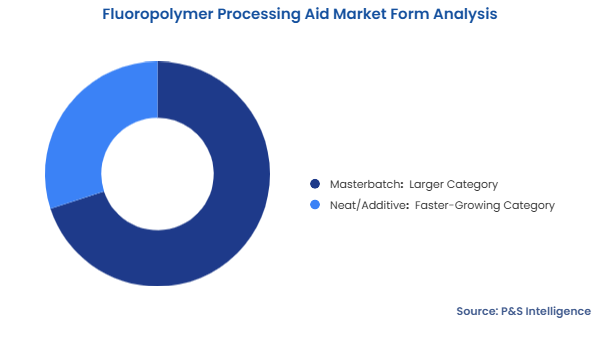
The masterbatch category holds the largest market share, of 70%, in 2025, due to the ability to reduce worker dust exposure when processing, a better means of accurately dosing using carrier resin systems, and easier inventory management as each of these types of resin can be formulated for use in different polymers. This significant share represents the practical realities of high volume manufacturing where material handling is most efficient, safe, and consistent to maximize profitability and to ensure regulatory compliance.
Masterbatches have a well-established distribution channel for delivering powdered additives in pelletized form, which is compatible with automated feed systems that are prevalent in today's extrusion-based manufacturing operations. Suppliers of masterbatches differentiate themselves through their selection of the appropriate resin carrier for compatibility with specific target resins, through their ability to produce a masterbatch with optimal dispersion quality that ensures that the effectiveness of the additive at the recommended dosage rate, and through their technical services capabilities to assist customers in processing trials and formulation optimization.
The neat/additive category seeing the highest growth, due to their direct enhancement to polymer performance in terms of flow, friction reduction, and process extension during manufacturing. Manufacturers in industries such as Automotive and Electronics are increasing use of these products to enhance the performance of their products throughout all phases of manufacturing. The flexibility to incorporate additives into current manufacturing processes and create new polymer compounds with enhanced properties, including lightweight and high performance, are fueling the demand for high performance, lightweight polymers, thereby increasing additive usage over other forms at a greater rate.
The forms analyzed in this report are:
Masterbatch (Larger Category)
Neat/Additive (Faster-Growing Category)
Drive strategic growth with comprehensive market analysis
Fluoropolymer Processing Aid Market Geographical Analysis
Asia-Pacific Fluoropolymer Processing Aid Market Size
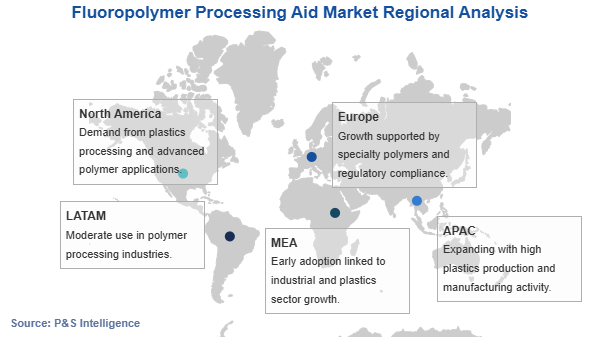
Asia-Pacific holds the largest market share, of 45%, in 2025, and it will have the highest CAGR, of 3.8%, The high volume of processing polyolefins in the region, with China and India alone hosting the polyethylene and polypropylene conversion capacity to produce film, pipes, and fibers contribute to this position of dominance. The increasing costs of labor and intensified competition among the converters in the region are driving up the rate at which converters implement process improvement technologies that can increase output without a corresponding need for capital expenditures to install new processing lines.
China Fluoropolymer Processing Aid Market Size
China represents the largest country market within Asia-Pacific, due to the government's industrial policy to achieve self-sufficiency in petrochemicals, the enormous scale of manufacturing in China providing low-cost production economics, and the vertical integration of the supply chain in China connecting feedstock production through downstream conversion of the feedstock into end-use products.
The market for fluoropolymer processing aids in China benefits from the concentration of demand in the coastal provinces of China where the manufacturing centers for packaging, building materials and automotive parts are located close together and provide a densely networked group of polymer processors who require a constant supply of additives.
According to the China National Bureau of Statistics, China has a large number of plastics processing enterprises with annual revenues exceeding RMB 20 million, reflecting a substantial installed manufacturing base that supports sustained demand for polymer processing aids across packaging, construction, automotive, and industrial applications.
China's future development is likely to continue to grow through 2032, however the growth rates in the past have been at historically high levels, and therefore may slow down as the market matures and environmental regulations become more restrictive and focus on the use of sustainable additives compatible with recycling processes. The trend towards the use of higher-value applications such as medical equipment, pharmaceutical packaging and electronic components is generating a demand for premium-quality processing aids that meet stringent purity and regulatory compliance standards.
The use of plastic packaging in China reflects China's large-scale manufacture and domestic markets. In 2024, China produced an estimated 15 million tonnes of plastic packaging; while production of plastic packaging has been generally stable since it peaked in 2021, China remains the world's leading manufacturer and consumer of plastic packaging. Consumption within China was estimated to be just under 12 million tonnes in 2024, the highest of all nations, but a slight decrease from previous years. The value of plastic packaging production is estimated to exceed USD 60 billion, while total packaging volume could reach 13 million tonnes by 2035.
North America Fluoropolymer Processing Aid Market Size
In 2025, North America represents a significant share of the total worldwide market share in terms of total fluoropolymer processing aid sales, ranking second after Asia-Pacific. North America has a developed base of polymer processing companies that are generally concerned with delivering high-quality products that meet or exceed all applicable regulatory requirements and also meet their customers' sustainable production needs.
In addition to these factors, North America's processing aid market is driven by the need for suppliers to provide additive solutions that have been proven and validated for use in strict food contact applications; manufacturers of pharmaceuticals and medical devices that require clean room compatible processing aids for their manufacturing processes; and manufacturers of automotive components that require lightweighted polymers to achieve fuel economy and emissions standards for their vehicles.
According to data from the U.S. Plastics Industry Association, U.S. plastic processors ship processed plastic products valued in the hundreds of billions of U.S. dollars annually. Packaging represents the largest application area, with construction accounting for a significant share too. Both of which rely on fluoropolymer processing aids to achieve optimal surface finish quality and dimensional stability in finished products.
U.S. construction output is being driven by strong activity in the residential building sector, where there are over 1.3–1.5 million housing starts per year across both single-family and multi-family residential construction. For example, in one recent year, approximately 1.4 million housing units began construction and over 1.5 million housing units completed construction, consisting of approximately 945,000 single-family and approximately 439,000 multi-family residential construction units.
The monthly average of housing completions has averaged approximately 1.4 million units on an annualized basis, demonstrating that construction activity is expected to continue at similar levels. This data illustrates the scale of physical construction output in the United States, primarily in residential development, which continues to be a primary source of total construction volume.
The FDA regulates the use of fluoropolymers as processing aids for food contact applications, as such applications require specific documentation and testing protocols to confirm that the processing aid does not migrate into the food product and meets the specified extraction limits. As such, fluoropolymer processing aid suppliers who meet these requirements will continue to experience stable demand for their products through 2032. Although, they may face pricing pressures from suppliers based in Asia who can produce similar products at lower costs, as well as challenges due to the increasing use of non-fluorinated alternatives in commodity packaging applications, where cost is the primary concern.
The regions and countries analyzed in the market are as follows:
North America
U.S. (Larger Country Market)
Canada (Faster-Growing Country Market)
Europe
Germany (Largest Country Market)
U.K.
France
Italy
Spain (Fastest-Growing Country Market)
Rest of Europe
Asia-Pacific (Largest and Fastest-Growing Regional Market)
China (Largest Country Market)
India (Fastest-Growing Country Market)
Japan
South Korea
Australia
Rest of APAC
Latin America
Brazil (Largest Country Market)
Mexico (Fastest-Growing Country Market)
Rest of LATAM
Middle East and Africa
Saudi Arabia (Largest Country Market)
South Africa
U.A.E. (Fastest-Growing Country Market)
Rest of MEA
Fluoropolymer Processing Aid Market Share
The market is semi-consolidated, primarily consisting of a large number of well-established, globally active companies that have a strong overall market presence, combined with smaller regional players and a variety of other chemical additive manufacturers with different types of products. While the level of concentration in the market remains relatively moderate compared to an oligopoly structure; there are no major suppliers of fluoropolymer processing aids who hold market dominance. This is due to the presence of several multinational chemical companies, as well as specialized fluoropolymer processors, who compete on technology, geographic location, and experience in specific applications of PE, PP, and PVC.
The degree of competitive intensity in the market will continue to remain high as suppliers seek to establish themselves in the rapidly growing Asian market, while protecting their existing market shares in the relatively slow-growing North American and European regions where they generate revenue through the sale of premium grades of processing aids.
Key Fluoropolymer Processing Aid Companies:
The Chemours Company
Daikin Industries, Ltd.
3M Company
Arkema S.A.
Syensqo
Solvay S.A.
Shanghai Fluorochem Industry Co., Ltd. (HAIFLON)
Zhejiang Juhua Co., Ltd.
Shanghai Lanpoly Polymer Technology Co., Ltd.
Ampacet Corporation
Zhejiang Java Specialty Chemicals Co., Ltd.
SCG Chemicals Public Company Limited
Fluoropolymer Processing Aid Market News
In February 2025, Daikin Industries, Ltd. developed a hydrocarbon-based polymer processing aid, called DAIKIN PPA DAHC-101, which was released as an environment-friendly processing aid alternative to PFAS-based processing aids.
In January 2024, Syensqo signed a strategic partnership agreement with the Ellen MacArthur Foundation to develop and advance circularity agendas for Syensqo’s specialty polymers, including processing aids & performance additives.
In 2024, Tosaf Compounds LTD launched non-PFAS based polymer processing aids. These products are designed to meet customer sustainability needs and regulatory changes associated with traditional fluoropolymer-based processing aids.
Frequently Asked Questions About This Report
What is the market size of the fluoropolymer processing aid market in 2025?+
The fluoropolymer processing aid market was valued at USD 1.8 billion in 2025.
What are the key restraints influencing demand for fluoropolymer processing aids?+
Key restraints include regulatory scrutiny on fluoropolymers and the gradual shift toward non-fluorinated alternatives.
Which application accounts for the highest consumption of fluoropolymer processing aids?+
The blown film & cast film represent the largest application in the market.
Who are the major companies operating in the fluoropolymer processing aid market and what are their key strategies?+
Major companies focus on product innovation, regulatory-compliant formulations, and expansion of additive masterbatch portfolios to support higher processing efficiency and meet sustainability and performance requirements of polymer converters.
Want a report tailored exactly to your business need?
Leading companies across industries trust us to deliver data-driven insights and innovative solutions for their most critical decisions. From data-driven strategies to actionable insights, we empower the decision-makers who shape industries and define the future. From Fortune 500 companies to innovative startups, we are proud to partner with organisations that drive progress in their industries.
Client Testimonials
Working with P&S Intelligence and their team was an absolute pleasure – their awareness of timelines and commitment to value greatly contributed to our project's success. Eagerly anticipating future collaborations.
McKinsey & Company
India
Unmatched Standards
Our insights into the minutest levels of the markets, including the latest trends and competitive landscape, give you all the answers you need to take your business to new heights
Complete Data Security
We take a cautious approach to protecting your personal and confidential information. Trust is the strongest bond that connects us and our clients, and trust we build by complying with all international and domestic data protection and privacy laws