Logo - P&S Intelligence
  • Home
  • Report Store
    • Report Store
      • Consumer Products
      • Life Sciences
      • ICT and Media
      • Semiconductor and Electronics
      • Chemicals and Materials
      • Automotive and Transportation
      • Power and Energy
      • Heating & Cooling
      • Aerospace & Defense
      • Construction & Heavy Machinery
    • Back
  • Services
  • Knowledge Center
    • Knowledge Center
      • Press Journals
      • Blogs
      • Case Studies
    • Back
  • About Us
  • Contact Us
Flexible Elastomeric Foam Market
  • Buy Report
  • Home
  • Chemicals and Materials
  • Foam and Insulation
  • Flexible Elastomeric Foam Market

Flexible Elastomeric Foam Market Size & Share Analysis - Trends, Drivers, Competitive Landscape, and Forecasts (2024 - 2030)

Get a Comprehensive Overview of the Flexible Elastomeric Foam Market Report Prepared by P&S Intelligence, Segmented by Foam Type (Natural Rubber/Latex, NBR/PVC, Ethylene-Propylene Dine Monomer, Chloroprene), Function (Thermal, Acoustic), End Use (HVAC, Automotive & Transportation, Solar Installation, Refrigeration Systems), and Geographic Regions. This Report Provides Insights From 2019 to 2030

  • Published: August 2024
  • Pages: 230
  • Report Code: 13178
Share:
  • Order this report
  • Inquire Before Ordering
Build Data-Driven Growth Strategies

This report contains the pivotal information you need to refine and strengthen your business strategy.

Need Assistance?
  • +91 93541 34657
  • [email protected]
  • Report Summary
  • Table of Contents
  • Sample Pages

Flexible Elastomeric Foam Market Size

Market Statistics

Study Period 2019 - 2030
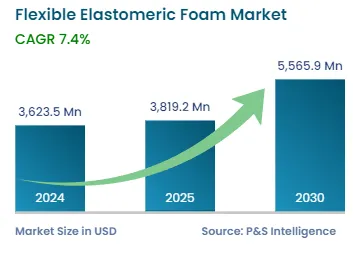
2024 Market SizeUSD 3,623.5 Million
2025 Market SizeUSD 3,819.2 Million
2030 ForecastUSD 5,565.9 Million
Growth Rate(CAGR) 7.4%
Largest RegionAsia-Pacific
Fastest Growing RegionAsia-Pacific
Nature of the Market Consolidated
Largest End User Category HVAC

Growth Forecast

Flexible Elastomeric Foam Market Size

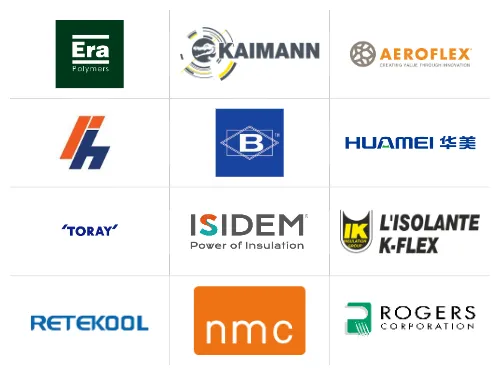
Key Players

Flexible Elastomeric Foam Market Players

Key Report Highlights

  • Market Size and Forecast
  • Value Chain Analysis
  • Pricing Analysis
  • Companies’ Recent Strategic Developments
  • Key Stakeholders
  • Voice of Industry Experts/KOLs
  • Future Opportunities
  • Emerging Trends

Explore the market potential with our data-driven report

Flexible Elastomeric Foam Market Future Prospects

The flexible elastomeric foam market will generate an estimated USD 3,623.5 million in revenue in 2024 and witness a CAGR of 7.4% during 2024–2030, reaching USD 5,565.9 million by 2030. The primary factor behind the market’s growth is the progression of HVAC, automotive, and transportation industries. Moreover, industries such as solar installations and construction are also contributing to the growth of the flexible elastomeric foam market globally.

Flexible elastomeric foams are open-celled and lightweight. They are generally used for insulation, filtration, and cushioning purposes.

End-use industries do not solely drive market growth; increasing awareness of energy-efficient insulation solutions also plays a significant role. This awareness helps end users enhance their cost-cutting measures. Furthermore, the rapid urbanization and industrialization in emerging regions, such as China and India, will likely aid in the market growth.

Additionally, in the upcoming years, the market for flexible elastomeric foam will expand due to the growing demand for these foams for soundproofing purposes.
Flexible Elastomeric Foam Market Trends & Growth Drivers

Increasing Utilization of Flexible Elastomeric Foam in HVAC Applications Is Key Trend in Market

  • The primary use of flexible elastomeric foam is to act as an active barrier to prevent the entry of vapor and moisture into the systems of the and refrigerators.
  • The increasing disposable incomes and spending in the construction domain in major economies worldwide are raising the demand for HVAC equipment.
  • Residential and commercial places’ aesthetic values increase due to the addition of HVAC units.
  • Water chillers and air conditioners are insulated by flexible elastomeric foams.
  • In the automotive sector, these foams are used in weather stripping, gasketing, and noise dampening apparatus.
  • In addition, these foams are useful for acoustic insulation in the construction sector and for pipe insulation in solar projects.
  • Moreover, elastomeric foam is environment-friendly as its production method does not involve CFCs, HFCs, or HCFCs.
  • Furthermore, huge amounts of money are being invested in R&D by numerous companies to produce innovative products such as hybrid HVAC equipment, which uses several sources of energy for cooling and heating functions.

Exceptional Characteristics of Flexible Elastomeric Foam Are Driving Market Growth

  • In recent years, the application of these foams has increased due to their exceptional characteristics over other materials, such as glass wool.
  • Moreover, closed-cell flexible elastomeric foams include seal closure, whereas foam glass does not.
  • They can withstand more vibrations than foam glass and are flexible in nature.
  • Flexible foam is usually more affordable compared to foam glass.
  • Better insulation properties are seen in flexible foams than glass wool even at cryogenic temperatures.
  • Additionally, they are non-porous, lightweight, and available in different shapes, such as pipe and sheets.
  • Closed-cell flexible elastomeric foam is also highly moisture-resistant due to its cellular structure, as millions of tiny blocks inhibit the migration of liquid. This protects its long-standing thermal performance and durability.

Complications in Managing Flexible Elastomeric Foam Waste Is Major Challenge for Market

  • The major challenge facing the market is managing flexible elastomeric foam waste.
  • This is because these foams are difficult to recycle, comprise petroleum-based components, and are not biodegradable.
  • As a result, inadequate recycling techniques and potential environmental hazards from improper disposal of these flexible elastomer foams may hinder the market's expansion.
  • Ethylene propylene diene monomer (EPDM) is the major constituent of elastomeric foam, which is not compatible with most oils, concentrated acids, halogenated solvents, aromatic and aliphatic hydrocarbons, kerosene, and gasoline.
  • The material is also inert, which makes it difficult to adhere to anything.
  • In addition, end users experience discomfort as a result of increased compression performance, which causes thermal disputes.
  • Lack of breathability exists in the closed-cell foams, which may cause discomfort due to heat from the absence of airflow.

Flexible Elastomeric Foam Market Analysis

Foam Type Insights

  • Nitrile butadiene rubber/polyvinyl chloride (NBR/PVC) is the largest category with a market share of 30% in 2024, and it is expected to grow at a CAGR of 7.8% in the forecast period.
  • This dominance is due to its exceptional resistance to fuels, lubricants, and chemicals, which makes it ideal for automotive and industrial use.
  • NBR/PVC foams also excel in fire retardance, which broadens their applicability across a diverse range of uses.
  • Furthermore, the cost-effectiveness of flexible elastomer foams makes them preferred over alternatives, attracting numerous end users.

The foam types included in this report are:

  • Natural Rubber/Latex
  • Nitrile Butadiene Rubber/Polyvinyl Chloride (NBR/PVC) (Largest and Fastest-Growing Category)
  • Ethylene–Propylene Dine Monomer (EPDM)
  • Chloroprene
  • Others

Function Insights

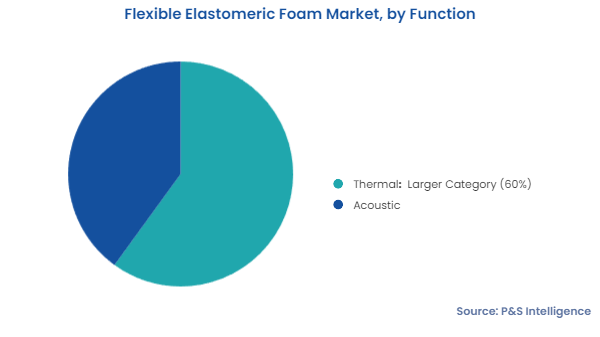
  • Thermal insulation will hold the larger market share, of 60%, in 2024, and it is expected to grow at a CAGR of 7.7% in the forecast period.
  • This is due to its rising need in HVAC and building construction for energy-efficient solutions.
  • These foams can reduce energy consumption and heat transmission, which has become increasingly valuable as the world addresses climate change and rising energy costs.
  • Additionally, thermal insulation majorly decreases the consumption of energy across a broad spectrum of applications, such as AC, refrigeration piping, residential & commercial heating, ventilation piping, and solar piping.
  • Thermal comfort for building occupants can be easily achieved due to the thermal insulation feature.
  • According to Invest India, the real estate industry in India is expected to reach around USD 1 trillion by 2030 and contribute 13% to the country’s GDP.

Flexible Elastomeric Foam Market Segments

The functions analyzed in this report are:

  • Thermal (Larger and Faster-Growing Category)
  • Acoustic

End Use Insights

  • HVAC is the largest end use, and it is expected to grow at a CAGR of 8.0% in the forecast period.
  • This dominance is a result of the growing and internationally acknowledged need for energy-efficient solutions and the fact that HVAC systems are now a crucial component of infrastructure and buildings.
  • Flexible elastomeric foam has an exceptional thermal insulation quality, which makes it ideal for insulating HVAC system ducts and pipes.
  • These foams help in reducing energy consumption and optimizing system performance by controlling heat gain or loss.

The end uses analyzed in this report are:

  • HVAC (Largest and Fastest-Growing Category)
  • Automotive & Transportation
  • Solar Installation
  • Refrigeration Systems
  • Others

Drive strategic growth with comprehensive market analysis

Geographical Analysis

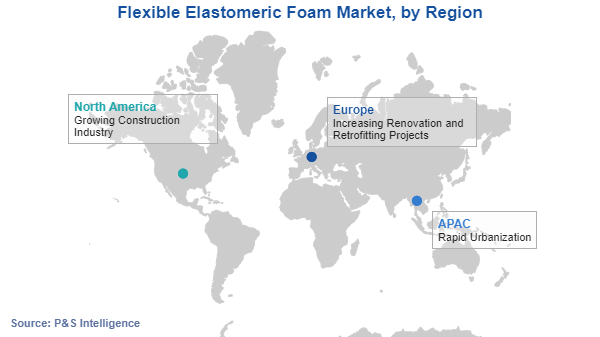
  • APAC is the largest region, with a market share of around 50% in 2024, and it is the fastest-growing region too.
  • This region is witnessing rapid urbanization and infrastructure development, which are raising the demand for insulation materials.
  • Furthermore, there is a lot of emphasis on sustainability and energy efficiency which is helping to drive the usage of flexible elastomeric foams in construction and other industries.
  • Moreover, the region is home to hugely productive construction and automobile industries, which aids in market growth.
  • Several government policies supporting energy efficiency, which, combined with robust demand from developing countries, such as Japan, India, and China, is driving market growth.

Flexible Elastomeric Foam Market Regional Analysis

The regions and countries analyzed in this report:

  • North America
    • U.S. (Larger Country Market)
    • Canada (Faster-Growing Country Market)
  • Europe
    • Germany (Largest and Fastest-Growing Country Market)
    • France
    • U.K.
    • Italy
    • Spain
    • Rest of Europe
  • APAC (Largest and Fastest-Growing Regional Market)
    • China (Largest Country Market)
    • Japan
    • India (Fastest-Growing Country Market)
    • South Korea
    • Australia
    • Rest of APAC
  • Latin America (LATAM)
    • Brazil (Largest and Fastest-Growing Country Market)
    • Mexico
    • Rest of LATAM
  • Middle East and Africa (MEA)
    • Saudi Arabia (Largest and Fastest-Growing Country Market)
    • South Africa
    • U.A.E.
    • Rest of MEA

Flexible Elastomeric Foam Market Share

The flexible elastomeric foam market is partially consolidated in nature with only a few major players dominating the market. Established players are using different strategies such as mergers & acquisitions, product launches, partnerships, and collaborations. A huge money is also being invested in R&D activities to innovate and fulfill the emerging demand of consumers.

Major Flexible Elastomeric Foam Companies:

  • Era Polymers Pty Ltd.
  • Kaimann GmbH
  • AEROFLEX USA INC
  • Hira Industries LLC
  • Huamei Energy-saving Technology Group Co. Ltd.
  • NMC SA
  • Rogers Corporation
  • Jinan Retek Industries Inc.
  • Isidem Insulation
  • Bemis Associates Inc.
  • Toray Industries Inc.

Flexible Elastomeric Foam Market News

  • In March 2022, Toray Industries developed stretchable device film with high resistance value stability.
  • In June 2021, Zotefoams launched ZOTEK F, a new line of flexible elastomeric foam insulation solutions.

Frequently Asked Questions About This Report

What will be the growth rate of the flexible elastomeric foam market?+

During 2024–2030, the growth rate of the flexible elastomeric foam market will be 7.4%.

What is the flexible elastomeric foam market size in 2024?+

In 2024, the size of the flexible elastomeric foam market will be USD 3,623.5 million.

Which is the largest foam type of flexible elastomeric foam market?+

NBR/PVC is the largest foam type of flexible elastomeric foam market.

Which is the largest market for flexible elastomeric foam?+

APAC is the largest market for flexible elastomeric foam.

What is the market nature of flexible elastomeric foam market?+

The market nature of flexible elastomeric foam market is partially consolidated.

Want a report tailored exactly to your business need?

Request Customization

Empowering Leaders Across the Globe

Leading companies across industries trust us to deliver data-driven insights and innovative solutions for their most critical decisions. From data-driven strategies to actionable insights, we empower the decision-makers who shape industries and define the future. From Fortune 500 companies to innovative startups, we are proud to partner with organisations that drive progress in their industries.

Client Partners
Client Partners (mobile view)
Testimonials
Client Testimonials

Working with P&S Intelligence and their team was an absolute pleasure – their awareness of timelines and commitment to value greatly contributed to our project's success. Eagerly anticipating future collaborations.

McKinsey & Company

India
Unmatched Standards
Unmatched Standards

Our insights into the minutest levels of the markets, including the latest trends and competitive landscape, give you all the answers you need to take your business to new heights

Data Security
Complete Data Security

We take a cautious approach to protecting your personal and confidential information. Trust is the strongest bond that connects us and our clients, and trust we build by complying with all international and domestic data protection and privacy laws

  • Request Customization
  • Request Free Sample
close

Customize the Report to Align with Your Business Objectives

*
*
*
close

Request the Free Sample Pages

*
*
*
Connect with us
Quick Links
  • Research Methodology
  • Career
  • Media Citations
  • FAQs
  • Events and Conferences
Find Help
  • How to Order
  • Privacy Policy
  • Terms & Conditions
  • Sitemap
24/7 Customer Support
  • India: +91 93541 34657
  • For business enquiries - [email protected]
  • For career enquiries - [email protected]
  • Dun-Verified
  • Paypal-Secure

©2026 P&S Intelligence. All Rights Reserved.

We use cookies to enhance your experience. By continuing to use this site you consent to our use of cookies. Privacy Policy