Explore the market potential with our data-driven report
Fleet Management Software Market Outlook
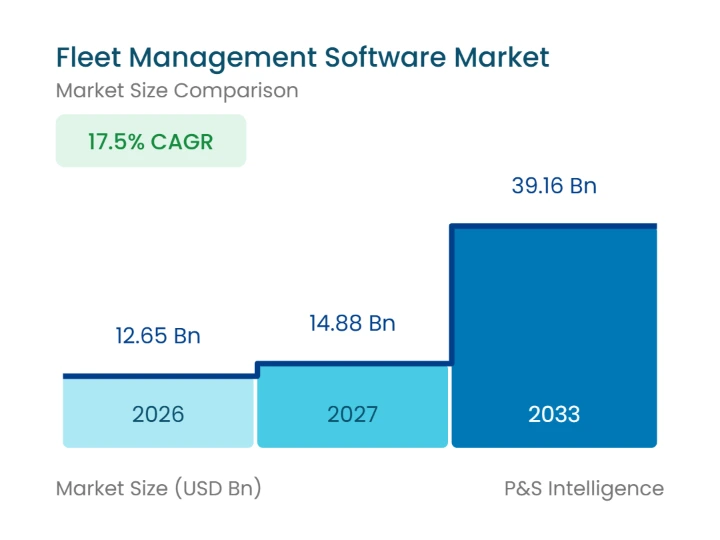
The global fleet management software market size is estimated at USD 12.65 Billion in 2026 and is projected to reach USD 14.88 Billion in 2027. Revenue is projected to climb to USD 39.16 Billion by 2033, advancing at a CAGR of 17.5% during 2027-2033 as per-vehicle software subscriptions spread across commercial fleets. Motor carriers, parcel networks, utilities, and city fleets pay these fees because driver logs, crash evidence, and electric-van charging run through software instead of paper and standalone trackers. Each added vehicle becomes recurring vendor revenue that lasts as long as the rule or insurance arrangement behind it.
Parcel carriers, grocers, and retailers that run their own delivery vans are adding routing and tracking subscriptions as home delivery takes a larger slice of retail, because planning dozens of daily stops per van by hand does not scale. The US Census Bureau recorded e-commerce at 17.1% of total US retail sales in the second quarter of 2026, and a higher online share puts more parcels onto multi-stop van routes. These fleets often add safety, maintenance, and fuel modules later, so the fleet management software market grows through deeper spending per vehicle as well as through new vehicles.
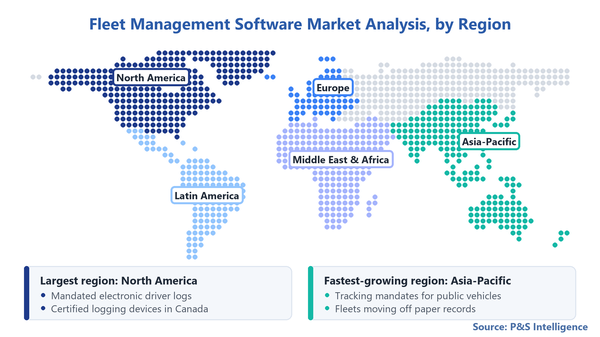
North America holds 38.0% of global revenue in 2026, led by the United States, where electronic logging has been compulsory for most interstate truck drivers, so much of the new spending goes into video safety and maintenance analytics added to existing accounts. Asia-Pacific is projected to expand at a CAGR of 20.8% during 2027-2033, with India, China, Indonesia, and Vietnam home to large commercial fleets, many of them connecting to software for the first time. Upselling an installed base and signing first-time subscribers call for different pricing and sales channels, which shapes how vendors split investment between the two regions.
Key market insights
By deployment mode, cloud-based (SaaS) accounts for 68.0% in 2026 and is also set to expand at the fastest pace, a 19.2% CAGR during 2027-2033.
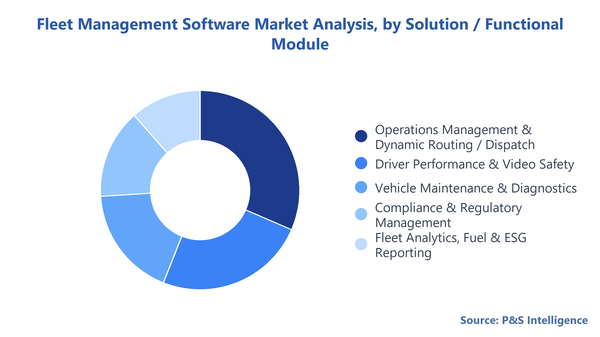
By solution and functional module, operations management & dynamic routing / dispatch holds 31.5% in 2026, while driver performance & video safety (AI Dashcam / telematics) is on course for a 21.4% CAGR during 2027-2033.
By fleet type and vehicle class, light commercial vehicles (LCVs - vans, pickups, utilities) represents 44.5% in 2026, and passenger vehicle & shared mobility fleets is expected to post an 18.8% CAGR during 2027-2033.
By end-use industry, transportation, logistics & supply chain captures 34.0% in 2026, with government, municipal & public transit forecast to advance at a 19.5% CAGR during 2027-2033.
By geography, North America leads with 38.0% in 2026, and Asia-Pacific is anticipated to record a 20.8% CAGR during 2027-2033.
Electric trucks and vans are redefining what fleet software has to manage
Operators adding battery-electric vans, trucks, and buses need functions that diesel fleets never bought, including depot charging schedules timed to electricity tariffs, state-of-charge checks before dispatch, and battery health records that support warranty and resale claims. Each electric vehicle can therefore add a module to an existing per-vehicle plan. Fleets running diesel and electric vehicles side by side also want one dashboard for both, which favors platforms that already hold the diesel data and can add charging control without a second contract.
According to the International Energy Agency, electric truck sales exceeded 400,000 units in 2025, doubling from 2024 and reaching 9% of global truck sales, with China accounting for more than 90% of the total. These figures size the vehicle base that could need charging and battery software, not adoption of that software itself. Because most electric trucks sold in 2025 went to Chinese buyers, near-term revenue from truck-charging modules is likely to concentrate among vendors serving fleets in China.
Tighter oversight of electronic logging devices is accelerating vendor switches among carriers
US motor carriers that must keep hours-of-service records have to use a logging device on the federal registry, and vendors self-certify that their devices meet the technical rule. When the regulator removes a device from that registry, every carrier using it must buy a replacement within a fixed window, which turns a compliance event into a new software contract. Carriers that once chose the cheapest logging app are now likely to weigh a vendor's compliance record alongside price.
The Federal Motor Carrier Safety Administration removed 12 devices from its registered list on May 20, 2026, and affected fleets had until July 20 to switch before drivers using them could be placed out of service. The agency has removed more devices since. Each removal sends a block of small carriers back into the market at once, and those switches are likely to favor vendors with long-standing listings. The rule asks only for a compliant log, yet a forced switch gives vendors a natural moment to sell tracking and safety modules alongside it.
Factory-fitted vehicle modems are opening a hardware-free route to new subscribers
Fitting an aftermarket tracking box is often the slowest and costliest step in signing a new fleet, because each vehicle has to come off the road for installation. Vehicle manufacturers now sell access to data from the modems they install at the factory, so a software vendor can activate a van or pickup remotely on the day it is delivered. That lowers the cost of serving small and mixed-brand fleets, which were often uneconomic to sign when every vehicle needed a technician visit.
Ford offers Ford Pro Data Services, an API that sends manufacturer-grade data on driver behavior, trips, and vehicle health to a fleet's preferred telematics provider, while its own Telematics Essentials service runs on embedded modems in 2021 model year and newer Ford and Lincoln vehicles. For software vendors, each manufacturer data agreement can cut acquisition cost on that brand's vehicles. The number and depth of these agreements could become a point of difference between platforms, especially in tenders for mixed light-commercial fleets.
Small-carrier economics are limiting spending beyond mandatory modules
Most US trucking firms are too small to employ a safety manager, maintenance planner, or full-time dispatcher, so they tend to buy the compliance minimum and resist per-vehicle fees for modules nobody in the company has time to use. A three-truck operator whose owner also drives gains little from video coaching alerts, and may drop add-ons when freight rates fall. This keeps revenue per vehicle low in the largest group of fleets by count and raises churn for vendors selling to them.
The American Trucking Associations counts more than 91% of US motor carriers as operating 10 or fewer trucks. Many of these carriers still fall under the logging mandate, so they generate subscriptions, but they are less likely than larger fleets to buy much beyond it. The economics favor pricing built around a low-cost compliance tier, with camera, maintenance, and fuel modules added as a carrier grows. Vendors whose sales model depends on field visits are likely to find this group hard to serve profitably.
Segmentation Analysis
Deployment Mode
Cloud-based (SaaS) platforms account for 68.0% of the fleet management software market in 2026, because fleets now buy tracking, logging, and video as per-vehicle subscriptions that the vendor hosts, updates, and keeps compliant. Hosted delivery suits multi-depot operators whose dispatchers and safety managers need the same live view from any site, and it shifts the work of applying logging-rule changes onto the vendor. On-premises and hybrid installations hold on in defense, emergency services, and large enterprises whose data policies keep vehicle records inside their own networks.
Cloud-based (SaaS) is also expected to record the fastest growth, a CAGR of 19.2% during 2027-2033, because camera footage, AI alerts, and manufacturer data feeds depend on storage and analysis in remote data centers. Samsara, which sells its operations platform only as a hosted service, posted USD 2.1 Billion in annual recurring revenue in results released September 3, 2026, up 30% year over year. A single vendor's figure does not size the segment. It does show how far a subscription-only model can scale across vehicles and equipment. On-premises vendors face pressure at each renewal to offer hosted versions.
Solution and Functional Module
Operations management & dynamic routing / dispatch accounts for 31.5% of 2026 revenue, because tracking and dispatch are typically the first functions a fleet buys and the ones every later module connects to. Parcel, field-service, and distribution fleets measure the payback directly in miles driven, stops per route, and overtime hours, which makes the purchase easy to justify to a finance team. Vendors that own the dispatch screen also hold the daily user relationship, an advantage when they later sell route optimization upgrades, safety, or maintenance modules.
Driver performance & video safety (AI Dashcam / telematics) is projected to grow at a CAGR of 21.4% during 2027-2033, as AI cameras shift from recording crashes to warning drivers about phone use and fatigue. Data from the National Highway Traffic Safety Administration show 5,340 people were killed in US traffic crashes involving large trucks in 2024, and a serious crash can expose a carrier to litigation in which video helps establish fault. Many fleets therefore buy in-cab camera software as a liability control, adding a fee on top of the base tracking plan that raises revenue per vehicle.
Copyright P&S Intelligence. Reuse requires attribution under CC BY 4.0.
Fleet Type and Vehicle Class
Light commercial vehicles (LCVs - vans, pickups, utilities) account for 44.5% of 2026 revenue, because vans and pickups make up much of the vehicle count in parcel, field-service, and utility fleets that buy routing and job dispatch per vehicle. The European Commission confirms that from July 1, 2026, light commercial vehicles of 2.5 to 3.5 metric tons used in international transport for hire or reward must have a tachograph installed. The rule mandates the device only, although operators handling driver-data downloads across many vans are likely to manage them through their fleet software.
Passenger vehicle & shared mobility fleets are projected to expand at a CAGR of 18.8% during 2027-2033, the quickest among vehicle classes, as leasing companies, rental firms, and corporate car-sharing operators connect cars that were often managed through spreadsheets and key cabinets. Factory-fitted connectivity in newer passenger cars lets these operators add a vehicle to a platform at delivery with no installation visit. Their purchase criteria differ from those of truck fleets, with digital key access, utilization tracking, and damage records ranking above hours-of-service logging, which favors vendors built around rental and car-sharing workflows.
End-Use Industry
Transportation, logistics & supply chain accounts for 34.0% of 2026 revenue, because for-hire carriers, third-party logistics providers, and parcel networks face hours-of-service rules, shipper requests for live tracking, and thin margins at the same time. Shippers commonly ask carriers for live arrival estimates when awarding freight, so tracking data becomes part of winning loads. Fleet software has therefore become a cost of doing business in this vertical, and its spending is likely to hold up better than discretionary technology budgets during freight downturns.
Government, municipal & public transit is projected to post the quickest growth among end-use industries, a CAGR of 19.5% during 2027-2033, as cities and agencies connect waste, transit, police, and emergency fleets that often still rely on manual logs and radio dispatch. In December 2025, the US Federal Transit Administration awarded about USD 2 Billion in bus grants to 165 transit systems, funding 2,400 new buses that agencies can bring onto connected platforms. Because agencies buy through multi-year tenders, vendors that meet public-sector data-security and documentation rules can secure several years of subscription revenue with each award.
The following segments are analysed in this report.
Medium & Heavy Commercial Vehicles (M&HCVs - Heavy Trucks & Semis)
Passenger Vehicle & Shared Mobility Fleets
End-Use Industry
Transportation, Logistics & Supply Chain
Construction, Mining & Heavy Infrastructure
Field Services, Utilities & Energy
Manufacturing, Wholesale & Retail Distribution
Government, Municipal & Public Transit
Other End-Use Verticals (Agriculture, Waste Management, Healthcare)
Geographical Analysis
North America fleet management software market outlook
North America holds 38.0% of global fleet management software revenue in 2026, and the United States is the region's largest market, with most interstate truck drivers already logging their hours electronically. That installed base means growth comes largely from carriers adding video safety, maintenance analytics, and fuel tools to existing fleet telematics subscriptions. Crash litigation costs encourage large carriers to keep video evidence, and vendors can grow by upselling accounts they already hold instead of hunting for unconnected fleets.
Canada adds a second compliance base. As per Transport Canada, federally regulated truck and bus carriers must use electronic logging devices tested and certified by an accredited certification body, with enforcement starting in January 2023. Third-party certification raises the cost of entering the Canadian market, which favors vendors already certified there and narrows the pool of low-cost alternatives. North America's share is likely to ease gradually as Asia-Pacific expands faster, while revenue per vehicle keeps rising as AI camera modules spread across existing accounts.
Asia-Pacific is projected to post the fastest growth, a CAGR of 20.8% during 2027-2033, as many carriers and bus operators in India, China, Indonesia, and Vietnam move fleets from paper records onto subscription platforms. India is a central source of this new demand, alongside Southeast Asian logistics fleets serving parcel and manufacturing flows. Many of these operators start buying when a regulator or a large shipper asks for location data.
India's Ministry of Road Transport and Highways requires location tracking devices with emergency buttons on public service vehicles registered from January 1, 2019, and its August 2022 notification extended the requirement to newly manufactured N2 and N3 goods vehicles carrying dangerous or hazardous goods. These rules mandate the device alone. Even so, each tracked vehicle produces a data feed that software vendors can build dispatch and safety services on. Regional growth should stay ahead of the global rate while many commercial vehicles remain unconnected, although lower price points per vehicle can compress revenue per subscriber.
Copyright P&S Intelligence. Reuse requires attribution under CC BY 4.0.
Europe market analysis
Cross-border trucking shapes much of Europe's demand for fleet software. Hauliers running trucks through several countries must download and archive tachograph data, track driving and rest times under EU rules, and document cabotage and driver posting, all work that fleet software automates across borders. Leasing companies and corporate fleets in Germany, France, Italy, and the U.K. form a second buyer group that values utilization and cost reporting more than compliance tools.
Figures from Eurostat put international transport at 24.4% of EU road freight tonne-kilometers in 2025, with cross-trade adding 10.7% and cabotage 2.7%, so well over a third of the work involves hauls beyond a carrier's home market. Vendors offering remote tachograph download, multi-language driver apps, and toll and fuel-card integration across many countries are better positioned with these hauliers than single-country providers. Manufacturer data agreements with European vehicle brands are also lowering onboarding costs for van fleets, which supports steady growth across the region's large light-commercial base.
Latin America market analysis
Latin America accounts for a smaller share of revenue, and security drives much of its spending. Brazil's cargo transport association, NTC&Logística, recorded 8,570 cargo thefts in 2025, 86.8% of them in the Southeast, even after a 16.7% decline from 2024. Theft on that scale, along with truck hijacking on Mexican highways, leads many carriers and insurers to treat tracking as a loss-prevention tool, so local providers commonly bundle stolen-vehicle recovery and remote immobilization with fleet management. Bundling ties software renewals to insurance terms, making contracts harder to displace.
Hardware-agnostic platforms sold through regional telematics resellers are common among the region's smaller fleets, because local partners handle installation, support, and billing in each country. Mexican carriers hauling freight into the United States beyond the border commercial zones must meet US logging rules, which adds a compliance-driven buyer group. Growth should stay steady as resellers move customers from basic tracking to subscription modules, although currency swings can delay renewals priced in US dollars.
Middle East & Africa market analysis
Middle East & Africa contributes a modest share of revenue, with demand split between Gulf states building regulated freight and logistics systems and South Africa, where vehicle security needs have long supported a dense tracking base. Saudi Arabia's freight transport regulation provides for a Transport General Authority electronic platform that tracks truck locations and speeds and monitors drivers' driving and rest periods. Freight operators therefore have reason to keep location and driving-time data in a form the regulator can check, which favors fleet software that exports it cleanly.
Logistics operators around ports, airports, and free zones in the U.A.E. and Qatar buy fleet software to coordinate trucks across hubs, while mining and energy fleets in Africa use it to monitor vehicles across long routes with patchy cellular coverage. Satellite-capable connectivity and offline logging matter more here than in denser markets, which favors vendors with rugged hardware partners. Growth should follow new logistics capacity in the Gulf and the large installed tracking base in South Africa, where vendors can sell added modules to existing accounts.
The following geographies are analysed in this report.
The fleet management software market is moderately fragmented, with more than a dozen vendors of national or global scale and a large layer of regional resellers running their own or licensed platforms. Low hardware barriers, country-specific compliance rules, and different needs across trucking, field-service, and car-sharing fleets leave room for specialists. Switching costs are real but limited, since moving a fleet means retraining drivers and reactivating or refitting devices, so vendors compete hard at renewal. The structure is evolving toward fewer, larger platforms as acquisitions combine subscriber bases.
Competition clusters around three groups. Subscription-scale platform vendors such as Geotab Inc., Samsara Inc., and Motive Technologies, Inc. compete on AI safety features, open data integrations, and enterprise sales reach. Vendors inside larger corporate groups, including Verizon Communications Inc. and Bridgestone-owned Webfleet Solutions B.V., sell through parent-company channels such as telecom accounts and tire and service networks. Regional and platform specialists such as Gurtam, Targa Telematics S.p.A., and EROAD Limited win business through local compliance expertise, reseller networks, and insurance-linked services.
For fleet buyers, consolidation narrows the field of independent vendors but strengthens the platforms that remain, as acquired subscriber bases move onto shared software. Vendors without manufacturer data agreements or AI video capabilities could face growing pressure to partner or sell if enterprise buyers keep adding those features to their tender requirements. Smaller fleets still have wide choice through regional resellers, which keeps price competition active at the low end of the market. Because most platforms now offer comparable tracking and logging, vendors increasingly win renewals on video, data integrations, and service quality.
Major Fleet Management Software Providers:
Geotab Inc.
Samsara Inc.
Verizon Communications Inc.
Platform Science Inc.
Webfleet Solutions B.V.
Solera Holdings LLC
Teletrac Navman Group
Powerfleet Inc.
Motive Technologies Inc.
CalAmp Corp.
The Descartes Systems Group Inc.
Zonar Systems Inc.
Gurtam
Targa Telematics S.p.A.
EROAD Limited
Fleet Management Software Market News
In October 2026, Motive Technologies Inc. launched Agents, AI tools that can call drivers, open maintenance work orders, and bring in managers the moment a safety or operations issue needs attention, making them available immediately to existing customers. The release moves fleet software from flagging problems toward acting on them, which can cut the staff time needed per vehicle.
In June 2026, Samsara Inc. introduced a single-module 360-degree camera for forklifts and other operated equipment and added rear collision warning and blind-spot detection to its AI Multicam system for road vehicles. Extending video safety from trucks to yard and warehouse equipment widens the number of assets each customer can place on one subscription.
In June 2026, Webfleet Solutions B.V. added Volkswagen Group Info Services AG to its OEM.connect program, letting fleets connect six brands (Volkswagen Passenger Cars, Volkswagen Commercial Vehicles, Skoda, SEAT, CUPRA, and Audi) without installing aftermarket hardware. Direct factory data removes the installation visit, lowering the cost of onboarding European van and car fleets.
In April 2026, The Descartes Systems Group Inc. acquired Idelic, a provider of AI-powered driver safety and performance management software, for upfront cash of about USD 28 Million plus a performance-based earn-out of up to USD 12 Million. The deal adds driver safety data to Descartes' routing and telematics offer, deepening its reach into trucking safety budgets.
In February 2026, Geotab Inc. launched the GO Focus Pro AI dash cam, which supports up to five weatherproof auxiliary cameras and detects traffic-light violations, forward-collision risk, and vulnerable road users in blind spots, with availability planned for North America and EMEA in the second quarter of 2026. The camera lets Geotab sell video safety directly into its existing subscriber base.
Last Updated: November 2026
Frequently Asked Questions About This Report
How big is the fleet management software market?+
The global fleet management software market size is estimated at USD 12.65 Billion in 2026 and is projected to reach USD 14.88 Billion in 2027.
What is the growth rate of the fleet management software market?+
Revenue is projected to climb to USD 39.16 Billion by 2033, advancing at a CAGR of 17.5% during 2027-2033 as per-vehicle software subscriptions spread across commercial fleets.
Which region dominates the fleet management software market?+
North America holds 38.0% of global fleet management software revenue in 2026, and the United States is the region's largest market, with most interstate truck drivers already logging their hours electronically.
Which region is the fastest-growing market for fleet management software?+
Asia-Pacific is projected to post the fastest growth, a CAGR of 20.8% during 2027-2033, as many carriers and bus operators in India, China, Indonesia, and Vietnam move fleets from paper records onto subscription platforms.
Who are the key players in the fleet management software market?+
Subscription-scale platform vendors such as Geotab Inc., Samsara Inc., and Motive Technologies, Inc. compete on AI safety features, open data integrations, and enterprise sales reach.
What is the fastest-growing segment in fleet management software?+
Driver Performance & Video Safety (AI Dashcam / Telematics) is projected to grow at a CAGR of 21.4% during 2027-2033, as AI cameras shift from recording crashes to warning drivers about phone use and fatigue.
Is fleet management software mostly cloud-based or on-premises?+
Cloud-Based (SaaS) platforms account for 68.0% of the fleet management software market in 2026, because fleets now buy tracking, logging, and video as per-vehicle subscriptions that the vendor hosts, updates, and keeps compliant.
Want a report tailored exactly to your business need?
Leading companies across industries trust us to deliver data-driven insights and innovative solutions for their most critical decisions. From data-driven strategies to actionable insights, we empower the decision-makers who shape industries and define the future. From Fortune 500 companies to innovative startups, we are proud to partner with organisations that drive progress in their industries.
Client Testimonials
Working with P&S Intelligence and their team was an absolute pleasure – their awareness of timelines and commitment to value greatly contributed to our project's success. Eagerly anticipating future collaborations.
McKinsey & Company
India
Unmatched Standards
Our insights into the minutest levels of the markets, including the latest trends and competitive landscape, give you all the answers you need to take your business to new heights
Complete Data Security
We take a cautious approach to protecting your personal and confidential information. Trust is the strongest bond that connects us and our clients, and trust we build by complying with all international and domestic data protection and privacy laws