This Report Provides In-Depth Analysis of the Fitness Apps Market Report Prepared by P&S Intelligence, Segmented by Type (Exercise & Weight Loss Apps, Diet & Nutrition Apps, Activity Tracking Apps, Health & Wellness Apps), Platform (iOS, Android), Device (Smartphone, Tablets, Wearable Devices, Smart TVs & Connected Equipment), Business Model (Freemium, Subscription-Based, One-Time Purchase / Paid App, In-App Purchases), Application (Personal, Corporate, Rehabilitation & Healthcare), and Geographical Outlook for the Period of 2019 to 2032
Explore the market potential with our data-driven report
Fitness Apps Market Analysis
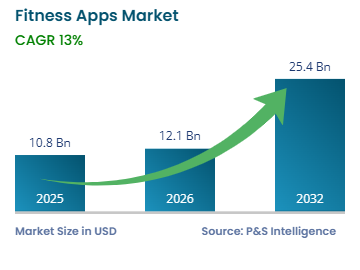
The fitness apps market size will be an estimated USD 10.8 billion for 2025, and it will grow by 13.0% during 2026–2032, to reach USD 25.4 billion by 2032.
The market growth is primarily driven by rising health consciousness, widespread smartphone adoption, integration with wearable devices, and increasing prevalence of lifestyle-related diseases worldwide. The mHealth market value is set to more than double from USD 70.1 billion in 2024 to USD 154.1 billion by 2030, boosted by the rising downloads of such apps.
The surge in obesity rates globally has emerged as a significant driver for fitness apps adoption. According to the WHO, in 2022, over one-eighth of the global population (890 million adults aged 18+) were living with obesity, with the prevalence of adult obesity more than doubling from 1990. This alarming trend has intensified consumer demand for accessible, self-directed weight management and fitness tracking solutions. Fitness apps provide users with personalized workout routines, calorie tracking, nutrition guidance, and progress monitoring, enabling individuals to take control of their health from anywhere.
Additionally, the integration of artificial intelligence and machine learning technologies is transforming the fitness apps landscape. These advanced capabilities enable highly personalized user experiences, adaptive workout plans, and predictive health insights that continuously improve based on individual progress and behavior patterns, further enhancing user engagement and retention.
Fitness Apps Market Emerging Trends
Artificial Intelligence Integration Is Key Trend
The integration of AI and machine learning technologies represents a transformative trend reshaping the fitness apps market.
AI-powered applications now deliver highly personalized workout plans that adapt dynamically to individual user performance, recovery status, and preferences.
These intelligent systems analyze vast amounts of user data to provide customized recommendations for exercise routines, nutrition plans, and recovery strategies that optimize results.
Investment in AI-driven fitness solutions has surged dramatically.
For instance, Zing Coach, a Munich-based startup, raised USD 10.3 million in Series A funding in June 2024 to enhance its AI-powered fitness app offering hyper-personalized training programs.
The application has achieved over one million downloads with strong user retention rates, demonstrating the market appetite for intelligent, adaptive fitness solutions.
India-based Healthify secured a USD 45 million funding round in October 2024 to expand globally and advance its AI capabilities, including personalized food & workout solutions.
A recent academic study, Co-Pilot for Health: Personalized Algorithmic AI Nudging, showed that AI-based nudges delivered via wearables to ~84,760 individuals increased daily steps by ~6.17% and weekly moderate-to-vigorous physical activity by ~7.61% over 12 weeks compared to control groups.
The trend supports a move from static, one-size-fits-all fitness plans to continuous, adaptive, real-time coaching experiences delivered through apps and wearables, making the “digital personal trainer” more intelligent, contextual, and scalable.
Widespread Smartphone and Wearable Device Adoption Is Biggest Driver
The proliferation of smartphones globally represents a fundamental driver for the fitness apps market.
With approximately 5.78 billion people using smartphones worldwide in 2024, the accessibility of fitness applications has expanded dramatically across diverse demographics and geographies.
Smartphones equipped with advanced sensors, including GPS, accelerometers, and heart rate monitors, enable comprehensive fitness tracking without requiring additional hardware.
According to the GSM Association, mobile technologies and services generate around USD 6.5 trillion in economic value added, demonstrating the pervasive integration of mobile devices into daily life.
The complementary growth of wearable fitness devices has further accelerated fitness app adoption.
According to research from the National Heart, Lung, and Blood Institute, one in three Americans now uses wearable devices to track their health and fitness.
Wearable devices integrate effortlessly with fitness apps, offering continuous insights into activity levels, sleep quality, and overall health metrics.
This integration enables users to receive comprehensive health insights and personalized recommendations based on continuous monitoring, significantly enhancing the value proposition of fitness applications.
Fitness Apps Market Segmentation Analysis
Type Analysis
The exercise & weight loss apps category holds the largest market share, of 55%, in 2025. This leadership stems from the direct alignment of these applications with the most common fitness objectives among users globally. These apps deliver a complete fitness experience with tools for customized training, guided videos, calorie management, and performance monitoring that address the core needs of individuals seeking to improve physical fitness and manage body weight.
The prevalence of obesity and overweight conditions worldwide drives sustained demand for this category. According to the WHO, over 1 billion people globally are living with obesity, creating a massive target audience actively seeking solutions. These apps offer convenience and flexibility, enabling users to exercise at home, outdoors, or in gyms while maintaining consistent tracking and motivation through features like scheduled notifications, achievement badges, and social sharing.
The activity tracking apps category will have the highest CAGR, of 13.2%, driven by the proliferation of wearable devices that seamlessly integrate with activity tracking applications. These apps monitor daily movement metrics, including steps taken, distance traveled, active minutes, and calories burned, providing users with comprehensive insights into their physical activity patterns.
The types analyzed in this report are:
Exercise & Weight Loss Apps (Largest Category)
Diet & Nutrition Apps
Activity Tracking Apps (Fastest-Growing Category)
Health & Wellness Apps
Others
Platform Analysis
The iOS category holds the largest market share, of 60%, in 2025, due to the strong presence of Apple devices and the premium positioning of iOS fitness applications. iOS users typically demonstrate higher engagement rates and greater willingness to pay for premium app features and subscriptions, making this platform highly attractive for fitness app developers. Apple's integrated ecosystem, including seamless connectivity with Apple Watch and the HealthKit framework, provides comprehensive health data aggregation and sharing capabilities that enhance user experience.
The Android category will have the highest CAGR, of 13.3%. This accelerated expansion reflects the widespread affordability and accessibility of Android smartphones, particularly in emerging markets across Asia-Pacific, Latin America, and Africa. Android's open-source architecture enables developers to create feature-rich applications compatible with diverse devices at varying price points.
The platforms analyzed in this report are:
iOS (Largest Category)
Android (Fastest-Growing Category)
Others
Device Analysis
The smartphones category holds the largest market share, of 65%, in 2025, driven by their ubiquitous presence and multifunctional capabilities. Smartphones serve as the primary access point for fitness applications, offering portability, convenience, and comprehensive functionality. According to the 2024 report, nearly 96.3% of the world's internet users utilize mobile phones to access the internet, with mobile phones contributing 60% of global web traffic.
The wearable devices category will have the highest CAGR during the forecast period. The rapid expansion of smartwatches, fitness bands, and smart rings has created strong demand for companion fitness applications optimized for wearable platforms. These devices provide continuous health monitoring, delivering real-time biometric data, including heart rate, blood oxygen levels, electrocardiogram readings, and stress indicators. The wearable medical devices market value is set to reach USD 67.2 billion by 2030.
The devices analyzed in this report are:
Smartphones (Largest Category)
Tablets
Wearable Devices (Fastest-Growing Category)
Smart TVs & Connected Equipment
Business Model Analysis
The subscription-based category holds the largest market share in 2025, reflecting the industry's shift toward recurring revenue streams and premium content delivery. Subscription models provide users with access to comprehensive features, including personalized training plans, nutrition guidance, live classes, and one-on-one coaching, which delivers ongoing value.
The in-app purchases category will have the highest CAGR during the forecast period, as this approach attracts new users by offering basic functionality at no cost while monetizing through premium feature upgrades, removing advertisements, or unlocking advanced capabilities.
The business models analyzed in this report are:
Freemium
Subscription-Based (Largest Category)
One-Time Purchase/Paid App
In-App Purchases (Fastest-Growing Category)
Others
Application Analysis
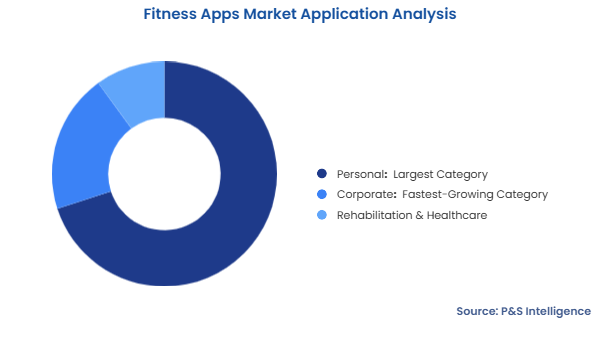
The personal use category holds the largest market share, of 70%, in 2025, as individual consumers represent the primary user base seeking health and fitness management solutions. Personal fitness app users span diverse demographics, including young professionals, parents, seniors, and students, who utilize applications for weight management, exercise tracking, nutrition planning, and overall wellness monitoring.
The corporate category is experiencing the fastest growth in the fitness apps market, fueled by increasing employer focus on employee wellness, mental health, and productivity. Companies are integrating fitness apps into workplace wellness programs, offering personalized health tracking, challenges, and rewards to promote healthier lifestyles and reduce healthcare costs.
The applications analyzed in this report are:
Personal (Largest Category)
Corporate (Fastest-Growing Category)
Rehabilitation & Healthcare
Drive strategic growth with comprehensive market analysis
Fitness Apps Market Regional Market Performance
North America Fitness Apps Market Size
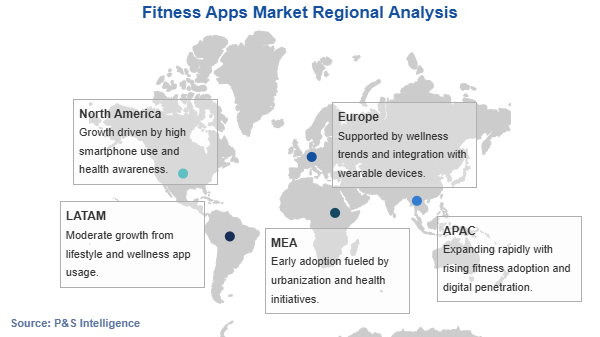
North America holds the largest market share, of 40%, in 2025. This dominance stems from multiple converging factors, including high smartphone penetration exceeding 80%, widespread adoption of wearable fitness devices, strong health consciousness among consumers, and well-established digital infrastructure.
North American consumers demonstrate high engagement with fitness and wellness technologies, driven by the increasing prevalence of lifestyle-related diseases and proactive health management attitudes. According to recent research, 82% of U.S. consumers consider wellness a top priority in their everyday lives. The region benefits from a mature ecosystem of leading fitness app developers, including Apple, Nike, Under Armour, Peloton, and Google, which drive continuous innovation in features, content, and user experience.
Asia-Pacific Fitness Apps Market Size
Asia-Pacific will have the highest CAGR, of 13.1%, driven by rapidly increasing smartphone penetration, rising middle-class populations with growing disposable incomes, increasing health awareness, and expanding digital payment infrastructure across the region. China and India, the world's two most populous nations, represent enormous growth opportunities for fitness app providers.
Urbanization trends across the Asia-Pacific contribute to sedentary lifestyles and rising obesity rates, creating an urgent need for accessible fitness solutions. The prevalence of lifestyle-related diseases is increasing rapidly in the region, with WHO data indicating that Asia-Pacific accounts for significant proportions of global diabetes and cardiovascular disease burdens.
Europe Fitness Apps Market Size
Europe held a substantial market share in the fitness apps market in 2025, driven by strong fitness culture, high smartphone and wearable device adoption, and increasing focus on preventive healthcare and wellness. Germany, the U.K., France, Italy, and Spain represent major markets with mature digital ecosystems and health-conscious consumer bases. Moreover, the WHO Regional Office for Europe highlights that nearly 59% of adults in the region are overweight or obese, driving greater adoption of fitness and wellness apps for weight management and lifestyle modification.
The regions and countries studied are as follows:
North America (Largest Regional Market)
U.S. (Larger Country)
Canada (Faster-Growing Country)
Europe
Germany (Largest Country)
U.K. (Fastest-Growing Country)
France
Italy
Spain
Rest of Europe
Asia-Pacific (Fastest-Growing Regional Market)
China (Largest Country)
India (Fastest-Growing Country)
Japan
South Korea
Australia
Rest of APAC
Latin America
Brazil (Largest Country)
Mexico (Fastest-Growing Country)
Rest of LATAM
Middle East and Africa
Saudi Arabia (Largest Country)
South Africa
U.A.E. (Fastest-Growing Country)
Rest of MEA
Fitness Apps Market Share
The market is fragmented due to the presence of numerous global technology companies, established fitness brands, specialized app developers, and emerging startups. Competition intensity remains high as companies differentiate through content quality, personalization capabilities, device integration, community features, and pricing strategies. This fragmentation stems from low barriers to entry for basic fitness app development, diverse consumer preferences requiring specialized solutions, and regional market variations enabling local players to compete effectively. Companies are investing heavily in AI-powered personalization, with machine learning capabilities that adapt workout plans, provide form correction through computer vision, and deliver predictive health insights.
Key Fitness Apps Companies:
Apple Inc.
Google LLC (Fitbit)
Samsung Electronics Co., Ltd.
Nike, Inc.
Adidas AG
Under Armour, Inc.
Peloton Interactive, Inc.
Garmin Ltd.
Strava Inc.
MyFitnessPal, Inc.
Noom Inc.
ASICS Corporation
Polar Electro Oy
Azumio Inc.
Zwift Inc.
Fitness Apps Market News
In March 2025, Mindbody Inc. entered into a partnership with Rokt Pte. Ltd. to integrate Rokt’s AI-driven technology for delivering personalized advertising experiences to its large member network, improving user engagement and supporting revenue growth through targeted content delivery.
In January 2025, Apple Fitness+ added new workout formats, including strength training, yoga with peak poses, pickleball conditioning, and breath meditation, along with integration with Strava to enhance cross-platform accessibility and content variety.
In December 2024, FIIT Ltd. announced a strategic partnership with Women's Health UK and Men's Health UK to launch exclusive workout content for subscribers of both platforms, expanding access to premium fitness programs through their respective mobile applications.
In August 2024, Reebok International Ltd. launched its subscription-based Reebok Fitness app, providing users with on-demand workouts, nutritional guidance, wellness content, GPS tracking features, and community challenges designed to foster engagement among fitness enthusiasts.
In August 2024, MyFitnessPal Inc. introduced the Quick Start High Protein Meal Plan feature within its application, designed to educate consumers about protein benefits, provide strategies for increasing protein intake, and offer practical guidance for incorporating protein into meals and snacks throughout the day.
In June 2024, Apple Inc. announced watchOS 11 at its Worldwide Developers Conference, incorporating enhanced workout tracking, advanced performance analytics, and expanded health monitoring features to provide users with a more detailed view of their fitness and wellness progress.
In April 2024, MyFitnessPal Inc. launched specialized tools and content to support users taking GLP-1 medications, including Mounjaro, Ozempic, Wegovy, and Zepbound, featuring medication logging functionality and a comprehensive GLP-1 Nutrition Plan aimed at optimizing nutrient intake and mitigating potential side effects.
Want a report tailored exactly to your business need?
Leading companies across industries trust us to deliver data-driven insights and innovative solutions for their most critical decisions. From data-driven strategies to actionable insights, we empower the decision-makers who shape industries and define the future. From Fortune 500 companies to innovative startups, we are proud to partner with organisations that drive progress in their industries.
Client Testimonials
Working with P&S Intelligence and their team was an absolute pleasure – their awareness of timelines and commitment to value greatly contributed to our project's success. Eagerly anticipating future collaborations.
McKinsey & Company
India
Unmatched Standards
Our insights into the minutest levels of the markets, including the latest trends and competitive landscape, give you all the answers you need to take your business to new heights
Complete Data Security
We take a cautious approach to protecting your personal and confidential information. Trust is the strongest bond that connects us and our clients, and trust we build by complying with all international and domestic data protection and privacy laws