This Report Provides In-Depth Analysis of the Fireproofing Materials Market Report Prepared by P&S Intelligence, Segmented by Type (Coatings, Films, Sprays, Putty, Sheets/Boards), End User (Commercial, Industrial, Residential), and Geographical Outlook for the Period of 2019 to 2032
Explore the market potential with our data-driven report
Fireproofing Materials Market Outlook
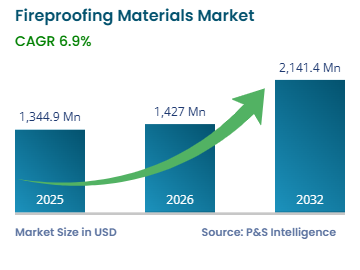
The fireproofing materials market size will be an estimated USD 1344.9 million for 2025, and it will grow by 6.9% during 2026–2032, to reach USD 2141.4 million by 2032.
This is ascribed to the rising number of fire incidents, the surging adoption of associated safety regulations and policies, and the rapid infrastructure development activities across the world. Fire accidents can be caused due to various factors such as overheated equipment, volatile chemical reactions or spilling, short circuits, and damaged lampshades or lighting equipment, thus making both residential as well as non-residential spaces vulnerable. Certain arrangements like extinguishers and sprinklers as well as utilizing flame retardants can aid in successfully combating these situations. Stricter building codes and fire regulations in residential areas are compelling the use of fireproof walls, roofing, and coatings.
Fireproofing aids in providing resistance to structures and materials against burning by utilizing certain chemicals or coatings, so that whenever these accidents occur, all the important components of a structure are able to function and everything remains safe till the situation is brought under control, thus preventing huge loss or damage to life and property. These materials are used in various commercial, industrial, and residential structures so that the risk of fire breakouts is reduced or mitigated and serious damage to life and property is prevented.
According to the National Fire Protection Association, local fire departments in the United States responded to approximately 1.39 million fires in 2023, resulting in property damage of USD 23 billion. Moreover, the World Health Organization (WHO) estimates 180,000 deaths annually due to burns, highlighting the critical need for effective fire protection solutions. This alarming statistic has prompted governments and regulatory bodies to enforce more stringent fire safety measures, particularly in high-rise buildings, industrial facilities, and public infrastructure projects.
Additionally, the construction industry's expansion, coupled with increasing investments in oil & gas refineries, petrochemical plants, and power generation facilities, has created a robust demand for advanced fireproofing solutions that can withstand extreme temperatures and provide extended fire resistance ratings.
Fireproofing Materials Market Emerging Trends
Technological Advancements in Intumescent Coatings Are Key Trends
The development of advanced intumescent coating technologies represents a significant trend reshaping the fireproofing materials landscape.
These innovative coatings expand when exposed to heat, forming a protective char layer that insulates the substrate from fire damage while maintaining structural integrity for extended periods.
Recent breakthroughs in nanotechnology have enabled manufacturers to develop ultra-thin intumescent coatings that provide equivalent or superior fire protection compared to traditional thick-film applications.
According to sources, modern water-based intumescent coatings can achieve up to 120 minutes of fire resistance with dry film thicknesses as low as 1–3 millimeters, compared to older formulations requiring 10–25 millimeters.
These technological improvements offer multiple advantages, including reduced material costs, easier application processes, minimal impact on architectural aesthetics, and lower environmental footprint due to reduced volatile organic compound emissions.
The shift toward sustainable, eco-friendly fireproofing solutions aligns with global environmental initiatives and green building certification requirements such as LEED and BREEAM.
Manufacturers are also developing smart fireproofing materials incorporating sensors and indicators that change color or emit signals when exposed to elevated temperatures, enabling early fire detection and preventive maintenance.
The European Fire Safety Week is held in November, wherein key opinion leaders discuss the best practices related to safety, legislation, and regulatory standards applicable across the region.
Similarly, a safety campaign through social media was launched in April 2023 by the International Labour Organization (ILO) for the workforce in Bangladesh.
It highlighted various prevention and safety measures to be taken care to prevent fire accidents.
This convergence of fireproofing technology with IoT and smart building systems represents a transformative trend that enhances both safety and operational efficiency.
Stringent Fire Safety Regulations and Building Codes Are Biggest Drivers
The enforcement of rigorous fire safety regulations and building codes across the globe serves as a fundamental driver for the fireproofing materials market.
Governments and regulatory authorities have implemented comprehensive standards requiring the mandatory installation of fireproofing materials in various structures, particularly in commercial and industrial buildings.
The European Union's Construction Products Regulation requires all construction products, including fireproofing materials, to meet specific performance standards and carry CE marking, ensuring consistent safety levels across member states.
In the U.S., the Occupational Safety and Health Administration mandates that employers must provide fire protection systems in workplaces, including passive fire protection through fireproofing materials, particularly in industrial settings handling flammable substances.
India, China, and Japan are increasingly enforcing fire safety regulations in urban and industrial areas, including mandatory fire safety audits and compliance with national building codes.
Chandigarh Municipal Corporation started large-scale third-party fire safety audits for commercial and institutional buildings in 2025.
Recent mishaps include Dubai accident cases involving a burning warehouse and one of the residential areas where several migrant workers reside.
In May 2023, an accident in a gold mine in Peru resulted in the death of about 27 workers.
In Mexico, an accident occurred in a dormitory wherein there were about 40 fatalities and injuries to more than 25 people.
High-profile global fire incidents, including the Valencia tower fire in 2024, have highlighted gaps in existing codes and accelerated regulatory updates in Europe and other regions.
Investments worth billions of USD for infrastructure developments are being done across the world.
According to the U.S. Census Bureau, the construction spending from January to March 2023 was more than USD 400 billion in the country, while for the entire 2024, it crossed USD 2 trillion.
In China, an investment worth more than USD 1 trillion has been announced for infrastructure development activities.
Numerous government buildings and monuments are being renovated in India, like the parliament, the area near the Prime Minister's abode, a residential multi-story building with approximately more than 80 floors is under construction, new airports in Mumbai city, a commercial tower project that can accommodate more than 350 retail outlets, office space in the capital city of the nation, and various others.
These regulatory frameworks have created a sustained demand for certified fireproofing materials that meet or exceed specified fire-resistance ratings.
The continuous updating and tightening of these regulations, especially following major fire incidents, further propels market growth.
Following several high-profile building fires, many countries have revised their cladding and insulation requirements, creating additional demand for advanced fireproofing solutions that combine thermal efficiency with superior fire resistance.
Fireproofing materials that meet eco-friendly standards, low VOC emissions, and certifications, such as LEED, BREEAM, and WELL, are increasingly demanded due to environmental and regulatory pressures.
The coatings category holds the largest market share, of 40%, in 2025. This can be majorly attributed to their varied applications in the construction industry. Coatings are used in both old as well as new buildings for restoration and maintenance along with resistance to weather conditions. Moreover, it is also applied to steel used in the construction of new buildings.
Furthermore, the intumescent coating type is likely to retain a higher market share during the projection period. This can be because intumescent coatings are made up of several elements such as a polymeric binder, an acid catalyst, some pigments, and expansion agents that swell up and expand several times than their original thickness when exposed to high temperatures or heat, thus protecting the structure within. As it tends to offer high resistance against flames and is quite durable, it is most commonly used in industrial and commercial spaces. Thus, various advantages of intumescent coatings are likely to propel the growth of the fireproofing materials market.
The sprays category will have the highest CAGR, driven by technological improvements in spray-applied fire-resistive materials (SFRM) and growing preference for rapid application methods in large-scale projects. The development of high-performance spray formulations that offer superior adhesion, durability, and fire-resistance ratings has expanded their application scope beyond traditional steel fireproofing to include complex geometries, concealed spaces, and retrofit projects. The labor efficiency and reduced installation time associated with spray applications make them increasingly attractive for time-sensitive construction projects.
The types analyzed in this report are:
Coatings (Largest Category)
Films
Sprays (Fastest-Growing Category)
Putty
Sheets/Boards
End User Analysis
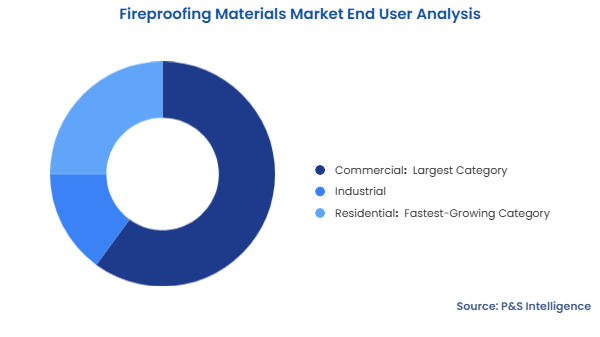
The commercial category holds the largest market share, of 60%, in 2025, because it is essential to fireproof commercial spaces to prevent loss of life as well as damage to buildings, critical equipment, materials, and other assets. Fireproofing materials also prevent the flame from spreading at a rapid pace, thus allowing additional time for people to escape and to firefighters for extinguishing it.
Moreover, exterior walls are safeguarded by using flame-resistant materials such as cement and also adding intumescent coating for further protection of a structure. Similarly, roofs can be protected by using fireproofing materials, and also implementing other precautionary measures like evading wood roofing shingles and opt for concrete or asphaltic structures instead. All these factors are indicative of the propensity to the surging demand for fireproofing materials.
The residential category will have the highest CAGR, driven by rapid urbanization, increasing construction of high-density housing, and heightened awareness among homeowners regarding fire safety. Stricter building codes and fire regulations in residential areas are compelling the use of fireproof walls, roofing, and coatings.
The end users analyzed in this report are:
Commercial (Largest Category)
Industrial
Residential (Fastest-Growing Category)
Drive strategic growth with comprehensive market analysis
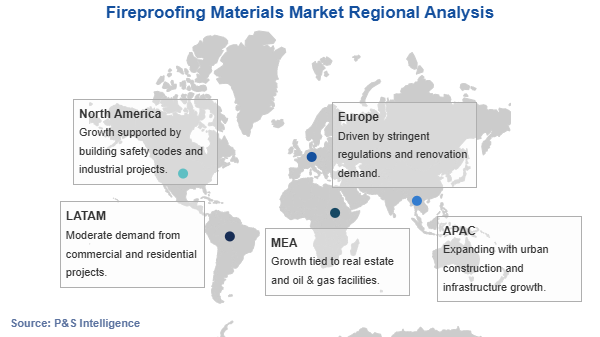
North America holds the largest market share, of 40%, in 2025, driven by stringent enforcement of fire safety codes, mature construction industry, and significant investments in industrial infrastructure maintenance and upgrades. The region's market leadership is reinforced by the presence of advanced manufacturing facilities, comprehensive regulatory frameworks, and high awareness levels regarding fire safety among end-users. Furthermore, the aging industrial infrastructure in North America, particularly in the oil & gas and petrochemical sectors, necessitates ongoing maintenance and retrofitting with modern fireproofing materials.
Additionally, there is a significant prevalence of construction activities in states such as Arizona, California, Florida, New York, and Texas, along with compliance to regulatory requirements that are covered under the fire safety section of Occupational Safety and Health Administration (OSHA) standards. Thus, all these factors are indicative of the augmentation of the fireproofing materials market in the region.
U.S. Fireproofing Materials Market Size
The U.S. is dominating the fireproofing materials market of North America due to extensive construction spending, stringent building codes, and increasing investments in industrial fire safety systems. In July 2025, the U.S. Census Bureau reported that construction spending reached approximately USD 2.139.1 billion, with a portion directed toward safety and protective systems, including fireproofing materials.
Asia-Pacific Fireproofing Materials Market Size
Asia-Pacific will have the highest CAGR, of approx. 7.0%, driven by rapid industrialization, urban development, and implementation of stricter fire safety regulations across emerging economies. The region's growth trajectory is supported by massive infrastructure investments, expanding manufacturing base, and increasing adoption of international building standards.
According to the Asian Development Bank, the region requires USD 26 trillion in infrastructure investments through 2030, with a significant portion allocated to urban development and industrial facilities requiring comprehensive fire protection systems. China's enforcement of the revised Fire Protection Law and India's implementation of the National Building Code have created mandatory requirements for fireproofing materials in various construction categories. The proliferation of petrochemical complexes, refineries, and manufacturing facilities across Southeast Asian countries, including Vietnam, Thailand, and Indonesia further amplifies demand.
The geographical breakdown of the market is as follows:
North America (Largest Regional Market)
U.S. (Larger and Faster-Growing Country)
Canada
Europe
Germany (Largest Country)
U.K. (Fastest-Growing Country)
France
Italy
Russia
Rest of Europe
Asia-Pacific (Fastest-Growing Regional Market)
China (Largest Country)
India (Fastest-Growing Country)
Japan
South Korea
Australia
Rest of APAC
Latin America
Brazil (Largest Country)
Mexico (Fastest-Growing Country)
Rest of LATAM
Middle East and Africa
Saudi Arabia (Largest and Fastest-Growing Country)
South Africa
U.A.E.
Rest of MEA
Fireproofing Materials Market Share
The market is fragmented because it consists of numerous global, regional, and local players competing across different segments such as intumescent coatings, cementitious sprays, and firestop products. Large multinational companies, such as 3M, AkzoNobel, Sika, RPM International, and Sherwin-Williams, are prominent, but they do not dominate the market. This fragmentation is further reinforced by varying building codes, fire safety standards, and material preferences across geographies, which create opportunities for local companies to compete effectively alongside global leaders.
Key Fireproofing Materials Companies:
3M Company
PPG Industries Inc.
RPM International Inc.
Contego International Inc.
No-Burn Inc.
Isolatek International
Iris Coatings S.r.l.
Hempel A/S
Morgan Advanced Materials
Knauf Insulation
AkzoNobel N.V.
Sika AG
Fireproofing Materials Market News
In January 2025, Isolatek International, a subsidiary of USMPC Buyer Inc.; launched Firesolve SB, a solvent-based intumescent fireproofing product. It offers low-VOC fireproofing designed for data centers, EV battery plants, and other demanding facilities.
In September 2024, PPG Industries, Inc. launched the PPG STEELGUARD 951 intumescent fire-protection coating in the Americas. It delivers multi-hour fire resistance for structural steel in sectors like data centers and modular construction.
In July 2024, Hexion Inc. and Clariant Ltd. announced a strategic collaboration on high-performance intumescent coatings. This aims to combine Hexion’s resin technology with Clariant’s additives to advance fire-protection coating performance.
In March 2024, Sherwin-Williams Company launched FIRETEX FX7002, a thin-film solvent-based intumescent coating, aiming to provide faster on-site application and wider steel beam protection listings.
In August 2023, Carboline International Corporation introduced a new protective coating, Hydroplate 6500, along with communications around fireproofing products. This aims to broaden its portfolio of protective and fireproofing solutions for structural steel and industrial applications.
Want a report tailored exactly to your business need?
Leading companies across industries trust us to deliver data-driven insights and innovative solutions for their most critical decisions. From data-driven strategies to actionable insights, we empower the decision-makers who shape industries and define the future. From Fortune 500 companies to innovative startups, we are proud to partner with organisations that drive progress in their industries.
Client Testimonials
Working with P&S Intelligence and their team was an absolute pleasure – their awareness of timelines and commitment to value greatly contributed to our project's success. Eagerly anticipating future collaborations.
McKinsey & Company
India
Unmatched Standards
Our insights into the minutest levels of the markets, including the latest trends and competitive landscape, give you all the answers you need to take your business to new heights
Complete Data Security
We take a cautious approach to protecting your personal and confidential information. Trust is the strongest bond that connects us and our clients, and trust we build by complying with all international and domestic data protection and privacy laws