Fire Suppression System Market Size & Share Analysis - Key Trends, Future Opportunities, Growth Strategies, and Forecasts (2025 - 2032)
This Report Provides In-Depth Analysis of the Fire Suppression System Market Report Prepared by P&S Intelligence, Segmented by Product Type (Fire Sprinkler Systems, Fire Suppression Systems), Fire Class (Class A, Class B, Class C, Class D, Class K), Application (Commercial, Industrial, Residential), and Geographical Outlook for the Period of 2019 to 2032
Explore the market potential with our data-driven report
Fire Suppression System Market Analysis
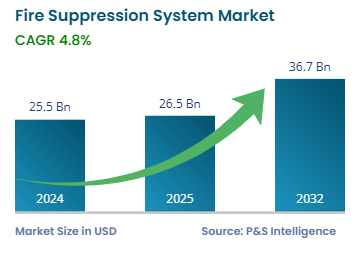
The fire suppression system market size was USD 25.5 billion in 2024, which is predicted to reach USD 36.7 billion by 2032, growing at a CAGR of 4.8% during 2025–2032.
As per the World Health Organization (WHO), burns lead to approximately 180,000 fatalities each year. The market is primarily driven by increasing awareness around fire safety, rising urbanization, and the enforcement of stringent government regulations across the globe. Between 2015 and 2024, wildfires inflicted approximately USD 132.6 billion in economic losses globally, with USD 78.6 billion covered by insurance. In 2024 alone, losses totaled USD 6.1 billion, while insured payouts reached USD 3 billion. These figures demonstrate the significant and growing financial burden of fire.
As buildings become more complex and densely populated, the demand for reliable fire protection systems has surged—especially in critical sectors like oil & gas, energy storage, data centers, manufacturing, transportation, and commercial real estate. The National Fire Protection Association (NFPA) codes, European standards (EN), and various national fire safety mandates compel facilities to adopt certified fire suppression systems, fueling consistent demand.
Additionally, the rise in the frequency of fire-related accidents and property loss has pushed industries and governments to invest in both active (suppression) and passive (prevention and detection) fire protection infrastructure. Technological advancements such as clean agent systems, water mist technology, hybrid suppression solutions, and smart (IoT-based) monitoring systems—are making fire suppression more effective, targeted, and compliant with sustainability goals. In particular, the shift toward environmentally friendly, non-toxic, and PFAS-free suppression agents is shaping procurement preferences, especially in regions with evolving environmental norms.
The rapid infrastructure development in emerging economies, coupled with increasing investments in industrial and commercial construction, further supports market growth. Moreover, sectors like electric vehicle manufacturing and energy storage systems (ESS) have introduced new fire risks, prompting innovation in suppression technologies such as aerosol-based systems, battery fire solutions, and thermal runaway mitigation agents. Together, these drivers make fire suppression systems a critical and fast-evolving market within the global safety and building technology landscape.
Fire Suppression System Market Emerging Trends & Growth Drivers
Technological Advancements Are Key Trend
The integration of IoT and smart sensors enables real-time monitoring and remote control of fire suppression systems.
The advancements in machine learning and AI improve fire detection accuracy and reduce false alarms.
The adoption of wireless fire suppression systems offers easier installation and scalability in complex infrastructures.
The development of environment-friendly suppression agents, such as Novec 1230 and inert gases, aligns with global environmental regulations.
The U.S. Federal Emergency Management Agency (FEMA) has allocated USD 32.4 million under its FY 2024 FP&S Grant Program to support fire detection, suppression, and safety technologies, with individual R&D projects eligible for up to USD 600,000.
The introduction of dual-action systems (combining detection and suppression) enhances response time and operational efficiency.
Enhanced integration with building management systems (BMS) allows for centralized control and automation.
The Growth in modular and pre-engineered suppression units facilitates quicker deployment in commercial and industrial spaces.
Under the Investing in America initiative, the U.S. government has allocated USD 79 million to enhance wildfire detection and communication systems, along with USD 250 million to help at-risk communities mitigate wildfire threats—indirectly supporting fire suppression efforts.
The advancements in aerosol-based suppression technologies provide effective solutions for confined and sensitive environments like data centers.
Rapid Urbanization and Infrastructure Development Accelerate Market Growth
The rapid urbanization is driving the construction of residential and commercial buildings, increasing the demand for integrated fire suppression systems.
Infrastructure projects, such as airports, hospitals, metro stations, and data centers, require advanced fire safety installations as per regulatory mandates.
High-rise buildings and smart city developments are adopting automated suppression technologies to ensure occupant safety and asset protection.
Governments and regulatory bodies are enforcing stringent fire safety codes in new infrastructure, boosting system deployment.
The U.S. Department of the Interior has received USD 1.5 billion under the Infrastructure Investment and Jobs Act (IIJA) to bolster wildland fire preparedness, fuels management, post-fire restoration, and fire science—investments that enhance suppression capabilities in expanding urban areas.
Urban expansion in emerging economies is leading to increased investments in industrial facilities, where fire suppression is a critical safety requirement.
Growth in warehouse and logistics infrastructure, driven by e-commerce, is further supporting the demand for large-scale fire protection systems.
Fire Suppression System Market Segmentation Analysis
Product Type Analysis
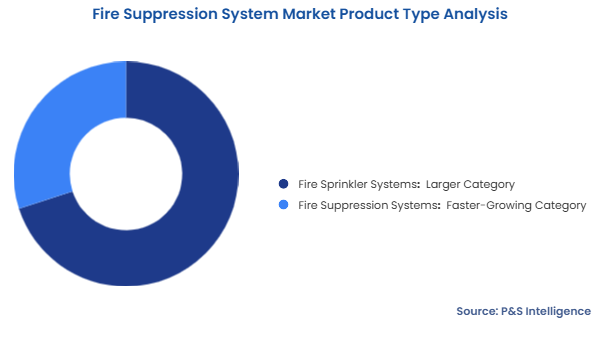
The fire sprinkler systems category held the larger share in the fire suppression system market of 70%, in 2024, primarily due to their widespread adoption, proven reliability, and cost-effectiveness across residential, commercial, and industrial applications. Fire sprinkler systems benefit from established installation practices, extensive regulatory support, and demonstrated effectiveness in controlling fire spread. Their versatility in addressing various fire classes and compatibility with existing building infrastructure maintains their dominant market position. The category encompasses wet pipe, dry pipe, pre-action, and deluge systems, each designed for specific environmental conditions and fire hazards.
Fire suppression systems represent the faster-growing category, during 2025–2032, driven by technological innovations and increasing adoption in specialized applications. Gas-based suppression systems, particularly those using clean agents, experience rapid growth due to their effectiveness in protecting sensitive electronic equipment and valuable assets without causing collateral damage. Foam-based systems gain traction in the petrochemical and aviation industries, while powder-based systems find applications in industrial settings with specific fire hazards. The growing emphasis on environmental sustainability accelerates the development of next-generation suppression agents that balance effectiveness with ecological responsibility.
These product types are covered:
Fire Sprinkler Systems (Larger Category)
Wet-pipe
Dry-pipe
Pre-action
Deluge
Fire Suppression Systems (Faster-Growing Category)
Water-based
Gas-based
Foam-based
Powder-based
Fire Class Analysis
The class A category held the largest share in the fire suppression system market of 35%, in 2024, as it covers fires involving wood, paper, textiles, plastics, and other everyday combustibles. Because these materials are common in residential buildings, offices, schools, warehouses, and public infrastructure, Class A fires are the most frequent. Governments also enforce strict building fire safety codes, which prioritize suppression solutions for Class A risks in urban infrastructure.
Class B is the fastest-growing category, during 2025–2032, as it includes fires involving gasoline, oils, solvents, paints, and other flammable liquids. With the growth of industrialization, chemical plants, oil & gas facilities, and transportation hubs, Class B fire suppression systems are witnessing the fastest growth rate. Government investments in industrial safety standards and stricter regulations for petrochemical, aviation, and manufacturing sectors are accelerating demand in this category.
These fire classes are covered:
Class A (Ordinary Combustibles) (Largest Category)
Class B (Flammable Liquids) (Fastest-Growing Category)
Class C (Electrical Equipment)
Class D (Combustible Metals)
Class K (Cooking Oils and Fats)
Application Analysis
The commercial category dominated the fire suppression system market in 2024 with 55% share, driven by stringent building codes, insurance requirements, and the concentration of high-value assets in commercial properties. Office buildings, retail spaces, hospitality facilities, and healthcare institutions require comprehensive fire protection to ensure occupant safety and business continuity. The commercial sector's emphasis on integrated building management systems facilitates the adoption of smart fire suppression technologies that interface with other building systems for coordinated emergency response.
The industrial category exhibits the highest growth potential, during the forecast period, attributed to expanding manufacturing activities, particularly in emerging economies, and heightened awareness of industrial fire risks. The industrial category dominates the Fire Suppression Market, accounting for nearly 49% of the revenue share in 2023, reflecting the critical need for fire protection in facilities handling flammable materials and high-temperature processes. Industries such as oil and gas, chemicals, power generation, and manufacturing face substantial fire risks requiring specialized suppression solutions tailored to specific hazards and operational requirements.
These applications are covered:
Commercial (Largest Category)
Retail spaces
Office buildings
Hospitality
Healthcare facilities
Industrial (Fastest-Growing Category)
Manufacturing
Oil & Gas
Mining
Transportation & logistics
Building & construction
Energy & power
Others
Residential
Single-family homes
Multi-family buildings
Drive strategic growth with comprehensive market analysis
Fire Suppression System Market Geographical Analysis
North America Fire Suppression System Market Size
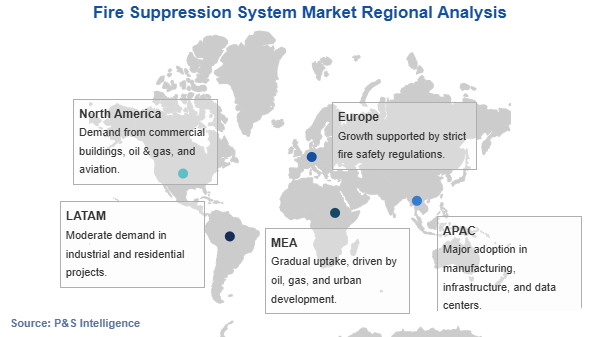
North America held the largest share of the global fire suppression system market in 2024, of 40%, and it is expected to maintain its leading position throughout the forecast period. The region's dominance stems from stringent fire safety regulations, mature infrastructure requiring retrofit solutions, and high awareness of fire safety importance. The U.S. fire suppression system market size was valued at USD 6.7 billion in 2024, representing the largest single-country market globally.
U.S. Fire Suppression System Market Size
The U.S. drives regional growth through comprehensive regulatory frameworks including NFPA codes and local fire safety ordinances that mandate fire suppression systems across various occupancy types. The country's extensive commercial and industrial infrastructure, combined with ongoing construction activities and renovation projects, sustains demand for both new installations and system upgrades. Additionally, technological leadership in IoT and AI integration positions North American companies at the forefront of smart fire suppression system development, attracting global investments and partnerships.
Asia-Pacific Fire Suppression System Market Growth
Asia-Pacific represents the fastest-growing regional market, with an expected CAGR of approx. 5.5% during 2025–2032, driven by the rapid industrialization, urban development, and improving fire safety standards across emerging economies.
China and India lead regional growth through massive infrastructure development projects, expanding manufacturing sectors, and increasing regulatory focus on fire safety. The proliferation of industrial facilities, commercial complexes, and residential high-rises in these countries creates substantial demand for fire suppression systems. Southeast Asian nations contribute to market expansion through foreign direct investment in manufacturing, growing tourism infrastructure, and adoption of international fire safety standards. Japan's technological expertise in advanced suppression systems and emphasis on earthquake-resistant fire protection solutions influence regional innovation trends.
India’s fire safety mandates, guided by the National Building Code (NBC) 2016, require buildings, especially high-rises, commercial, and public facilities to include non-combustible materials, multiple smoke-free escape routes, fire alarms, and automatic sprinkler systems. Firefighting provisions like hydrants, water storage tanks, and fire lifts are mandatory based on building type and height. High-rises must also have a Fire Command Center. All eligible structures need a Fire Safety NOC from the fire department, with periodic audits to ensure compliance. These norms are enforced through state bylaws and aim to minimize fire risk, improve evacuation, and enhance emergency response capabilities across India.
The regions and countries analyzed in this report are:
North America (Largest Regional Market)
U.S. (Larger Country Market)
Canada (Faster-Growing Country Market)
Europe
Germany (Largest Country Market)
U.K. (Fastest-Growing Country Market)
France
Italy
Spain
Rest of Europe
Asia-Pacific (Fastest-Growing Regional Market)
Japan
China (Largest Country Market)
India (Fastest-Growing Country Market)
South Korea
Australia
Rest of APAC
Latin America
Brazil (Largest Country Market)
Mexico (Fastest-Growing Country Market)
Rest of LATAM
Middle East and Africa
Saudi Arabia (Largest Country Market)
South Africa
U.A.E. (Fastest-Growing Country Market)
Rest of MEA
Fire Suppression System Market Share
The fire suppression system market exhibits a consolidated structure with established global players commanding significant market share through extensive product portfolios, technological capabilities, and widespread distribution networks. Market dynamics favor companies offering integrated fire protection solutions combining detection, suppression, and monitoring capabilities, driving consolidation through mergers and acquisitions. Leading companies maintain competitive advantages through continuous research and development investments, focusing on IoT integration, environmental sustainability, and application-specific solutions. Strategic partnerships with construction companies, system integrators, and regulatory bodies strengthen market positions while facilitating technology transfer and market expansion. The competitive landscape increasingly emphasizes service capabilities, with companies expanding maintenance, inspection, and emergency response offerings to generate recurring revenue streams and strengthen customer relationships.
Innovation in suppression agents, delivery mechanisms, and control systems differentiates market leaders from followers. Companies investing in clean agent technologies, water mist systems, and hybrid solutions capture premium market segments while addressing evolving environmental regulations. The growing importance of data analytics and predictive maintenance capabilities creates opportunities for technology-focused entrants to challenge established players through software-driven differentiation.
Key Fire Suppression System Companies:
Johnson Controls International plc
United Technologies Corporation
Robert Bosch GmbH
Siemens Aktiengesellschaft
Halma Public Limited Company
Hochiki Corporation
Firefly AB
Honeywell International Inc.
Minimax Viking Group GmbH
S & S Fire Suppression Systems, Inc.
Encore Fire Protection, LLC
Noha Norway AS
Consilium Safety Group AB
Firetrace International, LLC
Fike Corporation
Fire Suppression System Market Developments
In August 2025, the Chandigarh administration instructed the Chandigarh Housing Board (CHB) to promptly implement a firefighting system in the Dhanas Rehabilitation Colony.
In April 2025, Gentex Corporation acquired all the issued and outstanding shares of VOXX International’s common stock that were not already owned by Gentex for a purchase price of USD 7.50 per share. With this, Gentex expanded its presence in the automotive aftermarket and smart-home sectors. The deal strengthens Gentex’s PLACE and HomeLink product lines and enhances its distribution capabilities.
In April 2025, HOCHIKI Corporation showcased its L@titude fire control system and Ekho hybrid wireless devices at a major fire safety event in Birmingham. The company also celebrated the first anniversary of its Training Academy, highlighting its focus on innovation and professional development.
In November 2024, Defence Research and Development Organistion (DRDO) demonstrated its water-mist-based fire detection and suppression system (FDSS) for passenger compartments and aerosol-based FDSS for engine fire. The two systems, designed specifically for passenger buses, were demonstrated to several government officials, including the defense and road transport ministers.
In July 2024, Siemens AG released a whitepaper outlining how digitalization and AI are transforming fire safety. The company emphasized that future fire safety will increasingly rely on smart sensors, AI-driven analytics, and cloud-based platforms to predict and prevent fire hazards before they occur.
In July 2024, Halma plc acquired Global Fire Equipment S.A. through its safety-sector business Ampac. This deal, valued at approximately GBP 36 million, expands Halma’s fire safety portfolio and international footprint.
Want a report tailored exactly to your business need?
Leading companies across industries trust us to deliver data-driven insights and innovative solutions for their most critical decisions. From data-driven strategies to actionable insights, we empower the decision-makers who shape industries and define the future. From Fortune 500 companies to innovative startups, we are proud to partner with organisations that drive progress in their industries.
Client Testimonials
Working with P&S Intelligence and their team was an absolute pleasure – their awareness of timelines and commitment to value greatly contributed to our project's success. Eagerly anticipating future collaborations.
McKinsey & Company
India
Unmatched Standards
Our insights into the minutest levels of the markets, including the latest trends and competitive landscape, give you all the answers you need to take your business to new heights
Complete Data Security
We take a cautious approach to protecting your personal and confidential information. Trust is the strongest bond that connects us and our clients, and trust we build by complying with all international and domestic data protection and privacy laws