This Report Provides In-Depth Analysis of the Fiberglass Market Report Prepared by P&S Intelligence, Segmented by Type (E Glass, S Glass), Product (Glass Wool, Chopped Strands), Application (Composites, Insulation), and Geographical Outlook for the Period of 2021 to 2032
Explore the market potential with our data-driven report
Fiberglass Market Outlook
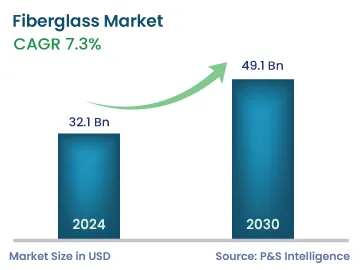
The fiberblass market size was USD 30.5 billion for 2025, and it will grow by 6.2% during 2026-2032, to reach USD 46.4 billion by 2032.
The market is expanding because fiberglass has become a standard material in various sectors, such as construction, transportation, energy, and industrial manufacturing. Builders and manufacturers are using fiberglass for its strength, low weight, and resistance to heat, corrosion, and moisture. With the increase in urbanisation and the ageing of infrastructure, there is a growing need for more durable materials with a longer lifespan and less maintenance needs. Therefore, traditional metals in vehicles, wind energy parts, and industrial equipment are being replaced by fiberglass to improve efficiency and handling.
Also, stricter performance and safety standards require materials with predictable behaviour. Both changes lead to a continuous demand for fiberglass in mature as well as developing markets. Global, As the IRENA, total renewable power capacity rose by a record 585 GW, and wind power generation capacity grew by 113 GW in 2024.
Key Market Insights
E glass is the largest type with 85% share, favoured in construction for its balance of high performance and low cost.
Glass wool leads product adoption with 75% share, essential for thermal and acoustic insulation in residential and commercial infrastructure projects.
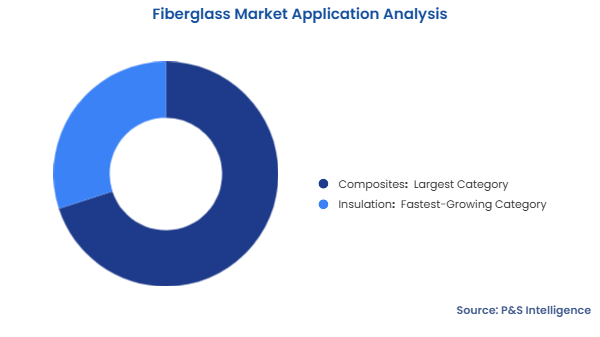
Composites are the largest application with 70% share, replacing metals in transportation and energy sectors due to superior strength-to-weight ratios.
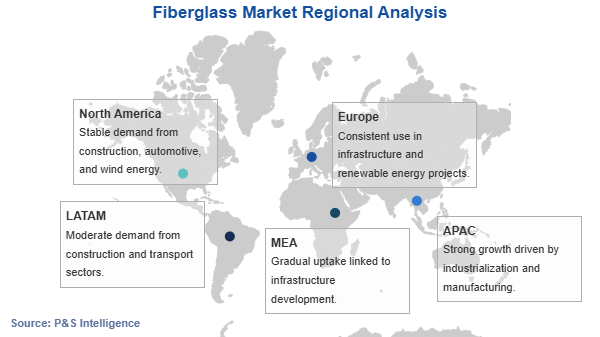
Asia-Pacific is the largest and fastest-growing region with 45% share and 6.3% CAGR, driven by rapid urbanization and massive infrastructure expansion across China and India.
Fiberglass Market Trends & Drivers
Application-Specific and Lightweight Fiberglass Is Major Trend
The industry is switching from all-purpose fiberglass materials to more specialised and application-specific products. Manufacturers are honing their fibre forms, surface treatments, and resin compatibility to respond to exact use cases in construction panels, automotive parts, wind blades, and electronics. Besides that, there is a definite change in the direction of lighter and thinner fiberglass structures without compromising the strength.
Production lines are becoming more automated to yield higher uniformity and less waste. Yet another observable trend is that the usage of fiberglass in prefabricated and modular components, which is in line with the quick building and assembly methods. In general, the market is progressing to be more technical, exact, and process-oriented. Around 150 GW of new wind capacity was installed in 2025, raising the demand for high-modulus fiberglass composites used to make longer and more complex turbine blades.
Rising Demand for Durable and Cost-Efficient Reinforcement Materials Drives Market
The market is growing because more and more industries demand materials that are durable, maintain their strength, and are not expensive. Fiberglass is one of the materials that meet these requirements quite well. Construction workers use it when they want to make their structures lighter without compromising on strength. Car manufacturers choose it mainly for the weight reduction of vehicles, while safety levels are maintained. Fiberglass has become the go-to material of the energy, marine, and industrial sectors as it is naturally resistant to corrosion and can withstand harsh conditions.
It is also a good insulation material, which is why it has become a favourite for energy-efficient buildings and equipment. As companies are always looking for ways to reduce maintenance problems and increase the lifespan of their products, fiberglass is being used to replace heavier and less flexible materials in a variety of applications. According to the International Energy Agency, global wind power generation is set to increase by 19% in 2026. This drives the demand for durable fiberglass to make wind turbine blades.
Fiberglass Market Segmentation and Category Analysis
Type Analysis
E glass is the largest category, holding a market share of 80%, mainly because of its ease of use, availability, and compatibility with a wide range of industries. It provides decent strength, electrical insulation, and corrosion resistance at a budget-friendly price. Producers are also inclined towards it as the manufacturing methods are mature and readily scalable. Hence, E Glass becomes the standard option for volume fiberglass products where consistency and cost control are more important than a slightly better performance from a niche product. E-glass fibers are extensively used as the standard reinforcement material in construction, electrical, and industrial applications.
S glass is the fastest-growing category, registering a CAGR of 6.4%, due to the increasing demand for materials with higher strength and stiffness. The aerospace, defence, and high-performance sporting goods sectors extensively use S glass as it provides superior mechanical properties over conventional glass fibers. Even as designs become lighter and more performance-oriented, the end customers are willing to pay more for materials with a better strength-to-weight ratio. In November 2025, AGY announced USD 12.1 million in investment to increase the production of speciality glass fibers for defence and electronics applications.
The types analysed in this report are:
E Glass (Largest Category)
S Glass (Fastest-Growing Category)
Product Analysis
Glass wool is the largest category, holding a market share of 75%, because of its extensive use for thermal and acoustic insulation in homes, offices, and factories. It is popular for its simple installation, effective fire resistance, and excellent insulation, which helps it meet the energy efficiency regulations implemented on modern buildings.
Chopped strands are the fastest-growing category, registering a CAGR of 6.5%, as they are versatile and simple to combine into composite manufacturing. They are commonly applied in the making of automotive parts, electrical components, and moulded products. Producers choose chopped strands for automated processes and intricate shapes. With the extension of composite usage in various new lightweight application areas, the need for flexible reinforcement forms such as chopped strands keeps increasing. The European Commission has stated that the domestic demand for glass fibre reinforcements, such as chopped strands, totalled about 3.1 million tonnes. Production output has consequently been ramped up by more than 1 million tons to satisfy both the industrial and export markets.
The products analysed in this report are:
Glass Wool (Largest Category)
Chopped Strands (Fastest-Growing Category)
Application Analysis
Composites are the larger category, holding a market share of 70%, as fiberglass-reinforced composites find applications in the transportation, construction, marine, and energy sectors. These materials provide the necessary strength without significantly increasing the weight. On top of that, they resist corrosion and lower the need for maintenance. Industries use composites to substitute metal in a lot of structural and semi-structural parts.
Insulation is the faster-growing category, due to the increasing emphasis on energy efficiency and indoor comfort. Fiberglass insulation is commonly used in buildings, appliances, and industrial systems due to strict energy standards and the increase in renovation activities. Since the need for insulation is no longer limited to the construction of new buildings but also extends to retrofitting, the demand for fiberglass in this application is still increasing rapidly.
The applications analysed in this report are:
Composites (Larger Category)
Insulation (Faster-Growing Category)
Drive strategic growth with comprehensive market analysis
APAC Holds Largest Market Share
Asia-Pacific Fiberglass Market Analysis
Asia-Pacific is the largest and fastest-growing market, with 45% share and 6.3% CAGR, respectively. This is attributable to robust construction, wind energy, and automotive sectors. Major countries, China and India, are leading the way with their numerous infrastructural development projects, industrial expansion, and adoption of renewable energy. Domestic producers are enlarging their capacities as foreign players set up new manufacturing units. Through urbanization and industrialization, the demand for composites and insulation materials remains continuously growing. Streamlining of the supply chain, reduction in production costs, and government incentives act as facilitators for rapid adoption. The region is experiencing huge private and public sector investments, thus, utilization is going up in various applications.
China Fiberglass Market Scenario
China leads the fiberglass market in the Asia-Pacific because of its extensive manufacturing capacity and large domestic consumption. Fiberglass usage is continually increasing across various industries, primarily due to the robust demand for infrastructure, electric vehicles, and wind turbines. As per the National Energy Administration data, the total installed wind power capacity hit 640 GW by 2025-end. This is indicative that China remains the top consumer of fiberglass materials required for the manufacturing of wind turbine blades.
India Fiberglass Market Drivers
India is the quickest developing fiberglass market in Asia-Pacific due to rapid urbanisation, transport infrastructure upgradation, and increasing application of composites in construction and water management. Additionally, the steady rise in local manufacturing capacity is helping to enhance product availability. As per the Ministry of New and Renewable Energy, renewable energy capacity additions in FY 2024–25 reached 29.52 GW, taking the total installed capacity to 220.10 GW.
Europe Fiberglass Market Analysis
Europe's demand for fiberglass is driven mostly by the automotive, aerospace, and renewable energy sectors. Germany is distinguished for its industrial and technological adoption, emphasising the use of high-performance composites. On the other hand, the U.K. is experiencing more rapid growth as a result of heavy investments in the infrastructure, wind energy, and green construction. Manufacturers are making headway in strict quality and environmental standards, primarily to cater to the demand for durable and energy-efficient materials. Moreover, regional logistics and distribution networks are efficient in handling timely delivery.
Germany Fiberglass Market Future
Germany dominates the European market mainly because of its highly developed automotive and industrial manufacturing sectors. There is a consistent demand for fiberglass-reinforced composites in the automobiles, machinery parts and components of the renewable energy sector, all being supported by strong engineering standards and material innovation. The German Association of the Automotive Industry reports that the production of electric vehicles reached 1.56 million units in 2025 till the end of November. This hints an increased use of lightweight composite materials in structural components for fuel efficiency.
UK Fiberglass Market Size
The U.K. market is growing fastest in Europe as the demand for fiberglass grows in the wind energy sector and buildings. The strong emphasis on energy efficiency and up-to-date construction techniques is leading to the increased use of insulation and composite materials. The Department for Business and Trade had forecast the overall construction output to increase by 3.5% in 2025, while public non-residential construction was set to rise by 3.8%.
North America Fiberglass Market Analysis
North America’s market is primarily driven by a well-developed industrial infrastructure and a high level of demand in various sectors such as construction, automotive, and aerospace. The growing usage of advanced composites and insulation drives the consumption of fibreglass in the region. Distribution channels are well established, and supply chains facilitate large-scale production. Customers put a high priority on quality and performance; therefore, specialised types of fiberglass are commonly used. Moreover, the extensive technological knowledge and research & development capabilities enable continuous innovations in both materials and production methods.
USA Fiberglass Market Share
The U.S. is the largest market for fiberglass in the continent due to the presence of a strong base of composite manufacturers and steady demand from the construction, automotive, aerospace, and wind energy sectors. Essentially, the consumption of fiberglass is driven by large-scale renovation activities and replacement demand. As per the U. S. Census Bureau, construction expenditure in October 2025 was USD 2,175.2 billion, out of which residential construction consumed USD 913.9 billion.
Canada Fiberglass Market Growth
Canada leads in market growth in North America because of the surging use of fiberglass in renewable energy projects, particularly wind power, and cold insulation. Moreover, infrastructure upgrades and public housing investments propel the use of this material in both industrial and residential applications. StatsCanada indicates that the overall investment in building construction increased by 4.5%, while the residential construction investment went up by 6.8% in the first nine months of 2025.
The regions and countries analysed in this report are:
North America
U.S. (Larger Country)
Canada (Faster-Growing Country)
Europe
Germany (Largest Country)
U.K. (Fastest-Growing Country)
France
Italy
Spain
Rest of Europe
Asia-Pacific (Largest and Fastest-Growing Regional Market)
China (Largest Country)
India (Fastest-Growing Country)
Japan
South Korea
Australia
Rest of APAC
Latin America
Brazil (Largest Country)
Mexico (Fastest-Growing Country)
Rest of LATAM
Middle East and Africa
Saudi Arabia (Largest Country)
U.A.E. (Fastest-Growing Country)
South Africa
Rest of MEA
Fiberglass Market Share Analysis
The fiberglass market is fragmented due to the existence of a large number of companies across regional, product and end-use segments. Although there are large global manufacturers, they have to compete with many regional and local producers. These players typically have a product, application, or customer focus. Barriers to entry are not high; so, new companies can come in with slightly different products or services.
Customers also keep multiple supplier options open to be able to choose the most-affordable, compliant and customisable product. Product differentiation is minimal for standard grades, which results in increased competition. There are a few firms in the market for fiberglass niche products, which allows room for specialized suppliers. The combination of global challengers and local players makes pricing competitive and prevents revenue concentration.
Top Fiberglass Companies:
Owens Corning
Jushi Group Co., Ltd.
Saint-Gobain Vetrotex
Nippon Electric Glass Co., Ltd.
Chongqing Polycomp International Corp. (CPIC)
Taishan Fiberglass Inc.
Johns Manville Corporation
PPG Industries, Inc.
AGY Holding Corp.
3B-the Fibreglass Company
Knauf Insulation GmbH
Asahi Fiber Glass Co., Ltd.
Taiwan Glass Industry Corporation
Nittobo (Nitto Boseki Co., Ltd.)
China Beihai Fiberglass Co., Ltd.
Fiberglass Market News & Updates
In January 2026, Owens Corning began commercial supply of a newly developed fiberglass insulation mat from its North American manufacturing network, marking the material’s entry into active building and industrial insulation projects.
In December 2025, Nippon Electric Glass Co., Ltd. launched its D2 Fiber low-dielectric glass fibre product, aimed at reducing signal loss in high-speed circuit boards.
In November 2025, Central Glass launched a recycled fiberglass-reinforced plastic (FRP) sleeper made from wind turbine blade scrap for Japanese rail infrastructure.
In October 2025, Asahi Fiber Glass introduced a vacuum insulation panel core made of glass wool for Japanese refrigerators and vending machine insulation systems.
Frequently Asked Questions About This Report
What are the primary factors driving the global fiberglass market growth?+
The market is driven by rising demand for lightweight materials in automotive manufacturing and increased infrastructure development requiring durable, corrosion-resistant composites.
What is the role of fiberglass in the renewable energy sector?+
Fiberglass is critical for wind energy, as it provides the lightweight, high-strength material necessary for manufacturing massive, efficient wind turbine blades.
Why is E-Glass the most dominant type of fiberglass used today?+
E-Glass holds the largest market share because it offers an exceptional balance of cost-effectiveness, electrical insulation, and strength for general-purpose construction applications.
Is fiberglass considered an environmentally friendly and sustainable building material?+
Yes, modern fiberglass is increasingly sustainable due to high recyclability, reduced manufacturing energy consumption, and its ability to improve building energy efficiency.
What are the main challenges currently facing the fiberglass industry?+
Major hurdles include high energy costs during production, supply chain disruptions for raw materials like silica sand, and difficulty recycling thermoset composites.
Want a report tailored exactly to your business need?
Leading companies across industries trust us to deliver data-driven insights and innovative solutions for their most critical decisions. From data-driven strategies to actionable insights, we empower the decision-makers who shape industries and define the future. From Fortune 500 companies to innovative startups, we are proud to partner with organisations that drive progress in their industries.
Client Testimonials
Working with P&S Intelligence and their team was an absolute pleasure – their awareness of timelines and commitment to value greatly contributed to our project's success. Eagerly anticipating future collaborations.
McKinsey & Company
India
Unmatched Standards
Our insights into the minutest levels of the markets, including the latest trends and competitive landscape, give you all the answers you need to take your business to new heights
Complete Data Security
We take a cautious approach to protecting your personal and confidential information. Trust is the strongest bond that connects us and our clients, and trust we build by complying with all international and domestic data protection and privacy laws