This Report Provides In-Depth Analysis of the Fermenter Market Report Prepared by P&S Intelligence, Segmented by Mode of Operation (Automatic, Semi-automatic), Scale of Production (Laboratory, Pilot, Industrial), Type (Stainless-Steel, Glass, Plastic, Wooden), Process Type (Batch, Fed-batch, Continous), Application (Food & Beverages, Pharmecutical Industry, Biofuel Production, Healthcare & Cosmetics, Agriculture), and Geographical Outlook for the Period of 2019 to 2032
Explore the market potential with our data-driven report
Fermenter Market Analysis
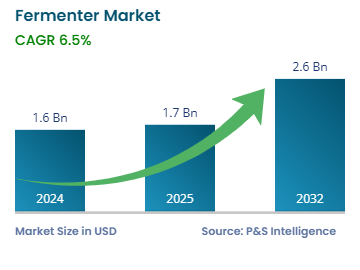
The fermenter market size was USD 1.6 billion in 2024, and it will grow by 6.5% during 2025–2032, to reach USD 2.6 billion by 2032.
The market growth is driven by the rising demand for processed food and beverage products, booming pharmaceutical industry, and rising need for eco-friendly, bio-based products. The demand for customized medicines, plant-based alternatives, and functional food also drives the market growth.
Fermenters are sterile, enclosed vessels that provide a proper temperature for microorganisms to grow on a large scale. They are widely used to prepare alcoholic beverages, such as beer, wine, and spirits, and biological products, including antibiotics, probiotics, and enzymes. In developed countries, people derive up to 50% of their daily calories from processed food.
Support from authorities globally is increasing the market growth. For instance, the Canadian government is investing CAD.2 billion from 2020 to 2025 to improve the life sciences and biomanufacturing industries, including fermentation technologies. The U.S. government is also actively encouraging local manufacturing of essential bioengineered products, such as vaccines, medicines, and the required fermentation apparatus under its National Biotechnology and Biomanufacturing Initiatives. Moreover, China has made a USD 4-billion investment in Made in China 2025 and the 14th Five-Year plans to boost its fermentation and bioprocessing capabilities.
Fermenter Market Emerging Trends & Growth Drivers
Rising Adoption of Single-Use Fermenters Is Biggest Trend
The rising push for single-use fermenters by the biotechnology, R&D, and biopharmaceutical sectors is a key market trend.
These fermenters, when integrated with sensors, mixers, and disposable polymer bags, provide better operational efficiency and accelerated batch cycles.
These devices help in cleaning validations, enhance flexibility, and shorten production time.
The European Medicine Agency, via its Annex 1 guidance and acknowledgement, promotes the use of closed and protected systems, including single-use fermenters in the manufacturing of pharmaceuticals.
According to a survey, nearly 87% of the biopharmaceutical companies use single-use fermenters at some stage of production.
Over 60 companies have manufactured more than 260 different disposable bioreactor designs for biological medicines.
Rising Demand for Plant-Based and Fermentation-Derived Proteins Is Key Driver
The increasing demand for plant and microbial proteins is a major driver for the market.
As per estimates, around 22% of the global population is vegetarian, and an increasing share is identifying itself as vegan.
Studies project that over USD 26.7 billion worth of plant-based proteins could be consumed around the world in 2030, compared to USD 11.1 billion in 2024.
Consumers are looking for eco-friendly yet ethical products that provide allergen-safe options.
Companies such as Formo, Imagindairy, and Perfect Day use these fermenters at a commercial scale to produce precision-fermented products, such as eggs, dairy, and meat.
More than 158 companies in the world use fermentation technologies to make alternative proteins.
These devices use fungi and microbes for producing alternative proteins, such as mycoprotein-based meat alternatives.
Governments are investing in fermentation technologies globally; for example, in 2024, nearly USD 203 million was provided in public funding to support fermentation-based initiatives.
Governments in China, India, South Africa, and many EU nations have introduced grants and set up programs for fermented food production.
In 2023, Israel became the first country to approve precision-based milk, which is not derived from animals, for commercial purposes.
Canada and New Zealand produce animal-free eggs and dairy proteins using fermentation technologies.
According to reports, Europe has invested EUR 119 million in large-scale biomass fermentation for fungal proteins as a sustainable food source.
Fermenter Market Segmentation Analysis
Mode of Operation Analysis
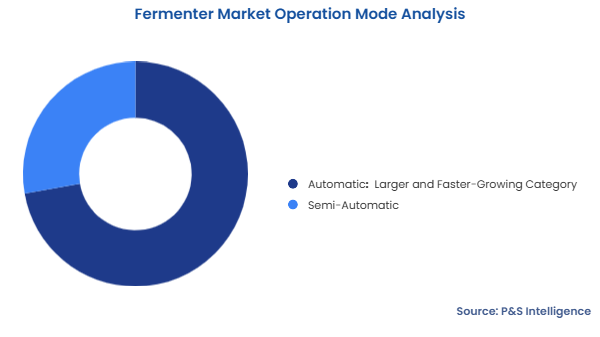
The automatic category held the larger market share, of 65%, in 2024, and it will have the higher CAGR, of approx. 7%. This is because of their increased accuracy, high speed, and scalability, which are prized amidst the increasing labor costs and constant evolution of smart bioprocessing solutions. They control several fermentation parameters, such as pH, temperature, oxygen, and agitation, with less human intervention in large-scale production in the biotech and pharma sectors. Moreover, they minimize human errors, improve batch efficiency, and generate optimized time schedules for scaleup.
The mode of operations analyzed in this report are:
Automatic (Larger and Faster-Growing Category)
Semi-Automatic
Scale of Production Analysis
The industrial category held the larger market share, of 55%, in 2024, because of its usage in commercial production in sectors such as biologics, food & beverage, and biofuel. Moreover, to produce a large volume of chemicals such as succinic acid, industrial fermenters are required. They can hold more than 10,000 l. For example, BioAmber offers fermenters with a capacity of 350,000 liters.
The pilot category will have the highest CAGR, of approx. 7.5%, because it provides an essential link between laboratory research and mass production. These experiments help in bringing new microbial processes developed in the laboratory to the market. It assists in the evaluation of product outputs, optimization of operational conditions, and confirmation of legal observance before investing. Furthermore, BioMADE, under the U.S. Department of Defense, invests heavily in pilot-scale fermentation to commercialize biomanufacturing technologies from lab scale.
The scale of production analyzed in this report are:
Laboratory
Pilot (Fastest-Growing Category)
Industrial (Largest Category)
Commercial
Large-Scale Production Facilities
Type Analysis
The stainless-steel category held the largest market share, of 40%, in 2024, because of its durability, easy maintenance, and compliance with strict legal standards, such as cGMP and FDA. They are preferred for large-scale commercial use in various sectors as they can handle high pressures and harsh sterilization methods.
The plastic category will have the higher CAGR, due to its affordability, adaptability, and minimal risk of cross-contamination. They are widely used in biopharmaceutical and R&D facilities, where prompt processing, smaller production runs, and regular process adaptations are needed. Moreover, as companies shift to modular biomanufacturing facilities, the need for lightweight and disposable plastic fermenters also increases.
The types analyzed in this report are:
Stainless Steel (Largest Category)
Glass
Plastic (Fastest-Growing Category)
Wooden
Process Type Analysis
The fed-batch category held the largest market share, of 45%, in 2024. This is due to the need for the optimized management of nutrient flow and fermentation parameters, which helps boost cell growth and yield. They are used in industrial enzyme production due to their expandability and capacity to overcome substrate toxicity. Moreover, its versatility to integrate with microbial culture broadens its usage in fermentation-based sectors.
The continuous category will have the highest CAGR, due to its ability to maintain a constant condition, facilitate constant output, and maximize volumetric yield. They are used for large-scale operations, such as biofuel production, as they reduce downtime and improve cost efficiency.
The process types analyzed in this report are:
Batch
Fed-batch (Largest Category)
Continuous (Fastest-Growing Category)
Chemostat
Perfusion System
Application Analysis
The food & beverage category held the largest market share, of 45% in 2024, due to the large-scale use of fermenters in brewing, baking, and winemaking. Fermenters used for brewing convert wort into beer. Moreover, the rising demand for fermented beverages, such as kombucha, kefir, and functional drinks, drives the market. According to The Brewers of Europe, European beer production increased from 380,550,000 hl in 2020 to 401,945,000 hl in 2022.
The rising consumer demand for functional foods and vegan products is also contributing to industry growth. As per reports, fermentation-based protein companies have increased from 136 in 2022 to 158 in 2023.
The pharmaceutical industry category will have the highest CAGR, due to rapid growth in biologics, vaccines, and specific enzymes. Fermenters are used in creating highly purified therapeutic agents, such as antibiotics and vaccines, with strict process control and legal standards. As per studies, global sales of biologics would be worth USD 745.1 billion in 2030, compared to USD 448.1 billion in 2023.
Moreover, over 20 billion cases of infections are detected around the world each year, some harmless and worth ignoring (such as the common cold); others more serious and almost deadly (such as rabies). This factor drives the demand for vaccines, which the world faced an acute shortage of during the COVID-19 pandemic, which has killed over 7 million people globally till now.
The applications analyzed in this report are:
Food & Beverages (Largest Category)
Bakeries
Breweries
Dairy Companies
Pharmaceutical Industry (Fastest-Growing Category)
Biofuel Production
Healthcare & Cosmetics
Agriculture
Drive strategic growth with comprehensive market analysis
Fermenter Market Regional Market Performance
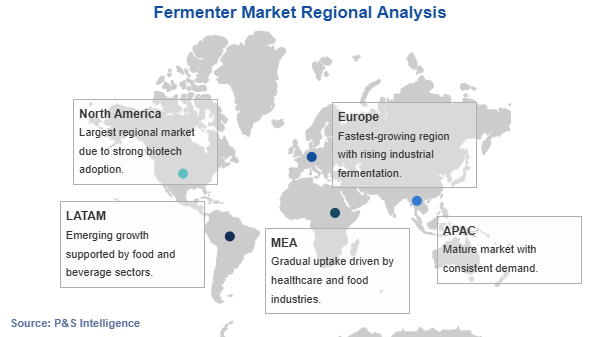
North America held the largest market share, of 40%, in 2024, due to extensive biopharmaceutical capacity, strong R&D investments, and government support for the regional food & beverage and biotechnology sectors. The U.S. leads global biologics production, with biologics representing nearly 40% of new drug approvals in recent years, as per the FDA. Growth in plant-based foods and microbial protein manufacturing, cited by the Good Food Institute, also fuels fermenter use. In industrial biotechnology, the U.S. bioeconomy contributes over USD 950 billion annually, highlighting sustained R&D. Additionally, increased investment in personalized medicine, synthetic biology, and vaccine production post-COVID-19 continues to accelerate fermenter adoption across both clinical and commercial-scale applications.
Asia-Pacific will have the highest CAGR, of approx. 6.5%, due to its accelerated industrial development, biopharma growth, and enhanced food and beverage yield. The rising government initiatives supporting local manufacturing practices are increasing the market growth across Japan, India, and China.
China leads with over 60% of global amino acid and vitamin fermentation output, supported by policy under the 14th Five-Year Plan, says industry analysis. Robust investments in probiotic foods and alternative proteins in Southeast Asia and rising adoption of automated and pilot-scale systems among over 60% of regional CROs is due to fermenters’ vital role in scaling clinical and commercial production.
India is the fastest-growing market in the region, driven by government programs, such as the National Biopharma Mission and the PLI scheme, have improved the biotechnology industry. This aims to transform India into a global biomanufacturing hub by 2030. India’s biotechnology sector, growing nearly 18% annually, leverages fermentation for vaccines, nutraceuticals, and bio-based chemicals under national programs.
As per the IBEF, the Strengthening of Pharmaceutical Industry scheme has a total financial allocation of USD 60.9 million (INR 500 crore). The PLI scheme for pharmaceuticals is being executed with a comprehensive budget of USD 2.04 billion (INR 15,000 crore) from 2020–21 to 2028–29. The Foreign Direct Investment (FDI) equity inflow into the pharmaceuticals sector amounted to USD 23.04 billion (INR 2,01,347 crore) from April 2000 to September 2024. The Union Budget for 2025–26 suggested an allocation of USD 602.90 million (INR 5,268.72 crore) for the Department of Pharmaceuticals.
The Indian pharmaceutical industry meets over 50% of the global demand for various vaccines, 40% of the generic demand in the United States, and 25% of all medicines in the United Kingdom. The domestic pharmaceutical sector comprises a network of 3,000 drug companies and approximately 10,500 manufacturing facilities. Currently, more than 80% of the antiretroviral medications utilized worldwide to treat AIDS are sourced from India.
The food & beverage sector is another key driver for the market in India, which stands as the foremost producer of milk and spices, and ranks among the top producers of fruits, vegetables, poultry, and meat. The food processing sector has attracted USD 12.96 billion (INR 85,343 crore) in FDI equity inflows from April 2000 to September 2024. As of 2024, it accounts for approximately 8.80% and 8.39% of the Gross Value Added (GVA) in Manufacturing and Agriculture respectively, contributing 13% to India's exports and 6% of total industrial investment. The GVA in the Food Processing sector has risen from USD 24.60 billion (INR 1.61 lakh crore) in 2015–16 to USD 24.43 billion (INR 1.92 lakh crore) in 2022–23, according to the First Revised Estimates from the Ministry of Statistics and Programme Implementation.
In 2022–23, India was a global frontrunner in milk production, contributing approximately 25% to the world's total milk output. The nation secured the second position in the production of vegetables, fruits, and eggs, and ranked fifth in meat production during the same period. Moreover, India is recognized as the largest global producer of spices, with 11.26 million tonnes of major spices produced in 2022–23.
The geographical breakdown of the market is as follows:
North America (Largest Regional Market)
U.S. (Larger Country)
Canada (Fastest-Growing Country)
Europe
Germany (Larger Country)
U.K.
France (Fastest-Growing Country)
Italy
Spain
Rest of Europe
Asia-Pacific (Fastest Regional Market)
China (Largest Country)
India (Fastest-Growing Country)
Japan
South Korea
Australia
Rest of APAC
Latin America
Brazil (Largest Country)
Mexico (Fastest-Growing Country)
Rest of LATAM
Middle East and Africa
Saudi Arabia (Fastest-Growing Country)
South Africa (Larger Country)
U.A.E.
Rest of MEA
Fermenter Market Share Analysis
The market is fragmented because of the presence of numerous players, including regional, local, and large global players. Sartorious AG, Thermo Fisher Scientific, and Pierre Guerin SAS have significant shares, but no single companies dominate all segments of the market. Many SMEs are innovating new products, which bring niche and emerging players to market, making it even more fragmented.
Key Fermenter Companies:
Sartorius Aktiengesellschaft
Eppendorf SE
Infors HT AG
Bioengineering AG
Praj Industries Limited
Locus Fermentation Solutions, LLC
MycoTechnology, Inc.
Pierre Guerin SAS
Bionet Ingenier
CerCell ApS
Biotehniskais Centrs Akciju sabiedrība
ABEC, Inc.
Fermenter Market Developments
In April 2025, Sartorious Aktiengesellschaft launched a next-generation line of automated disposable fermenters for smooth biopharmaceutical production.
In February 2025, Thermo Fisher Scientific Inc. declared plans to expand its fermentation manufacturing plant in Massachusetts, to meet the rising demand for the pharmaceutical and food industries.
In May 2024, Lonza Group AG extended its microbial capabilities in Visp, Switzerland, with a new facility housing two 4,000-l fermenters in the upstream suite and two separate downstream suites. This investment includes a state-of-the-art process development lab and a new 70-l pilot lab, aiming at upgrading microbial manufacturing technologies.
In March 2024, Locus Fermentation Solutions LLC raised USD 30 million from debt financing to extend its capacity for biological surfactant manufacturing for mining and bioenergy industries.
In October 2023, MycoTechnology Inc. created its fermentation as a service channel in the U.S., enabling clients to scale fermentation from 300 to 90,000 liters with full technical support.
Want a report tailored exactly to your business need?
Leading companies across industries trust us to deliver data-driven insights and innovative solutions for their most critical decisions. From data-driven strategies to actionable insights, we empower the decision-makers who shape industries and define the future. From Fortune 500 companies to innovative startups, we are proud to partner with organisations that drive progress in their industries.
Client Testimonials
Working with P&S Intelligence and their team was an absolute pleasure – their awareness of timelines and commitment to value greatly contributed to our project's success. Eagerly anticipating future collaborations.
McKinsey & Company
India
Unmatched Standards
Our insights into the minutest levels of the markets, including the latest trends and competitive landscape, give you all the answers you need to take your business to new heights
Complete Data Security
We take a cautious approach to protecting your personal and confidential information. Trust is the strongest bond that connects us and our clients, and trust we build by complying with all international and domestic data protection and privacy laws