Feeding Systems Market Size & Share Analysis - Emerging Trends, Growth Opportunities, Competitive Landscape, and Forecasts (2026 - 2032)
This Report Provides In-Depth Analysis of the Feeding Systems Market Report Prepared by P&S Intelligence, Segmented by Type (Rail-Guided Feeding Systems, Conveyor Feeding Systems, Self-Propelled Feeding Systems), Offering (Hardware, Software, Services), Technology (Automated Feeding Systems, Manual Feeding Systems), Function (Controlling Systems, Mixing Systems, Filling & Screening Systems), Livestock (Dairy, Poultry, Swine, Aquaculture), and Geographical Outlook for the Period of 2021 to 2032
Explore the market potential with our data-driven report
Feeding Systems Market Future Outlook
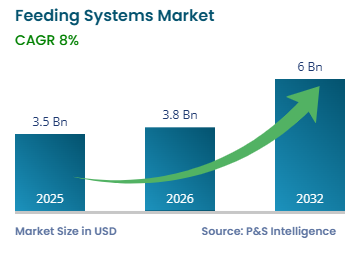
The feeding systems market size was USD 3.5 billion for 2025, and it will grow by 8.0% during 2026–2032, to reach USD 6.0 billion by 2032.
This growth reflects the accelerating shift toward automation across dairy, poultry, swine, and aquaculture operations worldwide, driven by mounting labor shortages and rising global protein consumption. The integration of robotics, IoT sensors, and RFID-enabled precision delivery has extended automation from basic equipment into the operational core of modern livestock infrastructure.
Feeding systems encompass rail-guided, conveyor, and self-propelled equipment architectures that automate the controlled delivery of feed through functions such as mixing, monitoring, and feed dispensing. The OECD-FAO Agricultural Outlook 2025–2034 indicates that global meat consumption is projected to increase by approximately 14% by 2030, alongside continued growth in dairy and egg production, amplifying the structural pressure on livestock operators to scale feeding efficiency without proportional increases in labor inputs.
Key Market Insights
The conveyor feeding systems category holds the largest market share, of 60%, in 2025, due to efficient, high-volume feed distribution with minimal labor.
The software category will have the highest CAGR, of approximately 8.3%, driven by AI analytics, IoT integration, and cloud-based feed optimization.
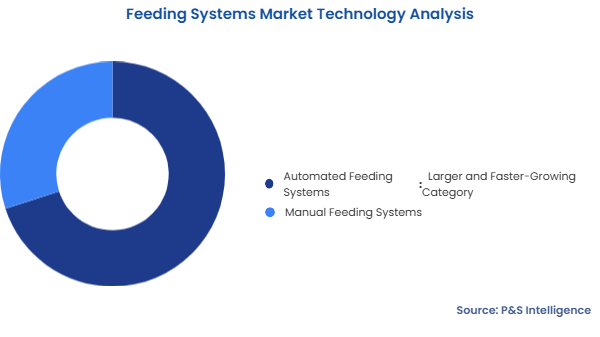
The automated feeding systems category holds the larger market share, of 70%, in 2025, and it will have the higher CAGR, of approximately 8.8%, driven by the shift from manual feeding.
The dairy category holds the largest market share, of 40%, in 2025, driven by the highly intensive feeding requirements of dairy operations.
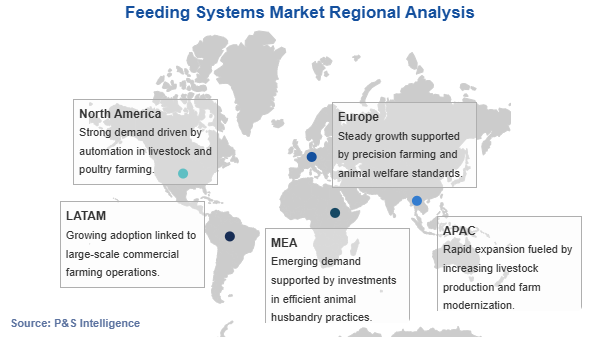
North America holds the largest market share, of 40%, in 2025, due to large-scale livestock operations and advanced precision agriculture.
Feeding Systems Market Trends and Drivers
Digitalization and Automated Precision Feeding Systems Are Key Trends
A major trend in the feeding system market is the rapid adoption of automated and IoT-enabled precision feeding systems. These systems enable real-time monitoring of animal nutrition, feed composition, and consumption patterns while replacing manual feeding methods in large-scale dairy and poultry operations. Studies indicate that feed costs account for approximately 60–70% of total livestock production costs. This cost burden makes precision feeding technologies critical for farm-level profitability. Sensors and AI-based feeding algorithms are enhancing livestock productivity, while automated distribution technologies optimize feed delivery at the individual animal level.
Broader digital agriculture initiatives are reinforcing this shift. The U.S. Department of Agriculture supports the adoption of digital and precision livestock farming practices aimed at improving feed efficiency and sustainable animal production. The European Commission promotes smart farming technologies under the Common Agricultural Policy (CAP), which carries a total budget of approximately EUR 387 billion for 2021–2027, with a portion directed toward sustainability, innovation, and digital transformation in agriculture. The Food and Agriculture Organization reports that global livestock production continues to expand to meet rising protein demand. This expansion intensifies the need for efficient, technology-driven feeding systems across commercial farming operations.
Rising Global Protein Demand and Expansion of Intensive Livestock Farming Are Biggest Drivers
The primary driver of the feeding system market is the increasing global demand for animal protein, which is driving the expansion of intensive livestock farming systems worldwide. Population growth and urbanization are broadening the consumer base for dairy, poultry, and meat products. Efficient feeding infrastructure is a structural requirement for large-scale animal production at this scale. The Food and Agriculture Organization indicates that global food production will need to increase by approximately 70% by 2050 to meet the food requirements of a growing population. This projection intensifies pressure on livestock production systems to enhance production capacity and output.
Livestock contributes approximately 40% of global agricultural GDP, making efficient feeding systems central to sustaining agricultural productivity at both national and global levels. Rapid growth in commercial livestock production is evident in emerging economies, where countries such as India and China are expanding large-scale dairy and poultry operations through government-supported livestock development programs. These structural shifts are accelerating the adoption of automated feeding technologies across intensive farming systems, supporting the transition toward large-scale, technology-enabled livestock production systems.
High Initial Capital Investment and Infrastructure Limitations Are Key Restraints
The feeding system market faces high initial investment requirements for automated feeding systems. Advanced feeding systems require sensors, automation infrastructure, and software platforms, with each component adding to upfront costs and restricting uptake in price-sensitive agricultural regions. Beyond capital expenditure, ongoing maintenance, system calibration, and software upgrade costs raise the total cost of ownership. Smaller farming operations are disproportionately exposed to this burden, as their production volumes cannot absorb the per-unit cost at the same rate as large-scale operators. Limited access to financing and credit facilities in rural agricultural sectors compounds this constraint. Farmers in these regions lack the capital access needed to invest in advanced equipment, slowing adoption of automated feeding technologies.
Fragmented farm structures in developing economies limit scalability. The Food and Agriculture Organization reports that over 80% of farms globally are smallholder-based. This structure makes it difficult to implement large-scale automation technologies and achieve economies of scale. Digital infrastructure deficits in rural farming regions present a separate barrier, with poor internet connectivity restricting real-time data transmission required by IoT-enabled feeding systems. Limited access to data platforms and low technical awareness among farm operators reduce the effective deployment rate of these systems even where connectivity exists. Variability in farm sizes, livestock types, and feeding practices across regions increases customization requirements. This variability adds complexity and cost to system deployment for both manufacturers and end users.
Aquaculture Expansion and Emerging Market Farm Modernization Are Biggest Opportunities
Two distinct opportunity vectors are expanding the addressable market for feeding systems beyond their established base in terrestrial dairy and swine operations. The rapid growth of commercial aquaculture is generating demand for specialized automated feeding systems. These systems must deliver precise underwater dosing that ensures controlled underwater feed distribution and prevents water quality degradation. The OECD-FAO Agricultural Outlook 2025–2034 projects that global fisheries and aquaculture production will increase from 189 million tonnes in the base period to 212 million tonnes by 2034. The same outlook projects that aquaculture will account for 56% of total global fisheries and aquaculture production by 2034, up from 52% in the base period. This expanding production scale is increasing the need for automated feeding infrastructure that can optimize feed utilization and improve production efficiency. Sustainable aquatic farming operations represent a distinct end-use segment that current terrestrial feeding system architectures are not designed to serve.
Farm consolidation and commercial livestock modernization across Asia-Pacific, Latin America, and the Middle East & Africa are progressively bringing large-volume, first-time feeding system adopters into the market. Urbanization is broadening the consumer base for dairy and poultry products across these regions, while rising middle-class protein consumption is deepening per-capita demand within that base. Government-backed agricultural investment programs are providing the capital conditions under which commercial farming expansion is occurring. This structural shift is expanding the total addressable installation base. Adoption rates in emerging markets are increasingly outpacing those of mature regions such as North America and Europe.
Feeding Systems Market Segmentation Analysis
Type Analysis
The conveyor feeding systems category holds the largest market share, of 60%, in 2025,
driven by their proven ability to deliver uniform, high-volume feed distribution across large-scale poultry, swine, and dairy facilities with minimal operator intervention. Structural simplicity relative to self-propelled architectures results in lower maintenance costs and higher operational reliability across diverse barn configurations, making them well-suited for continuous feeding operations where route consistency and throughput volume take precedence over flexibility. The Food and Agriculture Organization reports that global meat production is approaching 380 million tonnes, with poultry accounting for a substantial portion of incremental output, sustaining the demand base for conveyor-based feeding infrastructure.
The self-propelled feeding systems category will have the highest CAGR, of approximately 8.5%, driven by the expanding adoption of autonomous mixed-ration delivery systems capable of navigating multiple barn sections. These systems adapt routes in real time and integrate with digital farm management platforms, capabilities not available in fixed conveyor architectures. The operational flexibility of self-propelled designs makes them suited to large and variable herd configurations, particularly in dairy and ruminant operations.
The types analyzed in this report are:
Rail-Guided Feeding Systems
Conveyor Feeding Systems (Largest Category)
Self-Propelled Feeding Systems (Fastest-Growing Category)
Offering Analysis
The hardware category holds the largest market share, of 55%, in 2025, driven by the capital-intensive nature of physical installation. Hardware encompasses conveyors, silos, mixers, sensors, feed dispensers, and control panels, forming the foundational infrastructure of any automated feeding deployment. Hardware components account for approximately 60% of total system revenue, supported by the scale of initial installation projects, recurring replacement cycles for wear-intensive components, and the upgrade of legacy mechanical infrastructure across mature markets in North America and Europe. The USDA Economic Research Service confirms that the U.S. livestock sector employment rose from 1.07 million to 1.18 million between 2010 and 2024, a 10% increase even as labor costs escalated, a dynamic that continues to accelerate hardware investment as a labor substitution strategy.
The software category will have the highest CAGR, driven by rapid adoption of AI-enabled feed analytics, IoT-connected farm management dashboards, and cloud-based ration optimization platforms. As farm operators increasingly demand real-time visibility into animal behavior, feeding schedules, and nutritional outcomes, software layers are becoming commercially indispensable rather than optional add-ons. The OECD-FAO Agricultural Outlook 2025–2034 projects that lower-middle-income country livestock output will rise by 43.6% through 2034, expanding the first-time software adopter base in high-growth emerging markets.
The offerings analyzed in this report are:
Hardware (Largest Category)
Software (Fastest-Growing Category)
Services
Technology Analysis
The automated feeding systems category holds the larger market share, of 70%, in 2025, and it will have the higher CAGR, driven by the accelerating transition away from manual feeding practices across major livestock categories worldwide. Automated systems deliver consistent feeding intervals and precise ration composition at a commercial scale that manual feeding cannot efficiently replicate, while enabling consistent and scalable feeding operations across livestock categories.
The breadth of automated technology, encompassing rail-guided, conveyor, and self-propelled delivery mechanisms, means that the majority of incremental market growth is concentrated within the automated segment. According to the Food and Agriculture Organization, global per capita calorie intake of livestock and fish products is projected to increase by 6% over the next decade, with growth concentrated in lower-middle-income countries, further supporting the adoption of automated feeding systems.
The technologies analyzed in this report are:
Automated Feeding Systems (Larger and Faster-Growing Category)
Manual Feeding Systems
Function Analysis
The controlling systems category holds the largest market share in 2025, driven by its role as the central coordination layer across all automated feeding installations. Controlling systems manage feeding schedules and regulate dispensing accuracy. Biosecurity compliance requirements across commercial livestock operations have made controlling systems a regulatory necessity rather than an operational preference.
The mixing systems category will have the highest CAGR, of approximately 8.7%, driven by the growing adoption of total mixed ration (TMR) feeding protocols across dairy, beef, and swine operations. TMR-based feeding ensures precise nutritional composition per animal group and reduces feed segregation, supporting compliance with animal welfare and feed quality standards. As large-scale livestock operations continue to consolidate globally, demand for high-capacity automated mixing solutions is increasing across both mature and emerging markets.
The functions analyzed in this report are:
Controlling Systems (Largest Category)
Mixing Systems (Fastest-Growing Category)
Filling & Screening Systems
Others
Livestock Analysis
The dairy category holds the largest market share, of 40%, in 2025, driven by the highly intensive feeding requirements of dairy operations. Precision ration management directly influences milk yield, butterfat content, and reproductive performance. Dairy operations require continuous feeding cycles across multiple animal groups at different lactation stages, with each group needing a distinct ration composition that manual feeding cannot efficiently manage at a commercial scale.
The poultry category will have the highest CAGR, driven by the rapid industrialization of poultry production in Asia-Pacific and Latin America, alongside rising global broiler meat consumption. The increasing adoption of precision feeding systems in large-scale broiler and layer operations is translating production expansion into direct equipment demand. The USDA Foreign Agricultural Service reported that world chicken meat trade grew 9% between 2020 and 2025, with further expansion expected through 2026. This growth is accelerating the deployment of automated feeding systems across emerging commercial poultry markets.
The livestock analyzed in this report are:
Dairy (Largest Category)
Poultry (Fastest-Growing Category)
Swine
Aquaculture
Other
Drive strategic growth with comprehensive market analysis
Feeding Systems Market Regional Outlook
North America Feeding Systems Market Size
North America holds the largest market share, of 40%, in 2025, driven by the high concentration of large-scale commercial livestock operations and a well-established precision agriculture ecosystem. The United States and Canada together account for the bulk of regional revenue, with persistent structural labor shortages further accelerating the adoption of automated feeding systems. The USDA Economic Research Service reported that U.S. milk production reached 225.9 billion pounds in 2024, with growth driven by increasing dairy farm size and higher production per farm, reinforcing demand for automated feeding and livestock management technologies, while Agriculture and Agri-Food Canada reported 9,256 dairy farms in 2024.
Strong government funding for smart agriculture, robust R&D ecosystems, and the integration of AI-driven feed analytics with farm management platforms continue to sustain regional competitiveness, with the expansion of dairy and swine operations in key states expected to support North America’s leadership throughout the forecast period.
Asia-Pacific Feeding Systems Market Size
Asia-Pacific will have the highest CAGR, of approximately 8.9%, driven by the rapid industrialization of agriculture across China, India, Japan, South Korea, and Australia, along with rising middle-class demand for meat, dairy, and poultry products. Governments across the region are channeling dedicated investment into agricultural modernization, with China's 2025 No. 1 Central Document introducing the concept of new-quality productive forces in agriculture and emphasizing AI, smart farming, and digitalization as national priorities, supported by new rural financing mechanisms and agricultural modernization bonds that directly incentivize livestock technology adoption. Farm consolidation is accelerating the shift toward large-scale commercial dairy and swine operations in China and India, creating high-volume demand for conveyor and self-propelled feeding systems integrated with real-time monitoring. In Japan, the Ministry of Agriculture, Forestry, and Fisheries reports that over 70% of core agricultural workers are aged 65 and above, accelerating the adoption of automated feeding and smart livestock systems as a structural necessity. The United Nations projects Asia's population to expand from 4.6 billion in 2020 to 5.2 billion by 2050, underpinning a long-term structural increase in regional protein demand that will continue to drive feeding system adoption.
China Feeding Systems Market Size
China is the largest country market within Asia-Pacific, driven by the government's sustained push to modernize the livestock sector and policy-backed consolidation of smallholder farms into large commercial operations. The swine and poultry sectors were historically reliant on manual labor, with rapid industrialization across both sectors accelerating the transition to fully automated feeding solutions. Biosecurity concerns, heightened following recurrent African Swine Fever outbreaks, have strengthened the business case for closed, automated systems that minimize human contact with animal facilities. The National Bureau of Statistics of China reports that the country's pork production reached approximately 57.06 million tonnes in 2024. This output level reflects the scale of industrialized swine operations now requiring automated feeding infrastructure. China's raw milk production reached approximately 41.97 million tonnes in 2023, supported by the rapid expansion of large-scale dairy farms.
India Feeding Systems Market Size
India is the fastest-growing country market within Asia-Pacific, driven by its large livestock base and the transition from subsistence livestock keeping toward commercial dairy and poultry operations. The USDA reports that India holds the world's largest bovine population, with approximately 307.5 million cattle and water buffalo as of 2025, forming the structural foundation for scaling commercial livestock operations. The Union Budget 2024–25 allocated resources to livestock modernization and rural infrastructure, with policies targeting cooperative-based dairy expansion and disease control programs incentivizing precision farm management tools within this framework. The Department of Animal Husbandry and Dairying reports that India produced 239.3 million tonnes of milk in 2023–24, maintaining its position as the world's largest milk producer and increasing the need for efficient feed management and automation across dairy farms. Rising awareness of the productivity benefits of automated feeding, including reduced feed wastage and improved milk yield efficiency, is driving adoption among mid-scale and large commercial dairy operators across Maharashtra, Gujarat, and Punjab.
The regions and countries analysed in this report are:
North America (Largest Regional Market)
U.S. (Larger Country)
Canada (Faster-Growing Country)
Europe
Germany (Largest Country)
U.K.
France
Italy
Spain (Fastest-Growing Country)
Rest of Europe
Asia-Pacific (Fastest-Growing Regional Market)
China (Largest Country)
India (Fastest-Growing Country)
Japan
South Korea
Australia
Rest of APAC
Latin America
Brazil (Largest Country)
Mexico (Fastest-Growing Country)
Rest of LATAM
Middle East & Africa
Saudi Arabia (Largest Country)
South Africa (Fastest-Growing Country)
U.A.E.
Rest of MEA
Feeding Systems Market Share Analysis
The market is fragmented due to the widespread presence of numerous regional and local manufacturers that cater to diverse livestock farming needs across geographies. Diverse operational conditions across regions require customized solutions, enabling smaller players to compete effectively with global companies. In addition, relatively low entry barriers in basic hardware components such as conveyors and mixers encourage local production. Price sensitivity in emerging markets further supports the growth of cost-effective domestic suppliers. While large firms like DeLaval and GEA Group dominate advanced automated systems, the overall market remains dispersed due to limited standardization and strong demand for region-specific solutions.
Key Players in the Feeding Systems Market:
DeLaval International AB
GEA Group AG
Lely Industries N.V.
BouMatic LLC
Trioliet B.V.
Rovibec Agrisolutions Inc.
Pellon Group Oy
SKIOLD A/S
Big Dutchman International GmbH
Roxell N.V.
CTB, Inc.
ScaleAQ AS
Feeding Systems Market News & Updates
In September 2025, DeLaval International AB expanded its Hamra Farm R&D facility in Sweden, increasing herd capacity and integrating its Optimat automated feeding system alongside advanced herd monitoring technologies. The expansion strengthens its position as a demonstration center for integrated feeding and farm management solutions.
In November 2024, ScaleAQ AS partnered with a regional service provider in the Faroe Islands to strengthen maintenance and spare parts capabilities for aquaculture feeding systems, improving operational reliability in remote fish farming locations.
In September 2024, Lely Industries N.V. launched the Juno Max, an autonomous feed pusher designed for large-scale dairy farms, enhancing automation capabilities in feed management and supporting continuous feeding operations.
Frequently Asked Questions About This Report
How do automated feeding systems improve farm efficiency?+
Automated feeding systems improve farm efficiency by delivering precise feed quantities at scheduled intervals, reducing manual labor, minimizing feed wastage, and ensuring consistent nutrition, which enhances overall livestock productivity.
What factors are driving the growth of the feeding systems market?+
The growth of the feeding systems market is driven by rising global demand for animal protein, increasing labor shortages in agriculture, expansion of large-scale livestock farming, and the adoption of automation and precision farming technologies.
What are the benefits of using feeding systems in livestock farming?+
Feeding systems provide benefits such as improved feed conversion ratios, reduced feed wastage, consistent nutrient delivery, lower labor dependency, enhanced animal health monitoring, and increased operational efficiency.
How do feeding systems reduce feed wastage?+
Feeding systems reduce feed wastage by accurately controlling feed distribution, preventing overfeeding, minimizing spillage, and using sensors and monitoring systems to adjust feed quantities based on real-time consumption data.
What role does technology play in modern feeding systems?+
Technology plays a critical role by integrating IoT sensors, AI-based analytics, and automated controls that enable real-time monitoring, precision feeding, data-driven decision-making, and improved farm management efficiency.
Want a report tailored exactly to your business need?
Leading companies across industries trust us to deliver data-driven insights and innovative solutions for their most critical decisions. From data-driven strategies to actionable insights, we empower the decision-makers who shape industries and define the future. From Fortune 500 companies to innovative startups, we are proud to partner with organisations that drive progress in their industries.
Client Testimonials
Working with P&S Intelligence and their team was an absolute pleasure – their awareness of timelines and commitment to value greatly contributed to our project's success. Eagerly anticipating future collaborations.
McKinsey & Company
India
Unmatched Standards
Our insights into the minutest levels of the markets, including the latest trends and competitive landscape, give you all the answers you need to take your business to new heights
Complete Data Security
We take a cautious approach to protecting your personal and confidential information. Trust is the strongest bond that connects us and our clients, and trust we build by complying with all international and domestic data protection and privacy laws