Key Highlights
| Study Period | 2021 - 2032 |
| Market Size in 2025 | USD 2.45 Billion |
| Market Size in 2026 | USD 2.86 Billion |
| Market Size by 2032 | USD 7.15 Billion |
| Projected CAGR | 16.5% |
| Asia-Pacific | 43.00% |
| Latin America | 19.50% |
| Market Structure | fragmented |

| Study Period | 2021 - 2032 |
| Market Size in 2025 | USD 2.45 Billion |
| Market Size in 2026 | USD 2.86 Billion |
| Market Size by 2032 | USD 7.15 Billion |
| Projected CAGR | 16.5% |
| Asia-Pacific | 43.00% |
| Latin America | 19.50% |
| Market Structure | fragmented |
Explore the market potential with our data-driven report
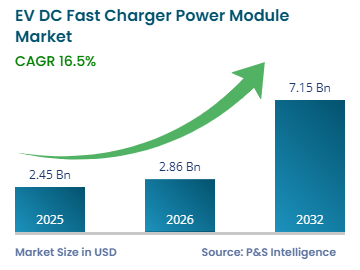
The EV DC Fast Charger Power Module Market size was USD 2.45 billion in 2025 and is projected to rise from USD 2.86 billion in 2026 to USD 7.15 billion by 2032, reflecting a CAGR of 16.5% during 2026–2032. Growth follows the construction of higher-power public, corridor, and fleet charging systems that assemble multiple conversion modules into scalable power cabinets. More than 7 million public charging points were operating worldwide at the end of 2025 after the stock added nearly 1.8 million points, or more than 33%, during the year, according to the International Energy Agency. The expanding installed base increases demand for replaceable rectifier and converter blocks while encouraging charger manufacturers to standardize cabinet platforms across several output ratings.
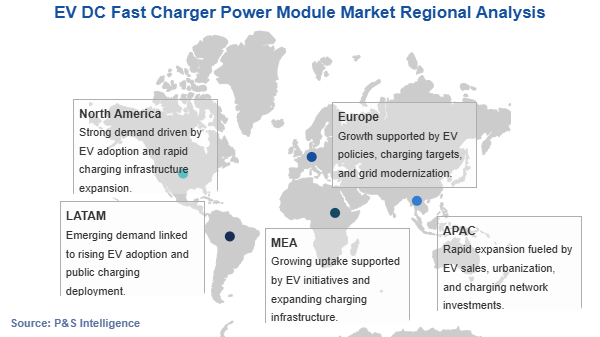
Asia-Pacific held 43.0% of the EV DC Fast Charger Power Module Market share in 2025, while Latin America is expected to post the fastest regional CAGR of 19.5% during 2026–2032. The regional split reflects differences in charging-network scale, equipment manufacturing, infrastructure investment, and the maturity of public and fleet charging programs.
EV DC fast charger power module suppliers are responding to rising power requirements with larger air-cooled modules, liquid-cooled formats, silicon-carbide platforms, and bidirectional architectures. Average rated power across the global public charging stock increased 15% from just over 40 kW in 2024 to nearly 50 kW in 2025 in data published by the International Energy Agency. Adoption remains conditioned by grid capacity, utilization, certification, serviceability, and the economics of replacing conventional silicon and forced-air designs.
EV DC Fast Charger Power Module Market growth is primarily driven by the rapid addition of public fast-charging capacity and the move toward cabinets that can allocate power dynamically across several connectors. A larger port base expands initial module demand, while higher utilization creates a replacement market for field-serviceable conversion blocks. Figures published by the International Energy Agency show that the global public charging stock grew more than 33% in 2025 to more than 7 million points, including nearly 1.8 million additions. Charger manufacturers can serve several station ratings by paralleling standardized modules, shortening platform-development cycles and simplifying spare-parts planning. The effect should remain strongest where networks combine high annual installation volumes with maintenance organizations capable of module-level replacement. Port counts alone can overstate module demand because they include slower equipment and do not disclose cabinet utilization, redundancy, or module output.
The EV DC fast charger power module industry's clearest opportunity lies in corridor hubs that must deliver progressively higher aggregate power without forcing operators to replace entire cabinets. Regulation (EU) 2023/1804 requires covered TEN-T core-road charging pools at intervals of no more than 60 km to provide at least 400 kW by the end of 2025, including one point rated at 150 kW or more. The requirement increases to 600 kW with two points of at least 150 kW by the end of 2027. Modular architectures let operators add conversion blocks as utilization rises, distribute power among dispensers, and retain service continuity when one block is unavailable. Suppliers can capture this opportunity through interoperable form factors, broad voltage windows, and conversion stages that support shared cabinets. Regulatory power requirements establish addressable infrastructure, although they do not guarantee utilization, module sourcing, or equal supplier access.
EV DC fast charger power module industry trends favor higher module ratings, liquid cooling, silicon-carbide switching, and architectures prepared for bidirectional energy flow. These changes seek to reduce cabinet size and conversion losses while supporting vehicles with higher charging acceptance. Higher output per slot can reduce module count in a fixed cabinet, while liquid cooling can stabilize performance where ambient temperature, dust protection, or continuous load challenges forced-air designs. The transition will be uneven because buyers weigh efficiency gains against coolant-system complexity, service procedures, qualification cycles, and component cost. A single supplier specification demonstrates technical direction and does not establish fleet-wide performance.
Grid availability is the most consequential restraint because charger cabinets cannot monetize high module capacity before interconnection and upstream electrical work are complete. High-power sites may require new transformers, switchgear, storage, or managed charging, which extends project schedules and increases capital exposure. The U.S. Department of Energy identified potential grid loads of 25–125 MW for high-power heavy-duty charging sites in its January 2025 vehicle-grid integration assessment. The 25–125 MW range illustrates the scale challenge for U.S. truck charging and is not a global site average. Delayed energization can cause operators to phase cabinet buildouts, install fewer modules initially, or choose lower peak power. Suppliers can mitigate some pressure through efficient conversion and power sharing, but modules cannot resolve transmission constraints, distribution queues, land limitations, or weak utilization economics.
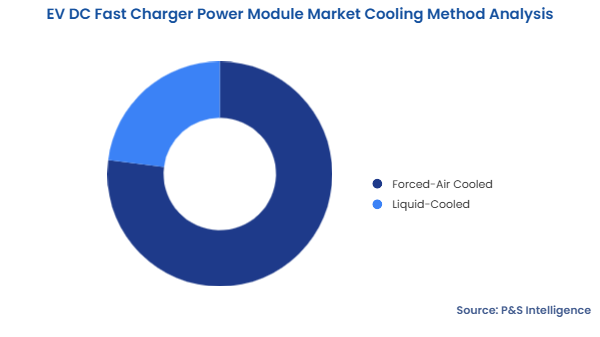
Forced-air cooled modules accounted for the largest share at 77% in 2025. Their established supply chain, straightforward cabinet integration, and familiar service procedures support use in conventional urban and corridor equipment. Infypower reports peak efficiency of at least 96.4% for one 40 kW air-cooled module, showing that forced-air platforms can retain competitive conversion performance at mainstream ratings. The specification applies to one vendor product, but it helps explain why operators do not need liquid cooling for every installation.
A 27.5% CAGR during 2026–2032 makes liquid-cooled modules the fastest-growing cooling category. Demand rises where higher power density, lower acoustic output, sealed cabinets, or sustained operation at elevated ambient temperatures justify added thermal-system complexity. Infypower's January 2026 liquid-cooled module carries a 62.5 kW rating and vendor-reported peak efficiency of at least 97.5%, demonstrating the output level suppliers are packaging into this format. Adoption depends on lifecycle savings exceeding coolant-loop, maintenance, and technician-training costs.
Unidirectional AC/DC modules represented the largest share at 87.0% in 2025. Most deployed fast chargers primarily convert grid AC into regulated DC for vehicle charging, making this architecture the established choice for public and destination equipment. Huawei's current charging-module range includes 20 kW and 40 kW products with a 150–1,000 V DC output window. Huawei's breadth illustrates how unidirectional platforms can address different cabinet ratings and vehicle voltages without introducing the control and compliance requirements associated with export to the grid.
At 28.0% during 2026–2032, bidirectional AC/DC modules carry the highest projected CAGR within conversion architecture. Expansion is linked to vehicle-to-grid pilots, depot energy management, and charging sites that seek to coordinate vehicles, storage, and renewable generation. At Power2Drive Europe 2026, Tonhe presented 30 kW and 40 kW DC/DC modules with peak efficiency of at least 98% alongside a 40 kW bidirectional V2G module. Supplier specifications do not establish interconnection approval or scaled bidirectional use, which will depend on standards, tariffs, vehicle support, and operating value.
Silicon-based modules held the largest share at 71.0% in 2025. The installed base favors proven silicon IGBT and super-junction silicon MOSFET designs because charger manufacturers have qualified their controls, thermal systems, and service processes over multiple product generations. Sinexcel reports cumulative sales of more than one million charging modules and offers 20 kW, 30 kW, and 40 kW products. Its disclosed volume does not identify semiconductor mix, but it quantifies the legacy product scale that new platforms must displace.
Silicon-carbide-based modules carry the segment's highest projected CAGR at 29.0% during 2026–2032. Higher switching efficiency and power density become more valuable as module output rises and cabinet space tightens. Sinexcel reports maximum efficiency of 97% for a 50 kW SiC module, providing a bounded example of performance at a higher rating. Procurement will still depend on device cost, supply security, cooling design, and whether energy savings justify platform requalification.
EV DC Fast Charger Power Module Market analysis shows that 20–30 kW modules held the largest share at 40.0% in 2025. The rating band balances cabinet density, cooling requirements, component availability, and serviceable unit weight across mainstream public fast chargers. Sinexcel reports more than one million cumulative charging-module sales and currently offers 20 kW, 30 kW, and 40 kW products. The disclosed volume does not separate ratings, but it quantifies the commercial scale achieved by modular platforms centered around the leading band. Charger manufacturers can parallel these blocks while preserving granular redundancy and field replacement.
Revenue from above 40 kW modules is projected to rise at a CAGR of 22.5% during 2026–2032, the fastest pace in the output segmentation. Ultra-fast passenger-car hubs and heavy-duty charging systems need more power from limited cabinet space. Vehicle capability data published by the International Energy Agency covered about 160 battery-electric models able to accept more than 150 kW in 2025, including 50 able to accept more than 250 kW. Vehicle capability does not ensure charging at peak power, but it strengthens the case for denser conversion blocks.
Public charging networks accounted for the largest share at 61.0% in 2025. Network operators require scalable power cabinets for urban sites, highway hubs, and multi-dispenser locations, generating both original-equipment and replacement-module demand. Global records compiled by the International Energy Agency included more than 7 million operating public charging points at the end of 2025. The figure includes slower equipment and cannot be converted directly into fast-charger module revenue, but it demonstrates the scale of the public asset base supporting the segment's lead.
A projected CAGR of 20.5% during 2026–2032 positions fleet and depot charging as the fastest-growing deployment category. Commercial fleets concentrate energy demand in defined operating windows, which raises the value of shared cabinets, dynamic power allocation, and high-duty-cycle modules. The global heavy-duty EV charging stock could rise from about 2 million points in 2025 to more than 11 million by 2035, with depot points representing 99% of the 2035 stock in the International Energy Agency's outlook. The projection supports direction rather than the approved segment CAGR and does not represent an observed 2035 result.
The complete segmentation hierarchy is as follows.
Drive strategic growth with comprehensive market analysis
Asia-Pacific held the largest regional share at 43.0% in 2025 and is projected to grow at a CAGR of 16% during 2026–2032. Its position rests on dense charger manufacturing networks, large public charging programs, and the use of modular power cabinets across several vehicle and site classes. China alone operated more than 4.7 million public charging points at the end of 2025, exceeding 65% of the global stock in the International Energy Agency's end-of-year tally. Regional suppliers also benefit from proximity to power-semiconductor, magnetics, enclosure, and contract-manufacturing ecosystems. Export-oriented production lets established platforms serve projects beyond their home markets, while domestic deployments provide a large qualification environment. The region should retain scale leadership as higher-rated and liquid-cooled products move into broader use. Its share could narrow if export restrictions, price competition, or slower domestic utilization reduce supplier returns while other regions localize equipment procurement.
EV DC Fast Charger Power Module Market growth in Latin America is forecast to lead all regions at a CAGR of 19.5% during 2026–2032, from a 5.0% share in 2025. Growth begins from a smaller installed and manufacturing base, allowing national corridor programs, urban fleet electrification, and private charging networks to generate high percentage gains. Brazil's public charging-point stock increased nearly 35% in 2025 in the International Energy Agency's country data, providing a current indicator of infrastructure momentum in the region's largest vehicle market. Module demand should broaden as operators move from isolated installations toward multi-dispenser sites that benefit from shared power cabinets. Importers and regional integrators can initially pair global module platforms with locally assembled cabinets, reducing the need for a fully localized component chain. Progress remains exposed to import costs, currency volatility, utility interconnection delays, uneven technical service coverage, and vehicle utilization that may not initially support high-power assets.
China accounted for 78.0% of Asia-Pacific revenue in 2025. Its country position combines the world's largest public charging stock with a concentrated base of module and charger manufacturers that can iterate products across domestic deployments and export programs. The International Energy Agency's end-2025 series shows that China's total public charging points grew from about 3.4 million at the end of 2024 to over 4.7 million by the end of 2025. Growth in higher-powered points supports demand for mainstream modules while passenger and commercial-vehicle sites encourage 40 kW and larger blocks. Domestic scale also permits suppliers to spread engineering and certification costs across more units before adapting platforms for overseas requirements. The country's module revenue should continue growing even if declining unit prices temper value expansion. Its regional share may fall if India, Southeast Asia, Japan, South Korea, and Australia accelerate deployment or require locally qualified supply.
Brazil is projected to record a CAGR of 21.0% during 2026–2032, making it the largest and fastest-growing country market within Latin America. The case rests on growing public networks, long intercity travel corridors, urban ride-hailing and delivery fleets, and increasing demand for dependable high-voltage charging in varied climate conditions. Fast chargers represented more than 20% of Brazil's public charging stock in 2025 in data published by the International Energy Agency. A rising fast-charger mix supports conversion-module value more directly than growth dominated by low-power points. Brazil can also serve as a qualification and service base for neighboring markets. Suppliers that combine broad voltage capability with local spare-parts access can address both metropolitan hubs and corridor installations without fragmenting the module platform. The trajectory could slow if grid upgrades, imported equipment financing, standards alignment, or technician availability fails to keep pace with announced charging projects.
The EV DC fast charger power module industry has a fragmented supplier field with a moderately concentrated core of Asian power-electronics specialists. Competition is shaped less by complete-charger branding than by conversion efficiency, power density, voltage range, acoustic performance, thermal design, certification, manufacturing scale, and the ability to maintain interchangeable platforms. Buyers balance purchase price against electricity losses, cabinet footprint, failure isolation, spare-parts continuity, and qualification risk. These requirements create meaningful barriers because a module must perform reliably inside a larger charger architecture and comply with the electrical and environmental expectations of each destination market.
Shenzhen Infypower Co. Ltd. competes through scalable 30 kW and 40 kW platforms and manufacturing scale, while Shenzhen UUGreenPower Co. Ltd. emphasizes protected form factors and cooling-format breadth. Huawei Digital Power Technologies Co. Ltd. uses charger-module integration as a differentiator. Shenzhen Sinexcel Electric Co. Ltd. combines installed module scale with a broad 20–40 kW range. Shijiazhuang Tonhe Electronics Technologies Co. Ltd. focuses on high-efficiency design, while Sicon Chat Union Electric Co. Ltd. spans AC/DC and DC/DC conversion needs.
Shenzhen Megmeet Electrical Co. Ltd. competes through international certification breadth. Shenzhen Increase Technology Co. Ltd. addresses both air-cooled and liquid-cooled configurations, and Rectifier Technologies Pacific Pty Ltd. offers 30 kW and 50 kW granularity. Competitive evolution is moving toward fewer modules per cabinet, wider vehicle-voltage coverage, protected cooling formats, and bidirectional readiness. Entrants can target specialized ratings or regional certification gaps, but scaling requires long qualification cycles, dependable semiconductor sourcing, local service support, and a credible field-reliability record. Price pressure should remain intense in standardized air-cooled products, while liquid-cooled and bidirectional modules offer more room for technical differentiation.
Want a report tailored exactly to your business need?
Request CustomizationLeading companies across industries trust us to deliver data-driven insights and innovative solutions for their most critical decisions. From data-driven strategies to actionable insights, we empower the decision-makers who shape industries and define the future. From Fortune 500 companies to innovative startups, we are proud to partner with organisations that drive progress in their industries.

Working with P&S Intelligence and their team was an absolute pleasure – their awareness of timelines and commitment to value greatly contributed to our project's success. Eagerly anticipating future collaborations.
McKinsey & Company
India
Our insights into the minutest levels of the markets, including the latest trends and competitive landscape, give you all the answers you need to take your business to new heights

We take a cautious approach to protecting your personal and confidential information. Trust is the strongest bond that connects us and our clients, and trust we build by complying with all international and domestic data protection and privacy laws


Customize the Report to Align with Your Business Objectives

Request the Free Sample Pages