This Report Provides In-Depth Analysis of the Ethyl Cyanoacetate Market Report Prepared by P&S Intelligence, Segmented by Grade (Pharmaceutical Grade, Industrial Grade), Function (Chemical Intermediates, Polymerization, Cross-linking Agents, Catalysts), Application (Pharmaceuticals, Agrochemicals, Adhesives, Dyes & Pigments), and Geographical Outlook for the Period of 2021 to 2032
Explore the market potential with our data-driven report
Ethyl Cyanoacetate Market Analysis
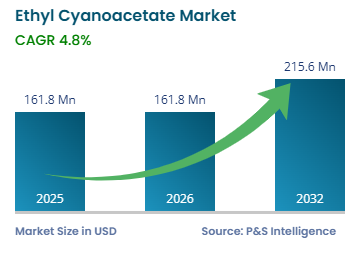
The ethyl cyanoacetate market size was USD 161.8 million for 2025, and it will grow by 4.8% during 2026–2032, to reach USD 215.6 million by 2032. This growth is supported by the compound's critical role as a chemical intermediate in pharmaceutical synthesis, agrochemical formulation, and specialty chemical production across multiple industrial applications, positioning ethyl cyanoacetate as an essential building block for complex organic molecules. The U.S. Food and Drug Administration maintains stringent regulatory frameworks for pharmaceutical intermediates used in drug substance synthesis, with ICH Q11 guidelines governing starting material selection and ensuring quality control across multi-step chemical synthesis processes that incorporate compounds like ethyl cyanoacetate into active pharmaceutical ingredient production.
The market expansion is driven by ethyl cyanoacetate's utility in synthesizing heterocyclic compounds, anticonvulsants, antibiotics, and cardiovascular medications. Simultaneously, the agrochemical sector demonstrates substantial demand for ethyl cyanoacetate as a precursor in herbicide, fungicide, and pesticide formulation, responding to agricultural productivity requirements. According to the USDA National Agricultural Statistics Service Agricultural Chemical Use Survey (Corn Highlights), herbicide active ingredients were applied on approximately 96% of acres planted to corn in the survey coverage.
Key Market Insights
The pharmaceutical grade category holds the largest market share, of 60%, in 2025, driven by stringent quality requirements in pharmaceutical synthesis and the compound's essential role in heterocyclic compound production for active pharmaceutical ingredient manufacturing.
The chemical intermediates category holds the largest market share, of 55%, in 2025, reflecting ethyl cyanoacetate's primary role as a versatile building block in multi-step synthesis processes across pharmaceutical, agrochemical, and specialty chemical manufacturing.
The pharmaceutical category holds the largest market share, of 50%, in 2025, and it will have the highest CAGR, reflecting the compound's indispensable role in synthesizing active pharmaceutical ingredients and the pharmaceutical industry's sustained global expansion.
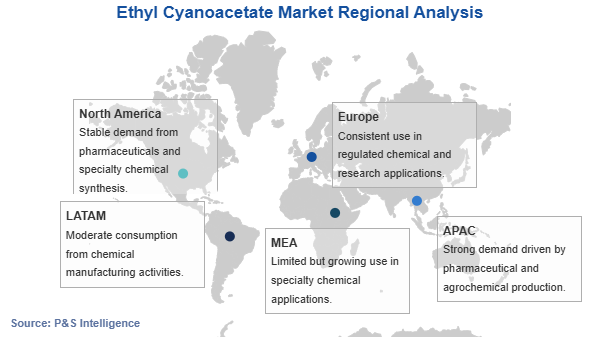
Asia-Pacific holds the largest market share, of 45%, in 2025, and it will have the highest CAGR.
China is the largest, and India is the fastest-growing, within the ethyl cyanoacetate market.
Ethyl Cyanoacetate Market Emerging Trends
Stringent Environmental Regulations Are Key Trends Shaping Chemical Manufacturing and Quality Standards
Regulatory frameworks governing chemical manufacturing operations are fundamentally reshaping production standards, quality control requirements, and operational costs across the ethyl cyanoacetate supply chain. In April 2024, the U.S. Environmental Protection Agency finalized comprehensive National Emission Standards for Hazardous Air Pollutants (NESHAP) updates for the Synthetic Organic Chemical Manufacturing Industry (SOCMI), introducing significantly tighter emission limits for hazardous air pollutants and volatile organic compounds. These rules are expected to reduce toxic air emissions by more than 6,200 tons annually across approximately 218 chemical manufacturing facilities, directly affecting producers of organic intermediates used in pharmaceutical and specialty chemical synthesis, including ethyl cyanoacetate.
These regulatory developments compel manufacturers to invest in advanced emission control systems, enhanced process monitoring technologies, and upgraded production infrastructure to meet evolving compliance requirements. Under the April 2024 SOCMI standards finalized by the U.S. Environmental Protection Agency, covered facilities are subject to enhanced monitoring and recordkeeping requirements, including provisions for facility boundary air quality evaluation for designated hazardous air pollutants, increasing ongoing compliance and transparency obligations for organic chemical and intermediate producers. Additionally, the December 2024 EPA amendments to Toxic Substances Control Act (TSCA) new chemicals review procedures establish more rigorous safety evaluation processes for chemical intermediates, affecting time-to-market for novel synthesis routes and potentially constraining production flexibility for manufacturers developing alternative ethyl cyanoacetate production methods.
Pharmaceutical Innovation and Complex Synthesis Is Biggest Driver
The global pharmaceutical industry's sustained focus on complex drug development is propelling ethyl cyanoacetate demand through its essential role in synthesizing heterocyclic compounds, anticonvulsants, antibiotics, and cardiovascular medications. Pharmaceutical manufacturers require ethyl cyanoacetate as a versatile building block for constructing complex molecular structures that form active pharmaceutical ingredients, particularly in generic drug production where cost-effective synthesis routes determine competitive positioning. The Organisation for Economic Co-operation and Development (OECD) reports that pharmaceutical companies across 26 OECD countries received USD 11.5 billion in external funding for research and development in 2019, representing just under 10% of total pharmaceutical R&D spending, demonstrating sustained industry investment in drug development activities that consume chemical intermediates.
Government-backed pharmaceutical manufacturing and supply-chain resilience programs are materially increasing demand for pharmaceutical intermediates used in complex synthesis. In the United States, federal allocations under the Biomedical Advanced Research and Development Authority (BARDA) and the CHIPS and Science Act life-science provisions have expanded funding for domestic API and intermediate manufacturing to reduce dependence on imports. Similarly, India’s Production Linked Incentive Scheme for Bulk Drugs earmarked INR 15,000 crore (≈ USD 1.8 billion) to support domestic production of critical pharmaceutical inputs, explicitly encouraging backward integration into key intermediates used in multi-step API synthesis. These policy measures are driving capacity expansion and technology upgrades among pharmaceutical chemical manufacturers, directly supporting sustained consumption of ethyl cyanoacetate in regulated drug manufacturing pathways.
Emerging Applications in Specialty Chemicals and Advanced Materials Are Biggest Opportunities
Ethyl cyanoacetate demonstrates expanding utility beyond traditional pharmaceutical and agrochemical applications, creating diversification opportunities in specialty chemical manufacturing, advanced adhesive formulations, and dye intermediate synthesis. The compound's reactive functional groups enable its incorporation into specialty polymer synthesis, photographic chemical production, and organic electronic material development, representing emerging market segments with differentiated technical requirements and premium pricing structures. Additionally, ethyl cyanoacetate serves as a precursor in synthesizing cyanoacrylate adhesives, the superglue family of fast-setting adhesives utilized across industrial assembly, medical device manufacturing, and consumer product applications. Recent industrial policy frameworks such as the EU’s Advanced Materials Industrial Strategy and U.S. manufacturing reshoring programs explicitly identified specialty adhesives and functional materials as priority inputs for electronics, medical devices, and precision manufacturing, supporting sustained downstream demand for cyanoacrylate-based formulations and their upstream intermediates, including ethyl cyanoacetate.
These emerging applications represent higher-value market segments compared to bulk pharmaceutical and agrochemical intermediate markets, offering manufacturers opportunities to capture margin expansion through technical service capabilities and customized synthesis routes. The specialty chemicals sector's emphasis on application-specific formulations creates demand for pharmaceutical-grade and ultra-pure ethyl cyanoacetate variants with tightly controlled impurity profiles, supporting premium pricing for manufacturers capable of meeting stringent quality specifications. Moreover, leading specialty chemical and adhesive manufacturers, including Henkel and Arkema, have expanded investments in medical-grade and electronics-grade adhesive platforms, publicly emphasizing tighter impurity control, regulatory compliance, and customized raw material sourcing.
Ethyl Cyanoacetate Market Segmentation Analysis
Grade Analysis
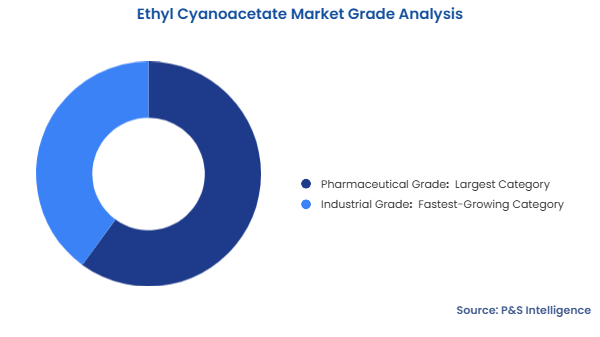
The pharmaceutical grade category holds the largest market share, of 60%, in 2025, driven by stringent quality requirements in pharmaceutical synthesis and the compound's essential role in heterocyclic compound production for active pharmaceutical ingredient manufacturing. The U.S. Food and Drug Administration enforces comprehensive current good manufacturing practice regulations under 21 CFR Parts 210 and 211, establishing minimum standards for the manufacture and control of components and materials used in pharmaceutical production that require identity, strength, quality, and purity assurance for all components including chemical intermediates used in drug substance synthesis. Pharmaceutical-grade ethyl cyanoacetate is typically supplied at ≥99% purity with tightly controlled impurity profiles, aligned with specifications referenced in official pharmacopeias such as the United States Pharmacopeia and the European Pharmacopoeia. These requirements support premium pricing and favor suppliers with robust quality systems, regulatory documentation, certificates of analysis, and batch-to-batch consistency, particularly in regulated markets such as the United States and the European Union.
The industrial grade category will have the highest CAGR, of 4.9%, reflecting expanding utilization in agrochemical synthesis, adhesive formulations, and specialty chemical applications where ultra-high purity specifications are unnecessary. Industrial-grade ethyl cyanoacetate serves cost-sensitive applications, including pesticide intermediate synthesis, cyanoacrylate adhesive production, and dye intermediate manufacturing, where purity requirements are generally lower than pharmaceutical-grade standards, enabling broader adoption in price-competitive end-use markets.
The grades analyzed in this report are:
Pharmaceutical Grade (Largest Category)
Industrial Grade (Fastest Growing Category)
Function Analysis
The chemical intermediates category holds the largest market share, of 55%, in 2025, reflecting ethyl cyanoacetate's primary role as a versatile building block in multi-step synthesis processes across pharmaceutical, agrochemical, and specialty chemical manufacturing. The compound's reactive cyanoacetate functional group enables nucleophilic addition, condensation, and cyclization reactions essential for constructing complex heterocyclic structures found in active pharmaceutical ingredients, pesticide formulations, and advanced materials.
The cross-linking agents category will have the highest CAGR, of 5.0%, driven by specialized applications in advanced adhesive formulations, polymer modification, and materials science where ethyl cyanoacetate's bifunctional reactivity enables network formation and property enhancement. Additionally, expanding use of ethyl cyanoacetate in specialized polymer networks and reactive formulations is driving incremental demand for cross-linking functions beyond traditional intermediate roles.
The functions analyzed in this report are:
Chemical Intermediates (Largest Category)
Polymerization
Cross-linking Agents (Fastest Growing Category)
Catalysts
Others
Application Analysis
The pharmaceutical category holds the largest market share, of 50%, in 2025, and it will have the highest CAGR, reflecting the compound's indispensable role in synthesizing active pharmaceutical ingredients and the pharmaceutical industry's sustained global expansion. National policies such as India’s Production Linked Incentive Scheme for Bulk Drugs, which incentivizes domestic API and intermediate manufacturing, and China’s pharmaceutical supply-chain localization programs under its industrial policy framework, aimed at reducing reliance on imported APIs, are strengthening domestic demand for pharmaceutical-grade chemical intermediates, reinforcing the dominance and accelerated growth of pharmaceutical applications within the ethyl cyanoacetate market.
The applications analyzed in this report are:
Pharmaceuticals (Largest and Fastest Growing Category)
Agrochemicals
Adhesives
Dyes & Pigments
Others
Drive strategic growth with comprehensive market analysis
Ethyl Cyanoacetate Market Geographical Analysis
Asia-Pacific Ethyl Cyanoacetate Market Size
Asia-Pacific holds the largest market share, of 45%, in 2025, and it will have the highest CAGR. This dual positioning reflects the region's comprehensive advantages in pharmaceutical intermediate manufacturing, including vertically integrated chemical supply chains, large-scale production infrastructure, cost-competitive synthesis operations, and rapidly expanding domestic pharmaceutical and agrochemical sectors. The region's dominance in generic drug manufacturing, with India producing over 20% of the world's generic medicines according to the Indian Pharmaceutical Alliance, directly translates to sustained ethyl cyanoacetate consumption for pharmaceutical intermediate applications.
Additionally, Asia Pacific's agricultural sector drives agrochemical demand, with expanding pesticide and herbicide production requiring ethyl cyanoacetate as a key building block for crop protection chemical synthesis. According to the Pharmaceuticals and Medical Devices Agency, Japan’s pharmaceutical manufacturing ecosystem operates under regulatory oversight aligned with ICH guidelines and World Health Organization GMP standards.
The World Health Organization released its 10th edition Pharmaceutical Quality Assurance guidelines in February 2024, establishing comprehensive good manufacturing practice standards that include comprehensive GMP guidelines covering pharmaceutical intermediate production. These standards are particularly relevant for Asia Pacific manufacturers supplying pharmaceutical-grade ethyl cyanoacetate to global markets, as regulatory harmonization facilitates international trade while ensuring product quality meets stringent specifications.
China Ethyl Cyanoacetate Market Size
China emerged as the largest country market within Asia Pacific for ethyl cyanoacetate in 2025, supported by its position as one of the world’s largest pharmaceutical manufacturing bases and a leading global producer of active pharmaceutical ingredients, accounting for a substantial share of global API manufacturing capacity by volume and driving sustained demand for pharmaceutical intermediates used in multi-step drug substance synthesis. Pharmaceutical manufacturing in China operates under the oversight of the National Medical Products Administration, with ongoing regulatory reforms strengthening GMP compliance and accelerating product approvals. In parallel, the country’s vertically integrated chemical manufacturing base and large-scale agrochemical production, supported by high pesticide and herbicide usage as reported by the Food and Agriculture Organization of the United Nations, reinforce demand for ethyl cyanoacetate across pharmaceutical, agrochemical, and specialty chemical applications.
India Ethyl Cyanoacetate Market Size
India represents the fastest-growing country market within Asia Pacific for ethyl cyanoacetate during 2026–2032, driven by its dominance in generic drug manufacturing and strong utilization of pharmaceutical and agrochemical intermediates. According to the Indian Pharmaceutical Alliance, India supplies over 20% of the world’s generic medicines by volume, sustaining continuous demand for intermediates used in drug synthesis. Pharmaceutical manufacturing in India operates under the oversight of the Central Drugs Standard Control Organization, with GMP frameworks aligned to international standards that support large-scale intermediate consumption for regulated markets.
The regions and countries of the market are as follows:
North America
U.S. (Larger and Faster-Growing Country Market)
Canada
Europe
Germany (Largest and Fastest-Growing Country Market)
U.K.
France
Italy
Spain
Rest of Europe
Asia-Pacific (Largest and Fastest-Growing Region)
China (Largest Country Market)
India (Fastest-Growing Country Market)
Japan
South Korea
Australia
Rest of Asia-Pacific
Latin America
Brazil (Largest Country Market)
Mexico (Fastest-Growing Country Market)
Rest of Latin America
Middle East & Africa
Saudi Arabia (Largest and Fastest-Growing Country Market)
South Africa
U.A.E.
Rest of MEA
Ethyl Cyanoacetate Market Share Analysis
The market has a moderately fragmented competitive structure, reflecting the compound's position as a specialty chemical intermediate. The market structure stems from relatively modest capital requirements for establishing synthesis capacity compared to bulk commodity chemicals, accessibility of raw material feedstocks such as cyanoacetic acid and ethanol, and regional demand dynamics favoring localized production to ensure supply chain reliability for pharmaceutical and agrochemical customers. This fragmentation enables competitive participation by both multinational specialty chemical manufacturers with diversified intermediate portfolios and regional producers focused on serving domestic pharmaceutical and agrochemical industries. Moreover, recent strategic developments include capacity expansion initiatives by Asian manufacturers responding to pharmaceutical industry growth, quality system upgrades enabling pharmaceutical regulatory compliance for export markets, and vertical integration moves by pharmaceutical companies establishing captive ethyl cyanoacetate production to ensure supply chain security for critical synthesis operations.
Key Ethyl Cyanoacetate Companies:
Merck KGaA
Shandong Xinhua Pharmaceutical Co., Ltd.
Tiande Chemical Holdings Limited
Tokyo Chemical Industry Co., Ltd.
Hebei Chengxin Co., Ltd.
TATEYAMA KASEI Co., Ltd.
Triveni Chemicals
EMCO Dyestuff Pvt. Ltd.
Loba Chemie Pvt. Ltd.
Sisco Research Laboratories Pvt. Ltd.
Central Drug House Ltd.
SimSon Pharma Limited
Pravin Dyechem Pvt. Ltd.
Thermo Fisher Scientific Inc.
Ethyl Cyanoacetate Market News & Updates
In January 2026, Merck KGaA signed a strategic research collaboration agreement (MoU) with Singapore-based ChemLex focused on AI-enabled chemical synthesis and automation.
In January 2024, WuXi STA, a subsidiary of WuXi AppTec, opened an active pharmaceutical ingredient manufacturing facility in Taixing, Jiangsu, China, expanding the company's global API production capacity.
In December 2024, BASF SE opened its Catalyst Development and Solids Processing Center in Ludwigshafen, Germany, serving as a pilot-scale synthesis hub for chemical catalysts and process technologies.
In June 2024, Merck KGaA announced a EUR 62 million (approximately USD 66.6 million) investment to construct a quality control facility for its Life Science business at its Darmstadt, Germany headquarters, scheduled for completion by mid-2025.
In May 2024, BASF SE announced investment in expanding its advanced additives plant in Nanjing, China, including a state-of-the-art production line for high-performance Controlled Free Radical Polymerization dispersants, planned for startup by end of 2025.
Frequently Asked Questions About This Report
What is ethyl cyanoacetate used for?+
Ethyl cyanoacetate is primarily used as a chemical intermediate in the synthesis of pharmaceutical active ingredients, agrochemicals, dyes & pigments, and specialty polymers due to its high reactivity and versatility in organic synthesis.
Which industries drive demand for the ethyl cyanoacetate market?+
The pharmaceutical industries are the primary demand drivers, supported by its use in drug intermediates, crop protection chemicals, and fine chemical synthesis.
What grades are available in the ethyl cyanoacetate market?+
The market is mainly segmented into pharmaceutical grade and industrial grade, with pharmaceutical grade requiring higher purity standards for regulated drug manufacturing.
Which region dominates the ethyl cyanoacetate market?+
Asia Pacific dominates the ethyl cyanoacetate market.
What factors are driving growth in the ethyl cyanoacetate market?+
Key growth drivers include rising pharmaceutical production, increasing agrochemical demand to improve crop yields, and expanding fine chemical manufacturing capacities in emerging economies.
Want a report tailored exactly to your business need?
Leading companies across industries trust us to deliver data-driven insights and innovative solutions for their most critical decisions. From data-driven strategies to actionable insights, we empower the decision-makers who shape industries and define the future. From Fortune 500 companies to innovative startups, we are proud to partner with organisations that drive progress in their industries.
Client Testimonials
Working with P&S Intelligence and their team was an absolute pleasure – their awareness of timelines and commitment to value greatly contributed to our project's success. Eagerly anticipating future collaborations.
McKinsey & Company
India
Unmatched Standards
Our insights into the minutest levels of the markets, including the latest trends and competitive landscape, give you all the answers you need to take your business to new heights
Complete Data Security
We take a cautious approach to protecting your personal and confidential information. Trust is the strongest bond that connects us and our clients, and trust we build by complying with all international and domestic data protection and privacy laws