This Report Provides In-Depth Analysis of the Enterprise Mobility Management Market Report Prepared by P&S Intelligence, Segmented by Component (Solutions, Services), Organization Size (Large Enterprises, SMEs), Deployment Mode (Cloud, On-Premises), Device (Smartphone, Tablet, Laptop), Vertical (BFSI, Retail and E-Commerce, Healthcare and Life Sciences, IT and Telecom, Manufacturing, Government, Transportation and Logistics, Travel and Hospitality), and Geographical Outlook for the Period of 2021 to 2032
Explore the market potential with our data-driven report
Enterprise Mobility Management Market Overview
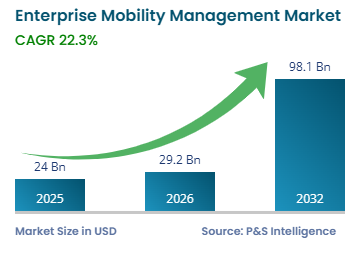
The enterprise mobility management market size was USD 24.0 billion for 2025, and it will grow by 22.3% during 2026–2032, to reach USD 98.1 billion by 2032.
This growth is supported by the widening deployment of mobile device management, mobile application management, mobile content management, and identity and access management capabilities across increasingly distributed workforces, positioning enterprise mobility management as a foundational layer of enterprise IT security architecture. Demand is particularly pronounced among BFSI, IT and telecom, and healthcare organizations managing large, security-sensitive device fleets.
Organizations are formalizing bring-your-own-device (BYOD) governance frameworks as hybrid and remote work models persist, a shift reinforced by the National Institute of Standards and Technology, which finalized guidance in 2023 for centrally managing and securing both organization-issued and personally owned mobile devices accessing enterprise resources. U.S. Bureau of Labor Statistics (BLS) reports that 35.5 million people teleworked or worked from home for pay in the first quarter of 2024, equivalent to 22.9% of those at work, up from 19.6% a year earlier. This continued prevalence of distributed work arrangements increases the need for organizations to centrally manage and secure mobile endpoints and access to enterprise resources.
Key Market Insights
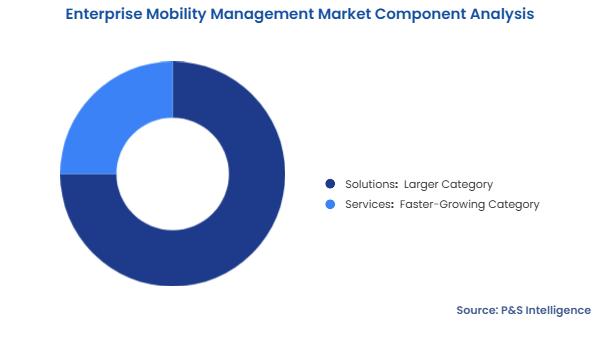
The solutions category held the larger market share, at 75% in 2025, driven by enterprise investment in MDM, MAM, MCM, IAM, and MEM capabilities.
The SMEs category will have the higher CAGR, at approximately 22.8%, driven by cloud-native EMM platforms and consumption-based pricing that reduce cost and complexity barriers.
The smartphone category held the largest share, at 45% in 2025, driven by widespread enterprise use.
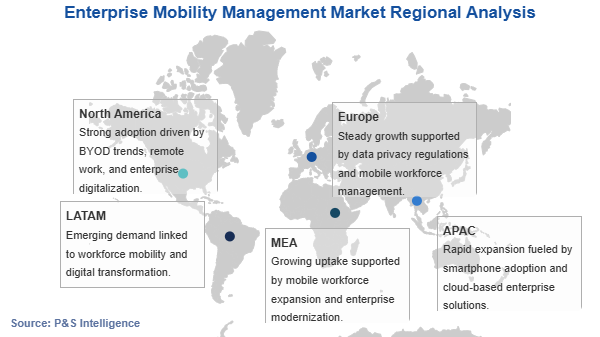
North America held the largest market share, at 40% in 2025, driven by large enterprises, hybrid work, and stringent compliance requirements.
Asia-Pacific will have the highest CAGR, at approximately 23.2%, driven by enterprise digitalization, expanding 5G infrastructure, and rising mobile workforce adoption.
Enterprise Mobility Management Market Trends and Drivers
AI Integration and Unified Endpoint Management Convergence Are Key Trends
Enterprise mobility management platforms are converging with broader unified endpoint management and Zero Trust security architectures as organizations consolidate previously separate device, application, and identity governance tools into unified consoles. Vendors are increasingly incorporating AI-enabled capabilities to detect anomalous device behavior, identify compliance risks, and automate security and access-management processes across expanding smartphone, tablet, and laptop fleets. This shift is increasing the use of AI to automate routine device-management and security tasks, allowing IT teams to manage larger device environments more efficiently. For instance, in March 2026, Apple Inc. introduced Apple Business, an all-in-one platform with built-in mobile device management (MDM) capabilities that enables organizations to configure device settings, manage applications and employee groups, apply security controls, and support zero-touch device deployment through a centralized interface, illustrating the industry's broader shift toward integrated enterprise mobility management.
Organisation for Economic Co-operation and Development (OECD) reports that AI adoption among firms rose from 5.6% in 2020 to 14% in 2024 across member countries, reflecting accelerating integration of AI-enabled tools into enterprise software. As AI-enabled governance matures, EMM platforms are expected to shift further from static policy enforcement toward continuous, behavior-based risk assessment, narrowing the gap between device management and broader enterprise security operations.
Escalating Cybersecurity Threats and Endpoint Vulnerabilities Are Biggest Drivers
Rising cybersecurity threats targeting mobile endpoints are compelling organizations to formalize centralized device governance rather than relying on ad hoc security controls. As phishing, business email compromise, and credential-based attacks increasingly expose organizations to compromised or unmanaged devices, enterprises face mounting financial and operational risks that support EMM investment as a risk-mitigation measure rather than a discretionary IT expense. This dynamic is particularly pronounced in BFSI and healthcare organizations, where regulatory requirements and the sensitivity of financial and health data reinforce the need for stronger mobile endpoint security and centralized device management.
Federal Bureau of Investigation Internet Crime Complaint Center (FBI IC3) reports that total cybercrime losses reached USD 16.6 billion in 2024, a 33% increase over 2023, with phishing/spoofing remaining the most frequently reported crime type. Verizon's 2025 Mobile Security Index reports that 85% of organizations said mobile device attacks are increasing, while 75% increased mobile security spending over the past year. This escalating threat environment is increasing the importance of mobile endpoint visibility, centralized security controls, and automated security management as enterprises seek to reduce exposure across increasingly distributed and mobile workforces.
Data Privacy Regulations and Cross-Border Compliance Complexity Are Key Restraints
Stringent data privacy regulations and inconsistent cross-border data transfer rules are constraining EMM deployment scope for multinational enterprises, particularly where mobile device management tools process employee location, application, and communication data across jurisdictions with divergent compliance requirements. Enterprises face substantial financial and operational exposure when EMM configurations inadvertently violate regional data protection mandates, complicating global platform standardization and increasing the need for jurisdiction-specific compliance controls.
These compliance requirements increase implementation costs, lengthen deployment timelines, and can limit the ability of multinational enterprises to standardize EMM platforms across jurisdictions. This regulatory complexity requires EMM vendors to support region-specific data residency, privacy, and consent-management capabilities to facilitate multinational enterprise deployments while addressing varying cross-border data protection requirements.
SME Cloud Migration and Digital Transformation Are Biggest Opportunities
Small and medium-sized enterprises represent a substantial, underpenetrated opportunity for EMM vendors as cloud-native deployment models lower the cost and complexity barriers that historically confined formal mobility management to large enterprises. Vendors offering consumption-based pricing and simplified onboarding are increasingly positioned to capture SMEs migrating core business operations to cloud infrastructure for the first time, a segment that has historically relied on informal, unmanaged device practices due to limited dedicated IT resources.
Eurostat reports that approximately 52% of EU SMEs used paid cloud computing services in 2025, highlighting the continued adoption of cloud-based technologies among smaller enterprises. This SME cloud migration wave is expected to open substantial EMM growth pathways, particularly for vendors able to bundle device management with broader cloud productivity and security suites at price points accessible to smaller IT budgets.
The solutions category holds the larger market share, of 75%, in 2025, supported by sustained enterprise investment in mobile device management, mobile application management, mobile content management, identity and access management, and mobile expense management capabilities that form the technical backbone of centralized device governance. The broad range of capabilities covered by EMM solutions and their recurring use across enterprise mobile environments contribute to their larger market share compared with services.
The services category will have the higher CAGR, of approximately 22.6%, reflecting rising demand for professional and managed services as organizations confront persistent shortages of in-house mobility and cybersecurity expertise. The International Information System Security Certification Consortium (ISC2) reported a global cybersecurity workforce gap of 4.8 million professionals in 2024, highlighting the shortage of skilled personnel needed to manage increasingly complex security environments. This shortage is supporting greater reliance on external providers for EMM implementation, configuration, monitoring, maintenance, and security management.
The components analyzed in this report are:
Solutions (Larger Category)
MDM
MAM
MCM
IAM
MEM
Services (Faster-Growing Category)
Professional
Managed
Organization Size Analysis
The large enterprises category holds the larger market share, of 70%, in 2025, driven by the scale of device fleets, complex multi-department IT environments, and dedicated IT security budgets that make formal mobility governance operationally necessary rather than optional. These organizations typically manage devices across multiple business units, geographies, and regulatory environments, requiring centralized platforms capable of enforcing differentiated policies at scale.
The SMEs category will have the higher CAGR, of approximately 22.8%, as cloud-native EMM platforms with consumption-based pricing lower the historical cost and complexity barriers that limited formal mobility management to larger organizations. The U.S. Small Business Administration Office of Advocacy reports that the number of small businesses in the United States reached 34.8 million, representing a substantial addressable customer base for EMM vendors seeking to expand mobility management beyond large enterprises. This expanding SME opportunity is supporting greater adoption of simplified EMM platforms, cloud-based deployment models, and bundled security offerings tailored to smaller IT teams with limited dedicated mobility resources.
The Organizations Size analyzed in this report are:
Large Enterprises (Larger Category)
SMEs (Faster-Growing Category)
Deployment Mode Analysis
The cloud category holds the larger market share, of 80%, in 2025, and it will have the higher CAGR, driven by the growing preference for cloud-based EMM platforms, which reduce the need for dedicated on-premises infrastructure while enabling centralized device management, faster policy updates, and scalable administration across geographically distributed device fleets. Cloud deployment also provides greater flexibility for managing expanding mobile environments and supports faster implementation compared with traditional on-premises deployments.
Eurostat reports that 52.7% of EU enterprises used paid cloud computing services in 2025, an increase of 7.4 percentage points from 2023. Cloud services were widely used for email, office software, file storage, and security applications, demonstrating the continued shift of enterprise IT operations toward cloud-based environments. The continued expansion of cloud adoption across enterprises supports the growing preference for cloud-based EMM deployment, particularly as organizations seek scalable and centrally managed solutions for increasingly distributed device environments.
The deployment modes analyzed in this report are:
Cloud (Larger and Faster-Growing Category)
On-Premises
Device Analysis
The smartphone category holds the largest market share, of 45%, in 2025, and it will have the highest CAGR, reflecting its widespread use for accessing corporate email, business applications, collaboration platforms, and other enterprise resources. The high volume and mobility of smartphones increase the need for centralized device management, application control, security enforcement, and policy management, supporting greater EMM adoption across enterprises.
The CTIA reports that the United States recorded 579 million wireless connections in 2024, with 259 million 5G-enabled devices, representing nearly half of all wireless connections nationwide. The figures cover a broad range of connected devices, including smartphones, wearables, and other wireless devices, highlighting the expanding mobile endpoint environment that EMM platforms are designed to manage. The continued expansion of smartphone-based enterprise workflows and 5G connectivity is supporting strong demand for smartphone management, while tablets and laptops remain important but more specialized device categories within enterprise mobility environments.
The devices analyzed in this report are:
Smartphone (Largest and Fastest-Growing Category)
Tablet
Laptop
Others
Vertical Analysis
The BFSI category holds the largest market share in 2025, driven by stringent regulatory requirements around data protection, a device-intensive mobile workforce spanning branch staff and field agents, and heightened fraud and cybersecurity risks that make formal mobile governance an important component of enterprise security and compliance. Financial institutions increasingly rely on mobile applications and connected devices to deliver banking and financial services, creating a strong requirement for centralized device, application, identity, and security management.
The healthcare and life sciences category will have the highest CAGR, of approximately 23.0%, as expanding telehealth delivery, remote care, and mobile clinical workflows extend device management requirements beyond traditional hospital IT infrastructure into distributed care settings. The increasing use of connected medical technologies and digital healthcare services is expanding the number of endpoints and applications that healthcare organizations must secure and manage. The U.S. Department of Health and Human Services reports that 95% of HRSA-funded health centers used telehealth to provide primary care in 2024, highlighting the continued integration of digitally enabled care into healthcare delivery.
The verticals analyzed in this report are:
BFSI (Largest Category)
Retail and E-Commerce
Healthcare and Life Sciences (Fastest-Growing Category)
IT and Telecom
Manufacturing
Government
Transportation and Logistics
Travel and Hospitality
Others
Drive strategic growth with comprehensive market analysis
North America Enterprise Mobility Management Market Size
North America holds the largest market share, of 40%, in 2025, driven by a high concentration of large enterprises operating complex, multi-device IT environments, sustained hybrid and remote work adoption, and stringent federal compliance mandates. Enterprises across the region continue prioritizing centralized mobile device oversight to safeguard sensitive data accessed outside traditional network perimeters.
Cybersecurity and Infrastructure Security Agency (CISA) published its Zero Trust Maturity Model 2.0 in April 2023, which identifies Devices as one of the five core Zero Trust pillars. Separately, OMB Memorandum M-22-09 required Federal Civilian Executive Branch agencies to advance Zero Trust security goals by the end of fiscal year 2024, including device-level security and access controls.
U.S. Enterprise Mobility Management Market Size
The U.S. represents the largest country market within North America, driven by the region's densest concentration of large enterprises and its advanced federal cybersecurity procurement infrastructure. Home-based and hybrid work arrangements have become structurally embedded in the U.S. workforce, sustaining continuous demand for centralized device oversight. Federal agencies further anchor demand through dedicated mobility procurement channels supporting both civilian and defense mobile fleets. Verizon's 2024 Mobile Security Index reports that 80% of organizations consider mobile devices critical to their operations, while 84% increased mobile-device security spending over the previous year, highlighting the growing importance of centralized mobile-device management and security within U.S. enterprises.
Asia-Pacific will have the highest CAGR, of approximately 23.2%, driven by rapid enterprise digitalization, expanding 5G infrastructure, and rising smartphone-based mobile workforce adoption across the region. Government-backed digital infrastructure investment and accelerating mobile connectivity are extending EMM demand beyond traditional technology hubs into manufacturing and retail sectors adopting mobile-first operating models.
International Telecommunication Union (ITU) data shows that Asia and the Pacific recorded 112 mobile cellular subscriptions per 100 inhabitants in 2024, matching the global average, while 5G network coverage reached 62% of the population, continuing the region’s decade-long upward trend in mobile connectivity.
China Enterprise Mobility Management Market Size
China represents the largest country market within Asia-Pacific, supported by the world's largest mobile subscriber base and aggressive government-led 5G infrastructure rollout that underpins enterprise mobile connectivity at scale. Rapid adoption of mobile-first enterprise workflows across manufacturing, retail, and financial services is reinforcing sustained demand for centralized device and application management.
China's Ministry of Industry and Information Technology (MIIT) reports that 5G mobile subscriptions surpassed 1.15 billion by August 2025, accounting for 63.4% of all mobile phone users nationwide. MIIT data shows that China had deployed approximately 4.2 million 5G base stations by the end of November 2024, accounting for more than 60% of the global total.
The regions and countries analyzed in this report are:
The market is fragmented due to the presence of multiple global technology providers, specialized mobility-management vendors, cybersecurity companies, and regional solution providers competing across different customer segments and product capabilities. This competition fragments the market across vendor types, and differences in enterprise requirements, including device management, application management, content management, identity and access control, endpoint security, and compliance, contribute to this fragmentation. Cloud-based deployment has lowered entry barriers, letting specialized vendors serve SMEs and specific industries alongside large enterprises. The convergence of EMM with unified endpoint management (UEM), Zero Trust, and broader cybersecurity platforms has expanded the competitive landscape beyond traditional mobility-management providers. Leading companies such as Microsoft, IBM, Ivanti, Jamf, SOTI, and BlackBerry strengthen competition by offering differentiated platforms, industry-specific capabilities, cloud-based solutions, and integrated security features. Enterprises select solutions based on their specific mobility, security, and compliance requirements.
Leading Companies in the Enterprise Mobility Management Market:
In January 2026, Francisco Partners completed its USD 2.2 billion acquisition of Jamf Holding Corp., taking the Apple device management and security specialist private. The transaction reflects continued private equity consolidation of mid-sized EMM vendors seeking capital flexibility to accelerate platform innovation.
In December 2025, Microsoft Corporation expanded Microsoft Intune capabilities within Microsoft 365 E3 and E5 subscriptions, including Intune Remote Help, Advanced Analytics, and Intune Plan 2. The expansion integrates advanced endpoint management and security capabilities more closely with Microsoft's broader productivity ecosystem.
Frequently Asked Questions About This Report
How does Enterprise Mobility Management (EMM) work?+
EMM works through centralized platforms that allow organizations to manage and secure mobile devices, applications, content, identities, and access policies from a unified console.
What are the benefits of Enterprise Mobility Management?+
EMM helps organizations strengthen mobile security, protect corporate data, manage devices and applications centrally, support BYOD and remote work, improve IT administration, enforce compliance policies, and provide employees with secure access to enterprise resources.
How does EMM improve mobile security?+
EMM improves mobile security through centralized device and application policies, access controls, authentication, encryption, remote management, compliance monitoring, and the ability to restrict or remotely wipe compromised or lost devices.
What are the challenges of implementing EMM?+
Key challenges include data privacy and cross-border compliance requirements, integration with existing IT and security systems, managing BYOD environments, deployment complexity, employee privacy concerns, and shortages of skilled mobility and cybersecurity personnel.
How does EMM support BYOD?+
EMM enables organizations to secure corporate data and applications on personally owned devices while separating business resources from personal information.
Want a report tailored exactly to your business need?
Leading companies across industries trust us to deliver data-driven insights and innovative solutions for their most critical decisions. From data-driven strategies to actionable insights, we empower the decision-makers who shape industries and define the future. From Fortune 500 companies to innovative startups, we are proud to partner with organisations that drive progress in their industries.
Client Testimonials
Working with P&S Intelligence and their team was an absolute pleasure – their awareness of timelines and commitment to value greatly contributed to our project's success. Eagerly anticipating future collaborations.
McKinsey & Company
India
Unmatched Standards
Our insights into the minutest levels of the markets, including the latest trends and competitive landscape, give you all the answers you need to take your business to new heights
Complete Data Security
We take a cautious approach to protecting your personal and confidential information. Trust is the strongest bond that connects us and our clients, and trust we build by complying with all international and domestic data protection and privacy laws