Energy Transition Market Size & Share Analysis - Emerging Trends, Growth Opportunities, Competitive Landscape, and Forecasts (2026 - 2032)
This Report Provides In-Depth Analysis of the Energy Transition Market Report Prepared by P&S Intelligence, Segmented by Type (Renewable Energy, Hydrogen, Energy Efficiency, Electrification, Carbon Management), Technology (Energy Storage Systems, Smart Grids, Solar Energy, Wind Energy, Hydropower, Bioenergy, Geothermal Energy), Deployment (Utility-Scale, Distributed Energy Systems, Behind-the-Meter, Off-Grid and Microgrid), End User (Utilities, Residential, Industrial, Commercial, Government and Public Sector), and Geographical Outlook for the Period of 2021 to 2032
Explore the market potential with our data-driven report
Energy Transition Market Future Outlook
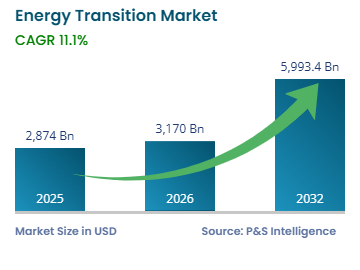
The energy transition market size was USD 2,874.0 billion in 2025, and it will grow by 11.1% during 2026-2032 to reach USD 5,993.4 billion by 2032.
The energy transition market is expanding as governments, utilities, and industrial organizations accelerate efforts to reduce dependence on conventional fossil fuels and strengthen long-term energy security. Rising electricity demand from transportation electrification, digital infrastructure, manufacturing activities, and urban development is increasing the need for cleaner, more resilient, and flexible energy systems. At the same time, renewable power generation, battery storage, grid modernization, and electrification technologies are becoming central components of national energy strategies. Falling renewable energy costs and ongoing improvements in energy storage performance are also improving the commercial viability of low-carbon energy projects across both developed and emerging economies.
Additionally, the market is benefiting from continued investment in modern power infrastructure, energy management technologies, hydrogen development, and advanced grid systems that support higher levels of renewable integration. Utilities are upgrading transmission and distribution networks to improve reliability and accommodate changing electricity consumption patterns. According to the International Renewable Energy Agency, global renewable power capacity increased by 585 GW in 2024, bringing total installed renewable capacity to 4,448 GW by year-end. This large-scale expansion reflects the accelerating deployment of clean energy assets across major economies. Growing renewable penetration is increasing demand for grid-balancing technologies, battery storage systems, digital energy platforms, and supporting infrastructure that enable reliable power delivery. Energy developers, equipment manufacturers, utilities, and technology providers are expanding investments across the value chain as renewable generation becomes more deeply integrated into industrial operations, transportation networks, and national electricity systems.
Key Market Insights
Renewable Energy is the largest category, holding a market share of 35%, due to extensive deployment of solar, wind, and hydropower capacity supporting global decarbonization goals.
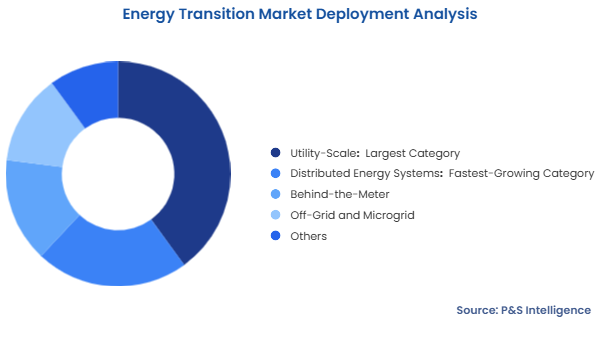
Utility-Scale is the largest deployment mode, holding a market share of 40%, due to the dominance of large renewable energy projects connected to transmission networks.
Solar energy is the largest category, holding a market share of 30%, because it is the most cost-competitive and rapidly deployable renewable energy technology, making it the preferred choice for utility-scale, commercial, and residential power generation.
Distributed Energy Systems is the fastest-growing category, registering a CAGR of approximately 11.5%, as businesses, communities, and consumers increasingly adopt localized energy generation and management solutions.
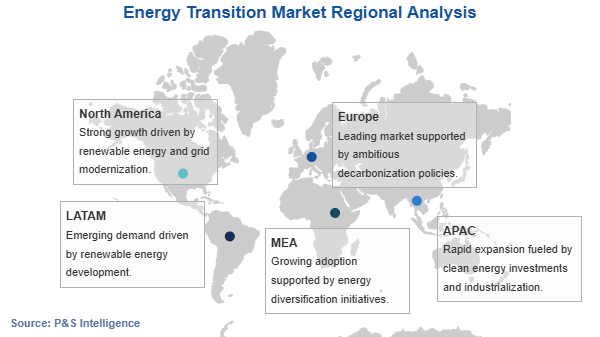
Asia-Pacific is the fastest-growing region, registering a CAGR of approximately 12.0%, driven by rapid renewable energy expansion, rising electricity demand, and increasing investment in energy infrastructure.
Energy Transition Market Trends and Drivers
Green Hydrogen and Integrated Energy Hubs Development Is a Major Trend
Green hydrogen and integrated energy hubs are becoming a major trend in the energy transition market as developers increasingly combine renewable power generation, battery storage, hydrogen production, and digital energy management within unified infrastructure platforms. This approach helps address renewable intermittency, improves grid flexibility, and supports decarbonization across industrial and energy-intensive sectors. According to the International Energy Agency, global installed water electrolysis capacity reached 2 GW in 2024 and exceeded 3 GW in 2025, reflecting the rapid expansion of green hydrogen infrastructure. Investment strategies are increasingly aligned with initiatives such as the REPowerEU Plan, which promotes integrated investments in renewable energy, battery storage, hydrogen production, and modern electricity infrastructure.
Moreover, the International Energy Agency reported that global utility-scale battery storage additions reached 63 GW in 2024, with total installed utility-scale battery capacity reaching 124 GW. The growing deployment of electrolyzers and battery systems is strengthening the operational connection between renewable electricity, energy storage, and low-carbon fuel production, creating larger opportunities for integrated energy infrastructure providers, equipment manufacturers, and technology developers.
Government Decarbonization Policies and Clean Energy Investment Programs Drive Market
Government decarbonization policies and clean energy investment programs remain key drivers of the energy transition market by creating a supportive framework for renewable energy deployment, electrification, energy storage, and grid modernization. National governments are expanding clean energy targets, emissions reduction programs, infrastructure funding initiatives, and investment incentive schemes to accelerate the shift toward low-carbon energy systems. These measures provide greater investment visibility for utilities, industrial companies, and private developers while supporting long-term project development pipelines. According to the International Energy Agency, the State of Energy Policy inventory included more than 5,000 policy records across 50 policy types from over 60 countries in 2024.
In addition, the United Nations Framework Convention on Climate Change recorded 64 new Nationally Determined Contributions in 2025, reflecting continued global efforts to strengthen climate commitments under the Paris Agreement. The expanding policy landscape is encouraging broader deployment of renewable generation, transmission infrastructure, battery storage systems, and emerging decarbonization technologies across major energy markets. For instance, in 2025, Schneider Electric launched the One Digital Grid Platform globally, integrating planning, operations, and asset management into a unified utility software platform. The platform supports grid modernization, renewable energy integration, and improved operational efficiency across electricity networks, reflecting how technology providers are advancing digital infrastructure to support the global energy transition.
High Capital Requirements and Grid Infrastructure Limitations Restrain Market Growth
High capital requirements and grid infrastructure limitations remain major restraints for the energy transition market. Renewable power plants, transmission upgrades, battery storage facilities, and grid modernization projects require substantial upfront investment and often involve lengthy permitting and development timelines. Grid networks in many regions are not expanding at the same pace as renewable energy deployment, creating connection bottlenecks and delaying project execution. According to the International Energy Agency, at least 1,650 GW of renewable capacity in advanced stages of development was waiting for grid connections worldwide in 2024. These delays increase project costs, extend revenue realization periods, and create uncertainty for developers and investors. Utilities, transmission operators, and energy producers are therefore facing greater pressure to accelerate grid expansion and improve network readiness.
Expansion of Green Hydrogen and Long-Duration Energy Storage Creates Market Opportunity
The expansion of green hydrogen and long-duration energy storage presents a significant opportunity for the energy transition market. Growing renewable energy capacity is increasing the demand for technologies that store excess electricity, enhance grid stability, and provide low-carbon energy solutions for hard-to-electrify sectors. Green hydrogen is attracting investment across industrial applications, transportation, chemicals, and heavy manufacturing, while long-duration storage technologies are improving renewable energy utilization. According to the International Energy Agency, battery storage accounts for around 90% of the growth in global energy storage capacity required by 2030 to support secure energy transitions and renewable energy integration.
Additionally, the International Energy Agency reported that global hydrogen production reached nearly 100 Mt in 2024, while less than 1% originated from low-emissions hydrogen technologies. As governments and industries work to replace conventional hydrogen with low-emissions hydrogen, the large supply gap is encouraging investment in electrolyzers, hydrogen infrastructure, energy storage systems, and related equipment across the clean energy value chain.
Energy Transition Market Segmentation Analysis
Type Analysis
Renewable Energy is the largest category, holding a market share of 35%, because it serves as the primary source of clean power supporting electrification, smart grid deployment, and utility-scale energy projects. Governments and utilities continue expanding solar, wind, and hydropower capacity to strengthen energy security and reduce carbon emissions. According to the International Renewable Energy Agency, global renewable power capacity reached 5,149 GW in 2025, including 2,391 GW of solar, 1,296 GW of hydropower, and 1,291 GW of wind capacity. This large installed base supports continued investment across transmission networks, energy storage systems, and digital grid technologies, reinforcing renewable energy’s leading position within the broader energy transition ecosystem.
Hydrogen is the fastest-growing category, registering a CAGR of approximately 11.4%, as industries increasingly seek low-carbon alternatives for applications that are difficult to electrify directly. Growing public and private investments in industrial decarbonization, sustainable fuel production, and long-duration energy storage are driving investment in hydrogen infrastructure, electrolyzer deployment, and hydrogen production technologies. For example, the Government of India approved the National Green Hydrogen Mission with an outlay of USD 2.3 billion (INR 19,744 crore) to support green hydrogen production, infrastructure development, and electrolyzer manufacturing. Rising focus on clean hydrogen as a strategic component of energy transition pathways continues to accelerate market growth across multiple sectors.
The types analysed in this report are:
Renewable Energy (Largest Category)
Hydrogen (Fastest-Growing Category)
Energy Efficiency
Electrification
Carbon Management (Carbon Capture, Utilization, and Storage)
Others
Technology Analysis
Solar energy is the largest category, holding a market share of 30%, because it is the most cost-competitive and rapidly deployable renewable energy technology, making it the preferred choice for utility-scale, commercial, and residential power generation. According to the International Energy Agency, solar PV accounted for approximately 80% of global renewable electricity capacity additions in 2025, driven by declining costs and continued policy support. The rapid expansion of solar energy is increasing investments in battery energy storage, grid modernization, and transmission infrastructure, thereby accelerating the growth of the market.
Energy storage systems are the fastest-growing category, due to its critical role in supporting renewable energy integration and grid reliability. As renewable power generation expands, storage technologies help balance fluctuations in electricity supply and demand while improving overall system flexibility. Utilities, grid operators, and commercial users are increasingly deploying battery systems to enhance energy management and maintain operational stability. Growing investment in grid modernization and renewable infrastructure continues to strengthen demand for energy storage solutions across global energy markets.
The technologies analysed in this report are:
Energy Storage Systems (Fastest-Growing Category)
Smart Grids
Solar Energy (Largest Category)
Wind Energy
Hydropower
Bioenergy
Geothermal Energy
Others
Deployment Analysis
Utility-Scale is the largest category, holding a market share of 40%, due to the dominance of large renewable energy projects connected directly to transmission infrastructure. Utilities and governments continue prioritizing utility-scale solar, wind, hydropower, and energy storage developments because they provide substantial generation capacity and benefit from economies of scale. According to the International Energy Agency Photovoltaic Power Systems Programme, utility-scale photovoltaic projects accounted for more than two-thirds of global new photovoltaic capacity additions in 2024. Strong project pipelines, established financing mechanisms, and growing renewable energy targets continue supporting large-scale deployment across major electricity markets.
Distributed Energy Systems is the fastest-growing category, as businesses, communities, and consumers increasingly adopt localized energy generation and management solutions. Rising interest in energy independence, resilience, and cost optimization is encouraging deployment of distributed renewable energy assets and storage technologies. According to REN21, rooftop solar photovoltaic installations added nearly 220 GW globally in 2024, while rooftop and distributed systems expanded by approximately 23%. This continued expansion reflects the growing adoption of decentralized energy systems across residential, commercial, and industrial sectors. Advances in digital energy management platforms are making decentralized systems more efficient and easier to operate. Growing support for flexible and customer-centric energy infrastructure is accelerating adoption across commercial, industrial, and residential applications.
The deployments analysed in this report are:
Utility-Scale (Largest Category)
Distributed Energy Systems (Fastest-Growing Category)
Behind-the-Meter
Off-Grid and Microgrid
Others
End User Analysis
Utilities is the largest category, because utility companies are responsible for developing, operating, and integrating a significant portion of renewable energy and grid infrastructure projects. These organizations play a central role in electricity generation, transmission, distribution, and system modernization activities. Large investment programs focused on renewable capacity expansion, energy storage deployment, and grid upgrades continue to drive substantial market participation. Their responsibility for maintaining reliable energy supply positions utilities as the leading end-user segment.
Industrial is the fastest-growing category, registering a CAGR of approximately 11.7%, as industries increasingly invest in renewable energy integration, electrification, energy efficiency, and low-carbon technologies to reduce emissions and improve operational efficiency. For example, in 2025, the European Commission proposed the Clean Industrial Deal, including a planned EURO 100 billion Industrial Decarbonisation Bank to accelerate clean manufacturing, industrial decarbonization, and clean technology deployment across energy-intensive industries. These investments are accelerating the adoption of renewable energy, hydrogen, energy storage, and digital energy management solutions across industrial operations, thereby driving the growth of the broader energy transition market.
The end users analysed in this report are:
Utilities (Largest Category)
Residential
Industrial (Fastest-Growing Category)
Commercial
Government and Public Sector
Others
Drive strategic growth with comprehensive market analysis
Energy Transition Market Regional Outlook
Asia-Pacific Energy Transition Market Analysis
Asia-Pacific holds the largest share, of 40%, and has the highest CAGR, of approximately 12.0%, because the region combines rapidly rising energy demand with large-scale investments in renewable energy, energy storage, electrification, and grid expansion. Industrial growth, urbanization, and long-term energy security objectives continue to accelerate the deployment of clean energy technologies across multiple economies. In addition, Japan is strengthening the regional energy transition through investments in hydrogen, offshore wind, and grid modernization. For example, the Japanese government allocated approximately JPY 3 trillion (around USD 20 billion) to support hydrogen supply chains over the next 15 years, reinforcing the country's long-term clean energy strategy. Supportive government programs, domestic manufacturing expansion, and rising private-sector participation further strengthen the region’s position in the global energy transition landscape.
China Energy Transition Market Analysis
China remains a leading market in the energy transition industry due to its large-scale renewable energy deployment, extensive manufacturing base, and ongoing investment in grid infrastructure. The country maintains strong capabilities across solar modules, battery production, wind equipment, and energy storage technologies, supporting domestic demand and global supply chains. According to China's National Energy Administration (NEA), cumulative installed renewable energy capacity reached 1.889 billion kW by the end of 2024. The country's large renewable energy capacity is driving demand for transmission upgrades, energy storage systems, hydrogen projects, and grid integration technologies across the clean energy ecosystem.
India Energy Transition Market Analysis
India is emerging as a high-growth energy transition market driven by rising electricity consumption, renewable energy expansion, and power infrastructure modernization. The country is strengthening transmission networks, expanding energy storage deployment, and encouraging domestic manufacturing of renewable energy components. Policy support and private sector investment are accelerating the adoption of solar, wind, and battery technologies across industrial and utility-scale applications. According to the Press Information Bureau of the Government of India, the country added 44.51 GW of renewable energy capacity by November 2025, increasing total installed renewable capacity to 253.96 GW. This rapid capacity expansion is increasing demand for transmission infrastructure, battery storage systems, grid balancing technologies, and renewable energy equipment across the country. Utilities and project developers are investing in network upgrades to integrate larger volumes of renewable generation, while equipment manufacturers are expanding production capabilities to support growing project pipelines. These developments are creating broader opportunities across the renewable energy value chain, including power infrastructure, storage deployment, and clean energy technology services.
North America Energy Transition Market Analysis
North America maintains a strong position in the energy transition market due to its advanced energy infrastructure, large-scale renewable energy investments, and active deployment of grid modernization technologies. The region benefits from significant participation by utilities, energy developers, technology providers, and institutional investors focused on decarbonization initiatives. The U.S. serves as the primary contributor owing to its extensive renewable energy pipeline, rapid growth in energy storage deployment, and increasing investment in hydrogen and carbon management projects. According to the U.S. Energy Information Administration (EIA), developers plan to add a record 18.2 GW of utility-scale battery storage capacity in 2025, highlighting the rapid expansion of energy storage needed to integrate renewable energy and improve grid reliability. Canada supports regional growth through clean electricity development, hydroelectric resources, and expanding investments in low-carbon energy infrastructure. The presence of established financing mechanisms, supportive policy frameworks, and continuous upgrades to transmission networks further strengthens market activity. In addition, growing electrification across transportation and industrial sectors continues to increase demand for clean energy solutions throughout the region.
Europe Energy Transition Market Analysis
Europe remains a key market for energy transition activities, supported by ambitious decarbonization strategies, strong renewable energy adoption, and extensive investments in clean energy infrastructure. Germany leads the regional market due to its large renewable energy capacity, industrial decarbonization efforts, and significant investments in hydrogen production and grid expansion projects. According to Germany's Federal Network Agency (Bundesnetzagentur), renewable installed capacity increased by nearly 20 GW in 2024, reaching a total of nearly 190 GW. Spain is emerging as one of the fastest-developing markets within the region, supported by abundant renewable energy resources and increasing investments in solar, storage, and green hydrogen facilities. Countries including France, Italy, and the U.K. continue to strengthen the regional ecosystem through offshore wind projects, electrification initiatives, and energy efficiency programs. The region also benefits from coordinated energy transition policies and cross-border infrastructure development, which support the integration of renewable energy across national electricity systems.
The regions and countries analysed in this report are:
North America
U.S. (Larger Country)
Canada (Faster-Growing Country)
Europe
Germany (Largest Country)
U.K.
France
Italy
Spain (Fastest-Growing Country)
Rest of Europe
Asia-Pacific (Largest and Fastest-Growing Regional Market)
China (Largest Country)
India (Fastest-Growing Country)
Japan
South Korea
Australia
Rest of APAC
Latin America
Brazil (Largest Country)
Mexico (Fastest-Growing Country)
Rest of LATAM
Middle East and Africa
Saudi Arabia (Largest Country)
U.A.E. (Fastest-Growing Country)
South Africa
Rest of MEA
Energy Transition Market Share Analysis
The energy transition market is fragmented, with participation from a broad mix of renewable energy developers, utility companies, energy storage providers, grid technology firms, hydrogen developers, engineering companies, and clean energy infrastructure investors. The market covers multiple technologies and application areas, creating opportunities for both large multinational corporations and specialized regional players. Competitive activity is driven by project development capabilities, technology innovation, strategic partnerships, infrastructure expertise, project execution capabilities, and access to financing rather than by the dominance of a small group of companies. Market participants are expanding their presence through renewable energy projects, battery storage deployments, hydrogen initiatives, and grid modernization programs across different regions. The evolving nature of the energy transition ecosystem continues to attract new entrants, particularly in emerging segments such as green hydrogen, energy management software, and advanced storage technologies. This competitive landscape remains widely distributed across the value chain, supporting a fragmented market structure.
Leading Companies in the Energy Transition Market:
GE Vernova Inc.
Iberdrola, S.A.
NextEra Energy, Inc.
Constellation Energy Corporation
First Solar, Inc.
Orsted A/S
Dongfang Electric Corporation Limited
ABB Ltd.
Eaton Corporation plc
Siemens AG
Danfoss A/S
Enel SpA
Ameresco, Inc.
Vestas Wind Systems A/S
Shell plc
General Motors Company
Schneider Electric SE
RWE AG
Energy Transition Market News
In June 2026, General Motors Company launched Energy Pass through its existing vehicle apps, adding a single public charging interface for electric vehicle drivers. The launch covers station search, session start, payment, charging history, and Plug & Charge support at compatible sites. The rollout connects GM’s charging software with major public charging networks and supports its broader electric mobility services.
In May 2026, Schneider Electric SE launched a fully integrated battery energy storage system at Innovation Summit India in May 2026. The platform combines power infrastructure, energy management software, grid-control tools, and battery-agnostic integration. It is aimed at utility, renewable energy, and commercial applications where storage is used to manage renewable generation and grid operations.
Frequently Asked Questions About This Report
What does the energy transition market include for organizations?+
It includes technologies, services, and investments that shift energy systems toward cleaner generation, lower emissions, electrification, storage, and efficiency.
What factors are driving demand in the energy transition market?+
Growth is supported by climate goals, renewable deployment, grid modernization, energy security needs, and business demand for cleaner operations.
Why are organizations adopting energy transition solutions across operations?+
Organizations adopt energy transition solutions to reduce emissions, manage energy costs, meet sustainability targets, and prepare for changing regulations.
How do energy transition solutions improve decision making and efficiency?+
These solutions improve operations by combining renewable power, storage, digital monitoring, and efficiency measures into more resilient energy strategies.
What challenges affect adoption of energy transition solutions today?+
Adoption is affected by grid constraints, project permitting, high capital needs, technology selection, policy changes, and supply chain availability.
Want a report tailored exactly to your business need?
Leading companies across industries trust us to deliver data-driven insights and innovative solutions for their most critical decisions. From data-driven strategies to actionable insights, we empower the decision-makers who shape industries and define the future. From Fortune 500 companies to innovative startups, we are proud to partner with organisations that drive progress in their industries.
Client Testimonials
Working with P&S Intelligence and their team was an absolute pleasure – their awareness of timelines and commitment to value greatly contributed to our project's success. Eagerly anticipating future collaborations.
McKinsey & Company
India
Unmatched Standards
Our insights into the minutest levels of the markets, including the latest trends and competitive landscape, give you all the answers you need to take your business to new heights
Complete Data Security
We take a cautious approach to protecting your personal and confidential information. Trust is the strongest bond that connects us and our clients, and trust we build by complying with all international and domestic data protection and privacy laws