This Report Provides In-Depth Analysis of the Electronic Specialty Gases Market Report Prepared by P&S Intelligence, Segmented by Product Type (Noble gases, Carbon-based gases, Halogen-based gases, Oxygen-based gases, Hydrogen and hydrogen-based gases, Other electronic specialty gases), Application (Etching, Deposition and film formation, Chamber cleaning, Doping and ion implantation, Lithography, Oxidation and nitridation, Other applications), End Use (Semiconductor manufacturing, Flat-panel displays, Compound semiconductors and LEDs, Photovoltaics, Other electronics end uses), and Geographical Outlook for the Period of 2021 to 2032
Explore the market potential with our data-driven report
Electronic Specialty Gases Market Overview
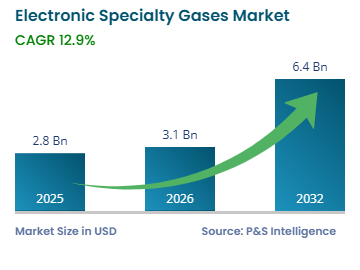
The electronic specialty gases market size was USD 2.80 billion in 2025 and is projected to rise from USD 3.10 billion in 2026 to USD 6.40 billion by 2032, advancing at a 12.9% CAGR during 2026–2032. Growth is tied to the precision, purity, and supply continuity required as chip structures become more complex and fabs add process capacity.
Commercial value depends on more than molecular availability. Suppliers must qualify gases for specific process steps, maintain consistent purity across deliveries, and provide containers or on-site systems suited to fab consumption. Linde plc reports a portfolio of more than 100 electronics specialty gases and mixtures delivered through a worldwide production network, illustrating the breadth that large customers may require across deposition, etching, doping, and supporting processes.
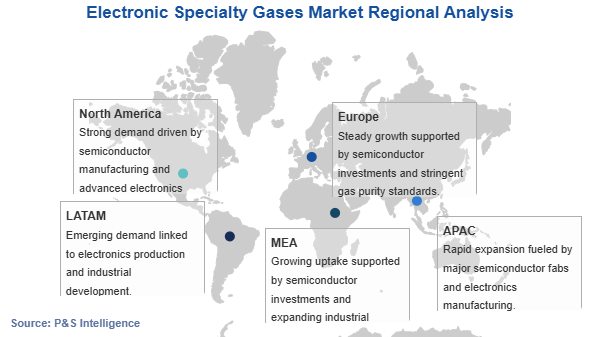
Asia-Pacific held 57.9% of the Electronic Specialty Gases Market share in 2025 and is also projected to record the fastest regional CAGR of 13.8% during 2026–2032. Its combination of scale and speed strengthens the commercial case for locating qualification teams, inventory, and production near major Asian fab clusters. The regional market measure remains distinct from semiconductor equipment spending and any single supplier's activity mix.
Key Market Insights
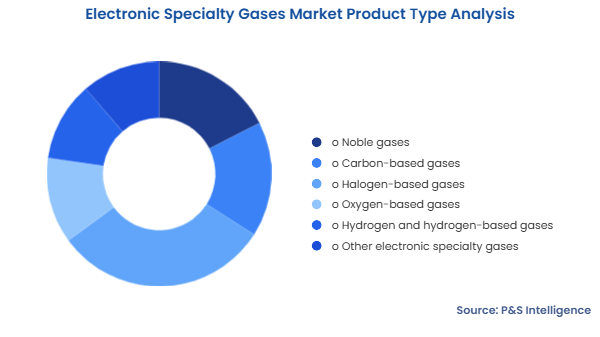
By product type, halogen-based gases held 30.7% in 2025, while hydrogen and hydrogen-based gases are projected to advance at a 13.9% CAGR during 2026–2032.
By application, etching held 32.3% in 2025, while deposition and film formation are projected to advance at a 13.9% CAGR during 2026–2032.
By end use, semiconductor manufacturing held 77.0% in 2025, while compound semiconductors and LEDs are projected to advance at a 14.2% CAGR during 2026–2032.
By geography, Asia-Pacific held 57.9% in 2025 and is projected to advance at a 13.8% CAGR during 2026–2032.
Electronic Specialty Gases Market Trends and Growth Drivers
Fab investment expands qualified gas demand
electronic specialty gases market growth is being driven by sustained investment in semiconductor fabrication capacity. Worldwide 300 mm fab equipment spending is projected by SEMI at USD 133 billion in 2026 and USD 151 billion in 2027. Equipment spending is a demand-side indicator that signals the scale of new and upgraded process capacity requiring qualified etching, deposition, cleaning, doping, and carrier gases.
The commercial effect appears as fabs move from construction into tool installation and production ramp. Gas suppliers must complete purity validation, cylinder or bulk-delivery approval, and continuity planning before recurring volume can be secured. This creates a staged demand path in which engineering engagement begins before full consumption, then expands as wafer starts rise. The trajectory supports suppliers that can align qualification resources and local infrastructure with customer ramp schedules.
Broader process portfolios deepen supplier access
The electronic specialty gases industry has an opportunity to capture more value per fab by serving multiple process families through one qualified supply relationship. Linde plc lists more than 100 gases and mixtures across deposition, etching, doping, and other electronics uses. That breadth matters because procurement and engineering teams often evaluate purity, packaging, analytical controls, and delivery reliability at the molecule and process level.
A supplier that can address several approved chemistries may reduce duplicated onboarding work for customers and gain more entry points into an account. The opportunity grows as advanced devices add layers, materials, and selective process steps, yet portfolio size alone does not establish commercial leadership. Suppliers still need molecule-specific performance, safe handling, and dependable replenishment. The market effect is a stronger incentive to combine broad portfolios with application support rather than treating each gas as an isolated sale.
Localized low-carbon supply moves closer to fabs
electronic specialty gases industry trends increasingly favor production and delivery assets placed near large semiconductor sites. Air Liquide S.A. plans an Arizona facility that will provide ultra-pure low-carbon hydrogen and other gases from 2028. The project shows how advanced-node expansion can support dedicated on-site production when consumption, purity control, and continuity requirements justify the infrastructure.
Localization shortens critical supply paths and gives suppliers more direct control over production, purification, storage, and delivery. Pairing those assets with lower-carbon production can reduce the hydrogen supply's carbon footprint while preserving the purity obligation. The trend should remain selective because dedicated facilities require sufficient contracted demand and long planning horizons. It favors projects where a fab cluster or anchor customer can support capital recovery and operating redundancy.
Qualification and hazardous handling slow supplier switching
Entry and switching remain constrained by validation and safety requirements. Entegris Inc. offers specialty-gas mixtures together with cylinder and cabinet delivery systems for microelectronics markets, showing that packaging and delivery configuration are part of the supply proposition. A new supplier must demonstrate composition, impurity control, container compatibility, delivery stability, and process performance before a fab can accept production risk.
These requirements lengthen sales cycles and can keep buyers tied to established supply arrangements even when price pressure rises. Suppliers also carry costs for analytical capability, regulated transport, emergency response, and backup inventory. The restraint becomes more demanding as process windows narrow, although it does not make switching impossible. Buyers can qualify alternatives to improve resilience, but dual sourcing takes time and must preserve identical process outcomes across production lines.
Halogen-based gases held the largest share at 30.7% in 2025. Their position reflects extensive use in precision etching and chamber-related processes. Resonac Corporation plans to add high-purity hydrogen fluoride production at a second Japanese site within 2026, creating a two-site system for a material used in advanced cryogenic etching. The planned addition is separate from the historical share and provides a quantified supply response to increasingly demanding etch structures.
Hydrogen and hydrogen-based gases are projected to grow fastest at a 13.9% CAGR during 2026–2032. Demand expands through wafer manufacturing, annealing, and surface-oxide removal. Air Liquide S.A. committed more than USD 160 million to an Arizona on-site facility that is planned to supply ultra-pure low-carbon hydrogen from 2028. The project illustrates how new advanced-node capacity can create dedicated future demand for high-purity hydrogen.
Application
Etching accounted for the largest application share at 32.3% in 2025. More complex three-dimensional structures require deep and precise processing of stacked layers while protecting sidewalls. Resonac Corporation's planned Tokuyama production will add a second Japanese source for high-purity hydrogen fluoride used in advanced cryogenic etching. The two-site plan is a quantified supply response, while its pending status prevents it from being treated as current operating capacity.
Deposition and film formation are projected to advance fastest at a 13.9% CAGR during 2026–2032. Miniaturization and nanoscale processing increase the need for reliable deposition materials near leading fabs. Air Liquide S.A. inaugurated a large-scale Taiwan plant for advanced deposition and etching materials in March 2026 and reported more than EUR 1 billion invested in Taiwan since 2019. That broader investment base supports localized material supply and technical collaboration.
End Use
Semiconductor manufacturing held 77.0% of revenue in 2025, making it the dominant end use. This position follows the number of gas-intensive steps across logic, memory, and other front-end processes. Worldwide 300 mm fab equipment spending is projected by SEMI at USD 133 billion in 2026, up 18%, followed by USD 151 billion in 2027. The forecast is a capacity-investment indicator rather than a gas-revenue measure, but it supports continued qualification demand.
Compound semiconductors and LEDs are projected to record the fastest CAGR of 14.2% during 2026–2032. Capacity expansion for SiC, GaN, and related materials broadens the prospective set of fabs requiring qualified process gases. Power and compound fab investment is projected by SEMI to reach nearly USD 27 billion in 2026, representing 17% annual growth. This investment broadens the future customer base for qualified gases, although the spending does not translate directly into gas sales.
The complete segmentation hierarchy is as follows:
Product Type
Noble gases
Carbon-based gases
Halogen-based gases
Oxygen-based gases
Hydrogen and hydrogen-based gases
Other electronic specialty gases
Application
Etching
Deposition and film formation
Chamber cleaning
Doping and ion implantation
Lithography
Oxidation and nitridation
Other applications
End Use
Semiconductor manufacturing
Flat-panel displays
Compound semiconductors and LEDs
Photovoltaics
Other electronics end uses
Drive strategic growth with comprehensive market analysis
Asia-Pacific held the largest regional position with 57.9% of revenue in 2025. The base is supported by concentrated semiconductor, display, and advanced-electronics manufacturing, which makes local purification, packaging, and delivery infrastructure commercially valuable. Air Liquide S.A. reported that about 73% of its Electronics activity was in Asia in 2025, compared with 19% in the U.S. and 8% in Europe. That company mix is separate from the regional market measure and shows how a major supplier aligns operations with Asian customer density. The region should retain scale as fabs raise utilization and qualify additional process materials. Its position would weaken if wafer production, local qualification work, or supplier investment shifted persistently toward other regions.
Electronic Specialty Gases Market growth in Asia-Pacific is projected at a 13.8% CAGR during 2026–2032, giving the region the fastest approved trajectory as well as the largest base. The growth mechanism differs from its scale mechanism. China is expected to remain the world's largest semiconductor-equipment spending market in 2026, while global installed capacity is forecast to rise 5% in 2026 and 6% in 2027, according to SEMI's Q3 2026 World Fab Forecast. New and expanded fabs create sequential opportunities for sample approval, process qualification, backup sourcing, and recurring delivery across Asia-Pacific. The growth path would soften if construction schedules slip, utilization remains below plan, or gas qualifications fail to convert into production supply.
China holds the selected largest-country position within Asia-Pacific because SEMI expects it to maintain the world's largest installed semiconductor capacity in both 2026 and 2027. Domestic fab expansion supports demand across mature and selected advanced processes, while local materials qualification can shorten replenishment paths and reduce exposure to cross-border logistics. Gas suppliers can benefit when projects move from tool installation into stable wafer output, since recurring consumption follows successful process approval. Capacity leadership alone does not establish a numerical China share of electronic specialty gas revenue. The outlook would change if equipment spending declines for a sustained period, new lines commission more slowly than expected, or customers qualify fewer local gas sources than planned.
India holds the fastest-country position within Asia-Pacific, but no numerical country gas CAGR is approved. Twelve semiconductor manufacturing units had been approved by July 2026 with cumulative investment above INR 1.64 lakh crore, including silicon, SiC, GaN micro-LED, and packaging projects, according to the Government of India. The same government release scheduled the first fab for commissioning in 2028 and included semiconductor gases and materials within Semicon 2.0 support. This creates a staged opportunity that begins with supplier engagement and qualification before full fab consumption develops. Momentum would slow if construction, process qualification, or commissioning is delayed, or if capital moves toward established Asian manufacturing hubs.
Geographies analyzed in this report:
North America
U.S.
Canada
Europe
U.K.
Germany
France
Italy
Spain
Rest of Europe
Asia-Pacific
China
Japan
India
South Korea
Rest of Asia-Pacific
Latin America
Brazil
Mexico
Rest of LATAM
Middle East and Africa
South Africa
Saudi Arabia
Rest of MEA
Electronic Specialty Gases Market Share Analysis
The electronic specialty gases industry has a consolidated, qualification-heavy competitive structure. Buyer approval depends on purity control, process consistency, safe handling, and reliable delivery, which makes supplier replacement slower than a standard commodity purchase. Capital requirements for purification, analytical systems, regulated packaging, and local inventory also limit entry. Buyers gain continuity from established networks, but concentration can increase the importance of backup qualification and contractual supply protections.
Competition occurs across several dimensions. Air Liquide S.A. emphasizes regional production and long-duration supply models, while Linde plc competes through portfolio breadth and a global production network. Entegris Inc. differentiates through toxic-gas packaging and controlled delivery. These approaches compete for the same fab account through different combinations of molecule access, engineering support, and supply assurance.
Focused producers add pressure in selected chemistries. SK Specialty Co. Ltd. concentrates on fluorinated and silicon-based process gases, while Kanto Denka Kogyo Co. Ltd. specializes in fluorinated gases and next-generation products. Resonac Corporation emphasizes localized high-purity supply and redundancy. Competitive intensity should rise as customers seek second sources, yet qualification costs and long asset cycles favor suppliers that can sustain technical service and redundant capacity over time.
Top Companies in Electronic Specialty Gases Market:
Air Liquide S.A.
Linde plc
Air Products and Chemicals Inc.
Merck KGaA
Entegris Inc.
Nippon Sanso Holdings Corporation
SK Specialty Co. Ltd.
Kanto Denka Kogyo Co. Ltd.
Resonac Corporation
Messer SE & Co. KGaA
Electronic Specialty Gases Market Developments
In July 2026, Linde plc secured a new long-term agreement and committed USD 1 billion to expand its Phoenix on-site gas complex with two additional air-separation units serving two new semiconductor fabs. The award links contracted demand to dedicated ultra-high-purity supply infrastructure.
In March 2026, Air Liquide S.A. inaugurated and started up its first large-scale advanced-materials manufacturing plant in Taiwan for deposition and etching molecules. The facility places advanced-material production near major semiconductor customers and broadens the local supply base for nanoscale processes.
In November 2025, Entegris Inc. opened its 135,000-square-foot Colorado Springs Manufacturing Center of Excellence after initial commercial operations began earlier that year. The site expands U.S. filtration, purification, and wafer-carrier capacity, strengthening contamination-control support for domestic semiconductor manufacturing.
Frequently Asked Questions About This Report
What is the electronic specialty gases market size?+
The electronic specialty gases market size was USD 2.80 billion in 2025 and is projected to rise from USD 3.10 billion in 2026 to USD 6.40 billion by 2032, advancing at a 12.9% CAGR during 2026-2032.
Which region leads the electronic specialty gases market?+
Asia-Pacific held 57.9% of the electronic specialty gases market share in 2025 and is also projected to record the fastest regional CAGR of 13.8% during 2026-2032.
What investment supports qualified gas demand?+
Worldwide 300 mm fab equipment spending is projected by SEMI at USD 133 billion in 2026 and USD 151 billion in 2027.
Which product type held the largest share?+
Halogen-based gases held the largest share at 30.7% in 2025. Their position reflects extensive use in precision etching and chamber-related processes.
Which end use is projected to grow fastest?+
Compound semiconductors and LEDs are projected to record the fastest CAGR of 14.2% during 2026-2032. Capacity expansion for SiC, GaN, and related materials broadens the prospective set of fabs requiring qualified process gases.
Want a report tailored exactly to your business need?
Leading companies across industries trust us to deliver data-driven insights and innovative solutions for their most critical decisions. From data-driven strategies to actionable insights, we empower the decision-makers who shape industries and define the future. From Fortune 500 companies to innovative startups, we are proud to partner with organisations that drive progress in their industries.
Client Testimonials
Working with P&S Intelligence and their team was an absolute pleasure – their awareness of timelines and commitment to value greatly contributed to our project's success. Eagerly anticipating future collaborations.
McKinsey & Company
India
Unmatched Standards
Our insights into the minutest levels of the markets, including the latest trends and competitive landscape, give you all the answers you need to take your business to new heights
Complete Data Security
We take a cautious approach to protecting your personal and confidential information. Trust is the strongest bond that connects us and our clients, and trust we build by complying with all international and domestic data protection and privacy laws