Electric Vehicle Tire Market Size & Share Analysis - Trends, Drivers, Competitive Landscape, and Forecasts (2026 - 2032)
This Report Provides In-Depth Analysis of the Electric Vehicle Tire Market Report Prepared by P&S Intelligence, Segmented by Vehicle Type (Passenger Vehicles, Commercial Vehicles, Two & Three-Wheelers), Propulsion Type (Battery Electric Vehicles, Hybrid Electric Vehicles, Plug-in Hybrid Electric Vehicles, Fuel Cell Electric Vehicles), Technology (Radial, Bias, Composite), Tire Size (13-15 inches, 16-18 inches, 19-21 inches, Above 21 inches), Application (On-Road, Off-Road), Sales Channel (OEM, Aftermarket), and Geographical Outlook for the Period of 2021 to 2032
Explore the market potential with our data-driven report
Electric Vehicle Tire Market Key Insights
Passenger vehicles hold the largest market share, of 60%, in 2025, driven by high EV adoption in the passenger car segment.
Two & three-wheelers will have the highest CAGR, of approximately 14.7%, supported by rapid electrification in emerging markets.
Battery electric vehicles (BEVs) hold the largest market share, of 45%, in 2025, and will also have the highest CAGR, of approximately 14.8%, due to increasing global EV penetration.
The 19–21 inches category will have the highest CAGR of approximately 15.0%, supported by increasing adoption of premium EVs and SUVs, which require larger tire sizes for enhanced performance and aesthetics.
Asia-Pacific holds the largest market share, of 40%, in 2025, driven by strong EV production and demand in China and India.
Electric Vehicle Tire Market Future Outlook
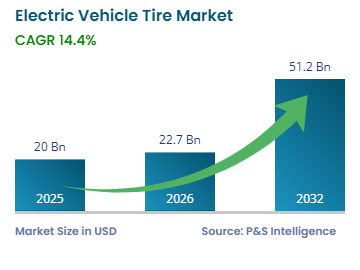
The electric vehicle tire market size was USD 20.0 billion in 2025, and it will grow by 14.4% during 2026–2032, to reach USD 51.2 billion by 2032. This growth is supported by the rapid global expansion of electric vehicle (EV) production, increasing demand for specialized tires designed to handle higher torque and weight, and the growing focus on energy efficiency and range optimization.
Unlike conventional tires, EV tires require low rolling resistance, enhanced durability, and noise reduction capabilities, which are driving innovation in tire materials and construction technologies. According to the International Energy Agency, global EV sales have grown strongly in recent years, reaching record levels in 2024, and are expected to exceed 20 million units in 2025, reflecting rising demand for EV-specific tires. Additionally, regulatory pressure to reduce carbon emissions and improve fuel efficiency is encouraging automakers to adopt advanced tire technologies that enhance vehicle performance and extend driving range.
Electric Vehicle Tire Market Emerging Trends and Growth Drivers
Increasing Focus on Energy-Efficient and Noise-Optimized Tire Designs Is Key Trend
A defining trend reshaping the electric vehicle tire market is the increasing focus on energy-efficient and low-noise tire designs tailored specifically for EV performance characteristics. Industry studies show that in electric vehicles, tire-road interaction becomes the dominant source of noise at speeds of 30 km/h, increasing the need for advanced noise-optimized tire technologies. Tire manufacturers are developing specialized tread patterns, foam-based noise reduction technologies, and low rolling resistance compounds to enhance vehicle efficiency and passenger comfort.
Advanced materials and digital tire monitoring systems are also being integrated into EV tire designs to improve durability and performance. The European Tyre and Rubber Manufacturers Association highlights that rolling resistance contributes significantly to vehicle energy consumption, reinforcing the need for optimized tire designs in EVs. This trend is driving continuous innovation in tire engineering, particularly in premium and high-performance EV segments.
Government Emission Mandates and Zero-Emission Vehicle Policies Are Biggest Drivers
Binding legislative frameworks in major economies are the most powerful structural force driving consistent, policy-guaranteed demand for electric vehicle tires. The European Union's CO₂ emission performance standards require new passenger cars and vans registered from January 2025 to emit on average 15% less CO₂ than 2021 baselines, with a further 55% reduction mandated from 2030. Regulation (EU) 2023/851 establishes a 100% CO₂ emissions reduction target for new passenger cars and vans by 2035, effectively requiring new vehicle registrations in the EU to be zero-emission (0 g CO₂/km). These targets carry financial penalties of EUR 95 per g/km per vehicle for non-compliance, creating a direct commercial imperative for automakers to accelerate BEV production at scale. As automakers scale up BEV volumes to avoid penalties, OEM-level tire procurement increases proportionally, with each new BEV platform requiring validated, model-specific tire specifications.
Beyond Europe, China's New Energy Vehicle mandate compels automakers to maintain escalating NEV production quotas annually, while India's PM E-DRIVE scheme and Production Linked Incentive for battery manufacturing embed state capital into the EV supply chain. This regulatory framework remains firmly in place, compelling manufacturers to transition away from ICE vehicle production and supporting a near-total shift toward EV-compatible tire demand. As the regulatory horizon hardens, tire manufacturers with OEM certification pipelines for BEV-specific designs hold durable competitive advantages over those reliant on general-purpose fitments.
Higher Cost of EV-Specific Tires Is a Key Restraint
The higher cost of EV-specific tires compared to conventional tires represents a key restraint in market growth. These tires require advanced materials, reinforced structures, and specialized tread designs, which increase production costs. EV tires typically carry a price premium over standard tires due to their enhanced performance characteristics, while limited economies of scale in EV-specific tire production and the need for OEM validation further contribute to higher costs, particularly in the early stages of market development.
Additionally, faster wear rates due to higher torque and vehicle weight can increase replacement frequency, adding to overall ownership costs for consumers. The U.S. Department of Energy notes that EV components are subject to different performance stresses compared to conventional vehicles, while in emerging markets, restricted availability of EV-specific tire variants and underdeveloped aftermarket networks can further elevate replacement costs and limit accessibility. This cost factor may limit adoption in price-sensitive markets, particularly in developing regions.
Accelerated EV Tire Replacement Cycles Creating Structural Aftermarket Is Key Opportunity
The physical characteristics of electric drivetrains create a predictable and structurally reinforced aftermarket demand channel. Instant torque delivery, heavier curb weights from battery packs, and regenerative braking stress apply maximum mechanical load to tire compounds, compounding degradation at rates conventional tire engineering was not designed to absorb. Unlike internal combustion engine vehicles, where torque builds progressively through gear shifts, electric vehicles apply peak torque from a standstill on every acceleration cycle, generating continuous scrubbing forces that degrade tread compounds at accelerated rates.
This wear differential directly expands aftermarket replacement frequency. Tire manufacturers that establish brand loyalty and OEM certification at the factory fitment stage benefit from downstream aftermarket pull, as EV owners typically seek model-validated replacement tires to maintain warranty compliance and range efficiency. This replacement cycle dynamic intensifies as EV penetration expands into mass-market ownership cohorts with higher mileage accumulation patterns.
Electric Vehicle Tire Market Segmentation Analysis
Vehicle Type Analysis
Passenger vehicles hold the largest market share, of 60%, in 2025, driven by strong adoption of electric cars across developed and emerging markets. Government incentives, improved charging infrastructure, and increasing consumer awareness are supporting the growth of electric passenger vehicles, thereby driving demand for EV-specific tires.
Two & three-wheelers will have the highest CAGR, of approximately 14.7%, driven by rapid electrification in countries such as India, China, and Southeast Asia. These vehicles are widely used for urban mobility and last-mile delivery, creating strong demand for affordable and durable tire solutions. The International Energy Agency reports that global electric two- and three-wheeler sales reached around 10 million units in 2024, reinforcing the scale of this segment in driving EV tire demand.
The vehicle types analyzed in this report are:
Passenger Vehicles (Largest Category)
Commercial Vehicles
Light Commercial Vehicles (LCV)
Heavy Commercial Vehicles (HCV)
Two & Three-Wheelers (Fastest-Growing Category)
Propulsion Type Analysis
Battery electric vehicles (BEVs) hold the largest market share, of 45%, in 2025, and they will have the highest CAGR, of approximately 14.8%, driven by zero-emission mandates and increasing consumer adoption. These vehicles also require tires with low rolling resistance and enhanced durability to support extended driving range and manage increased load stress, strengthening demand for EV-specific tire innovations. The International Energy Agency confirms that BEV car sales in China exceeded 11 million in 2024, reinforcing the scale of BEV adoption driving demand for EV-specific tires.
The propulsion types analyzed in this report are:
Battery Electric Vehicles (BEV) (Largest and Fastest-Growing Category)
Hybrid Electric Vehicles (HEV)
Plug-in Hybrid Electric Vehicles (PHEV)
Fuel Cell Electric Vehicles (FCEV)
Technology Analysis
The radial tires hold the largest market share, of 55%, in 2025, due to their superior durability, fuel efficiency, and performance characteristics. They are widely adopted across all vehicle types, making them the dominant tire construction technology. Leading manufacturers such as Michelin and Bridgestone are actively advancing EV-specific radial tire technologies. Michelin launched its e.Primacy tire range designed to improve energy efficiency and extend EV driving range, while Bridgestone introduced EV-focused Turanza tire solutions optimized for electric vehicle performance and durability.
The composite category will have the highest CAGR of approximately 14.9%, driven by increasing demand for lightweight, high-performance tire solutions. These materials improve energy efficiency and extend tire lifespan, making them suitable for next-generation EVs. The European Union’s evolving regulatory framework, including Regulation (EU) 2023/1542, is further reinforcing lifecycle transparency and sustainability expectations across EV supply chains, indirectly accelerating the adoption of traceable and eco-efficient materials in next-generation tire constructions.
The tire technologies analyzed in this report are:
Radial (Largest Category)
Bias
Composite (Fastest-Growing Category)
Tire Size Analysis
The 16–18 inches category holds the largest market share, driven by its widespread use in mid-size passenger vehicles, which represent the majority of EV sales globally. This tire size offers an optimal balance between rolling resistance, load-bearing capacity, and cost efficiency, making it the preferred specification for mass-market electric vehicles. Its strong availability across OEM fitments and aftermarket channels further supports its dominance in both initial demand and replacement cycles.
The 19–21 inches category will have the highest CAGR, supported by increasing adoption of premium EVs and SUVs, which require larger tire sizes for enhanced performance and aesthetics. The IEA notes that two-thirds of more than 400 new EV model launches expected over 2024–2028 are larger vehicles and SUVs, directly expanding the addressable volume for larger tire sizes across both OEM and aftermarket channels.
The tire sizes analyzed in this report are:
13–15 inches
16–18 inches (Largest Category)
19–21 inches (Fastest-Growing Category)
Above 21 inches
Application Analysis
On-road applications hold the larger market share, driven by the dominance of passenger EVs and urban transportation. On-road EV tires are specifically designed with low rolling resistance, noise reduction, and wet-grip performance to meet the operational requirements of urban and highway driving conditions. In Asia-Pacific government programs such as India’s electric bus initiatives under FAME have supported the deployment of over 7,000 electric buses, reinforcing the expansion of on-road EV usage and associated tire demand.
Off-road applications will have the higher CAGR of approximately 15.1%, driven by increasing adoption of electric construction equipment, agricultural machinery, and off-road vehicles. In China, electric truck adoption is accelerating, with the country accounting for over 80% of global electric truck sales in 2024, representing approximately 75,000 units, supported by strong policy incentives and declining battery costs, contributing to growing demand for heavy-duty EV tire solutions.
The applications analyzed in this report are:
On-Road (Larger Category)
Off-Road (Faster-Growing Category)
Sales Channel Analysis
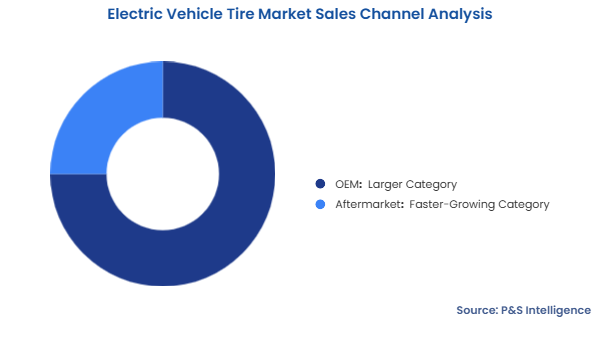
OEMs hold the larger market share, of 75%, in 2025, driven by direct supply agreements with automakers and the growing production of EVs globally. Tire manufacturers are increasingly collaborating with OEMs to develop customized tire solutions. For instance, Michelin has developed EV-specific tire solutions in collaboration with leading automakers to enhance energy efficiency and extend driving range, highlighting the growing importance of OEM–tire partnerships in EV platform development.
The aftermarket will have the higher CAGR, supported by increasing replacement demand as the installed base of EVs grows. This demand is further reinforced by higher tire wear rates associated with EV torque characteristics and vehicle weight, leading to more frequent replacement cycles and expanding opportunities for EV-specific tire offerings.
The sales channels analyzed in this report are:
OEM (Larger Category)
Aftermarket (Faster-Growing Category)
Drive strategic growth with comprehensive market analysis
Electric Vehicle Tire Market Geographical Analysis
Asia-Pacific Electric Vehicle Tire Market Size
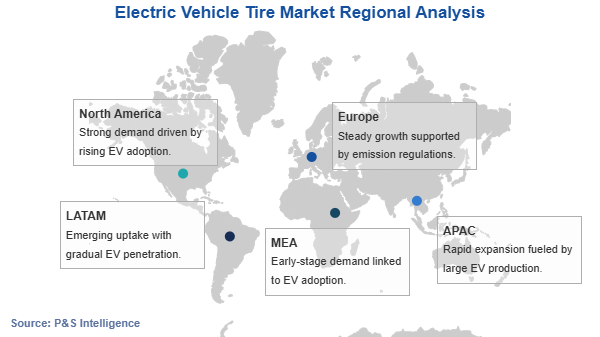
Asia-Pacific holds the largest market share, of 40%, in 2025, and it will have the highest CAGR, of 15.3%, driven by its dominance in EV production and sales. China alone accounts for nearly 60% of global EV sales, supported by strong government incentives, domestic manufacturing capabilities, and a well-developed EV ecosystem.
Japan and South Korea further reinforce the region’s position through strong OEM–tire manufacturer partnerships and advanced EV model development. In Japan, the government has set a target for 100% electrified vehicle sales by 2035, accelerating the transition toward electric mobility and supporting long-term demand for EV-specific tires. In South Korea, the government has outlined plans to deploy over 4 million electric vehicles by 2030, supported by subsidies and infrastructure expansion initiatives, strengthening the regional EV ecosystem. The International Energy Agency highlights that EV sales across emerging Asia grew significantly in 2024, with Southeast Asian markets recording strong growth, indicating broadening regional demand for electric vehicles and associated tire requirements.
China Electric Vehicle Tire Market Size
China is the largest country market within Asia Pacific for electric vehicle tires, driven by its position as the world’s most concentrated EV production base, a mature government incentive ecosystem, and a strong domestic tire manufacturing base supplying OEM fitment at scale. Over 850,000 new public charging stations were installed in China in 2024 alone, with a government target of 12 million by 2030, driving continued EV penetration and expanding the replacement tire demand cycle. China’s New Energy Vehicle Industry Development Plan (2021–2035) mandates escalating NEV production quotas, encouraging automakers to increasingly adopt EV-specific tire specifications at the factory level and creating durable upstream pull for manufacturers with OEM certification. Leading global tire manufacturers, including Continental, supply EV tires to a wide range of high-volume automakers, many of which are headquartered in or manufacture extensively within China, underscoring the country’s centrality to global EV tire supply chains.
The International Energy Agency reports that China’s electric car trade-in program attracted approximately 6.6 million applicants in 2024, with over one-third of the country’s 11-million-plus new EV sales benefiting from this central government incentive. As Chinese EV brands including BYD, NIO, and SAIC Motor expand into Southeast Asia, Europe, and Latin America, their export volumes will carry associated tire supply agreements, extending China’s influence on global EV tire demand well beyond its domestic market.
India Electric Vehicle Tire Market Size
India is the fastest-growing country market within Asia Pacific for electric vehicle tires, driven by strong electrification policies, rapid adoption of electric two- and three-wheelers, and expanding domestic manufacturing capabilities. The FAME II scheme continues to drive demand, particularly in the electric two- and three-wheeler segment, while Production Linked Incentive (PLI) programs for advanced battery manufacturing are strengthening the broader EV ecosystem. The country holds one of the largest electric two- and three-wheeler markets globally, where high utilization rates and frequent replacement cycles make it a primary channel for EV tire demand. The International Energy Agency reports that more than 50% of three-wheelers sold in India in 2023 were electric, creating a structurally distinct and large-scale demand base for EV tires that is uncommon in most other markets.
India is also expanding its EV charging infrastructure through central and state-level initiatives to support long-term adoption. Domestic tire manufacturers are actively responding to this shift, with Apollo Tyres launching its Amperion EV-specific tire range and TVS Eurogrip introducing EV-focused tires in 2024 aimed at improving rolling efficiency. India’s push to become an EV manufacturing hub, supported by investments from Tata Motors and Hyundai Motor Company, is expected to further strengthen domestic EV production and associated tire demand.
Europe Electric Vehicle Tire Market Size
Europe is the second-largest region in the global electric vehicle tires market, driven by the European Union’s tightening CO₂ emissions standards for new vehicles from 2025 onward, the European Green Deal’s focus on sustainable mobility, and strong national-level EV incentive programs. The International Energy Agency reports that one in five new cars sold across Europe in 2024 was electric, maintaining around a 20% share despite subsidy reductions in key markets such as Germany and France, indicating a shift toward structurally driven demand rather than incentive-dependent growth.
The European Commission has adopted CO₂ emission standards requiring a 100% reduction in emissions from new cars and vans by 2035 compared to 2021 levels, effectively mandating all new vehicle registrations to be zero-emission and accelerating battery electric vehicle (BEV) adoption, along with demand for EV-specific tire technologies. Europe had over 630,000 public EV charging points installed by 2023, with more than 150,000 new chargers added in that year alone, further supporting the region’s transition toward electric mobility.
The regions and countries of the market are as follows:
North America
U.S. (Larger and Faster-Growing Country Market)
Canada
Europe
Germany (Largest Country Market)
U.K.
France (Fastest-Growing Country Market)
Italy
Spain
Rest of Europe
Asia-Pacific (Largest and Fastest-Growing Regional Market)
China (Largest Country Market)
India (Fastest-Growing Country Market)
Japan
South Korea
Australia
Rest of APAC
Latin America
Brazil (Largest Country Market)
Mexico (Fastest-Growing Country Market)
Rest of LATAM
Middle East and Africa
Saudi Arabia
South Africa (Largest Country Market)
U.A.E. (Fastest-Growing Country Market)
Rest of MEA
Electric Vehicle Tire Market Share
The market is semi-consolidated, with a mix of global tire manufacturers and regional players competing across different segments. Leading companies such as Michelin, Bridgestone, and Continental AG benefit from strong OEM partnerships, advanced R&D capabilities, and global distribution networks. However, the presence of regional manufacturers and increasing competition in emerging markets prevent full consolidation, resulting in a competitive landscape characterized by innovation and strategic collaborations. High entry barriers in OEM supply, driven by certification requirements and performance specifications for EV-specific tires, further differentiate the competitive landscape, resulting in a market characterized by continuous innovation and strategic collaborations.
Top Companies in the Electric Vehicle Tire Market:
Bridgestone Corporation
Continental AG
The Goodyear Tire & Rubber Company
Pirelli & C. S.p.A.
Hankook Tire & Technology
Michelin
Yokohama Rubber Company
Sumitomo Rubber Industries
Toyo Tire Corporation
Kumho Tire Co., Inc.
Apollo Tyres Ltd
Nokian Tyres plc
Electric Vehicle Tire Market News & Updates
In December 2025, Kumho Tire Co., Inc. selected Opole, Poland, as the site for its first European manufacturing facility, committing a total investment of USD 587 million with an initial annual production capacity of 6 million. The plant positions Kumho to improve OE supply responsiveness to European premium automakers including Mercedes-Benz, BMW, and Volkswagen, where the absence of a local production base had constrained lead-time competitiveness.
In November 2025, Hyundai Motor Group signed a third MOU with Michelin to advance next-generation tire technologies, focusing on extreme low rolling resistance compounds and virtual development capabilities for premium EVs. The agreement builds on joint OE tire development for the Ioniq 5 and Genesis models, extending the partnership's scope into AI-assisted tire performance optimization for future Hyundai and Kia BEV platforms.
In April 2025, Pirelli & C. S.p.A. launched the Scorpion XTM AT tire line in North America in 37 sizes spanning 17 to 24 inches, including a dedicated Elect variant engineered specifically for battery-electric trucks and SUVs with Pirelli's higher load index and noise-reduction compound technology. The launch expands Pirelli's EV off-road fitment portfolio to address the growing electric pickup truck segment, including the Rivian R1S, Ford F-150 Lightning, and GMC Hummer EV.
In February 2025, Bridgestone Corporation was selected by Porsche AG to supply custom-engineered Potenza Sport ultra-high-performance tires for the Macan Electric and Panamera models, including the Blizzak LM005 as Bridgestone's first winter original equipment fitment for Porsche. The OE partnership extends Bridgestone's ENLITEN compound technology into Porsche's electric SUV lineup, reinforcing the company's premium EV certification credentials.
Frequently Asked Questions About This Report
What causes faster wear in electric vehicle tires?+
Electric vehicle tires wear faster due to higher vehicle weight from batteries, instant torque delivery, and stronger acceleration and braking forces compared to conventional vehicles.
What tires improve electric vehicle driving range the most?+
Low rolling resistance EV-optimized tires improve driving range by reducing energy loss and improving overall vehicle efficiency.
What is the average lifespan of EV tires?+
The average lifespan of EV tires is generally 20
What makes EV tires more expensive than regular tires?+
EV tires are more expensive due to advanced rubber compounds, reinforced structure, noise reduction technology, and engineering designed for heavy battery loads.
What factors are driving the growth of the EV tire market?+
The market is growing due to rising EV adoption, demand for energy-efficient mobility, government EV incentives, and advancements in tire technology.
Want a report tailored exactly to your business need?
Leading companies across industries trust us to deliver data-driven insights and innovative solutions for their most critical decisions. From data-driven strategies to actionable insights, we empower the decision-makers who shape industries and define the future. From Fortune 500 companies to innovative startups, we are proud to partner with organisations that drive progress in their industries.
Client Testimonials
Working with P&S Intelligence and their team was an absolute pleasure – their awareness of timelines and commitment to value greatly contributed to our project's success. Eagerly anticipating future collaborations.
McKinsey & Company
India
Unmatched Standards
Our insights into the minutest levels of the markets, including the latest trends and competitive landscape, give you all the answers you need to take your business to new heights
Complete Data Security
We take a cautious approach to protecting your personal and confidential information. Trust is the strongest bond that connects us and our clients, and trust we build by complying with all international and domestic data protection and privacy laws