Key Highlights
| Study Period | 2019 - 2032 |
| Market Size in 2024 | USD 2.4 Billion |
| Market Size in 2025 | USD 2.8 Billion |
| Market Size by 2032 | USD 8.5 Billion |
| Projected CAGR | 17.2% |
| Largest Region | APAC |
| Fastest Growing Region | APAC |
| Market Structure | Fragmented |

| Study Period | 2019 - 2032 |
| Market Size in 2024 | USD 2.4 Billion |
| Market Size in 2025 | USD 2.8 Billion |
| Market Size by 2032 | USD 8.5 Billion |
| Projected CAGR | 17.2% |
| Largest Region | APAC |
| Fastest Growing Region | APAC |
| Market Structure | Fragmented |
|
Explore the market potential with our data-driven report
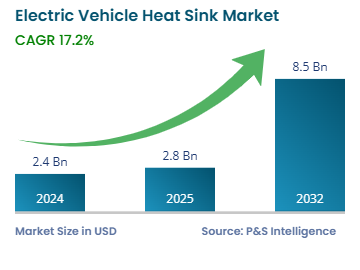
The electric vehicle heat sink market size was USD 2.4 billion in 2024, and it will grow by 17.2% during 2025–2032, to reach USD 8.5 billion by 2032.
The market growth is driven by the exponential rise in electric vehicle production, increasing power density of EV components requiring advanced thermal management, and stringent regulations on vehicle emissions, pushing automakers toward electrification.
The surge in electric vehicle adoption worldwide has created unprecedented demand for sophisticated thermal management solutions, with heat sinks emerging as critical components for maintaining optimal operating temperatures in battery systems, power electronics, and electric motors. As per studies, driving an EV for an hour could generate 16.2–41.4 Megajoules of heat.
Excess heat degrades EV components by accelerating battery aging, reducing motor efficiency, and stressing inverters and power electronics. Overheating can trigger thermal throttling or shutdowns, reduce range, and shorten component lifespan. Effective thermal management is crucial to maintain performance, safety, and longevity of electric vehicles under varying load and climate conditions.
This necessitates the implementation of effective heat dissipation solutions like heat sinks to maintain optimal operating temperatures. The transition to high-performance silicon carbide and gallium nitride semiconductors in EV inverters has further intensified the need for efficient heat dissipation, as these advanced components operate at higher power densities and switching frequencies compared to traditional silicon-based devices.
The aluminium category held the largest market share, of 40%, in 2024, due to aluminium's optimal balance of thermal conductivity, lightweight properties, and cost-effectiveness. Aluminium alloys 6060 (low-stress), 6061, and 6063 are commonly used, with thermal conductivity values of 166 and 201 W/(m·K) respectively. The automotive industry's focus on weight reduction to maximize EV range has made aluminium the preferred choice for most thermal management applications.
The composites category will have the highest CAGR, due to their thermal conductivity, flexible design, and low weight. As electric vehicles become more compact and performance-driven, manufacturers are looking for materials that can offer enhanced cooling without adding significant weight. Graphite composites, graphene-enhanced polymers, and metal–polymer hybrids provide personalized shapes, crucial for thermal management in limited spaces.
The material types analysed in this report are:
The battery EVs category held the largest market share, of 45%, in 2024, and it will have the highest CAGR, driven by the complete electrification of the powertrain requiring comprehensive thermal management solutions. BEVs rely entirely on battery power and electric motors, generating substantial heat during operation, charging, and regenerative braking. The absence of an internal combustion engine means all cabin heating must come from electrical sources, further increasing the thermal management complexity and the need for efficient heat sinks across multiple vehicle systems.
The propulsions analysed in this report are:
The battery thermal management category held the largest market share, of 50%, in 2024, due to its critical importance of maintaining optimal battery temperatures for performance, safety, and longevity. Electric vehicle batteries operate most efficiently within a narrow temperature range of 15-35°C, and deviations can significantly impact range, charging speed, and battery life. Heat sinks in battery applications work in conjunction with liquid cooling systems to dissipate heat generated during charging and discharging cycles.
The power electronic cooling category will have the highest CAGR. This growth is attributed to the increasing power density of inverters, converters, and on-board chargers in modern EVs. The main component inside the inverter is the insulated gate bipolar transistor, and it generates heat. An effective method of cooling the IGBT is through a liquid-cooled heat sink. The transition to 800V architectures and silicon carbide semiconductors has intensified thermal management requirements in power electronics.
The applications analysed in this report are:
The liquid cooled category held the larger market share, of 40%, in 2024, and it will have the higher CAGR, of approx. 17.5%, driven by its superior heat dissipation capabilities and widespread adoption in high-performance EV applications. Liquid cooling systems utilizing heat sinks with internal coolant channels provide efficient thermal management for high-power components. The technology's ability to maintain consistent temperatures across large battery packs and power electronics modules has made it the standard for premium and performance-oriented electric vehicles.
The cooling technologies analysed in this report are:
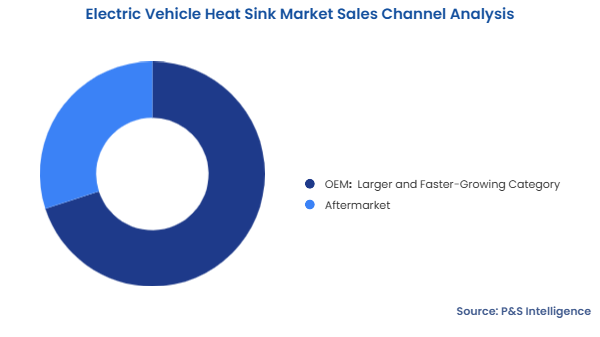
The OEM category held the largest market share, of 70%, in 2024, and it will have the highest CAGR, of approx. 18%, reflecting the integrated nature of thermal management systems in modern electric vehicles. OEMs are heavily investing in R&D to develop effective, affordable thermal solutions. During the vehicle design and manufacturing process, heat sinks are integrated as critical components of the overall thermal management architecture, making OEM partnerships essential for heat sink manufacturers. As EVs are becoming more compact, the OEMs are looking for customized heat sinks that are efficient and smaller in design. Companies, such as Tesla, are producing heat sinks in-house, making OEM demand important for heat-sink suppliers aiming to scale operations.
The sales channels analysed in this report are:
Drive strategic growth with comprehensive market analysis
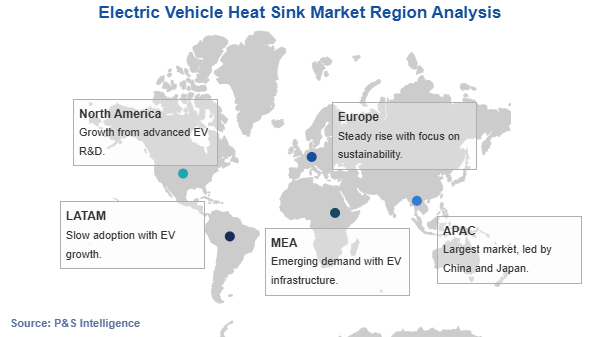
Asia-Pacific held the largest market share, of 45%, in 2024, and it will have the highest CAGR. This is driven by the massive electric vehicle production and adoption in China, coupled with the presence of major automotive manufacturers and component suppliers across the region. The expansion of semiconductor manufacturing businesses in China and South Korea is boosting the Asia Pacific thermal management market.
China alone accounts for over 50% of global electric vehicle production and sales, creating substantial demand for heat sink solutions. The Chinese government has implemented ambitious targets and policies to promote the production and adoption of electric vehicles, making China the largest electric vehicle market in the world. The country's comprehensive EV ecosystem, spanning from battery production to vehicle assembly, has fostered the development of a robust thermal management component industry.
Major Chinese EV manufacturers, including BYD, NIO, and Xpeng, are driving innovation in thermal management systems to improve vehicle efficiency and reduce costs. Moreover, the rapid growth of EV markets in India, Japan, and South Korea further strengthens the Asia Pacific's position.
In India, EV sales crossed 2 million units in 2024, with strong growth of around 27% from the previous year. Government incentives, improving charging infrastructure, and increasing environmental awareness are accelerating EV adoption across the region, consequently driving demand for advanced heat sink solutions.
The geographical breakdown of the market is as follows:
The market is moderately fragmented due to the presence of large local and global players providing a wide range of thermal management solutions. Companies such as Denso Corporation and MAHLE GmbH hold a significant share of the market. The market's evolving nature, driven by rapid electrification and material innovation, enables niche and emerging players in market competition. This competition prevents total dominance by a single company, maintaining market fragmentation.
Want a report tailored exactly to your business need?
Request CustomizationLeading companies across industries trust us to deliver data-driven insights and innovative solutions for their most critical decisions. From data-driven strategies to actionable insights, we empower the decision-makers who shape industries and define the future. From Fortune 500 companies to innovative startups, we are proud to partner with organisations that drive progress in their industries.

Working with P&S Intelligence and their team was an absolute pleasure – their awareness of timelines and commitment to value greatly contributed to our project's success. Eagerly anticipating future collaborations.
McKinsey & Company
India
Our insights into the minutest levels of the markets, including the latest trends and competitive landscape, give you all the answers you need to take your business to new heights

We take a cautious approach to protecting your personal and confidential information. Trust is the strongest bond that connects us and our clients, and trust we build by complying with all international and domestic data protection and privacy laws


Customize the Report to Align with Your Business Objectives

Request the Free Sample Pages