Electric Excavator Market Size & Share Analysis - Trends, Drivers, Competitive Landscape, and Forecasts (2026 - 2032)
This Report Provides In-Depth Analysis of the Electric Excavator Market Report Prepared by P&S Intelligence, Segmented by Product Type (Mini Excavators, Compact Excavators, Medium Excavators, Large Excavators), Propulsion Type (Battery Electric, Cable/Tethered Electric, Plug-In Hybrid Electric), Battery Capacity (Below 50 kWh, 50-200 kWh, Above 200 kWh), Application (Construction, Mining, Agriculture and Landscaping, Municipal and Utilities, Demolition and Indoor Work), and Geographical Outlook for the Period of 2021 to 2032
Explore the market potential with our data-driven report
Electric Excavator Market Overview
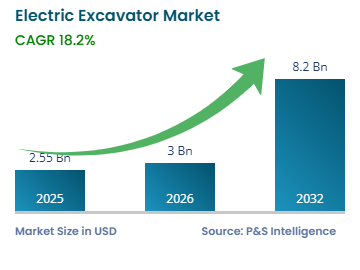
The Electric Excavator Market size was USD 2.55 billion in 2025 and is projected to rise to USD 3.00 billion in 2026 and USD 8.20 billion by 2032, advancing at an 18.2% CAGR during 2026–2032. Contractors are moving beyond compact pilot machines as full-shift medium excavators, high-capacity battery systems, and cable-assisted platforms widen the range of commercially workable duty cycles.
Adoption is strongest where buyers can monetize quiet operation, zero tailpipe emissions, and lower routine powertrain maintenance. Urban projects, indoor demolition, tunnels, utilities, and mines offer clearer operating benefits than remote sites with weak grid access. Fleet decisions still depend on utilization, charging windows, transport weight, and the residual value of relatively new electric platforms.
Battery economics are improving the equipment roadmap. The International Energy Agency reported that average battery prices declined 8% in 2025 and that lithium iron phosphate packs were more than 40% cheaper per kWh than nickel manganese cobalt alternatives. Cross-industry cost reductions support larger packs, although construction-grade integration and charging equipment keep excavator economics distinct from road vehicles.
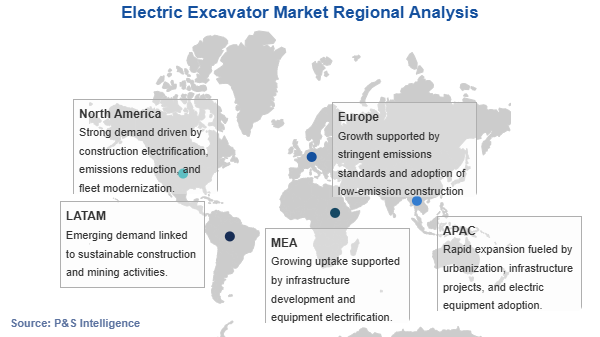
Asia-Pacific accounted for 42% of the Electric Excavator Market share in 2025, while Europe is forecast to expand at a 20.0% CAGR during 2026–2032. Asia-Pacific benefits from Chinese battery manufacturing and domestic equipment supply. Europe converts emissions and noise objectives into equipment demand through public procurement, municipal programs, and an expanding range of production-ready machines.
Key Market Insights
By product type, mini excavators held 38% in 2025, while medium excavators are projected to advance at a 21.5% CAGR during 2026–2032.
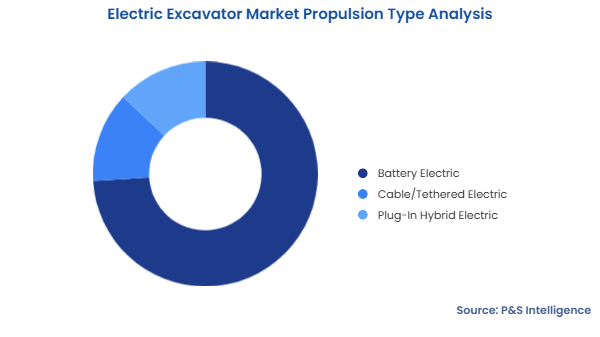
By propulsion type, battery electric systems held 74% in 2025, while cable/tethered electric systems are projected to advance at a 20.6% CAGR during 2026–2032.
By battery capacity, the 50–200 kWh category held 46% in 2025, while the above 200 kWh category is projected to advance at a 23.4% CAGR during 2026–2032.
By application, construction held 51% in 2025, while mining is projected to advance at a 22.1% CAGR during 2026–2032.
By geography, Asia-Pacific held 42% in 2025, while Europe is projected to advance at a 20.0% CAGR during 2026–2032.
Electric Excavator Market Trends and Growth Drivers
Procurement rules and local emissions limits accelerate fleet electrification
Public buyers and project owners are creating a demand channel that rewards low-emission equipment at the tender stage. The European Commission identifies excavators within regulated non-road mobile machinery and states that combustion engines in this category emit carbon monoxide, hydrocarbons, nitrogen oxides, and particulate matter. Tighter engine rules stop short of mandating electric power while increasing the compliance value of equipment that avoids tailpipe exhaust.
Policy-linked demand supports Electric Excavator Market growth when procurement specifications, urban access rules, or work-hour restrictions affect contract eligibility. Contractors can justify an electric premium more readily when the machine helps win work, operate indoors, or extend activity into noise-sensitive periods. Suppliers respond by pairing machines with chargers, mobile storage, and site-energy planning rather than selling the excavator as a stand-alone asset.
The effect remains project-specific. Diesel machines retain an advantage where utilization is high, sites are remote, and electric capacity is unavailable. Electrification therefore advances first through applications where emissions or noise have an identifiable commercial cost.
Full-shift medium machines open a larger revenue pool
The electric excavator industry has an opportunity to move from compact equipment into the core classes used for general construction, materials handling, and municipal infrastructure. Medium machines command higher selling prices and address broader workloads, but buyers require predictable runtime and charging that fits established shifts.
Volvo Construction Equipment AB brought its 15–17-ton EWR150 Electric wheeled excavator to the European market in June 2026 with indicative operating time of 8–10 hours, 150 kW DC fast charging, and 22 kW onboard AC charging. The combination shows how manufacturers are adapting energy systems to normal work patterns instead of asking contractors to redesign every task around the battery.
The commercial opening extends beyond unit sales. Rental fleets can package machine access and charging support, dealers can add energy assessments, and project owners can coordinate shared site power. Growth will depend on verified utilization and total ownership cost across several seasons, not only on catalog runtime.
Flexible battery and grid architectures reshape product design
Electric excavator industry trends increasingly favor power systems that match the duty cycle rather than a single propulsion architecture. Compact machines generally rely on onboard batteries. Medium platforms add DC charging, energy recovery, or plug-in operation. Large mining and quarrying machines can use tethered electricity when continuous output matters more than unrestricted travel.
Caterpillar Inc. lists a 387 kWh battery for its 320 Electric medium excavator development machine and unlimited connected operation for its 395 Tethered Electric large excavator development machine. The configurations illustrate how battery and cable solutions can coexist across a product range. Product-level specifications do not establish common performance for the wider market because runtime and power demand vary by attachment, material, temperature, and operator cycle.
Flexible energy design shifts competition toward systems integration. Thermal management, charging compatibility, mobile storage, cable handling, and energy-management software become purchasing criteria alongside digging force and reliability. Suppliers that can plan the site-energy interface may reduce adoption risk for customers entering new equipment classes.
Charging access and capital intensity constrain deployment
The largest restraint is the mismatch between machine energy demand and available jobsite power. A nominal full-shift specification may still require a midday charge, a high-capacity connection, a mobile battery, or a cable route that can coexist with site traffic. Those additions can reduce flexibility and raise project mobilization costs.
Hitachi Construction Machinery Co. Ltd. reported that a 2025 field demonstration used portable charging equipment for ZE85 and ZE135 excavators. The ZE85 averaged about 5.5 operating hours and required rapid charging during the daytime break, with actual operating and charging time dependent on site conditions. The result demonstrates workable scheduling while also showing why charging location and cable reach must be planned as production inputs.
Upfront cost adds a second hurdle for contractors that cannot guarantee utilization across future projects. Grants, rental channels, and tender commitments can narrow the risk. Grid constraints and uncertain resale values remain. Adoption could slow if public support weakens before charging infrastructure and secondary-market pricing mature.
Electric Excavator Market Segmentation Analysis
Product Type
The Electric Excavator Market analysis identifies mini excavators as the largest product category, with 38% of revenue in 2025. Their lower energy requirement, transportability, and ability to work in confined areas make them practical entry points for contractors and rental fleets. J C Bamford Excavators Ltd. states that its 19C-1E works for five hours in a standard application and produces 10 dB less operator-station noise than its diesel version, supporting use indoors and around noise-sensitive properties.
Medium excavators are projected to grow fastest, at a 21.5% CAGR during 2026–2032. Product development is moving into 15–25-ton classes that cover mainstream trenching, earthmoving, roadwork, and materials handling. Volvo Construction Equipment AB specifies a 450 kWh battery and 7–8 hours of indicative runtime for the 23-ton EC230 Electric. Longer runtime and fast-charging options reduce scheduling constraints for higher-value medium machines.
Propulsion Type
Battery electric excavators accounted for 74% of revenue in 2025. The category benefits from untethered movement and a commercially available base of compact machines. Wacker Neuson SE equips the EZ17e with a 23.4 kWh lithium-ion system and allows battery operation or stationary grid-connected operation, giving users a quantified compact-machine reference for normal-day scheduling.
Cable/tethered electric excavators are forecast to advance at a 20.6% CAGR during 2026–2032, the fastest rate within propulsion types. Their advantage appears in fixed or repeatable work areas where continuous high power outweighs the mobility limits imposed by a cable. Caterpillar Inc. specifies unlimited connected runtime for its 395 Tethered Electric development machine, illustrating the operating logic for sites that can manage fixed power distribution.
Battery Capacity
The 50–200 kWh category held 46% of revenue in 2025. The capacity range covers many compact and smaller medium platforms that need more endurance than entry-level mini excavators without taking on the mass and cost of the largest packs. Hitachi Construction Machinery Co. Ltd. specifies a 100 kWh battery for the ZE85 and a 200 kWh battery for the ZE135, placing two active construction classes at the boundaries of this band.
Above 200 kWh systems are projected to grow fastest, at a 23.4% CAGR during 2026–2032. They support the market's move toward higher-duty medium and large excavators. Guangxi LiuGong Machinery Co., Ltd. offers the 924FE with 423 kWh or 528 kWh lithium iron phosphate packs, DC fast charging, and indicative runtime of 5–8 hours, demonstrating how large packs are being configured for tunnel, waste, and industrial work.
Application
Construction generated 51% of revenue in 2025 because excavation supports foundations, utilities, roads, demolition, grading, and material movement across public and private projects. An U.K. government-backed construction decarbonization project described 20-ton, 360-degree excavators as workhorses and reported that one participating rental fleet operated 397 machines in the 20–25-ton class, about 30% of its large-excavator fleet. The example is company-specific, but it shows the installed-workflow importance of core construction sizes.
Mining is forecast to grow fastest, at a 22.1% CAGR during 2026–2032. Battery and tethered machines can reduce diesel exhaust, heat, and ventilation demand in enclosed operations while providing continuous electric power in fixed work zones. The U.S. National Institute for Occupational Safety and Health states that advanced battery-powered mining equipment can improve air quality and reduce fuel consumption and ventilation costs, although battery fire and explosion hazards still require dedicated controls.
The complete segmentation hierarchy is as follows.
Product Type
Mini Excavators
Compact Excavators
Medium Excavators
Large Excavators
Propulsion Type
Battery Electric
Cable/Tethered Electric
Plug-In Hybrid Electric
Battery Capacity
Below 50 kWh
50–200 kWh
Above 200 kWh
Application
Construction
Mining
Agriculture and Landscaping
Municipal and Utilities
Demolition and Indoor Work
Drive strategic growth with comprehensive market analysis
Electric Excavator Market Geographical Analysis
Asia-Pacific held 42% of global revenue in 2025 and is projected to expand at an 18.8% CAGR during 2026–2032. The region combines large construction and mining workloads with Chinese battery production and a broad domestic equipment base. The International Energy Agency reported that average battery pack prices in China were 30% below North America and 35% below Europe in 2025. The comparison covers batteries across applications rather than excavators alone, but it indicates a cost environment that can support larger packs and faster model iteration. The regional trajectory moves from compact urban equipment toward medium construction and heavy industrial machines. Faster uptake depends on charging capacity, utilization evidence, and after-sales support outside major Chinese manufacturing centers.
Europe represented 29% of revenue in 2025 and is expected to post the fastest Electric Excavator Market growth, at a 20.0% CAGR during 2026–2032. Public procurement and urban emissions requirements create a route from demonstration projects to fleet orders. The European Commission's zero-emission construction community reported that construction-related non-road machinery in 12 European countries emitted 56,860 tonnes of nitrogen oxides and 2,380 tonnes of fine particulate matter in 2023. The community also reported that an updated European database listed more than 170 emission-free equipment products across 22 categories in 2025. Model availability and procurement demand support expansion, while grid queues, charger logistics, and uneven national incentives may slow deployment on temporary sites.
China accounted for an estimated 52% of Asia-Pacific revenue in 2025. Domestic manufacturers offer electric excavators from mini classes to large mining platforms, and local battery supply provides an integration advantage. China's State Administration for Market Regulation records GB/T 45046-2024 for battery-electric hydraulic excavators as effective from June 1, 2025. The standard creates a common technical reference without proving adoption by itself. Growth is likely to spread from captive industrial and urban applications into broader construction fleets as runtime data and service networks mature. The pace could shift if battery input costs rise or contractors remain cautious about residual values.
The Netherlands is forecast to grow at a 23.5% CAGR during 2026–2032, the fastest rate among the selected European countries. Dense worksites, nitrogen constraints, and public purchasing programs make low-emission equipment commercially relevant. The Dutch government reported in September 2025 that more than 120 subnational authorities and 159 partners had joined the Clean and Zero-Emission Construction covenant. The government also said the support program covered 94 projects in 2024, was expected to exceed 200 projects in 2025, and had more than EUR 120 million allocated for 2026. The smaller installed base supports rapid percentage growth, but tender continuity and timely access to site power will determine whether projects translate into sustained fleet purchases.
North America
U.S.
Canada
Europe
Germany
U.K.
France
Italy
Spain
Netherlands
Rest of Europe
Asia-Pacific
China
Japan
India
South Korea
Australia
Rest of Asia-Pacific
Latin America
Brazil
Mexico
Rest of Latin America
Middle East and Africa
Saudi Arabia
U.A.E.
South Africa
Rest of Middle East and Africa
Electric Excavator Market Competitive Landscape
The electric excavator industry has a gray-zone competitive structure. Several global construction-equipment groups possess engineering scale and dealer coverage, while specialized compact-equipment suppliers and Chinese manufacturers broaden model choice. Concentration varies by weight class and geography, so a single global leadership claim would overstate the available evidence. Buyers compare machine availability and service coverage locally, even when product development is global.
Competition increasingly separates into three operating models. Caterpillar Inc., Volvo Construction Equipment AB, and Hitachi Construction Machinery Co. Ltd. compete through multi-class development and energy systems, while Komatsu Ltd. combines compact electric commercialization with established equipment channels. J C Bamford Excavators Ltd., Wacker Neuson SE, Bobcat Company, Takeuchi Mfg. Co., Ltd., and Kubota Corporation concentrate more heavily on compact machines suited to rental, utilities, landscaping, and indoor work. SANY Heavy Industry Co. Ltd. and Guangxi LiuGong Machinery Co., Ltd. extend competition into higher-capacity construction and mining platforms, while XCMG Construction Machinery Co. Ltd. adds medium electric excavators for industrial and civil work.
HD Construction Equipment Co. Ltd. competes through the Hyundai and Develon brands after consolidating the two former operating companies. Liebherr-International AG participates through heavy-duty and cable-electric excavation systems. Across these groups, the competitive unit is becoming the machine-plus-energy package. Charging compatibility, mobile power, thermal control, cable management, warranties, and dealer competence can influence a purchase as much as nominal digging performance.
Entry barriers remain high because excavators require durable hydraulics, validated battery safety, parts support, and residual-value confidence. Even established manufacturers must prove that runtime claims hold under varied loads. Competitive intensity should increase as more medium and large machines reach customers, but recurring service relationships and access to site-energy solutions will continue to favor suppliers with local support.
Top Companies in Electric Excavator Market:
Caterpillar Inc.
Komatsu Ltd.
Volvo Construction Equipment AB
Hitachi Construction Machinery Co. Ltd.
J C Bamford Excavators Ltd.
HD Construction Equipment Co. Ltd.
SANY Heavy Industry Co. Ltd.
XCMG Construction Machinery Co. Ltd.
Wacker Neuson SE
Liebherr-International AG
Bobcat Company
Takeuchi Mfg. Co. Ltd.
Kubota Corporation
Guangxi LiuGong Machinery Co. Ltd.
Electric Excavator Market Developments
In September 2026, Volvo Construction Equipment AB began customer testing of the first EC500 Electric pre-build excavator in Norway. The 50-ton machine combines onboard battery power with grid-connected operation through a 35-meter cable reel, extending electrification trials into heavy construction duty.
In July 2026, SANY Heavy Industry Co. Ltd. delivered two SY3000E electric mining excavators to PT Jhonlin Baratama at an Indonesian mine. The completed handover marked the model's first overseas delivery and provided a commercial reference for large electric mining equipment.
In May 2026, Hitachi Construction Machinery Co. Ltd. completed a Maebashi site demonstration in which ZE85 and ZE135 battery-powered excavators operated simultaneously with the Go-ENE mobile storage system. The test addressed multi-machine scheduling where available grid power is limited.
Frequently Asked Questions About This Report
What was the electric excavator market size in 2025?+
The electric excavator market size was USD 2.55 billion in 2025 and is projected to reach USD 3.00 billion in 2026 and USD 8.20 billion by 2032.
Which region held the largest electric excavator market share?+
Asia-Pacific held the largest electric excavator market share, at 42% in 2025. Europe is projected to record the fastest regional CAGR, at 20.0% from 2026 to 2032.
What is driving electric excavator market growth?+
Procurement rules, local emissions limits, improved battery economics, and production-ready medium electric excavators are supporting market growth.
What limits electric excavator deployment?+
Charging access, jobsite power constraints, upfront cost, utilization uncertainty, and residual-value risk can limit deployment.
Want a report tailored exactly to your business need?
Leading companies across industries trust us to deliver data-driven insights and innovative solutions for their most critical decisions. From data-driven strategies to actionable insights, we empower the decision-makers who shape industries and define the future. From Fortune 500 companies to innovative startups, we are proud to partner with organisations that drive progress in their industries.
Client Testimonials
Working with P&S Intelligence and their team was an absolute pleasure – their awareness of timelines and commitment to value greatly contributed to our project's success. Eagerly anticipating future collaborations.
McKinsey & Company
India
Unmatched Standards
Our insights into the minutest levels of the markets, including the latest trends and competitive landscape, give you all the answers you need to take your business to new heights
Complete Data Security
We take a cautious approach to protecting your personal and confidential information. Trust is the strongest bond that connects us and our clients, and trust we build by complying with all international and domestic data protection and privacy laws