Major Companies in E-Prescribing Market:
- Oracle Corporation
- Epic Systems Corporation
- Veradigm Inc.
- athenahealth, Inc.
- DrFirst, Inc.
- NextGen Healthcare, Inc.
- eClinicalWorks, LLC
- Surescripts, LLC
- CoverMyMeds LLC
- Change Healthcare Inc.
| Study Period | 2022 - 2033 |
|---|---|
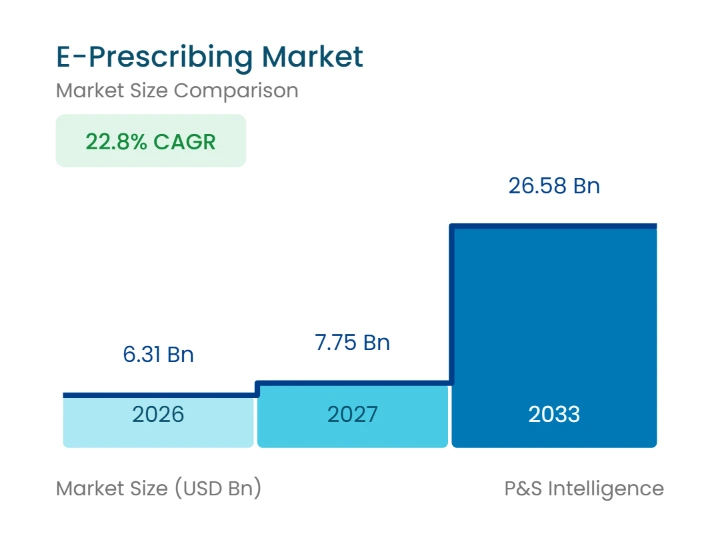
| Market Size in 2026 | USD 6.31 Billion |
| Market Size in 2027 | USD 7.75 Billion |
| Market Size by 2033 | USD 26.58 Billion |
| Projected CAGR | 22.8% |
| Largest Region | North America |
| Fastest Growing Region | APAC |
| Market Structure | Moderately Fragmented |
Explore the market potential with our data-driven report
The global e-prescribing market is valued at USD 6.31 Billion in 2026 and is projected to climb to USD 7.75 Billion in 2027. By 2033, revenue is expected to reach USD 26.58 Billion, expanding at a CAGR of 22.8% during 2027-2033. Physician groups, hospital systems, and pharmacy chains are paying for prescribing software and network connections because regulators and payers increasingly expect controlled-substance orders, drug-cost checks, and prior authorizations to move electronically. For software vendors, prescribing is turning from a basic EHR feature into a recurring compliance purchase.
U.S. prescribers routing medication orders to retail and mail-order pharmacies create the transaction volume that recurring software and routing fees depend on. Surescripts recorded 2.64 billion e-prescriptions filled in 2025 and 30.5 billion transactions across its network in the same year, so the network now carries far more traffic than the prescriptions alone. The rest includes medication history, benefit checks, and clinical record exchanges, and each added transaction type gives EHR vendors and network operators another service to price on top of a prescriber base that is already connected.
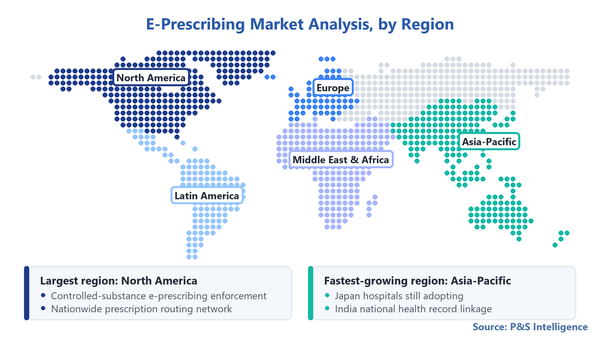
North America accounts for more than half of 2026 revenue, anchored by the United States, where federal controlled-substance rules and a national routing network have moved most prescribing off paper, with Canada adding demand as it shifts to an open national standard. APAC is set for the quickest expansion, at a 26.8% CAGR during 2027-2033, as Japan extends electronic prescribing from pharmacies into hospitals and India builds national health records that prescribing tools can connect to. North American e-prescribing market revenue comes mostly from upgrading systems already in place, while APAC revenue comes from sites connecting for the first time.
EHR developers and standalone prescribing vendors are now expected to deliver drug-cost and approval steps inside the prescribing screen, tasks that clinics once handled by phone, fax, or a payer portal after the prescription was sent. A prescriber who sees a patient's out-of-pocket cost and files a prior authorization in the same workflow can switch to a covered drug before the order reaches the pharmacy. That changes how health systems compare products, since a basic routing module no longer covers the functions their prescribers use every day.
The HTI-4 final rule from the Assistant Secretary for Technology Policy and Office of the National Coordinator for Health Information Technology (ASTP/ONC), finalized on July 31, 2025, requires any health IT module certified for electronic prescribing to also be certified for real-time prescription benefit. It also makes previously optional electronic prior authorization transactions mandatory for that criterion. Certified products must use the National Council for Prescription Drug Programs (NCPDP) SCRIPT standard version 2023011 after January 1, 2028. The rule raises development costs for smaller software makers, while vendors already shipping these functions face a shorter path to recertification.
Medicare prescribers of opioids, stimulants, and other Schedule II-V drugs are a direct source of mandated spending, because paper and fax orders for these drugs now count against their compliance rate. Electronic prescribing for controlled substances (EPCS) requires identity proofing, two-factor credentials, and audited software, so a practice that has kept these drugs on paper usually has to buy an EPCS add-on, credentialing services, or a fuller prescribing license. Each of these steps is a separate line item that vendors can bundle with onboarding support.
Under the EPCS program run by the Centers for Medicare & Medicaid Services (CMS), a prescriber complies when at least 70% of qualifying Medicare Part D controlled-substance prescriptions are sent electronically, and the non-compliance notification period for measurement year 2025 began in September 2026. Where evidence of fraud, waste, or abuse is present, CMS notes that non-compliance could lead to referral to law enforcement or revocation of billing privileges. Notices of that kind can turn a long-standing rule into a near-term purchase decision for lagging practices. Long-term care prescriptions enter the compliance count no earlier than January 1, 2028.
European EHR suppliers and pharmacy software vendors face a defined upgrade cycle as national e-prescription services are brought under common data requirements. Each country built its own service, so a prescription written in one member state often could not be dispensed electronically in another. Aligning those formats requires changes to both prescribing and dispensing modules, which creates replacement and integration work in countries that digitized early, as well as in those still moving off paper. The work arrives on a legal timetable, which makes it easier for vendors to plan staffing and pricing.
The European Commission confirms that the European Health Data Space Regulation entered into force on March 26, 2025, with its first group of priority data categories (patient summaries, ePrescriptions, and eDispensations) applying from March 2029. EHR systems that handle these categories will have to meet the regulation's harmonized requirements, so hospitals and clinics are likely to schedule software upgrades or replacements ahead of that date. Vendors holding certifications in several member states could convert this compliance work into multi-country contracts, an advantage single-market suppliers would find harder to match.
Hospitals are slower and more expensive to convert than pharmacies, because electronic prescribing has to connect to order-entry systems, hospital formularies, and clinician credentials that span many departments. Each interface change usually goes through the hospital's capital budget and its EHR vendor's release schedule, so adoption can stall for years after pharmacies are ready to receive electronic orders. That lag delays license and integration revenue in the settings where prescribing volume per site tends to be highest.
In Japan, Ministry of Health, Labour and Welfare (MHLW) figures for June 2026 put electronic prescription adoption at 90.5% of pharmacies but only 20.9% of hospitals, more than three years after the national service launched in January 2023. With most hospitals still issuing paper, pharmacies that invested in electronic intake receive only part of the volume they were equipped for, and vendors selling into hospital accounts face longer sales cycles. Cloud-hosted modules that reduce on-site interface work could narrow the gap, though hospital budgets will still set the pace.
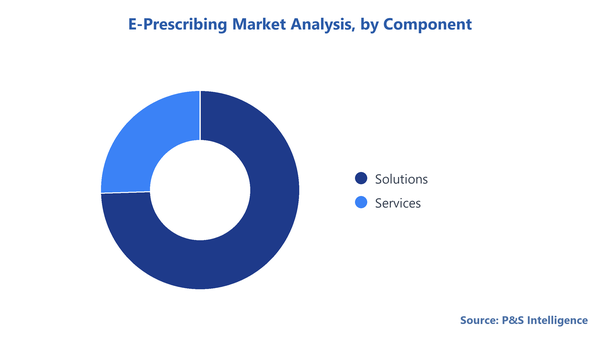
Solutions account for 74.5% of e-prescribing market revenue in 2026, since every prescriber who sends orders electronically needs a licensed module, either embedded in an EHR or sold as standalone software. Licenses are often sold on a per-prescriber subscription, so revenue recurs without a new feature purchase. Controlled-substance functions raise the cost of entry, as the Drug Enforcement Administration (DEA) requires an EPCS application to pass a third-party audit or DEA-approved certification before use, and again every two years or whenever related functions change. That audit cycle tends to keep controlled-substance prescribing inside established vendors' product lines.
Services are projected to grow faster, at a 24.6% CAGR during 2027-2033. Each change to prescribing standards, benefit-check rules, or national exchange requirements creates interface work that hospitals and practices rarely complete with in-house staff. Health systems switching EHR platforms also need prescription histories migrated, prescriber credentials re-enrolled, and pharmacy connections retested before go-live. Several of these upgrade deadlines fall between 2027 and 2029 in the United States and Europe, giving implementation partners and vendors' professional services teams a steady pipeline of integration and training contracts.
Cloud-based delivery accounts for 81.3% of revenue in 2026, largely because many prescribers work in practices too small to run their own servers. Survey data from the American Medical Association (AMA) show that 47.4% of U.S. physicians worked in practices with 10 or fewer physicians in 2024. Practices of that size rarely employ dedicated IT staff, so a hosted prescribing tool that the vendor patches, recertifies, and connects to pharmacy networks costs them less than software maintained on site. Hospital systems with their own data centers make up much of the remaining on-premises base.
Cloud-based deployment is also projected to grow fastest, at a 23.9% CAGR during 2027-2033. Prescribing rules now change every few years, and a hosted platform can push a new standard version or benefit-check function to every customer in a single release. On-premises customers must test and install each upgrade themselves, which raises their compliance costs. Government exchange services in Germany, Japan, and Brazil also run as central hubs that local software reaches over the internet, so new prescribers in those markets are more likely to start on hosted tools. For vendors, revenue shifts toward subscriptions and away from one-time license sales.
Hospitals hold the largest share of end-user revenue, owing to the number of clinicians, wards, and discharge prescriptions that a single facility's prescribing system has to serve. The American Hospital Association (AHA) counts 35,658,583 admissions at U.S. hospitals in 2024, a figure that sizes the volume of inpatient care rather than e-prescription use, though many of those stays end with medicines sent electronically to a retail pharmacy. Hospitals also buy prescribing within enterprise EHR contracts, so one award covers thousands of prescribers at once, which typically makes a hospital account worth more to a vendor than a single clinic.
Pharmacies are expected to grow fastest among end users during 2027-2033, as each new transaction type added to prescribing workflows has to be received, answered, or recorded at the dispensing counter. Change requests, cancellations, and benefit-check responses all pass through pharmacy management systems, and national services are adding dispensing duties of their own. Japanese pharmacies record dispensing results in the national prescription management service, and Brazilian pharmacies must log each use of an electronic controlled-medicine prescription in the national control system. Pharmacy software vendors and chains therefore face integration spending that recurs with every rule change.
Controlled substances account for the larger share of revenue, since a prescriber cleared to send these orders electronically pays for more than the base prescribing license. Identity checks, credential tokens, and audit-ready software are each added to the contract, and state rules can add steps on top of federal ones. The New York State Department of Health, for example, requires computer applications used for controlled-substance prescriptions to be registered with its Bureau of Narcotic Enforcement, under an electronic prescribing mandate in force since March 27, 2016. Each extra step can raise revenue per prescriber for EPCS vendors and credentialing partners.
Non-controlled substances are projected to grow faster during 2027-2033, because several national e-prescription services outside the United States digitized routine medicines first and kept controlled drugs on a separate, slower track. In Germany, narcotics prescriptions still run on paper, and a draft ordinance the federal government sent to the Bundesrat on November 4, 2026 would test electronic narcotics prescriptions in model regions before any nationwide rollout. New prescribers joining national services in Asia, Europe, and Latin America therefore add mostly routine prescription volume, which tends to favor vendors whose pricing scales with transaction counts.
The following segments are analyzed in this report.
North America accounts for 54.0% of global revenue in 2026. Its largest market, the United States, combines federal enforcement on controlled-substance prescribing, certification rules that now fold benefit checks into prescribing software, and one routing network that carries nearly all of the country's electronic prescription traffic. With most prescribing already electronic, U.S. spending comes mostly from upgrades, add-on modules, and per-transaction fees on a mature installed base. That mix favors vendors with large existing customer counts, since growth depends on selling more functions to prescribers who are already connected.
Canada is changing its delivery model. According to Canada Health Infoway, national adoption of its centrally operated PrescribeIT service had not reached the level required for long-term sustainability, and the agency set May 29, 2026 as the service's end date while making a national standard for electronic prescribing publicly available to jurisdictions and vendors. Moving from a federally funded hub to a standards-based model shifts integration work to EHR developers and pharmacy software providers. North America's share is likely to ease gradually as faster-digitizing regions grow from smaller bases, even as regional spending keeps rising.
Revenue in APAC is projected to climb faster than in any other region, at a 26.8% CAGR during 2027-2033. Governments in the region are building national prescription services and patient record systems first, giving clinics and pharmacies a central service to connect to and creating first-time software purchases at sites that have never sent a prescription electronically. Japan's pharmacies joined its national electronic prescription service soon after the 2023 launch, while most hospitals have yet to follow. Australia, where electronic prescriptions have been issued since 2020, adds upgrade demand on a more mature base.
India, the region's fastest-growing market, is laying the record infrastructure that prescribing software will connect to. A Press Information Bureau backgrounder dated July 6, 2026 states that over 104 crore (more than 1 billion) health records had been linked to over 93 crore Ayushman Bharat Health Account (ABHA) accounts. That count covers all linked record types and does not measure e-prescription volume. It does give clinics adopting prescribing tools a national patient identifier to attach prescriptions to, and vendors with low-cost hosted products sized for small clinics could turn more of this base into paying users.
Europe ranks behind North America in regional revenue, with spending shaped by national mandates that have already moved most outpatient prescribing onto state-run exchanges. Germany made electronic prescriptions compulsory nationwide from the start of 2024, and gematik, the national digital health agency, recorded the one-billionth redeemed E-Rezept on October 17, 2025. In England, NHS Business Services Authority statistics indicate that 1.16 billion items, 97% of all items dispensed, went through the Electronic Prescription Service in 2025/26.
With electronic transmission close to universal in these two markets, European vendor revenue comes increasingly from workflow additions, such as the link between German e-prescriptions and the electronic medication list in patient records since January 2025, and from preparing for common cross-border data requirements. France, Italy, and Spain are at different stages of the same shift, giving EHR and pharmacy software suppliers with multi-country certifications more national contracts to bid on. Regional growth is therefore likely to track regulatory deadlines closely.
Latin America contributes a smaller share of global revenue, and Brazil is where the clearest regulatory change is under way. Brazilian prescribers have long used numbered paper forms for controlled medicines, and Anvisa, the national health regulatory agency, is moving that workflow online. Under Resolution RDC 1,000/2025, Anvisa set rules for issuing and dispensing electronic prescriptions, and its National Prescription Control System (SNCR) began offering electronic issuance and control functions from September 30, 2026. Prescribing systems must integrate with SNCR to use those functions.
That integration requirement is a defined task that local EHR developers, telehealth platforms, and pharmacy chains have to complete before they can use the electronic route. Paper forms remain valid, and the Federal Pharmacy Council (CFF) reports that the transition period for electronic special-control and retention prescriptions was extended to March 3, 2027, so prescriber adoption is likely to build gradually. Vendors that complete SNCR integration early would hold a working reference implementation, which could help them in Mexico and Argentina if those markets update their own prescribing rules.
The Middle East & Africa accounts for the smallest regional share, with the clearest demand in Gulf states that run government-mandated prescribing platforms. In the United Arab Emirates, Ministerial Decree No. 379 of 2019 created a unified platform for prescribing and dispensing narcotic, controlled, and semi-controlled medicines. Abu Dhabi's Department of Health has activated it in stages, announcing an inpatient module in an April 2024 circular and switching on an inventory module from July 15, 2024. Facilities covered by these rules have to connect their EHR or pharmacy systems to the platform.
Saudi Arabia runs a comparable national model through its Wasfaty service, which lets patients of Ministry of Health facilities collect prescribed medicines from private pharmacies. Platform-led systems of this kind keep the routing layer in government hands, so commercial spending concentrates on EHR modules, interfaces to the national platforms, and staff training each time a new module goes live. Suppliers with Arabic-language interfaces and approved integrations with these platforms could have an edge in Gulf hospital tenders.
The following geographies are analyzed in this report.
The e-prescribing market is moderately fragmented at the software layer, where a broad set of EHR developers and a smaller group of standalone prescribing specialists compete for prescribers, and concentrated at the U.S. routing layer, where one network carries nearly all electronic prescription traffic. Certification rules and EPCS audits set a fixed cost of entry, but they apply to every developer equally and do not stop established EHR vendors from adding prescribing to their suites. The structure is stable, since prescribing is rarely bought apart from the EHR, and the routing network gains value as more prescribers and pharmacies join.
Vendors split by how prescribing reaches the user. Suite vendors such as Epic Systems, Oracle Health, athenahealth, and eClinicalWorks sell prescribing inside enterprise or ambulatory EHR contracts and compete on workflow integration, hospital pharmacy links, and the breadth of their installed base. DrFirst competes as a specialist, licensing its prescribing platform and EPCS credentialing to other EHR developers and offering a mobile app for independent prescribers. Surescripts operates the network these products route through. CoverMyMeds and Change Healthcare add a pharmacy-benefit layer, embedding prior authorization and benefit checks into the same prescribing workflow.
For health systems, the prescribing decision is usually made once, during EHR selection, and changing it later means replacing or re-integrating the wider record system. Independent practices have more choice, since standalone and cloud-based tools connect to the same pharmacy network through common NCPDP standards, which supports active price competition in the small-practice tier. Competition at the network level is narrower, because a new routing network would need pharmacies and prescribers to connect at the same time.
Want a report tailored exactly to your business need?
Request CustomizationEmpowering Leaders Across the Globe
Leading companies across industries trust us to deliver data-driven insights and innovative solutions for their most critical decisions. From data-driven strategies to actionable insights, we empower the decision-makers who shape industries and define the future. From Fortune 500 companies to innovative startups, we are proud to partner with organisations that drive progress in their industries.



Working with P&S Intelligence and their team was an absolute pleasure – their awareness of timelines and commitment to value greatly contributed to our project's success. Eagerly anticipating future collaborations.
McKinsey & Company
India
Our insights into the minutest levels of the markets, including the latest trends and competitive landscape, give you all the answers you need to take your business to new heights

We take a cautious approach to protecting your personal and confidential information. Trust is the strongest bond that connects us and our clients, and trust we build by complying with all international and domestic data protection and privacy laws

Customize the Report to Align with Your Business Objectives

Request the Free Sample Pages