Drip Irrigation Market Size Forecast
Key Highlights
| Study Period | 2021 - 2032 |
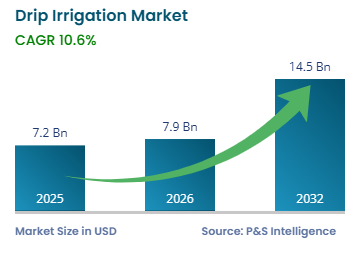
| Market Size in 2025 | USD 7.2 Billion |
| Market Size in 2026 | USD 7.9 Billion |
| Market Size by 2032 | USD 14.5 Billion |
| Projected CAGR | 10.6% |
| Largest Region | Asia-Pacific |
| Fastest-Growing Region | Asia-Pacific |
| Market Structure | Moderately Consolidated |
Market Size
Explore the market potential with our data-driven report
Drip Irrigation Market Key Insights
- Emitters/drippers accounted for the largest revenue share, of 35%, in 2025.
- The subsurface category has the higher CAGR during 2026–2032, of 10.8%.
- Cereals & grains accounted for the largest share, of 40%, in 2025.
- Greenhouse/controlled-environment agriculture has the highest CAGR, of 11.2%.
- Asia-Pacific held the largest regional share, of 40%, in 2025, and it has the highest CAGR, of 11.4%.
Drip Irrigation Market Future Outlook
The global drip irrigation market stood at USD 7.2 billion in 2025 and is projected to reach USD 14.5 billion by 2032, expanding at a compound annual growth rate of 10.6% over 2026–2032. This growth is driven by escalating water scarcity pressures, expanding precision agriculture adoption, and widening government subsidy programs that compress system payback periods for commercial growers across both developed and emerging economies.
Drip irrigation delivers water directly to the root zone, reducing consumption by 50–60% compared to conventional flood irrigation and improving crop yields by up to 90%, depending on crop type and climate conditions. The integration of IoT sensors, AI-based scheduling platforms, and remote monitoring controllers is elevating system performance, enabling growers to optimize fertigation cycles and respond in real time to soil moisture variability.
Agriculture's substantial share of global freshwater demand has placed efficient micro-irrigation systems at the center of global water governance frameworks. The Food and Agriculture Organization (FAO) affirms that agriculture accounts for almost 70% of global freshwater withdrawals. Escalating water scarcity and expanding precision agriculture adoption are accelerating uptake, while widening government subsidy programs compress system payback periods for commercial growers across both developed and emerging economies.
Drip Irrigation Market Trends & Drivers
Precision Agriculture and IoT Integration Are Major Trends
The convergence of precision agriculture methodology with IoT connectivity is reshaping drip irrigation from a passive water delivery infrastructure into an active, data-driven farm management platform. This transformation is expanding the market's addressable value pool well beyond hardware. Soil moisture sensors, weather-adaptive controllers, AI-based scheduling algorithms, and cloud-connected fertigation systems are now routinely integrated with drip laterals, enabling growers to optimize application volumes, timing, and nutrient delivery at the individual emitter level.
AI-based irrigation systems have demonstrated significant reductions in water consumption of up to 30–50% and notable improvements in crop yields of around 20–30% in field and experimental deployments. The technological transition is also driving component upgrade cycles, as existing drip infrastructure is retrofitted with smart controllers and pressure-compensating emitters, generating recurring service and software subscription revenue for leading suppliers. The FAO affirms that precision water management technologies are central to achieving global sustainable development targets under SDG 6.4.
Global Water Scarcity and Government Subsidies Drive Market
Accelerating groundwater depletion and intensifying droughts are making conventional flood and furrow methods operationally unsustainable, lifting demand for drip irrigation systems. Over 2 billion people live under water stress, and regulatory frameworks in major farming nations are progressively incentivizing the transition to precision micro-irrigation. As aquifer levels fall and water tariffs rise, growers face compressing margins on flood-irrigated operations, making capital investment in drip systems economically rational within three seasons for high-value crops.
Government subsidy programs amplify this economic signal. The United States Environmental Quality Incentives Program (EQIP) and India's Pradhan Mantri Krishi Sinchayee Yojana (PMKSY) Per Drop More Crop (PDMC) scheme represent substantial public investments in micro-irrigation access. Saudi Arabia mandates drip adoption on new commercial farms and channels targeted grants toward irrigation modernization. Intensifying climate variability and tightening aquifer management regulations across the U.S., EU, India, and China are converting latent adoption potential in mid-scale farming operations into active procurement activity.
The FAO confirms that agriculture accounts for approximately 70% of global freshwater withdrawals, rising to around 90% in many developing countries. The agency further highlights that 3.2 billion people live in agricultural areas experiencing high to very high water scarcity, including 1.2 billion in severely water-constrained farming regions. UN-Water estimates that around 4 billion people face severe water scarcity for at least one month per year, directly affecting irrigation capacity and crop yields. FAO data also shows that renewable freshwater availability per capita has declined by approximately 7% over the past decade even as agricultural demand continues to rise. Irrigated agriculture currently covers only around 20% of global farmland yet produces roughly 40% of the world's food, concentrating the consequences of water scarcity on the most productive land.
Untapped Agricultural Area in Emerging Economies Offers Opportunities
Despite rapid growth in micro-irrigation deployment, the global drip irrigation market remains significantly underpenetrated relative to its addressable land base. Latin America's smallholder farming sector and Southeast Asia's expanding horticultural production zones represent underdeveloped frontiers where agroclimatic conditions, crop economics, and rising water stress collectively favor adoption.
High upfront installation costs typically ranging between USD 1,200–2,800 per hectare, along with limited technical extension services, and fragmented land holdings are progressively being addressed through modular low-cost drip kit designs, solar-powered pump integration, and microfinance-linked subsidy delivery models. The World Bank identifies irrigation modernization as a core lever for agricultural productivity improvement in low- and middle-income countries and provides programmatic and financial backing to reduce adoption barriers for smallholder farmers across Africa, Southeast Asia, and Latin America.
High Installation Costs and Technical Complexity Hamper Market Growth
Drip irrigation adoption among smallholder farming communities remains materially constrained by capital barriers and knowledge gaps that subsidy programs only partially address. System installation costs of USD 1,200–2,800 per hectare represent a prohibitive threshold for farmers operating on less than two hectares, even after government subsidies, due to disbursement structures that require upfront expenditure followed by reimbursement. Beyond cost, drip systems require sustained technical competence for emitter maintenance, filtration management, and fertigation calibration. The infrastructure to deliver such support remains inadequate across low-income agricultural regions.
Clogging from poor-quality water sources and degradation of polyethylene components from UV exposure add maintenance cost burdens that discourage sustained system use in resource-constrained settings. Low-cost drip kit innovations, including porous clay pipe systems, bucket drip kits, and thin-walled tape systems, are designed for smallholder applications, with system costs typically priced below USD 300 per unit, improving affordability for marginal farmers. This restraint is expected to persist, moderating gradually as financing models and extension infrastructure mature across key emerging markets. The Ministry of Agriculture and Farmers Welfare, Government of India confirms that adoption rates vary significantly by state, reflecting the critical role of administrative capacity and farmer outreach in determining penetration outcomes.
Drip Irrigation Market Segmentation Analysis
Component Analysis
Emitters/drippers accounted for the largest revenue share in the global drip irrigation market in 2025. They are the core functional unit of every drip system — the precise point of water and nutrient delivery to the root zone. High replacement frequency driven by clogging, UV degradation, and routine maintenance generates recurring procurement demand independent of new system installations. Broad applicability across crop types, farm sizes, and geographic environments sustains baseline sales volume, while continuous product innovation in pressure-compensating and anti-clogging designs drives demand upgrades within existing system footprints. Emitters are also the primary entry point for IoT integration, with sensor-embedded and remotely addressable dripper units driving component premiumization in North America and Europe.
Drip tubes/drip lines are the fastest-growing product segment during 2026–2032. Large-scale government irrigation modernization programs across India, China, and Sub-Saharan Africa are driving high-volume lateral deployment across broad acreage. Declining material costs and rising demand for biodegradable and thin-walled drip tape configurations suited to annual crop applications are propelling this category.
The market segments into the following components:
- Emitters/Drippers (Largest Category)
- Drip Tubes/Drip Lines (Fastest-Growing Category)
- Pressure Pumps
- Filters
- Valves, Fittings & Accessories
- Others
Application Analysis
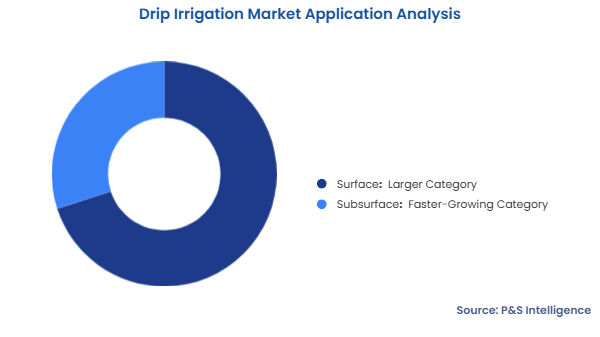
The surface category accounted for the larger revenue share, of 70%, in the global drip irrigation market in 2025. Lower installation costs relative to subsurface systems, simpler design requiring less specialized labor, and compatibility with the widest range of annual crops underpin this position. For sugarcane, cotton, corn, and vegetables, above-ground lateral placement enables rapid deployment and seasonal reconfiguration. Surface systems are also the default configuration supported by government subsidy programs across India, China, Brazil, and the Middle East, where standardized installation guidelines and program-approved equipment lists favor established surface configurations. Rapid deployment capability makes surface drip the preferred choice for smallholder adoption programs, where installation speed and ease of maintenance are decisive procurement factors. The Ministry of Agriculture and Farmers Welfare, Government of India highlights the widespread adoption of drip irrigation systems under the PMKSY Per Drop More Crop initiative, with surface drip configurations commonly used across smallholder farming applications.
The subsurface category is the faster-growing installation type during 2026–2032, registering a CAGR of 10.8%. Orchard, vineyard, and permanent crop operators are seeking to eliminate evaporative losses, suppress weed pressure, and extend system operational life. Groundwater extraction restrictions under California's Sustainable Groundwater Management Act, EU water framework directives, and rising electricity tariff pressures are incentivizing adoption of subsurface systems' efficiency advantages.
The market segments into the following applications:
- Surface (Larger Category)
- Subsurface (Faster-Growing Category)
Crop Type Analysis
Cereals & grains accounted for the largest share, of 40%, in the global drip irrigation market in 2025. The sheer scale of wheat, corn, rice, and sugarcane cultivation worldwide underpins this position. As per FAOSTAT data, wheat covers over 220 million hectares globally, followed by maize at over 200 million hectares, and rice (paddy) at about 165 million hectares. In China, drip-under-mulch systems have been extensively deployed for corn and wheat in Xinjiang and Hebei provinces.
In the U.S., expanding drip adoption in row crops such as corn across the Midwest is steadily widening cereal and grain penetration beyond traditional horticultural drip strongholds. Federal cost-share programs and soil moisture sensor integration are accelerating this shift. The United States Department of Agriculture indicates that grains and oilseeds are among the key crops cultivated on irrigated cropland in the U.S., while long-term trends show improvements in irrigation efficiency and water-use intensity.
Fruits & vegetables are the fastest-growing crop category during 2026–2032, registering a CAGR of 10.9%. The global expansion of high-value export horticulture, greenhouse cultivation, and controlled environment agriculture is driving this trajectory. In these sectors, precise root-zone water and nutrient management directly translates into premium yield quality, marketable grade consistency, and reduced disease incidence. Rising consumer demand for fresh produce and government support for food security-oriented horticultural intensification across Asia-Pacific and the MEA are reinforcing adoption.
The FAO identifies horticultural intensification as a priority pathway for improving smallholder income and food security outcomes across developing economies. According to FAOSTAT, global fruit production reached approximately 900 million tonnes and vegetable production around 1.2 billion tonnes in 2023, with total crop production increasing by about 27% between 2010 and 2023.
The market segments into the following crop types:
- Cereals & Grains (Largest Category)
- Fruits & Vegetables (Fastest-Growing Category)
- Oilseeds & Pulses
- Turf & Ornamentals
- Others
End Use Analysis
Commercial farms accounted for the largest share, of 60%, in the global drip irrigation market in 2025. Economies of scale make precision irrigation most financially viable at commercial operation size, distributing drip infrastructure cost across sufficient cultivated area to achieve payback within two to three growing seasons for high-value crop portfolios. Large commercial operations in the U.S., Spain, Israel, Brazil, and Australia have led global drip adoption since the technology's commercial introduction, driving continued uptake through system expansions, technology upgrades, and fertigation system integrations. Commercial farms also represent the primary recipients of direct-to-grower distribution by major suppliers, whose agronomic service models are designed around commercial-scale system design and maintenance contracts.
Greenhouse/controlled-environment agriculture is the fastest-growing end-user segment during 2026–2032. Year-round crop production, urban and peri-urban farming expansion, and fully automated greenhouse operations in the Netherlands, Japan, South Korea, and the UAE are sustaining capital investment in precision drip infrastructure. In these environments, closed-loop fertigation management and zero-runoff water stewardship are operational requirements rather than optional optimizations, generating recurring system investment. The World Bank identifies commercial agricultural productivity improvement through irrigation modernization as a primary development finance priority, reinforcing capital availability for commercial farm system investments across emerging economies.
The market segments into the following end uses:
- Commercial Farms (Largest Category)
- Greenhouse/Controlled Environment Agriculture (Fastest-Growing Category)
- Residential/Landscape
Drive strategic growth with comprehensive market analysis
Drip Irrigation Market Geographical Analysis
Asia-Pacific Drip Irrigation Market Growth
Asia-Pacific held the largest regional share, of 40%, in the global drip irrigation market in 2025 and is the fastest-growing region over the forecast period, expanding at a CAGR of 11.4%. The region's extraordinary scale of irrigated agriculture and rapid government-led micro-irrigation expansion across China, India, and Southeast Asia underpin this dual position. Government mandates, smallholder scheme expansion, and rising private-sector investment in smart drip systems are collectively driving market formation.
China holds the largest country revenue share within the region, with commercial-scale adoption concentrated in vegetable, fruit, and greenhouse operations. India is the fastest-growing country market within Asia-Pacific. Under the 14th Five-Year Plan, China has prioritized the expansion of water-saving irrigation technologies and the modernization of irrigation infrastructure to improve agricultural water-use efficiency.
China Drip Irrigation Market Dynamics
China is the largest country market within Asia-Pacific for drip irrigation. The world's largest irrigated agricultural area and a national policy imperative to improve water-use efficiency across water-stressed northern and northwestern provinces establish this position. Under the 14th Five-Year Plan (2021–2025), China's Ministry of Water Resources and Ministry of Finance committed to renovating 461 medium-sized irrigation districts and converting 33 million hectares of irrigation areas to high-standard farmland. Water-saving transformation is a central objective across the Yellow River Basin and major grain-producing zones. Drip adoption has accelerated in Xinjiang, Inner Mongolia, and Gansu, where cotton, corn, and vegetable production under film-mulched drip configurations has achieved water savings of 30–50% versus conventional flood systems.
The Ministry of Water Resources reports that investment in water conservancy construction reached RMB 1.35 trillion in 2024, with water-saving agricultural irrigation a core national priority. In 2021, China unveiled a plan to increase its area of high-standard farmland to 71.67 million hectares by 2025 and 80 million hectares by 2030, creating a structural foundation for sustained drip irrigation deployment. Growing domestic manufacturer competitiveness and accelerating IoT integration in commercial irrigation operations are expanding market reach beyond government-mandated program areas.
India Drip Irrigation Market Expansion
India is the fastest-growing country market within Asia-Pacific, with more than 4.5 million hectares under drip irrigation as of 2024. Under the PMKSY–Per Drop More Crop (PDMC) scheme, India has provided 55% financial assistance to small and marginal farmers and 45% to other farmers, resulting in cumulative micro-irrigation coverage of approximately 95.58 lakh hectares between 2015–16 and 2024–25. Maharashtra, Andhra Pradesh, Gujarat, Karnataka, and Telangana lead adoption, with drip systems delivering documented yield improvements of 36–80% across sugarcane, banana, and cotton.
The INR 5,000-crore Micro Irrigation Fund (MIF) administered through the National Bank for Agriculture and Rural Development (NABARD) provides low-interest loans to state governments for further scheme expansion. The Ministry of Agriculture and Farmers Welfare reports that PMKSY disbursed INR 21,968.7 crore (USD 2.6 billion) between fiscal years 2016 and 2025, subsidizing drip and sprinkler adoption across all Indian states. Expanding RKVY-integrated support, rising private-sector competition, and growing adoption in northeastern and Himalayan states are broadening the market's geographic base.
North America Drip Irrigation Market Outlook
North America's drip irrigation market is anchored by the United States, where commercial-scale adoption of precision irrigation is well advanced across row crops, vineyards, and greenhouse operations. Mature agricultural infrastructure, longstanding federal incentive frameworks, and strong private-sector investment in smart irrigation technologies are sustaining market growth. State-level groundwater regulations under the Sustainable Groundwater Management Act (SGMA) are encouraging irrigation efficiency improvements in California, where over 4 million acres are under drip and other low-flow micro-irrigation systems.
Canada is the fastest-growing country market within North America. The federal AgriInvest and Canadian Agricultural Partnership programs extend irrigation modernization support to prairie and horticultural producers. Declining sensor costs and the mainstreaming of precision agronomy are expanding subsurface drip adoption beyond premium horticulture into broad-acre field crops.
U.S. Drip Irrigation Market Forecast
The U.S. is the largest country market in North America, with deep penetration across commercial horticulture, vineyards, row crops, and rapidly expanding greenhouse operations. The economic importance of high-value crops is reflected in trade performance, with specialty crop exports reaching USD 22.5 billion in FY2020, accounting for 15% of total U.S. agricultural exports. Concentrated program funding is compressing capital recovery periods to under three seasons for high-value specialty crop producers.
California remains the epicenter of national adoption, with SGMA provisions compelling growers to shift from flood and furrow systems toward closed-loop drip configurations. IoT-enabled controllers, AI-based scheduling platforms, and subsurface drip conversion projects are driving the market's technology transition.
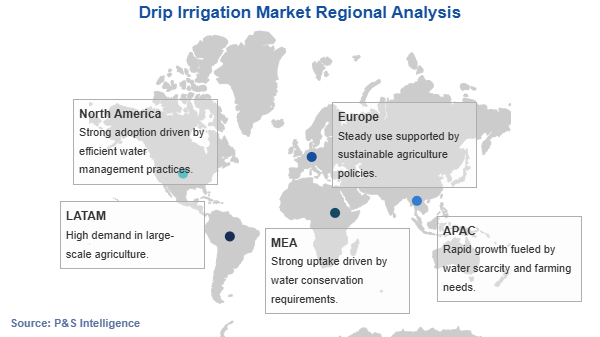
The regions and countries analyzed in this report include:
- North America
- U.S. (Largest Country Market)
- Canada (Fastest-Growing Country Market)
- Europe
- Germany (Largest Country Market)
- U.K. (Fastest-Growing Country Market)
- France
- Italy
- Spain
- Rest of Europe
- Asia-Pacific (Largest & Fastest-Growing Region)
- China (Largest Country Market)
- India (Fastest-Growing Country Market)
- Japan
- South Korea
- Australia
- Rest of APAC
- Latin America
- Brazil (Largest Country Market)
- Mexico (Fastest-Growing Country Market)
- Rest of LATAM
- Middle East & Africa
- Saudi Arabia (Largest Country Market)
- South Africa
- U.A.E. (Fastest-Growing Country Market)
- Rest of MEA
Drip Irrigation Market Share Analysis
The global drip irrigation market exhibits a moderately consolidated competitive structure. The capital intensity of manufacturing precision emitters, drip tubes, and fertigation components at commercial scale favors vertically integrated producers with established supply chains. The agronomic complexity of system design and installation creates customer dependency on technically capable suppliers with regional service networks. Growing integration of proprietary digital platforms — cloud-based schedulers, IoT controllers, and AI-driven agronomic advisory tools — is building switching costs that protect incumbent positions against hardware-only challengers.
Moderate market concentration also reflects the geographic diversity in demand, as differing climates, crop profiles, and subsidy frameworks favor suppliers with broad geographic footprints over narrow specialists. Competitive intensity is increasing at the intersection of hardware and digital services, as established players accelerate investment in cloud-based irrigation management platforms to generate recurring software revenue and deepen customer relationships beyond commodity component replacement cycles.
Leading Companies in the Drip Irrigation Market:
- Netafim Limited
- Jain Irrigation Systems Ltd.
- Rain Bird Corporation
- The Toro Company
- Hunter Industries Inc.
- Rivulis Irrigation Ltd.
- Lindsay Corporation
- Valmont Industries Inc.
- Elgo Irrigation Ltd.
- Irritec S.p.A.
- Grupo Azud
- Chinadrip Irrigation Equipment Co. Ltd.
Drip Irrigation Market News
- In December 2025, The Toro Company launched the Toro Aqua Traxx Azul REvive drip tape, manufactured using recycled agricultural plastic resins. The product targets commercial growers and large-scale agricultural operations seeking to reduce environmental footprint without compromising water delivery performance.
- In October 2025, Rain Bird Corporation partnered with the California Water Efficiency Partnership (CalWEP) to launch the Direct Distribution Program, enabling CalWEP member water agencies to deliver smart drip conversion kits, smart controllers, sensors, and flow meters directly to end users across California.
- In November 2024, Netafim Italia S.r.l. acquired 100% of Tecnir S.r.l., a precision irrigation system design and installation company operating across Italy. The acquisition expands Netafim's technical service depth and design-to-installation capability in Southern Europe, a region of high drip penetration intensity among Mediterranean fruit and vegetable producers.
- In September 2024, Rivulis Irrigation Ltd. opened a 160,000-square-foot micro-irrigation manufacturing facility in Tijuana, Mexico, dedicated to production of T-Tape drip products using advanced film technology. The facility expands Rivulis's supply capacity to serve growers across the U.S., Mexico, and Canada.
- In February 2024, Hunter Industries Inc. partnered with Saudi Drip Irrigation Company to manufacture and distribute agricultural, residential, commercial, and golf irrigation system products across Saudi Arabia.