This Report Provides In-Depth Analysis of the Direct-to-Chip Cooling Components Market Report Prepared by P&S Intelligence, Segmented by Component (Cold Plates, Coolant Distribution Units (CDUs), Manifolds, Quick Disconnects), Cooling Solution (Phase) Type (Single-Phase, Two-Phase), Coolant Type (Water-Based / Water-Glycol Coolants, Dielectric Fluids, Mineral Oils, Engineered Fluids), Application (Data Center, High-Performance Computing (HPC), Supercomputers, Workstations, Edge Computing), End-Use Industry (Telecommunications, Financial Services / BFSI, Healthcare & Life Sciences, Aerospace & Defense, Oil & Gas), and Geographical Outlook for the Period of 2021 to 2032
Explore the market potential with our data-driven report
Direct-to-Chip Cooling Components Market Overview
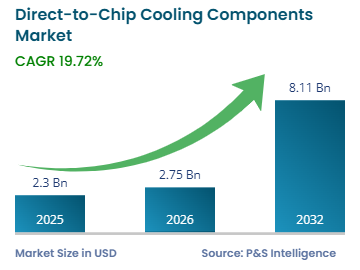
The direct-to-chip cooling components market was valued at USD 2.30 billion in 2025 and is estimated at USD 2.75 billion in 2026. It is projected to reach USD 8.11 billion by 2032, expanding at a CAGR of 19.72% during 2026-2032. Cloud operators and AI-chip designers are now buying cold plates, coolant distribution units, and quick-disconnect couplings as standard line items on server orders, because fans and chilled air alone can no longer pull enough heat off a modern GPU rack. That shift is turning cooling hardware into a recurring procurement category instead of a one-off facility upgrade.
Demand follows the rapid expansion of hyperscale and AI-focused data center capacity. Lawrence Berkeley National Laboratory's national data center energy usage report found that US data centers consumed 4.4% of total US electricity in 2023, up from 1.9% in 2018, a jump concentrated in AI training and inference facilities. Each new AI cluster commissioned at that pace needs its own cold plates, manifolds, and coolant distribution units before racks can power on, tying Direct-to-Chip Cooling Components Market growth directly to data center construction schedules instead of broader IT budget cycles.
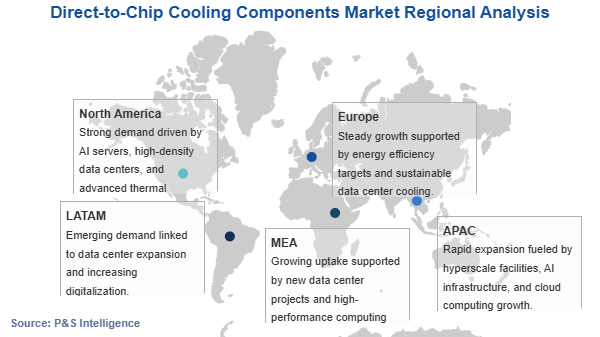
North America held 38% of 2025 revenue, anchored by hyperscale campuses across the U.S. and Canada that were among the earliest to standardize on direct-to-chip racks for AI training clusters. Asia-Pacific's growth outpaces every other region, with a 20.4% CAGR projected for 2026-2032 as China, Japan, South Korea, India, and Singapore commission new AI and cloud capacity instead of retrofitting older air-cooled halls. That contrast, upgrade-led demand in North America against greenfield buildout in Asia-Pacific, is pulling component orders toward the region building the newest capacity.
Key Market Insights
By component, cold plates held 41% of the market in 2025, while coolant distribution units (CDUs) are set to grow fastest through 2026-2032.
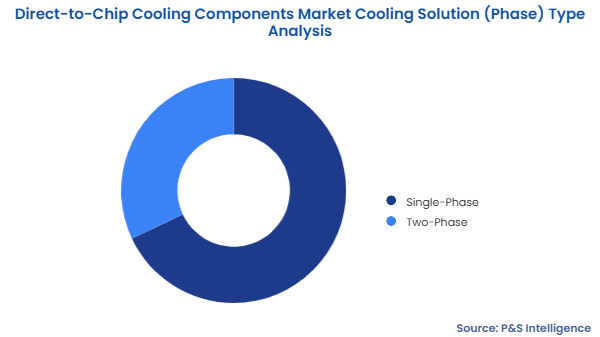
By cooling solution (phase) type, single-phase systems accounted for 68% of the market in 2025, while two-phase systems are on track to grow fastest through 2026-2032.
By coolant type, water-based / water-glycol coolants held 53% of the market in 2025, while dielectric fluids are set to grow fastest through 2026-2032.
By application, data center held 51% of the market in 2025, while high-performance computing (HPC) is on track to grow fastest through 2026-2032.
By end-use industry, telecommunications accounted for 48% of the market in 2025, while oil & gas is set to grow fastest through 2026-2032.
By geography, North America generated 38% of revenue in 2025, while Asia-Pacific is projected to grow at a 20.4% CAGR through 2026-2032.
Direct-to-Chip Cooling Components Market Trends and Growth Drivers
Escalating Accelerator Power Density Is Driving Cold Plate and CDU Purchases
AI accelerators now draw far more power per chip than the servers they replace, and every one of those watts has to leave the package as heat. A single high-end GPU or ASIC throws off a heat flux well beyond what fan-driven air handles reliably, so operators moving to these chips must add a cold plate and a liquid loop to each server or accept throttled performance. That equipment need turns a chip refresh into a Direct-to-Chip Cooling Components Market order.
The International Energy Agency reports that AI server power density rose roughly elevenfold between 2020 and 2025, with newer racks drawing 30 to 110 kilowatts against the 5 to 15 kilowatts a conventional server rack uses, a load air cooling struggles to remove even with precision airflow. Once a rack crosses that threshold, buying cold plates and a coolant distribution unit becomes close to unavoidable. Component vendors already qualified on the newest accelerator packages are best placed to win these deployments as each hardware generation raises the bar further.
Standardized Coupling Interfaces Are Opening the Door to Multi-Vendor Sourcing
Data center operators have historically had to commit to one cooling vendor's proprietary fittings once a rack was built, since cold plates, manifolds, and quick disconnects from different makers rarely mated. That lock-in made buyers wary of single-source risk on a component that touches every server in a cluster. A shared coupling interface removes that friction and lets an operator qualify more than one supplier for the same rack design instead of being tied to one vendor's full stack.
The Open Compute Project's Universal Quick Disconnect specification, now in its second revision, gives cold plate, manifold, and hose makers a common mechanical and thermal interface so hardware from different suppliers can be mixed within one loop. That commonality lets smaller component makers compete for sockets that used to go only to an incumbent's full stack, widening the qualified supplier list hyperscale buyers can draw from. Vendors that certify early to the shared specification gain access to design-ins they would otherwise miss.
Rising Copper Input Costs Are Constraining Component Price Competitiveness
Cold plates, manifolds, and much of the tubing in a direct-to-chip loop are built from copper because of its thermal conductivity, which leaves component makers directly exposed to the price of that metal. A sudden jump in copper input costs cannot be absorbed quietly on a part that already competes on price per kilowatt of heat removed, so it shows up quickly in either supplier margins or the quote a buyer sees.
A US Section 232 proclamation set a 50% tariff on imports of semi-finished copper products and copper-intensive derivatives, including tubes, pipes, and connectors, effective August 1, 2025. Component makers sourcing cold plates or manifolds from outside the U.S. now face that duty on top of the underlying metal price, a cost that is hard to pass through in a market where buyers routinely compare quotes across several qualified suppliers. Manufacturers with domestic copper fabrication or long-term supply contracts are better shielded than those buying on the spot market.
Liquid-Specific Thermal Guidelines Are Redefining Cooling Component Design Targets
Data center cooling equipment has long been designed against air-cooling temperature classes, leaving liquid-side supply and return temperatures, coolant chemistry, and system pressure to each vendor's own judgment. That gap forced cold plate and CDU makers to engineer bespoke specifications for every customer instead of building to one shared target, slowing qualification and adding cost to smaller production runs.
ASHRAE's Technical Committee 9.9 has published liquid-cooling environmental classes, labeled H1 through H3, alongside its long-standing air-cooling classes, with a further revision addressing AI-specific thermal density expected around 2026 to 2027. As those classes firm up, component makers can design a smaller number of standard coolant-distribution-unit and cold-plate models instead of custom builds per customer, cutting engineering cost per deployment. Buyers gain from shorter lead times once a supplier's catalog already matches the class their facility specifies.
Cold plates accounted for 41% of Direct-to-Chip Cooling Components Market revenue in 2025. A cold plate mounts on each CPU, GPU, or AI accelerator package and removes nearly all of that chip's heat, so a rack with eight accelerators needs eight cold plates against a single coolant distribution unit, keeping cold-plate volumes ahead of every other category. Accelerator vendors change package dimensions and hot-spot layouts often enough that cold plates need re-engineering nearly every generation, a pattern an arXiv-published cold-plate design study confirms, finding that microchannel geometry tuned to a chip's hot-spot map lowers thermal resistance versus a generic layout.
coolant distribution units are on pace to outgrow every other component category through 2026-2032. A CDU bridges the facility's chilled-water supply and the sealed fluid loop running through the servers, and as AI racks climb into the tens of kilowatts each, a single room-level CDU increasingly cannot serve enough racks to keep pace with cluster build-outs. Operators are responding by installing smaller CDUs at the row or rack level, multiplying the number of units needed per megawatt of compute deployed instead of relying on fewer large, central units.
Cooling Solution (Phase) Type
Single-phase cooling held 68% of the market's revenue in 2025. A single-phase loop keeps its water-glycol or dielectric coolant entirely liquid as it passes through the cold plate, which makes the hardware simpler to design, install, and service than a system managing a liquid-to-vapor phase change inside the plate. Operators already familiar with chilled-water plumbing can extend that expertise to a single-phase loop with little retraining of facilities staff, and integrators have standardized single-phase cold plates and CDUs across most mainstream server platforms, giving buyers a wider choice of interchangeable hardware.
Two-phase cooling is set to expand faster than single-phase through 2026-2032. A two-phase cold plate lets coolant boil as it absorbs heat, which removes more heat per unit of coolant flow than a single-phase loop and lets the system handle the highest-wattage accelerators without raising pump flow rates to impractical levels. As the newest AI accelerators push per-chip power well past what single-phase cold plates remove efficiently, server makers are qualifying two-phase cold plates for their highest-density platforms first, even though the added fluid-handling and leak-detection hardware raises cost.
Coolant Type
Water-Based and water-glycol coolants accounted for 53% of market revenue in 2025. Water carries heat more efficiently than most dielectric or engineered fluids and costs a fraction as much, so operators default to a water-glycol mix wherever the loop stays isolated from powered electronics behind a cold plate's sealed wall. Facilities teams already stock and maintain water-glycol chemistry for chillers elsewhere in the building, so extending it to the direct-to-chip loop avoids adding a second fluid-management discipline, keeping water-glycol the default choice for most new cold plate and CDU installations.
Dielectric Fluids are positioned to expand faster than any other coolant type through 2026-2032. Because a dielectric fluid does not conduct electricity, it can safely contact a powered chip package or connector if a fitting weeps, which matters more as each rack carries hundreds of thousands of dollars in accelerators that a water leak could damage. Operators running the newest, highest-density racks are increasingly specifying dielectric fluid for the highest-risk connections even where the rest of the loop still runs water-glycol, and that selective substitution is lifting dielectric fluid volumes faster than the broader coolant category.
Application
Data center applications accounted for 51% of market revenue in 2025. Hyperscale and colocation operators are commissioning new AI training and inference capacity faster than any other buyer group, and each new hall of GPU racks needs its own cold plates, manifolds, and CDUs before it can go live. That construction pace, combined with the sheer scale of a single hyperscale campus next to a university HPC cluster or an edge site, keeps data center deployments the largest single source of component demand.
High-performance computing is poised to outpace every other application in growth through 2026-2032. National laboratories and research agencies are standardizing new exascale-class systems on direct-to-chip cooling over air, a shift illustrated by the US Department of Energy's liquid-cooled El Capitan supercomputer at Lawrence Livermore National Laboratory and further liquid-cooled systems planned for delivery through 2026. Each of these systems needs custom, high-density cold plate and CDU installations sized for research workloads in place of standard commercial racks, giving component makers design wins that carry a higher value per system than a typical cloud deployment.
End-Use Industry
Telecommunications accounted for 48% of market revenue in 2025 under the end-use classification used in this study, which groups carrier-neutral colocation operators and telecom-owned cloud and edge data centers together with traditional network operators. Telecom carriers and the colocation providers that serve them were among the earliest large buyers of dense compute infrastructure for 5G core, edge, and cloud services, giving this category a multi-year head start in cold plate and CDU installations over industries that only began deploying AI infrastructure more recently.
Oil & Gas is set to post the fastest growth among end-use industries through 2026-2032. Energy majors run large on-premises clusters for seismic imaging and reservoir simulation, and adding GPU acceleration to those workloads has pushed per-rack power well past what the air-cooled halls built for earlier-generation servers can remove. Many of these clusters also sit in hot, arid production regions where liquid cooling cuts facility energy costs more than in temperate climates, giving oil and gas operators an added incentive to retrofit existing compute halls with direct-to-chip hardware instead of delaying the upgrade.
The complete segmentation hierarchy is as follows:
Component
Cold Plates
Coolant Distribution Units (CDUs)
Manifolds
Quick Disconnects
Coolant Fluids / Others
Cooling Solution (Phase) Type
Single-Phase
Two-Phase
Coolant Type
Water-Based / Water-Glycol Coolants
Dielectric Fluids
Mineral Oils
Engineered Fluids
Application
Data Center
High-Performance Computing (HPC)
Supercomputers
Workstations
Edge Computing
Others
End-Use Industry
Telecommunications
Financial Services / BFSI
Healthcare & Life Sciences
Aerospace & Defense
Oil & Gas
Others
Drive strategic growth with comprehensive market analysis
North America Direct-to-Chip Cooling Components Market Outlook
North America held 38% of market revenue in 2025, the largest share of any region. The biggest cloud platforms, chip designers, and colocation operators are based in the U.S. and Canada, and their AI training clusters were among the first anywhere to standardize on direct-to-chip racks instead of air-cooled halls, giving the region a multi-year head start in cold plate and CDU installations. Local component-qualification programs run by US hyperscalers also shorten the path from a new accelerator launch to a cooling design win for suppliers already on an approved vendor list.
The U.S. is the region's largest market, anchored by hyperscale campuses clustered around Virginia, Texas, and the Pacific Northwest. The US Census Bureau's construction-spending survey shows private data center construction reached a USD 50.7 billion annualized rate by April 2026, up from USD 39.8 billion a year earlier, a pace that keeps pulling new cooling-hardware orders into the region even as growth elsewhere accelerates faster. Buyers here are now expanding and upgrading existing campuses more often than commissioning first-time deployments, a pattern that should hold North America's share steady even as its growth rate trails the newer build-out regions.
Asia-Pacific leads all regions on growth, expanding at a 20.4% CAGR during 2026-2032. Governments across the region are funding national AI-compute programs that require new data center capacity over the retrofit of existing halls common in more mature markets, and each new facility needs its cold plates, manifolds, and coolant distribution units installed from the first day of construction. Falling component costs are also letting mid-sized cloud and telecom operators in the region justify a direct-to-chip build where they might once have stayed with air cooling.
China is the region's largest market, while India is emerging as its fastest-growing one as domestic cloud and AI infrastructure investment accelerates. China's National Development and Reform Commission reports that the country's installed data center power capacity rose to roughly 40 gigawatts in 2026, up from 32 gigawatts at the end of 2025, under its national computing-hub program. Capacity growth at that pace should keep Asia-Pacific's build-out ahead of other regions through the rest of the forecast period, particularly as more new capacity is purpose-built for the highest-density AI racks.
Europe holds a smaller share of global revenue than North America or Asia-Pacific but is expanding steadily as more operators commission new AI and cloud capacity. National grid constraints across Germany, France, and the United Kingdom are pushing new facilities toward denser server layouts, which in turn require direct-to-chip hardware to fit more compute into a limited power allocation. Germany remains the region's most active market for new data center capacity, with automotive and industrial users adding to demand from cloud operators.
The European Union's Energy Efficiency Directive now requires data centers drawing 500 kilowatts or more of IT power to publicly report power usage effectiveness and related metrics each year, a disclosure requirement that gives operators a clear incentive to adopt cooling technology that measurably lowers those figures. Suppliers with local service and calibration support across multiple European countries are better placed to win this qualification-driven demand than single-market entrants.
Latin America's data center buildout remains small next to North America or Asia-Pacific, with activity concentrated in Brazil and Mexico. Brazil's government enacted the REDATA program in September 2026, granting qualifying data center projects relief from several federal taxes in exchange for meeting sustainability and domestic-use requirements, a policy aimed at drawing new digital infrastructure investment into the country over the coming decade. Every new facility built under that program needs its own cooling loop from the outset, giving component makers a defined pipeline of new-build projects over retrofits.
Mexico's Querétaro corridor is a second notable hub, built mainly around export-oriented cloud and colocation capacity serving the U.S. rather than the domestic market. Because that capacity is built to the same specifications US hyperscale buyers use, suppliers already qualified with Brazilian data center developers or on US-based approved vendor lists are best placed to pick up this adjacent demand without a separate qualification cycle.
Saudi Arabia anchors demand across the Middle East and Africa, a region that otherwise contributes a modest slice of global revenue. The country's Public Investment Fund has committed more than USD 100 billion through its HUMAIN platform to build data center capacity exceeding two gigawatts across eleven sites, all designed from the outset for the highest-density GPU racks instead of converted from older facilities. That scale gives component makers a rare pipeline of large, greenfield direct-to-chip projects within a single national market.
South Africa is a smaller but expanding source of demand, as regional cloud and colocation operators add capacity to serve businesses across the wider continent instead of concentrating around a single anchor project like Saudi Arabia's. Vendors already qualified on Saudi Arabia's sovereign AI projects can apply the same cold plate and CDU designs here, giving them a shorter path into this second, resource-backed buyer base than a supplier starting from scratch.
This report is categorized into the following geographies:
The Direct-to-Chip Cooling Components Market is moderately fragmented, with roughly 18 companies competing for design wins across cold plates, coolant distribution units, manifolds, and quick disconnects, and no single supplier holding a dominant share. Component fabrication draws on established metalworking, fluid-handling, and precision-machining skills rather than capital-intensive plants, keeping entry barriers low for any one product line. The real constraint is the qualification cycle, since hyperscalers and server makers test a cold plate or CDU against their own thermal and reliability standards before approving a supplier, a process that can take many months per accelerator generation.
One cluster of competitors consists of large, diversified electrical and thermal-management manufacturers, including Vertiv Holdings Co., Schneider Electric SE, nVent Electric plc, and Rittal GmbH & Co. KG, which sell direct-to-chip components alongside power distribution, rack, and facility-cooling equipment and compete on the ability to bundle a full data center thermal order. A second cluster of specialists, including CoolIT Systems Inc., Asetek A/S, LiquidStack B.V., ZutaCore Ltd., and Iceotope Technologies Limited, compete mainly on cold plate and CDU engineering depth and speed to qualify against the newest accelerator packages, without the broader facility-equipment portfolio the first cluster offers.
This structure is starting to consolidate as diversified industrial and HVAC companies acquire specialist cooling businesses to offer a complete thermal chain. Ecolab Inc. completed its acquisition of CoolIT Systems Inc. in 2026, adding a specialist cold plate and CDU maker to a broader industrial water-treatment business, while separate transactions moved Boyd Corporation's thermal division and LiquidStack B.V. to other diversified acquirers the same year. Deals like these let a buyer offer facility power, HVAC, and the coolant loop under one contract, shortening a hyperscaler's vendor list even as the broader roster of independent specialists stays largely intact.
Leading Companies in the Direct-to-Chip Cooling Components Market:
In July 2026, Ecolab Inc. completed its acquisition of CoolIT Systems Inc. for approximately USD 4.75 billion, folding the Calgary-based cold plate and CDU maker into Ecolab's industrial water-treatment business. The deal gives a fluid-management company direct ownership of a cooling-hardware supplier list CoolIT built over two decades in the sector.
In July 2026, nVent Electric plc leased a 160,000-square-foot manufacturing site in Blaine, Minnesota to expand its data center liquid cooling production, its third such expansion in three years. The added capacity targets rising orders for coolant distribution units and manifolds tied to hyperscale AI cluster build-outs.
In June 2026, ZutaCore Ltd. raised a USD 100 million Series C funding round backed by Mitsubishi Electric, Carrier Ventures, and Samsung Ventures. The investment extends ZutaCore's waterless, two-phase direct-to-chip platform and deepens a supply relationship with Carrier's broader data center thermal business.
In May 2026, Iceotope Technologies Limited raised USD 26 million in a Series B round led by Two Seas Capital and Barclays Climate Ventures. The funding backs precision liquid-cooling hardware aimed at the thermal limits next-generation AI accelerators are placing on existing rack designs.
In April 2026, Vertiv Holdings Co. acquired Strategic Thermal Labs LLC, a cold-plate design specialist based in Georgetown, Texas, to add engineering capacity at the interface between server-side cold plates and facility cooling infrastructure. The deal strengthens Vertiv's ability to design and qualify complete direct-to-chip loops for high-density AI and HPC deployments.
In March 2026, Eaton Corporation plc completed its USD 9.55 billion acquisition of the Boyd Thermal business from Boyd Corporation's prior owner, Goldman Sachs Asset Management. The purchase pairs Boyd's cold plate and manifold manufacturing with Eaton's power-management portfolio, positioning Eaton to sell combined power-and-cooling packages to data center customers.
In March 2026, Trane Technologies plc completed its acquisition of LiquidStack B.V., headquartered in Carrollton, Texas, bringing the two-phase and single-phase direct-to-chip specialist under a global HVAC manufacturer's data center cooling division. The deal removes one of the sector's few independent CDU and manifold specialists from the competitive field.
Frequently Asked Questions About This Report
What is driving demand for direct-to-chip cooling components?+
AI accelerators now draw far more power per chip than the servers they replace, and every one of those watts has to leave the package as heat.
Why are standardized cooling interfaces important?+
A shared coupling interface removes that friction and lets an operator qualify more than one supplier for the same rack design instead of being tied to one vendor's full stack.
How are copper costs affecting component pricing?+
Cold plates, manifolds, and much of the tubing in a direct-to-chip loop are built from copper because of its thermal conductivity, which leaves component makers directly exposed to the price of that metal.
Why is Asia-Pacific growing faster than other regions?+
Falling component costs are also letting mid-sized cloud and telecom operators in the region justify a direct-to-chip build where they might once have stayed with air cooling.
What are the key differences between North America and Asia-Pacific markets?+
That contrast, upgrade-led demand in North America against greenfield buildout in Asia-Pacific, is pulling component orders toward the region building the most new capacity.
What role do ASHRAE standards play in the market?+
As those classes firm up, component makers can design a smaller number of standard coolant-distribution-unit and cold-plate models instead of custom builds per customer, cutting engineering cost per deployment.
How are oil and gas operators adopting direct-to-chip cooling?+
Energy majors run large on-premises clusters for seismic imaging and reservoir simulation, and adding GPU acceleration to those workloads has pushed per-rack power well past what the air-cooled halls built for earlier-generation servers can remove.
What market consolidation is occurring?+
Deals like these let a buyer offer facility power, HVAC, and the coolant loop under one contract, shortening a hyperscaler's vendor list even as the broader roster of independent specialists stays largely intact.
Want a report tailored exactly to your business need?
Leading companies across industries trust us to deliver data-driven insights and innovative solutions for their most critical decisions. From data-driven strategies to actionable insights, we empower the decision-makers who shape industries and define the future. From Fortune 500 companies to innovative startups, we are proud to partner with organisations that drive progress in their industries.
Client Testimonials
Working with P&S Intelligence and their team was an absolute pleasure – their awareness of timelines and commitment to value greatly contributed to our project's success. Eagerly anticipating future collaborations.
McKinsey & Company
India
Unmatched Standards
Our insights into the minutest levels of the markets, including the latest trends and competitive landscape, give you all the answers you need to take your business to new heights
Complete Data Security
We take a cautious approach to protecting your personal and confidential information. Trust is the strongest bond that connects us and our clients, and trust we build by complying with all international and domestic data protection and privacy laws