Digital Thread Market Size & Share Analysis - Trends, Drivers, Competitive Landscape, and Forecasts (2026 - 2032)
This Report Provides In-Depth Analysis of the Digital Thread Market Report Prepared by P&S Intelligence, Segmented by Technology (Product Lifecycle Management, Computer-Aided Design, Computer-Aided Manufacturing, Application Lifecycle Management, Material Requirements Planning, Enterprise Resource Planning, Manufacturing Execution System), Module (Data Collection, Data Management & Integration, Connectivity & Interoperability, Analytics & Visualization), Deployment (On-Premises, Cloud), End User (Automotive, Aerospace & Defense, Industrial Machinery & Manufacturing, Energy & Utilities, Consumer Electronics, Medical Devices, Pharmaceuticals), and Geographical Outlook for the Period of 2021 to 2032
Explore the market potential with our data-driven report
Digital Thread Market Future Outlook
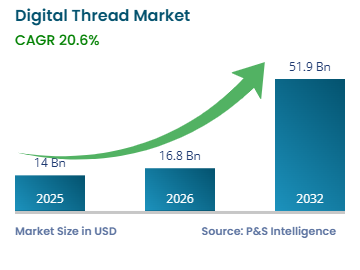
The digital thread market size was USD 14.0 billion for 2025, and it will grow by 20.6% during 2026–2032, to reach USD 51.9 billion by 2032.
The market growth is driven by the expanding integration of product lifecycle management, computer-aided design, and manufacturing execution systems across complex product development environments in automotive, aerospace, and defense programs. U.S. Department of Defense Instruction 5000.97 indicates that new defense acquisition programs are required to adopt digital engineering and model-based systems engineering practices beginning in 2024. This mandate is reinforcing institutional demand for digital thread continuity among aerospace and defense suppliers.
China's Ministry of Industry and Information Technology reports that the country has established more than 30,000 smart factories nationwide. Advanced-tier facilities among these are recording materially shorter product development cycles. This policy-driven momentum is accelerating the shift away from document-intensive engineering toward persistent, model-based data architectures across discrete manufacturing.
Key Market Insights
The product lifecycle management category holds the largest market share, of 30%, in 2025, as the core system enabling product design, engineering change, and lifecycle data management in complex, regulated industries.
The analytics & visualization category will have the highest CAGR, of approximately 20.7%, due to the shift from data collection to predictive and prescriptive analytics.
The automotive category holds the largest market share, of 30% in 2025, due to complex supplier networks and strong reliance on lifecycle engineering continuity.
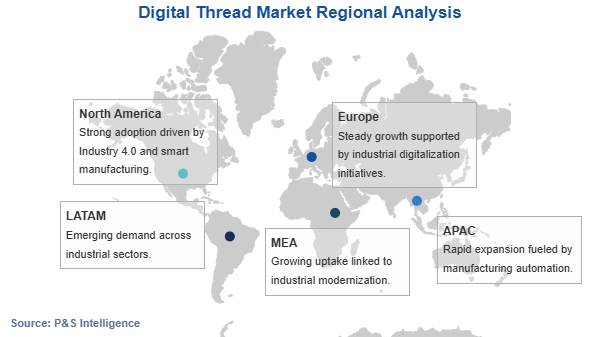
North America holds the largest market share, of 40%, in 2025, driven by a concentration of aerospace, defense, and automotive original equipment manufacturers.
Asia-Pacific will have the highest CAGR, of approximately 21.5%, driven by an unmatched concentration of discrete manufacturing capacity.
Digital Thread Market Trends and Drivers
Generative AI Copilot Integration Is Key Trend
Enterprise software vendors are embedding generative AI copilots directly into product lifecycle management, manufacturing execution systems, and application lifecycle management platforms, converting static engineering repositories into conversational, queryable knowledge systems. This shift is transforming how engineers interact with digital thread data. Rather than manually navigating bills of materials, specifications, and change records across disconnected modules, users can pose natural-language queries grounded in live product data; these queries extract requirements from connected systems, generate change packages, and trace affected components across disconnected modules. Siemens AG announced at CES 2026 that it is deploying multiple AI-powered copilots across its Teamcenter, Polarion, and Opcenter software portfolios, and these copilots streamline product data navigation, automate compliance processes, and improve manufacturing operations. Similarly, in April 2026, PTC Inc. launched Windchill AI Assistant, a generative AI capability embedded in its Windchill product lifecycle management platform that enables engineers to query product data through a natural-language chat interface, accelerating access to engineering knowledge and strengthening digital thread continuity across lifecycle workflows.
Moreover, Germany's Manufacturing-X initiative is advancing interoperable industrial data ecosystems through the Factory-X flagship project, led by Siemens AG and SAP SE along with multiple industrial partners. The initiative aims to enable standardized data exchange across engineering, production, and supply-chain environments, and this standardization is strengthening the foundation for digital thread architectures that rely on seamless lifecycle data connectivity.
Lifecycle Traceability Mandates Are Biggest Driver
Regulatory bodies are increasingly mandating structured, machine-readable lifecycle data as a condition of market access. This requirement is forcing digital thread adoption rather than leaving it as a voluntary efficiency investment, and this shift is most pronounced in the European Union, where product sustainability disclosure is being codified into binding law rather than aspirational guidance. Policy frameworks such as the Ecodesign For Sustainable Products Regulation (ESPR), which entered into force in 2024, introduce the concept of a digital product passport. This passport requires manufacturers to capture and share product composition, repairability, and environmental impact data across the lifecycle. Implementation timelines include the development of a centralized registry by 2026 and phased category-specific rollouts, including battery passports starting in 2027.
Persistent, auditable data linkage from design through end-of-life is now a condition of compliance. Manufacturers exporting into the EU are restructuring product lifecycle management and enterprise resource planning integration specifically to meet digital passport requirements. This compliance shift is extending digital thread adoption beyond early-adopter sectors into mainstream consumer and industrial goods manufacturing.
Legacy System Fragmentation Constraining Enterprise-Wide Digital Thread Continuity
Despite clear demand signals, enterprise-wide digital thread continuity remains constrained by persistent fragmentation across the product, production, and business data dimensions of manufacturing IT environments. Many manufacturers continue to operate legacy product lifecycle management (PLM), manufacturing execution systems (MES), and enterprise resource planning (ERP) systems built on incompatible data models. The National Institute of Standards and Technology highlights that achieving integration across product, production system, and business dimensions of manufacturing remains a significant challenge.
Ongoing development of interoperability standards is required, as historically siloed systems are only slowly evolving to support end-to-end digital thread connectivity. This structural fragmentation is expected to ease over time as standards bodies and technology vendors converge on common data models and interoperability frameworks, but in the near term, this convergence delay continues to lengthen implementation timelines and increase integration costs for mid-sized manufacturers lacking dedicated systems integration capabilities.
Medical Device Traceability Requirements Are Biggest Opportunity
Stringent device-tracking regulations in healthcare manufacturing are opening substantial expansion potential for digital thread platforms beyond their traditional aerospace and automotive base. Medical device and pharmaceutical manufacturers face increasing regulatory pressure to maintain continuous digital records linking design specifications to manufactured lots and post-market surveillance data. The U.S. Food and Drug Administration mandates that labelers of Class I, II, and III medical devices marketed in the United States comply with the Unique Device Identification system. This system requires submission of device identification data to the Global Unique Device Identification Database as a condition of market access, and full compliance deadlines were reached by 2022.
The European Union's Medical Device Regulation, fully applicable since 2021, imposes stringent requirements for device traceability, post-market surveillance, and lifecycle documentation. This requirement is increasing the need for integrated digital data management systems across medical device supply chains. This regulatory burden creates a structural challenge, manufacturers without integrated digital thread architectures must reconcile UDI records manually across design, quality, and post-market systems. This manual reconciliation is increasing operational complexity and the risk of data inconsistencies. Vendors are extending product lifecycle management and quality management system integration capabilities specifically to support end-to-end device traceability. This extension is positioning digital thread solutions as critical infrastructure for regulatory compliance in healthcare manufacturing.
Digital Thread Market Segmentation Analysis
Technology Analysis
The product lifecycle management category holds the largest market share, of 30%, in 2025, driven by its role as the foundational system of record connecting design, engineering change, and configuration data across the product lifecycle, and manufacturers in regulated and complex-assembly industries have standardized around this function for decades. The category benefits from deep entrenchment in long-cycle industries such as aerospace and automotive, where engineering data continuity must persist across decades-long product support windows. The International Organization for Standardization maintains ISO 10303 (STEP), a large family of international standards for product data representation and exchange, and this standards family underpins interoperability across CAD, CAM, and PLM systems.
The manufacturing execution system category will have the highest CAGR, of approximately 21.2%, driven by manufacturers' need to close the gap between design-time digital thread data and real-time shop-floor execution. The National Institute of Standards and Technology has documented that inadequate interoperability of engineering data alone has cost the U.S. automotive supply chain an estimated USD 1 billion annually, per the NIST Manufacturing Interoperability Program, and this structural gap is one that modern, digitally connected MES platforms are increasingly designed to close.
Manufacturing Execution System (MES) (Fastest-Growing Category)
Others
Module Analysis
The data collection category holds the largest market share, of 40%, in 2025, driven by its role as the entry point through which physical-world product and process information enters digital systems. Its dominance stems from its foundational role, as sensor-, scanner-, and machine-generated data provide the base layer on which downstream integration, connectivity, and analytics modules depend. This dependency makes data collection the first and most universally deployed module across manufacturing environments. The International Telecommunication Union highlights that industrial IoT and machine-to-machine communication continue to expand, driving the proliferation of sensor-based data acquisition infrastructure.
The analytics & visualization category will have the highest CAGR, driven by manufacturers shifting from simply collecting data toward extracting predictive and prescriptive value from it. As digital thread architectures mature, the ability to transform lifecycle data into actionable insights is becoming a key differentiator. Process optimization and predictive maintenance benefit directly from this capability, and quality improvement gains from it as well. The IEA highlights that the adoption of AI-driven optimization across industrial processes can deliver meaningful efficiency and energy savings, and this potential is reinforcing the growing importance of advanced analytics capabilities within connected manufacturing environments.
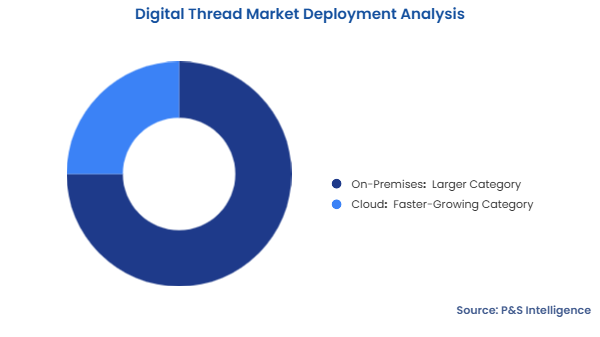
The on-premises category holds the larger market share, of 75%, in 2025, driven by continued reliance on locally hosted infrastructure among manufacturers operating in security-sensitive or compliance-intensive environments. Aerospace, defense, and other regulated industries prefer on-premises architectures to maintain direct control over engineering data and operational technology systems, and this control minimizes exposure to network dependencies. The Cybersecurity and Infrastructure Security Agency highlights the complexity of securing industrial control systems and legacy operational technology environments, and this complexity reinforces why many critical manufacturing operations continue to retain on-premises control over digital thread infrastructure.
The cloud category will have the higher CAGR, driven by scalable, subscription-based access that is lowering the barrier to entry for mid-sized manufacturers. Cloud architectures enable faster deployment and cross-site data accessibility, and they also improve collaboration across distributed engineering and production environments. These capabilities are critical for digital thread implementation. This transition is further evidenced by recent industry developments. For instance, Rockwell Automation has expanded its cloud-based manufacturing solutions, including SaaS-enabled MES platforms, to improve scalability, cross-site visibility, and integration between operational technology and enterprise IT systems.
The deployments analyzed in this report are:
On-Premises (Larger Category)
Cloud (Faster-Growing Category)
End User Analysis
The automotive category holds the largest market share in 2025, driven by the sector's complex, multi-tier supplier networks and long-standing reliance on digital engineering continuity from design through aftermarket service. The global scale of vehicle manufacturing reinforces this position. The International Organization of Motor Vehicle Manufacturers reports that global vehicle production increased from approximately 92.7 million units in 2024 to 96.4 million units in 2025, representing growth of around 3.9%, and this vast and expanding base of complex, multi-component assemblies continues to drive demand for end-to-end traceability and lifecycle data integration, as well as digital thread implementation across automotive value chains.
The pharmaceuticals category will have the highest CAGR, of approximately 20.9%, driven by tightening global traceability and serialization mandates. Regulations such as the European Union Falsified Medicines Directive (FMD) and the U.S. Drug Supply Chain Security Act (DSCSA) require medicines to carry unique identifiers and be verified against centralized databases prior to dispensing, creating a structural compliance requirement for end-to-end, auditable data linkage across the pharmaceutical value chain. This regulatory environment is accelerating digital thread adoption across pharmaceutical manufacturing, packaging, distribution, and post-market monitoring operations.
The end users analyzed in this report are:
Automotive (Largest Category)
Aerospace & Defense
Industrial Machinery & Manufacturing
Energy & Utilities
Consumer Electronics
Medical Devices
Pharmaceuticals (Fastest-Growing Category)
Others
Drive strategic growth with comprehensive market analysis
Digital Thread Market Geographical Analysis
North America Digital Thread Market Size
North America holds the largest market share, of 40%, in 2025, driven by a concentration of aerospace, defense, and automotive original equipment manufacturers. A mature industrial software vendor base headquartered domestically strengthens this advantage, and federal initiatives that promote digital continuity across acquisition and engineering programs provide additional support. The region's engineering ecosystem has increasingly transitioned from document-based workflows toward model-based, traceable data environments. This transition is supporting the adoption of digital thread architectures across complex product lifecycles.
Canada is emerging as an important market for digital thread adoption. National initiatives aimed at accelerating industrial digitalization and advanced manufacturing are driving this position. The country's aerospace, automotive, and industrial sectors are increasingly investing in connected engineering and production environments to improve product traceability and lifecycle visibility. The Government of Canada's Canada Digital Adoption Program (CDAP), with funding of approximately CAD 4 billion, is enabling businesses to adopt digital technologies and modernize operations. This program is supporting the broader implementation of digital thread solutions across manufacturing industries.
U.S. Digital Thread Market Size
The United States represents the larger and one of the faster-growing country markets within North America, driven by the domestic headquarters presence of leading product lifecycle management, enterprise resource planning, and computer-aided manufacturing vendors, which supports a dense innovation and integration ecosystem. The Army, Navy, and Air Force have each introduced service-specific digital engineering transformation strategies. This service-level adoption is extending demand beyond major weapons programs into business systems and software acquisition environments.
Major industrial software providers such as Siemens Digital Industries Software and PTC Inc. continue to invest in expanding their digital thread and model-based engineering capabilities. Platform enhancements and cloud-based solutions support this expansion, and strategic initiatives extend it further. For instance, Siemens AG strengthened its industrial software portfolio through its approximately USD 10.6 billion acquisition of Altair Engineering Inc., announced in 2024, and this acquisition enhanced Siemens' capabilities in simulation, AI, and digital engineering technologies. These technologies are foundational to digital thread deployments across manufacturing enterprises.
Asia-Pacific Digital Thread Market Size
Asia-Pacific will have the highest CAGR, of approximately 21.5%, driven by an unmatched concentration of discrete manufacturing capacity. State-backed digitalization mandates and rapid smart factory build-out across the region's largest industrial economies are reinforcing this trajectory. Japan continues to advance digital thread adoption through its leadership in precision manufacturing, robotics, and model-based engineering across automotive and electronics sectors, while South Korea is accelerating deployment through government-led smart factory initiatives aimed at digitizing thousands of manufacturing SMEs.
Moreover, China is the largest country market within Asia-Pacific, driven by the world's largest manufacturing base, and state-led industrial digitalization policies. According to official government data, the country has built more than 30,000 smart manufacturing facilities, including over 1,200 at an advanced level and 230 recognized as excellence-tier factories. Data from the International Organization of Motor Vehicle Manufacturers indicates that China produced over 31 million motor vehicles in 2024, accounting for roughly one-third of global output. This production scale is driving demand for integrated product lifecycle management and manufacturing execution data flows.
India Digital Thread Market Size
India is the fastest-growing country market within Asia-Pacific, driven by an aggressive industrial policy push to localize advanced manufacturing. Government initiatives such as the Production Linked Incentive (PLI) scheme, with a total outlay of approximately ₹1.91 lakh crore across multiple strategic sectors including electronics and automotive, are expanding domestic manufacturing capacity and reducing import dependence. This localization drive is extending digital thread adoption beyond multinational anchor manufacturers into India's expanding domestic supplier base in electronics and automotive component production.
The regions and countries analyzed in this report are:
North America (Largest Regional Market)
U.S. (Larger and Faster-Growing Country)
Canada
Europe
Germany (Largest Country)
U.K. (Fastest-Growing Country)
France
Italy
Spain
Rest of Europe
Asia-Pacific (Fastest-Growing Regional Market)
China (Largest Country)
India (Fastest-Growing Country)
Japan
South Korea
Australia
Rest of APAC
Latin America
Brazil (Largest Country)
Mexico (Fastest-Growing Country)
Rest of LATAM
Middle East and Africa
Saudi Arabia (Largest Country)
South Africa
U.A.E. (Fastest-Growing Country)
Rest of MEA
Digital Thread Market Competitive Landscape
The market exhibits a semi-consolidated structure due to the coexistence of a limited number of large enterprise software vendors and a broader ecosystem of specialized solution providers. The development of integrated product lifecycle management (PLM), computer-aided design (CAD), and manufacturing execution platforms requires significant R&D investment, deep domain expertise, and the ability to support long product lifecycles, creating high entry barriers that favor established players. However, the market remains only partially consolidated because manufacturers typically adopt a hybrid approach, combining a core platform from major vendors such as Siemens AG, Dassault Systèmes, and PTC Inc. with specialized solutions for simulation, analytics, or quality management from smaller providers. This modular adoption model, along with diverse vendor strategies and the need for interoperability across complex industrial environments, prevents any single company from dominating overall market share.
Leading Companies in the Digital Thread Market:
Siemens AG
PTC Inc.
Dassault Systemes SE
International Business Machines Corporation
SAP SE
Oracle Corporation
Rockwell Automation, Inc.
Autodesk, Inc.
Accenture plc
General Electric Company
ANSYS, Inc.
Hexagon AB
Synopsys, Inc.
AVEVA Group Limited
NVIDIA Corporation
Digital Thread Market News
In March 2026, AVEVA Group Limited announced a collaboration with NVIDIA Corporation to integrate its engineering and operations software into the NVIDIA Omniverse DSX Blueprint for gigawatt-scale AI data center facilities. The partnership applies AVEVA's industrial digital twin and CONNECT platform capabilities to accelerate design and deployment of AI infrastructure facilities using engineering-procurement-construction methodologies.
In February 2026, Dassault Systemes SE and NVIDIA Corporation announced a long-term strategic partnership to build a shared industrial AI architecture combining Dassault Systèmes' Virtual Twin technologies with NVIDIA's AI infrastructure and open models. The collaboration extends to Dassault's OUTSCALE cloud brand deploying AI factories across three continents to power science-validated industry models on the 3DEXPERIENCE platform.
In July 2025, Synopsys, Inc. completed its USD 35 billion acquisition of ANSYS, Inc., combining Synopsys' silicon design and IP solutions with ANSYS' simulation and analysis portfolio. The deal required divestitures including Synopsys' Optical Solutions Group and ANSYS' PowerArtist software to satisfy antitrust conditions, and resulted in ANSYS' delisting from Nasdaq as it became a wholly owned Synopsys subsidiary.
In March 2025, Siemens AG completed its acquisition of Altair Engineering Inc. for an enterprise value of approximately USD 10 billion, adding mechanical and electromagnetic simulation, high-performance computing, and data science capabilities to the Siemens Xcelerator industrial software platform. The acquisition extends Siemens' digital twin and simulation portfolio alongside its existing Teamcenter and Opcenter offerings.
Frequently Asked Questions About This Report
What are the key drivers of digital thread adoption?+
The key drivers include the increasing need for lifecycle traceability, Industry 4.0 adoption, regulatory compliance, and the demand for integrated PLM, MES, and ERP systems.
What are the major challenges in digital thread implementation?+
The major challenges include legacy system fragmentation, data interoperability issues, high integration costs, and the lack of standardized data models.
How does digital thread improve product lifecycle management (PLM)?+
It connects data across design, manufacturing, and service stages, enabling real-time visibility, traceability, and better decision-making.
What is the ROI of digital thread implementation?+
ROI is driven by reduced design errors, improved efficiency, faster time-to-market, better compliance, and lower operational costs.
Want a report tailored exactly to your business need?
Leading companies across industries trust us to deliver data-driven insights and innovative solutions for their most critical decisions. From data-driven strategies to actionable insights, we empower the decision-makers who shape industries and define the future. From Fortune 500 companies to innovative startups, we are proud to partner with organisations that drive progress in their industries.
Client Testimonials
Working with P&S Intelligence and their team was an absolute pleasure – their awareness of timelines and commitment to value greatly contributed to our project's success. Eagerly anticipating future collaborations.
McKinsey & Company
India
Unmatched Standards
Our insights into the minutest levels of the markets, including the latest trends and competitive landscape, give you all the answers you need to take your business to new heights
Complete Data Security
We take a cautious approach to protecting your personal and confidential information. Trust is the strongest bond that connects us and our clients, and trust we build by complying with all international and domestic data protection and privacy laws