Digital Signal Processor Market Size & Share Analysis - Emerging Trends, Growth Opportunities, Competitive Landscape, and Forecasts (2025 - 2032)
This Report Provides In-Depth Analysis of the Digital Signal Processor Market Report Prepared by P&S Intelligence, Segmented by Core Type (Multi Core, Single Core), Type (DSP Multiprocessors on a Die, 32-bit Floating Point, 16-bit Fixed Point), End User (Consumer Electronics, Aerospace & Defense, Automotive, Manufacturing, Healthcare), and Geographical Outlook for the Period of 2019 to 2032
Explore the market potential with our data-driven report
Digital Signal Processor Market Future Outlook
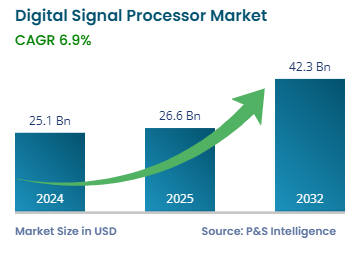
The global digital signal processor market generated an estimated revenue of USD 25.1 billion in 2024, which is expected to witness a CAGR of 6.9% during 2025–2032, to reach USD 42.3 billion by 2032.
This growth can be ascribed to the increasing demand for high-performance processing capabilities in a variety of sectors, including telecommunications, consumer electronics, automotive, healthcare, and industrial automation.
The continuous advancements in digital technologies, along with the rising adoption of connected devices and the Internet of Things (IoT), are further accelerating the need for DSPs that offer enhanced data processing, signal modulation, and real-time computation.
Additionally, the proliferation of 5G networks, AI-driven applications, and the expansion of smart devices are expected to further fuel market expansion, as DSPs play a critical role in managing complex algorithms and ensuring high-speed, efficient processing across multiple platforms.
Digital Signal Processor Market Trends & Drivers
Integration of Al and ML Technologies into DSP Architectures Is a Key Trend
The integration of AI and ML technologies into the digital signal processor (DSP) architecture is a key market trend.
AI and ML have revolutionized various industries by enabling advanced data analysis, pattern recognition, and decision-making processes, and their incorporation into DSPs is enhancing the capabilities of signal processing.
The integration is particularly beneficial in applications such as telecommunications, automotive, healthcare, and industrial automation.
In telecommunications, AI-enhanced DSPs enable more efficient use of network resources, improving data transmission quality and network management.
AI and ML integration allows for more intelligent and adaptive signal processing in medical devices, improving diagnostics and monitoring.
AI and ML integration into DSPs enhances real-time data analysis, enabling smarter, faster decision-making in applications like autonomous vehicles, telecommunications, and image processing.
This fusion improves efficiency, adaptability, and accuracy while reducing latency, driving innovation across industries requiring complex signal and sensor data processing.
DSPs integrated with AI/ML analyze medical imaging data rapidly, improving diagnostic accuracy and enabling early detection of diseases like cancer.
AI/ML-powered DSPs optimize signal quality and manage network traffic dynamically, enhancing wireless communication reliability and speed.
In smart speakers, AI/ML DSPs enable real-time voice recognition and noise cancellation, providing seamless user interactions and improved audio quality.
Rising Applications in Automotive Industry Is Key Driver
One of the key drivers of the global digital signal processor market is the rising application of DSP technology in the automotive industry.
The global sale of autonomous and connected vehicles is rapidly increasing, driven by technological advances in digital signal processors (DSPs) that enable real-time sensor data processing critical for safety and infotainment.
According to the International Energy Agency, connected cars now represent a significant portion of new vehicle sales worldwide, especially in China, the US, and Europe.
With the increasing shift towards advanced driver-assistance systems (ADAS) and autonomous vehicles, the demand for sophisticated signal processing solutions has surged.
DSPs play a crucial role in processing data from various sensors, such as cameras, radar, and LiDAR, which are integral to ADAS technologies.
These processors enable real-time analysis of sensor data, ensuring precise decision-making for critical functions like collision avoidance, lane departure warnings, and adaptive cruise control.
Furthermore, DSPs are essential for the seamless operation of in-car infotainment systems, including audio, video, and navigation processing, delivering high-quality user experiences.
The Society of Automotive Engineers highlights DSPs as vital components for enabling advanced driver-assistance systems and vehicle-to-everything communication.
This growing adoption accelerates demand for high-performance DSPs, essential for processing complex algorithms and supporting autonomous functionality.
In autonomous vehicles, AI/ML-enabled DSPs process sensor data from cameras and LiDAR in real time, enabling accurate object detection and collision avoidance for safer driving.
Challenges in Implementation and Security Issues Hinder Market Growth
Implementing DSPs in various applications can be complex due to the need for specialized knowledge and expertise in hardware design, software development, and system integration.
DSP systems often require customization to meet the specific requirements of different industries, making the implementation process time-consuming and resource-intensive.
This complexity can increase the cost and extend the time-to-market for products using DSP technology, especially for small and medium-sized enterprises with limited resources.
In addition to implementation challenges, security issues are a significant concern.
DSPs face security risks, such as firmware tampering, side-channel attacks, and unauthorized access, which can compromise sensitive data and system integrity.
Their integration in critical infrastructure makes them targets for hackers.
Ensuring secure firmware updates, hardware encryption, and intrusion detection is vital to protect DSPs from evolving cyber threats.
In 2024, a critical vulnerability (CVE-2024-43047) was identified in Qualcomm's DSP architecture.
This flaw could enable unauthorized access to sensitive data or arbitrary code execution on affected devices, posing serious security risks.
Qualcomm has since released security advisories urging users to update their devices to mitigate potential threats.
Digital Signal Processor Market Segmentation and Category Analysis
Core Type Insights
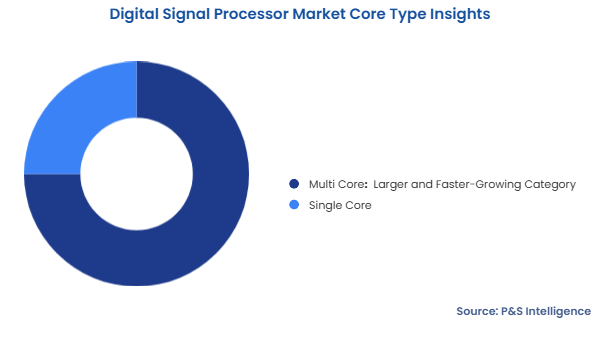
The multi core type category is projected to grow at the highest CAGR, of 7%, during 2025–2032, after holding the largest market share in 2024, of approx. 75%. Multi-core DSPs provide significant advantages over single-core processors, particularly in applications that require high performance and real-time processing capabilities. By leveraging multiple cores, these processors can handle parallel processing tasks more efficiently, enabling them to support complex algorithms, handle larger data sets, and perform intricate computations simultaneously.
This makes multi-core DSPs ideal for demanding applications in fields such as telecommunications, automotive, healthcare, and industrial automation, where low latency, high throughput, and reliability are essential. As technologies like 5G, AI, autonomous vehicles, and IoT continue to evolve, the need for powerful, scalable, and energy-efficient processing solutions has increased, driving the demand for multi-core DSPs.
During the study, we have analyzed the following core types in the report:
Multi Core (Larger and Faster-Growing Category)
Single Core
Type Analysis
The 32-bit floating point type category is projected to grow at the highest CAGR, after holding the largest market share in 2024, of 55%. This is due to its superior processing capabilities in handling complex, high-precision calculations.
Floating-point DSPs, especially those with 32-bit precision, provide enhanced accuracy and dynamic range in applications requiring detailed data manipulation, such as digital audio processing, image and video signal processing, and scientific computations.
These processors excel where the signal variations are wide and require high mathematical accuracy, which is critical in industries like telecommunications, healthcare, and automotive.
Below are the types analyzed:
DSP Multiprocessors-on a Die
32-bit Floating Point (Largest and Faster-Growing Category)
16-bit Fixed Point
End User Insights
The consumer electronics category accounts for the largest share in 2024. This is primarily due to the widespread adoption of DSPs in various devices that require advanced signal processing capabilities. Consumer electronics, such as smartphones, smart TVs, gaming consoles, wearables, and audio equipment, rely heavily on DSPs for high-quality audio and video processing, real-time signal enhancement, and efficient power management.
As consumers increasingly demand enhanced multimedia experiences, DSPs provide the necessary computational power to process complex tasks such as noise reduction, image and video scaling, and surround sound audio processing, ensuring superior product performance. Furthermore, the rapid advancements in wireless technologies like 5G, coupled with the proliferation of connected devices, are fueling the growth of DSPs in consumer electronics.
Globally, over 6 billion smartphones are in use, with users averaging 3.7 hours daily. Video game consoles engage roughly 3 billion players worldwide, who spend about 8 hours weekly gaming. These devices drive digital connectivity and entertainment, reflecting growing consumer reliance on interactive and mobile technologies.
The automotive industry is the fastest-growing end user, with 7.5% CAGR, due to the rise of advanced driver-assistance systems (ADAS), autonomous driving, and connected car technologies. DSPs process data from sensors like cameras, radar, and LiDAR to enable real-time decision-making and enhance vehicle safety. Additionally, DSPs support infotainment, voice recognition, and powertrain control in electric vehicles. Regulatory demands for improved safety and emissions also boost DSP adoption. As vehicles become smarter and more connected, the automotive sector’s complex electronics systems increasingly rely on DSPs, driving significant market growth in this area.
The following end users are included in the report:
Consumer Electronics (Largest Category)
Aerospace & Defense
Automotive (Faster-Growing Category)
Manufacturing
Healthcare
Others
Drive strategic growth with comprehensive market analysis
Digital Signal Processor Market Geographical Analysis
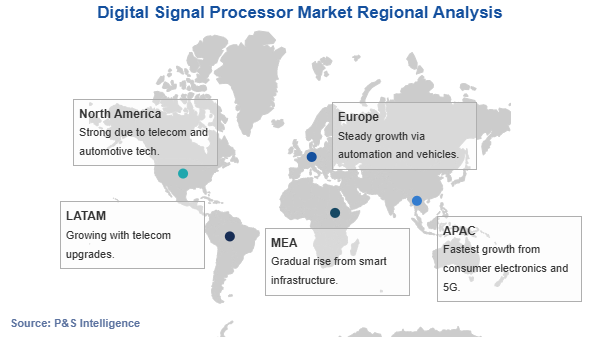
Geographically, North America holds the largest market share, of 45%, in 2024. This is due to technological innovation, high demand across key industries, and the region’s robust infrastructure. The United States is home to leading semiconductor companies and has a strong presence in industries such as telecommunications, automotive, healthcare, aerospace, and defense, all of which are major consumers of DSP technology.
The rapid adoption of 5G networks, autonomous vehicles, and AI-driven technologies further accelerates the need for advanced DSP solutions that can handle complex computations, real-time data processing, and large volumes of information. North America also benefits from a highly developed ecosystem of research and development (R&D), which fosters the creation of cutting-edge DSP technologies. The region's significant investments in smart manufacturing, IoT, and digital communication also contribute to the increasing demand for DSPs.
The Asia-Pacific (APAC) region is the fastest-growing market, with 8% CAGR, driven by rapid integration of automotive electronics, expansion of 5G networks, focus on industrial automation & smart factories, increasing consumer electronics demand, government initiatives, and increasing adoption of AI, ML, and IoT. In China, the booming automotive sector, especially the electric vehicle (EV) market, fuels DSP demand, with over 6 million EVs sold in 2023 alone, according to the China Association of Automobile Manufacturers.
India’s telecommunications industry sees significant growth in 5G deployment, with over 400 million 5G subscribers reported by the Telecom Regulatory Authority of India, necessitating advanced DSPs for signal processing and network optimization.
South Korea leads in semiconductor manufacturing and smart factory adoption, with more than 50% of manufacturers implementing Industry 4.0 technologies, according to the Korea Industrial Technology Association. This integration requires DSPs for real-time data processing and automation. Japan’s consumer electronics market remains strong, especially in digital imaging; the Japan Electronics and Information Technology Industries Association notes a consistent increase in camera sensor production, a key DSP application.
Further, regions and countries analyzed for this report include:
Brazil (Largest and Fastest-Growing Country Market)
Mexico
Rest of LATAM
Middle East and Africa (MEA)
Saudi Arabia (Largest Country Market)
South Africa
U.A.E. (Fastest-Growing Country Market)
Rest of MEA
Digital Signal Processor Market Competitive Landscape
The industry is relatively fragmented, characterized by the presence of numerous players offering a wide range of solutions across different applications and industries. This is primarily due to the diversity of use cases for DSP technology, which spans sectors like telecommunications, automotive, healthcare, consumer electronics, and industrial automation. Each industry has specific requirements for DSP performance, power efficiency, and processing capabilities, leading to a broad spectrum of players competing to address these needs with specialized products.
Companies range from large, established semiconductor firms such as Texas Instruments, Qualcomm, and Analog Devices to smaller, niche players offering custom DSP solutions tailored to specific applications. This is further driven by the rapid pace of technological innovation and the continuous evolution of digital signal processing algorithms. As new technologies like 5G, AI, and edge computing gain traction, new DSP architectures and solutions are emerging, creating opportunities for both established companies and startups to capture market share.
Key Digital Signal Processor Companies:
Analog Devices Inc.
Microchip Technology Inc.
Texas Instruments Incorporated
NXP Semiconductors N.V.
Intel Corporation
Qualcomm Technologies Inc.
Cirrus Logic Inc.
STMicroelectronics N.V.
Infineon Technologies AG
Broadcom Inc.
ON Semiconductor Corporation
Asahi Kasei Corporation
Digital Signal Processor Market News & Updates
In June 2025, Microchip Technology Incorporated launched a new line of digital signal controllers with enhanced PWM Resolution and ADC Speed. Equipped with specialized peripherals for effective power conversion, the new DSCs are designed for data center power supplies and various intricate real-time systems.
In October 2024, Edifier International unveiled the NeoDots true wireless earbuds, equipped with a hybrid driver and a digital signal processor to ensure optimal sound quality. The hybrid driver units, which consist of balanced armature and 10-mm dynamic drivers, work in conjunction with digital signal processing and an active crossover to offer sound characterized by high resolution and minimal distortion, while also enhancing noise cancellation capabilities to -48 dB. Bluetooth V5.4 allows for multipoint connectivity, enabling seamless transitions between music, videos, and calls across two different devices at the same time.
In September 2024, Mercury Systems Inc. expanded its Direct RF digital signal processing product portfolio. These new products are based on Altera Agilex FPGAs to detect and process emissions across a wide electromagnetic spectrum range.
In February 2024, Monolithic Power Systems Inc. acquired Axign B.V., which offers programmable multicore digital audio signal processors. They offer near-zero distortion in the signals and significantly lower power consumption for consumer automotive audio systems. The acquisition enabled Monolithic Power Systems to offer more products for automobiles, concert venues, homes, and sports arenas.
In January 2024, HARMAN International launched BSS Audio's Soundweb OMNI open-architecture DSPs.
Want a report tailored exactly to your business need?
Leading companies across industries trust us to deliver data-driven insights and innovative solutions for their most critical decisions. From data-driven strategies to actionable insights, we empower the decision-makers who shape industries and define the future. From Fortune 500 companies to innovative startups, we are proud to partner with organisations that drive progress in their industries.
Client Testimonials
Working with P&S Intelligence and their team was an absolute pleasure – their awareness of timelines and commitment to value greatly contributed to our project's success. Eagerly anticipating future collaborations.
McKinsey & Company
India
Unmatched Standards
Our insights into the minutest levels of the markets, including the latest trends and competitive landscape, give you all the answers you need to take your business to new heights
Complete Data Security
We take a cautious approach to protecting your personal and confidential information. Trust is the strongest bond that connects us and our clients, and trust we build by complying with all international and domestic data protection and privacy laws