Digital Rights Management Market Size & Share Analysis - Trends, Drivers, Competitive Landscape, and Forecasts (2026 - 2032)
This Report Provides In-Depth Analysis of the Digital Rights Management Market Report Prepared by P&S Intelligence, Segmented by Component (Solutions, Services), Deployment Mode (Cloud-based DRM, On-premises DRM), Application (Video & streaming content protection, Gaming & mobile app protection, Audio & music rights management, Document & confidential data protection, Software & application licensing, eBook & digital publishing security), Enterprise Size (Large Enterprises, Small & Medium Enterprises), End-User (Media & Entertainment, Education, BFSI, IT & Telecommunications, Healthcare, Manufacturing, Government & Public Sector), and Geographical Outlook for the Period of 2021 to 2032
Explore the market potential with our data-driven report
Digital Rights Management Market Future Outlook
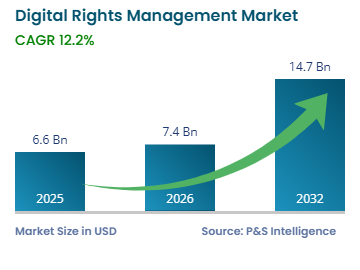
The digital rights management market size was USD 6.6 billion in 2025, and it will grow by 12.2% during 2026-2032, to reach USD 14.7 billion by 2032.
The market is expanding due to the increasing consumption and distribution of digital content across connected platforms. Streaming services, e-learning platforms, gaming ecosystems, and enterprise data sharing require controlled access to prevent unauthorized use. Content owners are distributing digital assets across websites, mobile applications, connected televisions, cloud platforms, and subscription-based services, creating greater exposure to unauthorized copying, screen recording, credential sharing, and content redistribution. The growing use of remote access environments is further increasing the need for technologies that can control viewing permissions, usage rights, and content accessibility across multiple devices. According to the International Telecommunication Union, approximately 6 billion people, representing 74% of the global population, used the internet in 2025. This level of connectivity is increasing the volume of digital content consumed daily and expanding the number of users accessing licensed media, educational resources, software applications, and enterprise information through internet-enabled platforms.
The increasing scale of online content distribution is encouraging organizations to strengthen protection mechanisms for copyrighted material, confidential documents, digital publications, and subscription-based services. Digital rights management solutions help content providers define access policies, restrict unauthorized downloads, manage licensing terms, and monitor content usage throughout the distribution lifecycle. Furthermore, enterprises are implementing these solutions to secure internal documents shared across cloud storage platforms and remote work environments. The technology is also becoming important for software vendors, publishers, broadcasters, and educational institutions that depend on digital delivery models to reach users. Moreover, the ability to maintain content ownership while supporting legitimate access across different devices and locations is encouraging wider deployment of digital rights management platforms. This is increasing investment in authentication controls, encryption technologies, license management tools, and content tracking capabilities across digital ecosystems where content remains a valuable business asset.
Key Market Insights
Solutions are the larger component, holding a market share of 75%, due to increasing volumes of digital content requiring encryption, access control, and rights management systems.
Cloud-based DRM is the faster-growing deployment, registering a CAGR of approximately 12.6%, driven by growing use of scalable platforms supporting remote access and global digital content distribution.
Video & streaming content protection is the largest application, holding a market share of 35%, due to dominant video consumption and rising need to prevent unauthorized distribution.
North America holds the largest share of 40%, due to the strong presence of content creators, streaming platforms, and high investment in cybersecurity and enterprise software.
Asia-Pacific is the fastest-growing region, registering a CAGR of approximately 13.1%, driven by rapid growth in digital content consumption across online platforms and expanding digital business activities.
Digital Rights Management Market Trends and Drivers
Rise of Cloud-Based and Multi-Platform Content Protection Is a Major Trend
The market is shifting toward cloud-driven digital rights management solutions that enable secure content protection across multiple platforms and connected devices. Organizations are adopting scalable systems to support streaming services, mobile applications, digital publishing platforms, and remote access environments where content is accessed across diverse networks and user endpoints. According to Microsoft, approximately 86% of organizations have adopted a multicloud approach in 2024, while Ericsson reported that 5G networks carried 34% of global mobile data traffic by the end of 2024. These developments are increasing the volume and speed of digital content distribution across cloud-based ecosystems. Furthermore, content owners require greater visibility and control over how licensed media, software, educational materials, and enterprise documents are accessed and shared. Digital rights management platforms are therefore being integrated with cloud infrastructure to support authentication, license enforcement, encryption, and usage monitoring. This is strengthening content security while enabling organizations to manage digital assets efficiently across expanding multicloud and high-connectivity environments.
Growing Need to Prevent Digital Piracy and Unauthorized Content Use Drives Market
The market is growing due to increasing risks associated with unauthorized access and large-scale distribution of digital content across online platforms. Media companies, software vendors, publishers, and enterprises face persistent challenges as copyrighted content, licensed software, digital publications, and proprietary information are copied, shared, or redistributed without proper authorization. According to Microsoft, AI-generated IDs used to bypass identity verification increased by 195% globally in 2025, while MUSO reported 216.3 billion visits to piracy websites in 2024, highlighting the growing scale and sophistication of digital misuse. These activities are making it more difficult for content owners to maintain control over licensed assets and authorized user access. Furthermore, organizations are deploying digital rights management solutions to strengthen authentication, enforce licensing terms, restrict unauthorized sharing, and monitor content usage across digital channels. The technology is becoming increasingly important for protecting subscription-based revenues, securing intellectual property, and maintaining greater control over digital assets distributed through cloud platforms, streaming services, software delivery channels, and online publishing environments.
High Implementation Complexity and User Experience Issues Limiting Adoption
The market faces challenges due to the complexity involved in deploying and managing digital rights management systems. Many organizations struggle to integrate DRM solutions with existing content management platforms, cloud environments, streaming infrastructure, enterprise applications, and legacy systems. These integration requirements often increase implementation timelines, raise operational costs, and create compatibility issues across different devices and digital distribution channels. According to the World Economic Forum, 49% of public-sector organizations lacked the necessary talent to meet their cybersecurity goals in 2025. Limited availability of skilled cybersecurity and digital rights management professionals can slow deployment, weaken policy management, and reduce the effectiveness of content protection strategies. Furthermore, organizations must balance security requirements with user accessibility, platform performance, and seamless content delivery. These challenges are creating adoption barriers, particularly for organizations seeking scalable rights management capabilities across complex digital ecosystems while maintaining efficient operations and consistent user experiences.
Expansion of DRM in Enterprise Data Security and New Digital Business Models
The market presents strong opportunities as digital rights management expands beyond media into enterprise data protection and emerging digital service models. Organizations are securing internal documents, product designs, intellectual property, and confidential business information as cloud-based collaboration and remote work environments become more common across industries. According to the World Bank, the digital economy accounted for approximately 15% of global GDP in 2024, representing around $16 trillion of the total economy. This growing digital ecosystem is increasing the value of digital assets and creating greater demand for technologies that control access, prevent unauthorized distribution, and support secure content sharing. Furthermore, organizations are adopting DRM solutions to support subscription-based services, digital licensing models, and controlled information exchange across multiple platforms while protecting commercial value and ownership rights.
Digital Rights Management Market Segmentation Analysis
Component Analysis
Solutions are the larger category, holding a market share of 75%, because companies prioritize core tools that directly secure digital content across platforms. These tools support encryption, access control, license management, watermarking, and usage monitoring for video streaming, software licensing, enterprise documents, and digital publishing. According to the World Intellectual Property Organization, approximately 11.7 million trademark applications were filed globally in 2024. This expanding base of protected brands and digital assets increases the need for reliable rights management solutions that help organizations control ownership, prevent unauthorized use, and secure content distributed through cloud, on-premises, and hybrid digital environments.
Services are the faster-growing category, because organizations need external support to deploy, integrate, and maintain DRM systems across complex digital ecosystems. As cloud-based DRM, streaming protection, gaming applications, and enterprise document security expand, companies require consulting, implementation, managed monitoring, and platform update services. Services also help small and medium enterprises adopt DRM without building large internal technical teams. This demand is increasing as businesses need continuous support for license configuration, access policy management, compliance alignment, and user experience optimization across media, education, software, and enterprise content workflows.
The components analysed in this report are:
Solutions (Larger Category)
Content encryption & access control systems
License and rights management platforms
Digital watermarking & tracking technologies
Services (Faster-Growing Category)
Consulting & advisory
Integration & deployment
Managed DRM services & maintenance
Deployment Mode Analysis
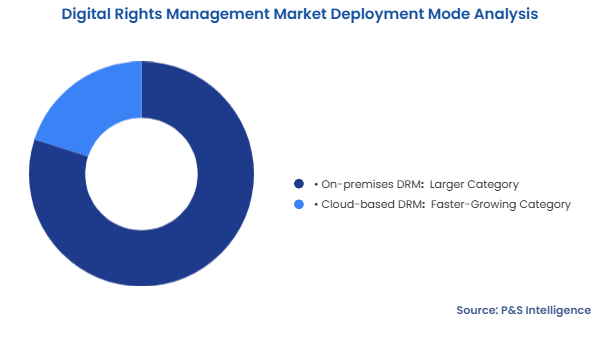
On-premises DRM is the larger category, holding a market share of 80%, because many organizations prefer direct control over sensitive content, licensing data, and security infrastructure. Large enterprises, media companies, financial institutions, and government users often manage confidential files, copyrighted assets, and regulated digital records through internal systems. This deployment model supports tighter access governance, customized security policies, and integration with legacy enterprise platforms. It remains important where organizations need stronger control over encryption keys, audit logs, and content repositories while supporting applications such as document protection, software licensing, and internal digital asset management.
Cloud-based DRM is the faster-growing category, as businesses shift toward scalable deployment models for managing digital content. It supports remote access, faster updates, flexible storage, and global content delivery without heavy on-premises infrastructure. According to the International Telecommunication Union, 5G coverage reached 51% of the world’s population in 2024. This wider high-speed network availability improves cloud connectivity and supports real-time content authentication. It also helps companies manage access rights, license validation, and usage tracking across distributed users, making cloud-based DRM more practical for streaming, software, publishing, and enterprise content platforms.
The deployment modes analysed in this report are:
On-premises DRM (Larger Category)
Cloud-based DRM (Faster-Growing Category)
Application Analysis
Video and streaming content protection is the largest category, holding a market share of 35%, because video content dominates digital consumption and remains highly exposed to piracy. Streaming platforms, broadcasters, media companies, and educational content providers require DRM tools to secure playback, prevent unauthorized access, and protect licensed distribution. According to Ericsson, video traffic accounted for around 75% of all mobile data traffic by the end of 2025. This heavy video usage increases the need for specialized protection systems that support encryption, watermarking, device authentication, and controlled streaming access across mobile networks, connected televisions, cloud platforms, and subscription services.
Gaming & mobile app protection is the fastest-growing category, because online gaming, mobile applications, and in-app digital purchases are expanding quickly across connected devices. Developers need DRM systems to protect game assets, paid features, user accounts, downloadable content, and software code from piracy and unauthorized modification. The growth of cloud-based deployment and high-speed connectivity also supports real-time license checks, anti-tampering controls, and secure access validation. This is increasing demand for DRM platforms that can protect mobile-first content models while supporting a smooth user experience across gaming ecosystems and app-based digital services.
The applications analysed in this report are:
Video & streaming content protection (Largest Category)
Gaming & mobile app protection (Fastest-Growing Category)
Audio & music rights management
Document & confidential data protection
Software & application licensing
eBook & digital publishing security
Others
Enterprise Size Analysis
Large Enterprises are the larger category, because these organizations manage high volumes of digital content, intellectual property, licensed software, and confidential business information. They also operate across multiple regions, channels, and user groups, increasing exposure to piracy, credential misuse, and unauthorized redistribution. Large enterprises often adopt on-premises or hybrid DRM models to maintain stronger control over security policies and sensitive assets. Their larger budgets, compliance requirements, and structured security teams support wider use of encryption, licensing, watermarking, and access governance across media, software, enterprise documents, and cloud-based collaboration platforms.
Small and Medium Enterprises are the faster-growing category, registering a CAGR of approximately 12.4%, as smaller firms increasingly adopt digital business models and expand into online markets. These enterprises require cost-effective solutions to manage intellectual property risks and secure digital content across distributed platforms. According to the World Bank, SMEs accounted for approximately 90% of businesses and over 50% of global employment in 2024. This large and expanding base of digitally active firms drives demand for accessible DRM solutions, especially cloud-based tools and managed services that reduce infrastructure needs while supporting secure content sharing, software licensing, and online monetization.
The enterprise sizes analysed in this report are:
Large Enterprises (Larger Category)
Small & Medium Enterprises (Faster-Growing Category)
End-User Analysis
Media and entertainment are the largest category, holding a market share of 30%, because the sector distributes high volumes of copyrighted digital content across streaming, gaming, music, and online video platforms. Movies, television programs, digital events, and interactive content require continuous protection against unauthorized sharing, account misuse, and revenue leakage. According to the World Intellectual Property Organization, copyright and digital content accounted for 77% of disputes handled by its arbitration center in 2024. This high dispute concentration shows the sector’s need for DRM systems that manage usage rights, restrict piracy, support licensing terms, and protect monetized content across multiple channels.
Education is the fastest-growing category, registering a CAGR of approximately 12.9%, because schools, universities, and online learning providers are distributing more paid digital courses, eBooks, recorded lectures, and assessment material. The shift toward cloud-based learning platforms increases the need to control access, prevent unauthorized copying, and protect institutional content. Education users also require DRM systems that balance security with easy access for students across devices. This demand connects strongly with video protection, document security, and cloud deployment, as digital classrooms depend on controlled content delivery, subscription access, and secure sharing of academic resources.
The end-users analysed in this report are:
Media & Entertainment (Largest Category)
Education (Fastest-Growing Category)
BFSI
IT & Telecommunications
Healthcare
Manufacturing
Government & Public Sector
Others
Drive strategic growth with comprehensive market analysis
Digital Rights Management Market Regional Outlook
North America Digital Rights Management Market Analysis
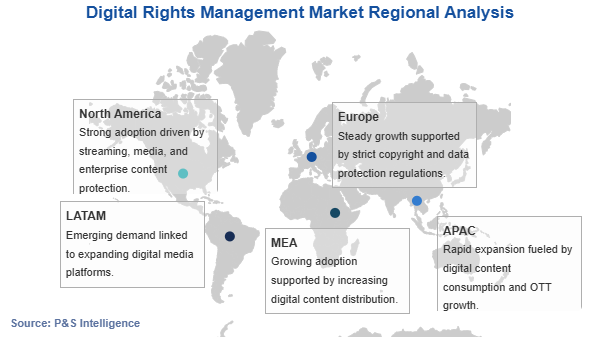
North America holds the largest share, of 40%, because the region hosts many leading streaming platforms, software vendors, media companies, publishers, and cloud service providers that depend on digital content monetization. Organizations actively invest in content security, license management, intellectual property protection, and subscription-based business models to safeguard revenue streams. The region also benefits from advanced digital infrastructure and widespread adoption of cloud, mobile, and connected-device ecosystems that increase the need for rights management controls. Furthermore, enterprises across media, software, education, and corporate sectors use DRM technologies to secure proprietary content and regulate user access. Strong cybersecurity spending and continued investment in digital services support broad deployment of advanced DRM platforms across commercial and enterprise environments.
U.S. Digital Rights Management Market Analysis
United States represents a leading market for digital rights management due to its advanced digital content ecosystem and strong intellectual property protection framework. Major streaming providers, software companies, publishers, and media organizations continuously invest in technologies that secure content distribution and monetization. According to the United States Copyright Office, 510,003 copyright claims were received, and 415,780 registrations were processed in FY 2025. This substantial volume of copyrighted material increases demand for DRM platforms that manage ownership rights, control content access, support licensing activities, and protect valuable digital assets across commercial and enterprise environments.
Canada Digital Rights Management Market Analysis
Canada is experiencing steady growth in the digital rights management market due to increasing digital content creation and a stronger emphasis on intellectual property protection. Media companies, educational institutions, software developers, and digital publishers are expanding online distribution channels that require secure content management. According to Innovation, Science and Economic Development Canada, 10,048 copyright applications were filed, and 10,110 registrations were processed in 2024–2025. This growing volume of protected content encourages wider adoption of DRM systems that support rights enforcement, content tracking, license administration, and secure distribution across digital platforms used by businesses and content owners.
Asia-Pacific Digital Rights Management Market Analysis
Asia-Pacific has the highest CAGR, of approximately 13.1%, because the region is experiencing rapid growth in digital content consumption across streaming, gaming, software, and online learning platforms. Rising internet penetration, expanding smartphone adoption, and increasing use of cloud-based services are generating higher volumes of digital content that require protection against unauthorized access and distribution. Many businesses are shifting toward subscription-based and digital delivery models, creating greater demand for content encryption, access management, and licensing solutions. Furthermore, the region has a growing technology startup ecosystem and expanding software development activity that supports DRM adoption across new digital products and services. Organizations are increasingly seeking scalable platforms that can secure content across diverse user bases, devices, and online distribution channels.
China Digital Rights Management Market Analysis
China represents a significant market for digital rights management due to its vast digital economy, large online population, and extensive digital content consumption. Streaming services, online gaming platforms, digital publishing providers, and technology companies require stronger content control mechanisms to manage intellectual property and platform compliance. According to the China Internet Network Information Center, internet users reached 1.125 billion and penetration reached 80.1% in 2025. This large-scale digital engagement increases demand for DRM technologies that regulate content access, support copyright protection, monitor distribution activity, and secure digital assets across rapidly expanding online ecosystems.
India Digital Rights Management Market Analysis
India is emerging as a high-growth market for digital rights management driven by rapid digital adoption and expanding online content consumption. Rising use of smartphones, streaming services, digital education platforms, and subscription-based applications is increasing the need for secure content delivery and access management. According to the Telecom Regulatory Authority of India, internet subscribers reached 1,028.61 million in 2025. This expanding digital user base is encouraging organizations to implement scalable DRM solutions that support content protection, license management, controlled distribution, and secure monetization across diverse digital platforms serving large consumer audiences.
Europe Digital Rights Management Market Analysis
Europe shows steady growth in the DRM market due to strong regulatory frameworks governing digital rights, intellectual property protection, and data privacy. Organizations across media, publishing, education, and software industries are required to maintain tighter control over digital assets while supporting secure content distribution. The region has a mature digital economy with established demand for subscription-based media, digital publications, educational resources, and enterprise information sharing. Moreover, content owners are increasingly implementing DRM technologies to manage licensing rights, prevent unauthorized redistribution, and support compliance requirements across multiple jurisdictions. Growing use of cloud collaboration platforms and digital delivery channels is also increasing the importance of access controls, content tracking, and rights management capabilities throughout the European digital ecosystem.
The regions and countries analysed in this report are:
North America (Largest Regional Market)
U.S. (Larger Country)
Canada (Faster-Growing Country)
Europe
Germany (Largest Country)
U.K. (Fastest-Growing Country)
France
Italy
Spain
Rest of Europe
Asia-Pacific (Fastest-Growing Regional Market)
China (Largest Country)
India (Fastest-Growing Country)
Japan
South Korea
Australia
Rest of APAC
Latin America
Brazil (Largest Country)
Mexico (Fastest-Growing Country)
Rest of LATAM
Middle East and Africa
Saudi Arabia (Largest Country)
U.A.E. (Fastest-Growing Country)
South Africa
Rest of MEA
Digital Rights Management Market Competitive Landscape
The market is fragmented in nature, with numerous global technology providers, specialized DRM vendors, cybersecurity firms, and content protection companies competing across different application areas. Competition is driven by capabilities such as content encryption, license management, watermarking, access control, cloud deployment, and multi-device compatibility. Demand varies significantly across media and entertainment, software licensing, digital publishing, education, and enterprise document protection, preventing any single vendor from establishing a dominant position across all end-user segments. Furthermore, vendors increasingly differentiate themselves through integration with cloud platforms, streaming infrastructure, identity management systems, and enterprise collaboration tools. New entrants continue to target niche opportunities in cloud-native DRM, mobile content protection, and industry-specific deployments. Moreover, established companies are expanding technology portfolios through partnerships, platform enhancements, and service offerings, creating a competitive environment with market share distributed across a broad range of participants.
Top Companies in the Digital Rights Management Market:
Microsoft Corporation
Alphabet Incorporated
Apple Incorporated
Adobe Incorporated
Oracle Corporation
International Business Machines Corporation
Dell Technologies Incorporated
Sony Group Corporation
Broadcom Incorporated
Kudelski Societe Anonyme
Verimatrix Incorporated
Intertrust Technologies Corporation
Irdeto Besloten Vennootschap
Open Text Corporation
Seclore Technology Private Limited
Digital Rights Management Market News
In April 2024, Seclore launched a professional services offering along with a verified partner network to support the implementation of its data-centric security platform. The offering includes training, onboarding, consulting, and integration services, enabling partner-led deployments and helping enterprises secure and manage sensitive data across complex on-premise and cloud-based IT environments.
In February 2023, Irdeto launched an enhanced version of its ActiveCloak for Media software development kit for video streaming applications. The update incorporates multiple layers of application-level security, including code obfuscation, anti-debugging, and integrity verification, to protect content encryption keys and strengthen software-based digital rights management environments.
Frequently Asked Questions About This Report
What is driving demand for Digital Rights Management solutions today?+
Demand is increasing because streaming, digital publishing, software delivery, and online education need stronger access control, licensing, piracy prevention, and content usage protection.
Why do content owners invest in Digital Rights Management platforms?+
Content owners use DRM platforms to protect copyrighted assets, control authorized access, manage distribution rights, reduce misuse, and support secure monetization.
How does DRM help protect copyrighted digital content online securely?+
DRM protects content through encryption, access permissions, licensing rules, user authentication, and restrictions that limit unauthorized copying, sharing, or modification.
Which industries commonly use Digital Rights Management technology today most?+
Media, entertainment, publishing, education, gaming, software, healthcare, and enterprise sectors use DRM to secure valuable digital files and controlled content access.
What challenges affect adoption of Digital Rights Management solutions globally?+
Adoption challenges include user inconvenience, interoperability issues, device compatibility limits, privacy concerns, implementation complexity, and balancing protection with customer experience.
Want a report tailored exactly to your business need?
Leading companies across industries trust us to deliver data-driven insights and innovative solutions for their most critical decisions. From data-driven strategies to actionable insights, we empower the decision-makers who shape industries and define the future. From Fortune 500 companies to innovative startups, we are proud to partner with organisations that drive progress in their industries.
Client Testimonials
Working with P&S Intelligence and their team was an absolute pleasure – their awareness of timelines and commitment to value greatly contributed to our project's success. Eagerly anticipating future collaborations.
McKinsey & Company
India
Unmatched Standards
Our insights into the minutest levels of the markets, including the latest trends and competitive landscape, give you all the answers you need to take your business to new heights
Complete Data Security
We take a cautious approach to protecting your personal and confidential information. Trust is the strongest bond that connects us and our clients, and trust we build by complying with all international and domestic data protection and privacy laws