Digital Logistics Market Size & Share Analysis - Key Trends, Future Opportunities, Growth Strategies, and Forecasts (2025 - 2032)
This Report Provides In-Depth Analysis of the Digital Logistics Market Report Prepared by P&S Intelligence, Segmented by Component (Solutions, Services), Application (Transportation Management, Warehouse Management, Labor), Deployment Mode (Cloud, On-Premises), Organization Size (Large Enterprises, Small and Medium Enterprises), End Use (Retail & E-Commerce, Manufacturing, Healthcare & Pharmaceuticals, Automotive, Aerospace & Defense, Energy & Utilities), and Geographical Outlook for the Period of 2019 to 2032
Explore the market potential with our data-driven report
Digital Logistics Market Analysis
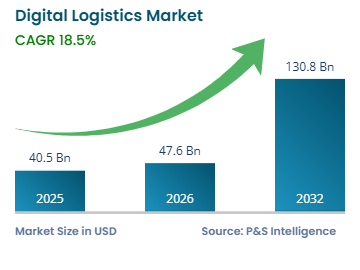
The global digital logistics market size is estimated at USD 40.5 billion in 2025, which is predicted to reach USD 130.8 billion by 2032, growing at a CAGR of 18.5% during 2026–2032.
The market expansion is driven by the rapid growth of e-commerce activities, increasing adoption of advanced technologies such as artificial intelligence and internet of things, and the growing need for supply chain transparency and operational efficiency. The e-commerce sector is experiencing unprecedented growth worldwide, creating massive demand for sophisticated digital logistics solutions. As per the U.S. International Trade Administration, global ecommerce sales for B2B companies have consistently increased annually over the past decade, with the worldwide B2B ecommerce market projected to reach a valuation of USD 36 trillion by 2026.
This surge in online retail transactions necessitates real-time tracking capabilities, automated warehouse management, and optimized delivery routes, all of which are enabled through digital logistics platforms. Companies are increasingly investing in digital transformation initiatives to handle the complexities of modern supply chains, manage inventory efficiently, and meet rising customer expectations for faster and more transparent delivery services.
Furthermore, supply chain disruptions have accelerated the adoption of digital logistics technologies. Resilinc's 2024 supply chain data reveal a striking 38% increase in global supply chain disruptions compared to the previous year, prompting organizations to invest heavily in IoT-enabled tracking and predictive analytics tools. The integration of artificial intelligence and machine learning into logistics operations is enabling businesses to forecast demand more accurately, optimize routes dynamically, and enhance overall operational resilience in an increasingly volatile global trade environment.
Digital Logistics Market Emerging Trends & Growth Drivers
Integration of IoT and Real-Time Tracking Technologies Is Key Trend
The global digital logistics market is witnessing the increasing adoption of IoT devices to enhance operational efficiency.
Real-time tracking technologies allow companies to monitor shipments and inventory continuously.
Integration of IoT with tracking systems provides precise data on location, temperature, humidity, and other environmental factors.
This trend improves supply chain visibility, enabling faster decision-making and proactive issue resolution.
India’s National Logistics Policy emphasizes digital transformation in supply chains, including IoT-based solutions like real-time tracking, geospatial mapping, and digital documentation.
Inspired by this, Telangana plans to attract INR 10,000 crore in investments and create 50,000 jobs over 5 years by setting up IoT pilot zones in Hyderabad, Warangal, and Sircilla.
Companies can optimize routes, reduce delays, and lower transportation costs through real-time insights.
Enhanced tracking contributes to better customer service by providing accurate delivery updates.
Predictive analytics, supported by IoT data, helps anticipate demand fluctuations and prevent stockouts.
Rapid Expansion of E-Commerce Is Driving Market Growth
The global rise of e-commerce is significantly increasing the demand for efficient logistics and delivery services.
Online shopping growth requires faster, more reliable, and last-mile delivery solutions.
Digital logistics platforms are being adopted to manage high volumes of parcels and real-time tracking.
Companies are investing in automation, smart warehouses, and AI-based route optimization to handle e-commerce demands.
E-commerce expansion drives the need for integrated supply chains, linking suppliers, distributors, and retailers seamlessly.
Real-time tracking and IoT technologies help improve customer experience with timely updates and accurate delivery estimates.
The surge in e-commerce is leading to increased investments in logistics infrastructure globally, boosting market growth.
Digital Logistics Market Segmentation Analysis
Component Insights
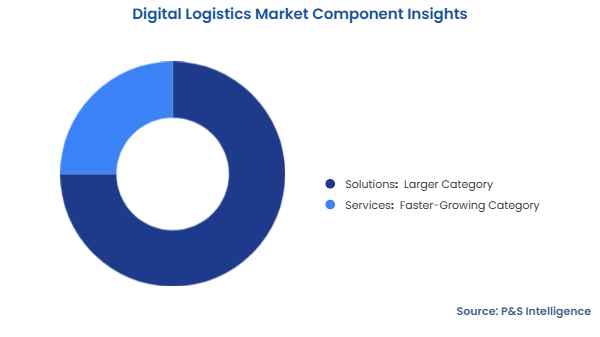
The solutions category holds the larger share in the digital logistics market in 2025, of 75.0%, and it is expected to maintain its dominant position throughout the forecast period. This dominance is primarily attributed to the comprehensive capabilities that digital logistics software platforms provide in optimizing end-to-end supply chain operations, from transportation management and warehouse automation to inventory control and real-time tracking systems.
Services will witness the higher CAGR during the forecast period, driven by the increasing complexity of digital logistics implementations and the growing need for specialized expertise. As organizations undergo digital transformation initiatives, they require comprehensive support services, including consulting, system integration, customization, training, and ongoing maintenance. Consulting services help companies assess their existing logistics processes, identify improvement opportunities, and design tailored digital strategies aligned with business objectives. Integration services are critical for connecting new digital logistics platforms with legacy systems, third-party applications, and partner networks. The rapid pace of technological advancement necessitates continuous updates and optimization, creating sustained demand for managed services and technical support.
These components are covered:
Solutions (Larger Category)
Services (Faster-Growing Category)
Application Analysis
The transportation management segment holds the largest share in the digital logistics market in 2025, of 45.0%, and it is projected to maintain its leading position during the forecast period. This dominance reflects the critical role that transportation represents in overall logistics costs and the substantial optimization opportunities that digital technologies provide in this area.
Digital transportation management systems enable companies to optimize routing decisions, consolidate shipments, select carriers more strategically, and track shipments in real time across multiple modes of transport. These platforms use sophisticated algorithms that consider numerous variables, including distance, traffic patterns, weather conditions, fuel costs, carrier capacity, and delivery windows, to determine the most efficient transportation strategies.
The integration of artificial intelligence and machine learning enhances these capabilities by continuously learning from historical data to improve routing accuracy and identify patterns that human planners might miss. Real-time visibility into shipment status allows companies to proactively address potential delays, communicate accurate delivery estimates to customers, and dynamically adjust plans when disruptions occur.
The expansion of cross-border e-commerce and the growth of just-in-time manufacturing have intensified the complexity of transportation management, making digital solutions increasingly essential. Companies are leveraging digital platforms to manage multi-modal transportation networks that seamlessly combine trucking, rail, air, and ocean freight to optimize cost and speed trade-offs. Advanced analytics provide insights into carrier performance, enabling data-driven decisions about carrier selection and contract negotiations. The pressure to reduce carbon emissions has also driven the adoption of digital transportation management systems that can optimize routes to minimize fuel consumption and support sustainability reporting requirements.
Warehouse management will witness the highest CAGR during the forecast period, driven by the rapid advancement of automation technologies and the growing complexity of order fulfillment operations. The proliferation of e-commerce has fundamentally changed warehouse requirements, with companies needing to process higher volumes of smaller, more frequent orders with greater speed and accuracy. Digital warehouse management systems orchestrate complex operations involving receiving, putaway, picking, packing, and shipping, while optimizing space utilization and labor productivity.
Robotics and autonomous vehicles are being integrated into warehouse environments, requiring sophisticated software platforms to coordinate activities between human workers and machines. The adoption of artificial intelligence enables predictive inventory positioning, ensuring that fast-moving products are strategically located to minimize picking time. Real-time visibility into inventory levels, order status, and resource availability allows warehouse managers to identify inefficiencies quickly and implement continuous improvement initiatives.
These applications are covered:
Transportation Management (Largest Category)
Warehouse Management (Fastest-Growing Category)
Labor/Workforce Management
Others
Deployment Mode Insights
The cloud deployment segment held the larger share in the digital logistics market in 2025, of 80.0%, and it will also have the higher CAGR till 2032. This reflects the substantial benefits that cloud-based platforms provide in terms of scalability, flexibility, cost efficiency, and rapid deployment capabilities. Cloud-based digital logistics solutions eliminate the need for significant upfront capital investments in IT infrastructure, making advanced capabilities accessible to organizations of all sizes. Companies can scale their usage up or down based on seasonal demand fluctuations or business growth without purchasing additional hardware or software licenses. Cloud platforms enable seamless integration with partner systems, providing the connectivity required to manage complex, multi-party supply chains effectively. The subscription-based pricing models associated with cloud deployments convert fixed IT costs into variable expenses that align with business volumes, improving financial flexibility.
These deployment modes are covered:
Cloud (Larger and Faster-Growing Category)
On-Premises
Organization Size Analysis
The large enterprises segment dominates the digital logistics market in 2025, with 75.0% market share, driven by their substantial logistics operations, significant IT budgets, and strategic imperatives to optimize complex global supply chains. Large enterprises typically manage high volumes of shipments across multiple geographies, operate extensive warehouse networks, and coordinate with hundreds or thousands of suppliers and carriers. The scale and complexity of these operations create both the need and the economic justification for comprehensive digital logistics platforms.
Small and medium enterprises will witness the higher CAGR during the forecast period as cloud-based digital logistics solutions become increasingly accessible and affordable for organizations with more limited resources. SMEs are recognizing that digital capabilities are no longer optional but essential for competing effectively against larger rivals and meeting customer expectations. Cloud deployment models have dramatically lowered the barriers to entry by eliminating large upfront investments and providing flexible pricing that scales with business volumes.
These organization sizes are covered:
Large Enterprises (Larger Category)
Small and Medium Enterprises (Faster-Growing Category)
End Use Insights
The retail & e-commerce segment holds the largest share in the digital logistics market in 2025, of 30.0%, reflecting the profound impact that online shopping has had on logistics requirements and the sophisticated digital capabilities necessary to meet modern consumer expectations. The retail and e-commerce sector has been fundamentally transformed by digital technologies, with online channels now representing a substantial and growing portion of total retail sales. This shift has created enormous logistics challenges, as retailers must fulfill orders rapidly, accurately, and cost-effectively while providing customers with real-time visibility into order status and delivery timelines. Digital logistics solutions enable retailers to manage inventory across multiple channels, optimize fulfillment from the most appropriate location, and coordinate complex delivery networks that may include company-operated facilities, third-party logistics providers, and delivery partners.
Manufacturing will witness the highest CAGR during the forecast period, driven by the adoption of Industry 4.0 principles and the increasing complexity of global manufacturing supply chains. Modern manufacturing operations require precise coordination of raw materials, components, and finished goods across multiple facilities, suppliers, and distribution channels. Digital logistics solutions enable manufacturers to implement just-in-time and just-in-sequence delivery strategies that minimize inventory holding costs while ensuring production continuity. Real-time visibility into supplier performance, transportation status, and inventory levels allows manufacturers to respond quickly to disruptions and maintain operational efficiency.
These end uses are covered:
Retail & E-Commerce (Largest Category)
Manufacturing (Fastest-Growing Category)
Healthcare & Pharmaceuticals
Automotive
Aerospace & Defense
Energy & Utilities
Others
Drive strategic growth with comprehensive market analysis
Digital Logistics Market Regional Market Performance
North America Digital Logistics Market Size
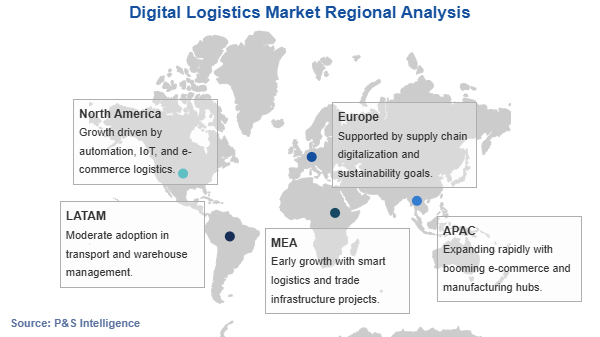
North America holds the largest share in the digital logistics market in 2025, of 40.0%, and is expected to maintain its leadership position throughout the forecast period. This dominance is primarily attributed to the region's highly developed e-commerce ecosystem, advanced technological infrastructure, substantial investments in supply chain innovation, and the presence of major logistics technology providers and early adopters.
U.S. Digital Logistics Market Size
The U.S. leads the region's digital logistics market, driven by the massive scale of its e-commerce sector and the sophisticated logistics networks required to serve a large, geographically dispersed population. Amazon and Walmart controlled over 40% of all U.S. online retail transactions in 2024, and these retail giants have made substantial investments in digital logistics technologies, including warehouse automation, artificial intelligence, and predictive analytics. The competitive intensity in the U.S. logistics market has driven rapid technology adoption as companies seek operational advantages through digital capabilities.
Asia-Pacific Digital Logistics Market Growth
Asia-Pacific is expected to witness the highest CAGR during the forecast period, of approx. 19.0%, driven by rapid e-commerce growth, expanding manufacturing activities, increasing logistics infrastructure investments, and accelerating digital transformation initiatives across the region. The Asia-Pacific region represents the world's largest and fastest-growing e-commerce market, with China alone accounting for a substantial portion of global online retail sales. This explosive growth in online shopping has created enormous demand for sophisticated digital logistics solutions capable of managing high-volume order fulfillment, last-mile delivery optimization, and real-time tracking across vast geographic areas.
Governments across the region are making significant investments in logistics infrastructure, including smart ports, automated warehouses, and digital trade facilitation systems, creating a supportive environment for digital logistics adoption. The region has emerged as a hotbed of logistics technology innovation, with numerous startups and established technology companies developing solutions tailored to local market conditions.
The regions and countries analyzed in this report are:
North America (Largest Regional Market)
U.S. (Larger Country Market)
Canada (Faster-Growing Country Market)
Europe
Germany (Largest Country Market)
U.K. (Fastest-Growing Country Market)
France
Italy
Spain
Rest of Europe
Asia-Pacific (Fastest-Growing Regional Market)
Japan
China (Largest Country Market)
India (Fastest-Growing Country Market)
South Korea
Australia
Rest of APAC
Latin America
Brazil (Largest Country Market)
Mexico (Fastest-Growing Country Market)
Rest of LATAM
Middle East and Africa
Saudi Arabia (Largest Country Market)
South Africa
U.A.E. (Fastest-Growing Country Market)
Rest of MEA
Digital Logistics Market Share
The global digital logistics market is consolidated, with a moderate number of established technology companies and logistics service providers dominating the landscape, while numerous smaller players and startups compete in specialized niches. The market structure reflects the substantial resources required to develop comprehensive digital logistics platforms, the importance of scale in serving large enterprise clients, and the network effects that benefit established players with extensive customer bases.
These leading companies benefit from substantial research and development budgets, extensive partner ecosystems, and the ability to integrate digital logistics capabilities with broader enterprise software portfolios that include enterprise resource planning, customer relationship management, and business intelligence solutions. Companies invest heavily in artificial intelligence, machine learning, and cloud infrastructure to enhance their platforms' predictive capabilities, automation features, and scalability.
Specialized logistics technology providers such as Blue Yonder and Manhattan Associates focus specifically on supply chain and logistics applications, offering deep domain expertise and industry-specific functionality that enterprise software generalists may not match. These specialists compete through superior logistics functionality, industry knowledge, and focused innovation in areas such as warehouse management, transportation optimization, and supply chain visibility.
Key Digital Logistics Companies:
SAP SE
Oracle Corporation
IBM Corporation
Blue Yonder
Manhattan Associates, Inc.
Honeywell International Inc.
Infosys Limited
HCL Technologies Limited
Microsoft Corporation
Intel Corporation
Accenture plc
Kuehne + Nagel International AG
C.H. Robinson Worldwide, Inc.
DHL Group
Digital Logistics Market News
In November 2024, Microsoft highlighted collaborations between Germany's industrial sector and artificial intelligence technologies to advance digital logistics capabilities, emphasizing the integration of machine learning tools for predictive maintenance, demand forecasting, and real-time shipment visibility across European supply chains.
In July 2024, C.H. Robinson Worldwide officially launched Digital Dispatch, an advanced load-matching platform. This new tool leverages artificial intelligence (AI) and data science to provide carriers with real-time, personalized freight recommendations
In March 2024, Oracle introduced new AI-powered logistics capabilities as part of its Oracle Fusion Cloud Supply Chain and Manufacturing suite, using machine learning algorithms to improve forecasting accuracy, automate warehouse workflows, and enhance supply chain visibility across global operations.
Want a report tailored exactly to your business need?
Leading companies across industries trust us to deliver data-driven insights and innovative solutions for their most critical decisions. From data-driven strategies to actionable insights, we empower the decision-makers who shape industries and define the future. From Fortune 500 companies to innovative startups, we are proud to partner with organisations that drive progress in their industries.
Client Testimonials
Working with P&S Intelligence and their team was an absolute pleasure – their awareness of timelines and commitment to value greatly contributed to our project's success. Eagerly anticipating future collaborations.
McKinsey & Company
India
Unmatched Standards
Our insights into the minutest levels of the markets, including the latest trends and competitive landscape, give you all the answers you need to take your business to new heights
Complete Data Security
We take a cautious approach to protecting your personal and confidential information. Trust is the strongest bond that connects us and our clients, and trust we build by complying with all international and domestic data protection and privacy laws