Digital Forensics Market Size & Share Analysis - Trends, Drivers, Competitive Landscape, and Forecasts (2026 - 2032)
This Report Provides In-Depth Analysis of the Digital Forensics Market Report Prepared by P&S Intelligence, Segmented by Component (Software, Services, Hardware), Forensics Type (Computer Forensics, Cloud Forensics, Network Forensics, Mobile Device Forensics, Database Forensics, Email Forensics, IoT Forensics), Function (Data Acquisition & Preservation, Decryption, Examination & Analysis, Data Recovery & Reconstruction, Reporting & Presentation), Deployment Mode (On-Premises, Cloud), End-User (Government & Law Enforcement, Healthcare, BFSI, IT & Telecom, Retail & E-commerce, Defense & Aerospace, Energy & Utilities, Manufacturing, Transportation & Logistics, Education), Organisation Size (Large Enterprises, Small and medium enterprises), and Geographical Outlook for the Period of 2021 to 2032
Explore the market potential with our data-driven report
Digital Forensics Market Future Outlook
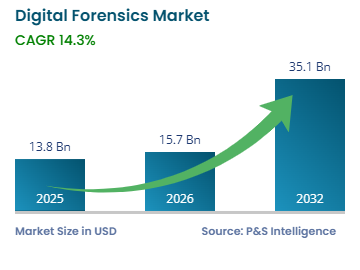
The digital forensics market size was USD 13.8 billion for 2025, and it will grow by 14.3% during 2026-2032, to reach USD 35.1 billion by 2032.
The digital forensics market is expanding as cybercrime, data breaches, insider incidents, and online fraud create stronger demand for structured investigation capabilities across enterprises and public institutions. Organizations now manage evidence across endpoints, cloud accounts, mobile devices, emails, collaboration platforms, and network logs, making manual investigation slower and less reliable. The growth is also supported by wider digital operations, remote access systems, and third-party applications that increase the number of places where evidence may be stored or altered. Security teams need tools that preserve chain of custody, recover deleted data, and support legally defensible analysis when incidents involve financial loss, employee misconduct, or regulatory review.
According to the Federal Bureau of Investigation, reported losses from internet crime exceeded $16 billion in 2024, reflecting a 33 percent rise in financial damage from digital threats. This level of reported loss shows why organizations are treating digital forensics as a core part of cyber resilience rather than a post-incident activity. Furthermore, stricter data protection rules and audit requirements are increasing the need for accurate evidence collection, timeline reconstruction, and incident documentation. The market impact is visible in stronger adoption of forensic software, managed investigation services, and integrated platforms that connect endpoint detection, cloud security, and case management for faster response across complex incident environments.
Key Market Insights
Software is the largest component, holding a market share of 60%, due to growing demand for evidence collection, examination, reporting, and chain-of-custody management across digital environments.
Cloud Forensics is the fastest-growing forensics type, registering a CAGR of approximately 15.0%, driven by increasing investigations involving cloud workloads, SaaS applications, virtual machines, and distributed storage environments.
Data Acquisition and Preservation is the largest function, holding a market share of 35%, due to rising requirements for secure evidence collection and preservation throughout forensic investigations.
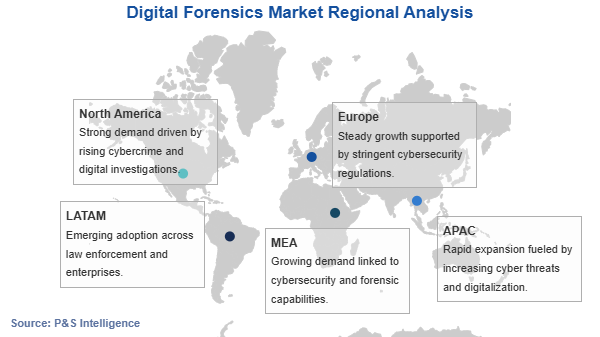
North America holds the largest share of 40%, due to its mature cybersecurity ecosystem, widespread deployment of digital investigation technologies, and strong forensic capabilities.
Asia-Pacific is the fastest-growing region, registering a CAGR of approximately 15.2%, driven by rapid digital transformation, expanding cloud adoption, and growing digital payment ecosystems.
Digital Forensics Market Dynamics
AI-Powered Investigation Platforms and Cloud Evidence Tools Are Major Trends
The digital forensics market is advancing as investigation platforms increasingly incorporate artificial intelligence to automate evidence review, accelerate threat analysis, and improve case reconstruction across complex digital environments. Growing volumes of data from endpoints, cloud workloads, enterprise applications, and network infrastructure are making traditional forensic workflows more time-consuming and resource-intensive. According to the International Business Machines Corporation Cost of a Data Breach Report 2024, organizations using artificial intelligence and automation reduced the average time required to identify and contain a breach by nearly 100 days. Furthermore, according to the Microsoft Digital Defense Report 2025 published by Microsoft Corporation, cloud attacks increased by 87 percent during 2025. These trends are encouraging vendors to develop cloud-native forensic platforms with automated evidence correlation, remote acquisition capabilities, and integrated analytics. The market impact extends beyond faster investigations, as organizations are increasing investments in forensic readiness, cloud evidence management, and automated incident response functions that support larger investigation workloads across distributed digital environments.
Rising Cybercrime and Data Breach Investigations Drive Market
The digital forensics market is expanding as ransomware attacks, phishing campaigns, insider threats, and online fraud schemes generate a growing volume of digital evidence across enterprise and public-sector environments. Organizations and law enforcement agencies are handling more investigations involving compromised credentials, unauthorized transactions, data theft, and attacks targeting critical business systems. According to the United Nations Office on Drugs and Crime report on emerging cyber threats, cybersecurity studies estimate that nearly 1.2 percent of all emails sent globally are malicious, translating to about 3.4 billion phishing emails every day. Additionally, according to the International Criminal Police Organization Annual Report, global law enforcement operations targeting online scams across 61 countries froze 6,745 illicit bank accounts and identified over 14,000 suspects in 2024. These developments are increasing demand for forensic software, evidence preservation tools, malware analysis platforms, and specialized investigation services that help organizations process larger caseloads and support complex digital investigations across multiple systems.
High Investigation Costs and Shortage of Skilled Experts
The digital forensics market faces constraints due to the high cost of forensic software, secure storage infrastructure, evidence management platforms, and ongoing system upgrades needed to support modern investigation requirements. Many small and mid-sized organizations delay investments because digital forensics projects often require specialized tools, trained personnel, and long implementation cycles. According to the World Economic Forum Global Cybersecurity Outlook 2025, 49 percent of public-sector organizations reported lacking the necessary cybersecurity talent to meet their cybersecurity goals, representing a 33 percent increase from 2024. Limited access to skilled investigators, forensic analysts, and incident response professionals can slow evidence processing and case management. These workforce and deployment challenges often extend investigation timelines, increase operational costs, and restrict broader adoption of advanced forensic capabilities across organizations.
Managed Forensics Services and SME Cloud Adoption
Strong opportunities are emerging in managed digital forensic services and cloud-based forensic platforms as organizations seek cost-effective investigation capabilities without building dedicated internal teams. Small and medium-sized enterprises are increasingly adopting outsourced incident response, evidence preservation, and compliance support because maintaining specialized forensic expertise remains expensive and resource intensive. According to the World Economic Forum Global Cybersecurity Outlook 2024, the number of organizations maintaining minimum viable cyber resilience declined by 30%, while small and medium-sized enterprises showed a significant decline in cyber resilience compared with larger organizations. Furthermore, growing exposure to ransomware, business email compromise, and data theft is encouraging wider adoption of subscription-based forensic services, creating demand for scalable platforms, remote evidence collection, and faster investigative workflows across diverse industries.
Digital Forensics Market Segmentation Analysis
Component Analysis
Software is the largest category, holding a market share of 60%, because digital forensic investigations depend on software for evidence collection, preservation, examination, reporting, and chain-of-custody management across computers, mobile devices, networks, databases, and cloud environments. Organizations increasingly require platforms that consolidate multiple evidence sources into a single investigation workflow while supporting automation and frequent updates. According to the Microsoft Digital Defense Report 2025 published by Microsoft Corporation, Microsoft processes more than 100 trillion security signals daily and blocks 4.5 million net new malware files every day. This volume of digital activity increases demand for scalable forensic software that can accelerate evidence review, improve investigation accuracy, and support complex case workloads.
Services is the fastest-growing category, registering a CAGR of approximately 14.7%, because many organizations lack specialized forensic personnel and increasingly rely on external experts for incident response, breach investigations, litigation support, and forensic readiness programs. As cloud, endpoint, and network environments become more complex, the need for specialized investigation skills continues to expand. Service providers help organizations manage evidence handling, expert testimony, and case documentation while reducing internal resource pressure. This growing reliance on outsourced expertise strengthens demand for consulting, managed forensic operations, and investigation support services across both public and private sector environments.
The components analysed in this report are:
Software (Largest Category)
Data acquisition and preservation software
Forensic analysis and investigation platforms
Email, file, and database analysis tools
Reporting and visualisation tools
Services (Fastest-growing Category)
Digital investigation and incident response
Forensic data analysis and evidence handling
Consulting and advisory services
Training and certification services
Managed forensic services
Hardware
Forensic workstations and imaging devices
Write blockers and data acquisition devices
Storage and duplication systems
Mobile forensic extraction devices
Forensics Type Analysis
Computer Forensics is the largest category, holding a market share of 30%, because computers remain a primary source of digital evidence in cybercrime investigations, insider threat cases, financial fraud inquiries, and corporate compliance reviews. Organizations continue to generate large volumes of files, application records, user activity logs, and stored communications on endpoints that require structured examination. Computer forensic tools also support evidence preservation and analysis workflows that connect with network, cloud, and mobile investigations. This central role in digital investigations sustains strong demand for endpoint-focused forensic platforms, evidence management tools, and workstation-based examination capabilities.
Cloud Forensics is the fastest-growing category, because investigations increasingly involve cloud workloads, SaaS applications, virtual machines, containers, and distributed storage environments. Evidence is often spread across remote logs, user permissions, cloud-native services, and shared infrastructure, creating new investigation requirements. According to the International Energy Agency, data center electricity consumption reached about 415 terawatt-hours in 2024 and grew 12 percent annually over the previous five years. Growing cloud infrastructure activity increases demand for forensic tools that support remote evidence collection, timeline reconstruction, and large-scale analysis across complex cloud ecosystems.
The forensics types analysed in this report are:
Computer Forensics (Largest Category)
Cloud Forensics (Fastest-growing Category)
Network Forensics
Mobile Device Forensics
Database Forensics
Email Forensics
IoT Forensics
Others
Function Analysis
Data Acquisition and Preservation is the largest category, because every forensic investigation begins with secure evidence collection and preservation procedures that maintain integrity throughout the examination process. Organizations prioritize imaging systems, mobile extraction tools, log capture platforms, and secure repositories to establish reliable chain-of-custody records. According to the International Telecommunication Union, global internet users reached an estimated 6 billion in 2025. The growing volume of connected users generates more digital evidence across devices, applications, and networks, increasing the need for technologies that capture, preserve, and manage information in legally defensible investigation workflows.
Decryption is the fastest-growing category, registering a CAGR of approximately 14.9%, because investigators increasingly encounter encrypted smartphones, protected files, secure enterprise systems, and encrypted communication platforms during investigations. Stronger privacy controls and wider adoption of encryption technologies create additional challenges when accessing time-sensitive evidence. Organizations are investing in password recovery, lawful access solutions, and advanced unlocking technologies to support investigations involving restricted data. This growing focus on evidence accessibility strengthens demand for specialized decryption capabilities that help forensic teams examine protected information while maintaining compliance with legal and regulatory requirements.
The functions analysed in this report are:
Data Acquisition & Preservation (Largest Category)
Decryption (Fastest-growing Category)
Examination & Analysis
Data Recovery & Reconstruction
Reporting & Presentation
Others
Deployment Mode Analysis
On-Premises is the larger category, holding a market share of 75%, because law enforcement agencies, financial institutions, defense organizations, and regulated enterprises prefer direct control over sensitive evidence, storage infrastructure, and access management processes. Internal deployment helps organizations maintain compliance with strict legal, security, and audit requirements while reducing concerns related to external data handling. On-premises environments also support established forensic workflows involving evidence preservation and chain-of-custody controls. This preference for controlled investigation environments continues to sustain demand for locally deployed forensic platforms, evidence repositories, and examination infrastructure.
Cloud is the faster-growing category, because organizations increasingly seek scalable forensic environments that support remote investigations, distributed teams, and subscription-based deployment models. Cloud platforms enable faster access to logs, remote evidence preservation, and collaborative case management across multiple locations. According to the Cloudflare Radar 2024 Year in Review published by Cloudflare, global Internet traffic grew 17.2 percent in 2024. Rising digital activity increases forensic data volumes, encouraging adoption of cloud-based tools that can process large datasets efficiently while supporting rapidly evolving evidence sources and investigation requirements.
The deployment modes analysed in this report are:
On-Premises (Larger Category)
Cloud (Faster-growing Category)
End-User Analysis
Government & Law Enforcement is the largest category, holding a market share of 25%, because police departments, intelligence agencies, judicial bodies, and public investigation units manage substantial volumes of cybercrime, fraud, criminal, and national security cases. These organizations require reliable evidence collection, chain-of-custody controls, forensic laboratories, and courtroom-ready reporting capabilities. Government agencies also continue investing in cyber investigation infrastructure and digital evidence management systems. Their ongoing operational responsibilities and long-term forensic requirements sustain strong demand for advanced investigation platforms, specialized tools, and professional forensic expertise across public sector environments.
Healthcare is the fastest-growing category, because healthcare providers increasingly depend on electronic health records, telehealth platforms, connected medical systems, and digital patient information. These environments generate large volumes of clinical, billing, imaging, and access-related records that require monitoring and investigation capabilities. According to the Office of the National Coordinator for Health Information Technology, 96 percent of non-federal acute care hospitals and nearly four in five office-based physicians used an ONC-certified electronic health record system in 2021. This expanding digital infrastructure increases demand for forensic solutions that support audit trails, compliance reviews, and security investigations.
The end-users analysed in this report are:
Government & Law Enforcement (Largest Category)
Healthcare (Fastest-growing Category)
BFSI
IT & Telecom
Retail & E-commerce
Defense & Aerospace
Energy & Utilities
Manufacturing
Transportation & Logistics
Education
Others
Organisation Size Analysis
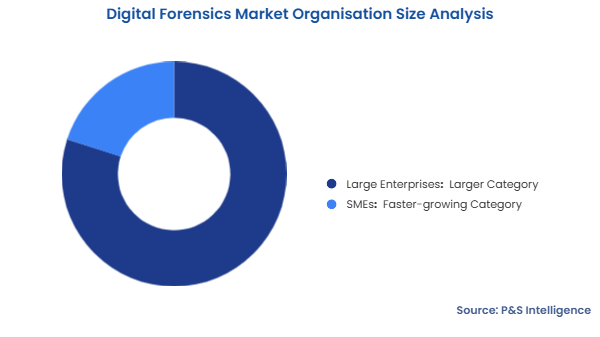
Large Enterprises is the larger category, holding a market share of 80%, because these organizations operate complex technology environments that include extensive endpoint networks, cloud platforms, business applications, and sensitive data repositories. Higher incident volumes, regulatory obligations, and security monitoring requirements create continuous demand for advanced forensic capabilities. According to the World Economic Forum Global Cybersecurity Outlook 2025, only 10 percent of medium-to-large private-sector organizations reported insufficient cyber resilience. Strong cybersecurity investment supports adoption of enterprise-grade forensic platforms, evidence management systems, and investigation tools designed to handle large-scale digital environments and complex incident response activities.
SMEs is the faster-growing category, registering a CAGR of approximately 14.7%, because small and medium-sized businesses increasingly face phishing attacks, ransomware incidents, fraud attempts, and other cyber threats despite having limited internal security resources. Cloud-based forensic tools and managed investigation services have improved accessibility by reducing infrastructure and staffing requirements. Many SMEs are also strengthening compliance programs and cybersecurity practices as digital operations expand. Growing awareness of operational disruption, financial loss, and regulatory exposure is encouraging broader adoption of forensic technologies and external investigation support across smaller business environments.
The organisation sizes analysed in this report are:
Large Enterprises (Larger Category)
SMEs (Faster-growing Category)
Drive strategic growth with comprehensive market analysis
Digital Forensics Market Geographical Analysis
North America Digital Forensics Market Analysis
North America holds the largest share, of 40%, due to its established cybersecurity ecosystem, mature incident response capabilities, and widespread deployment of digital investigation technologies across both public and private sectors. Large enterprises in banking, healthcare, telecommunications, defense, and government agencies manage extensive digital infrastructures that generate significant volumes of logs, endpoint data, cloud records, and user activity information requiring forensic review. Regulatory requirements related to breach disclosure, litigation support, e-discovery, and evidence preservation further increase demand for specialized forensic tools and services. Furthermore, the region benefits from the presence of major cybersecurity and digital forensics vendors that provide advanced software, managed investigation services, technical training, and research support. Ongoing ransomware incidents, insider misconduct investigations, business email compromise cases, and cross-border cybercrime activities continue to drive sustained usage of forensic platforms across organizations handling complex digital evidence environments.
U.S. Digital Forensics Market Analysis
The United States holds the leading position in the digital forensics market due to high cyber incident volumes, advanced cybersecurity infrastructure, and strong enterprise investment in investigation technologies. Organizations across finance, healthcare, telecommunications, government, and critical infrastructure generate substantial volumes of digital evidence that require specialized analysis and preservation capabilities. According to the Federal Bureau of Investigation Internet Crime Complaint Center, 1,008,597 complaints were received in 2025, increasing from 859,532 in 2024. This level of cyber activity supports ongoing demand for forensic software, incident response platforms, evidence management systems, and investigation services used across public and private sector environments.
Canada Digital Forensics Market Analysis
Canada is witnessing steady growth in the digital forensics market as organizations strengthen cybersecurity resilience across finance, healthcare, government, energy, and critical infrastructure sectors. Rising concern regarding fraud, ransomware, data theft, and business disruption is encouraging greater investment in investigation readiness and evidence management capabilities. According to Statistics Canada, total business spending on recovering from cybersecurity incidents increased from approximately $600 million in 2021 to $1.2 billion in 2023. This increase reflects greater attention to incident response and recovery activities, supporting adoption of forensic investigation software, digital evidence platforms, and managed forensic services across Canadian organizations.
Asia-Pacific Digital Forensics Market Analysis
Asia-Pacific has the highest CAGR, of approximately 15.2%, supported by rapid digital transformation across businesses, government agencies, financial institutions, manufacturing facilities, and consumer-facing platforms. Expanding cloud adoption, widespread smartphone usage, growing digital payment ecosystems, and increasing e-commerce activity are generating larger volumes of digital records that require structured investigation and evidence management capabilities. Many countries across the region are strengthening cybersecurity regulations, national cyber defense initiatives, and data protection frameworks to address rising cyber risks. Furthermore, organizations are increasing investment in incident response readiness, threat investigation, and forensic preparedness following ransomware attacks, financial fraud incidents, and data breach events. Demand is also rising from manufacturing and industrial sectors that rely on connected systems, operational technology networks, and digital supply chains, creating additional requirements for forensic tools capable of supporting investigations across diverse technology environments.
China Digital Forensics Market Analysis
China represents the largest digital forensics market in Asia-Pacific due to its extensive digital economy, large online population, and widespread adoption of enterprise technologies. E-commerce platforms, industrial systems, digital payment networks, cloud services, and connected applications generate significant volumes of digital records that require monitoring and investigative support. According to the China Internet Network Information Center, China had 1.125 billion internet users by the end of 2025, with internet penetration reaching 80.1 percent. The scale of digital activity is increasing demand for forensic technologies that support evidence preservation, cyber investigations, compliance requirements, and security operations across multiple sectors.
India Digital Forensics Market Analysis
India is the fastest-growing digital forensics market due to the rapid expansion of digital payments, increasing cybercrime exposure, and growing enterprise digitalisation. Government agencies and businesses are strengthening cyber investigation and enforcement capabilities. According to the Press Information Bureau, digital payment transactions reached 22,167.90 crore in volume during FY 2024–2025, reflecting massive digital financial activity across the economy. This is driving demand for forensic tools, fraud investigation systems, and cloud-based evidence management solutions across sectors.
Europe Digital Forensics Market Analysis
Europe benefits from well-established regulatory frameworks, mature legal systems, and strong demand for compliant digital evidence management across both private and public sectors. Organizations require forensic solutions that support auditability, chain-of-custody controls, secure evidence storage, and investigation procedures aligned with regional data protection and privacy requirements. Financial institutions, telecommunications providers, energy companies, manufacturers, and government agencies remain major adopters due to their exposure to cyber threats and regulatory oversight. Furthermore, organizations increasingly require forensic capabilities to investigate data breaches, insider incidents, intellectual property theft, and operational disruptions affecting critical business functions. Growing concern regarding state-linked cyber activities, corporate espionage campaigns, and attacks targeting critical infrastructure is encouraging broader investment in forensic software, investigation services, and coordinated cross-border evidence analysis capabilities throughout the region.
The regions and countries analysed in this report are:
North America (Largest Regional Market)
U.S. (Larger Country)
Canada (Faster-Growing Country)
Europe
Germany (Largest Country)
U.K. (Fastest-Growing Country)
France
Italy
Spain
Rest of Europe
Asia-Pacific (Fastest-Growing Regional Market)
China (Largest Country)
India (Fastest-Growing Country)
Japan
South Korea
Australia
Rest of APAC
Latin America
Brazil (Largest Country)
Mexico (Fastest-Growing Country)
Rest of LATAM
Middle East and Africa
Saudi Arabia (Largest Country)
U.A.E. (Fastest-Growing Country)
South Africa
Rest of MEA
Digital Forensics Market Share Analysis
The market is fragmented, with digital forensic software vendors, cybersecurity companies, forensic hardware manufacturers, managed investigation providers, and specialist service firms competing across a wide range of investigation requirements. Competition remains distributed because customers select solutions based on evidence source, deployment environment, regulatory obligations, investigation complexity, and integration requirements rather than relying on a single provider. Vendors differentiate through capabilities such as endpoint forensics, mobile device extraction, cloud evidence collection, network traffic analysis, malware investigation, and incident response support. Furthermore, the market includes specialized providers focused on law enforcement, government agencies, corporate security teams, and legal investigations. Product innovation remains active, particularly in artificial intelligence-assisted evidence review, cloud-native forensic platforms, automation features, and remote investigation workflows. Strategic partnerships, technology integrations, and acquisitions continue across the sector, while diverse customer requirements sustain competition among both established vendors and emerging participants.
Leading Companies in the Digital Forensics Market:
International Business Machines Corporation
Cisco Systems Incorporated
Open Text Corporation
Cellebrite DI Limited
Nuix Limited
Exterro Incorporated
Magnet Forensics Incorporated
Microsoft Corporation
Micro Systemation Aktiebolag
Oxygen Forensics Incorporated
Paraben Corporation
Exabeam Incorporated
Belkasoft Limited
Advanced Digital Forensic Solutions Incorporated
Digital Detective Group Limited
Digital Forensics Market News
In March 2026, Cellebrite released its Spring 2026 update, expanding support for a wider range of mobile devices and operating systems, introducing drone forensics capabilities, and enabling Corellium availability on Google Cloud. The release focused on enhancing device access, data capture, and forensic workflows for investigation teams handling multiple devices and locked phones.
In October 2025, OpenText introduced new cybersecurity capabilities in Cloud Editions 25.4, integrating identity management, threat detection and response, data protection, and compliance tools within a unified security framework. The update enhanced security operations and AI-driven workflows, including support for forensic and investigation processes, and was released as a generally available software package for enterprise customers.
In September 2025, Exterro launched FTK Imager Pro, a forensic imaging and evidence acquisition tool designed for investigators working with encrypted devices and digital evidence. The release introduced features such as on-the-fly decryption, iOS logical collection, and live preview capabilities, and was introduced as a commercial solution for forensic, legal, and cybersecurity investigation teams.
Frequently Asked Questions About This Report
What is driving demand in the digital forensics market today?+
Demand is rising because cyberattacks, data breaches, cloud usage, remote work, and digital investigations require faster evidence collection and stronger incident analysis.
Why do organizations invest in digital forensics solutions?+
Organizations invest to investigate security incidents, preserve evidence, understand attack timelines, support legal action, and strengthen cybersecurity defenses after breaches.
Which industries use digital forensics tools the most?+
Law enforcement, government, banking, healthcare, legal services, enterprises, and cybersecurity teams use digital forensics tools for investigations and compliance support.
How does digital forensics support cyber incident response teams?+
Digital forensics helps incident response teams identify attack sources, analyze compromised systems, preserve evidence, and document findings for recovery and legal review.
What role does cloud forensics play in this market?+
Cloud forensics helps investigators collect, preserve, and analyze evidence from cloud platforms, online accounts, remote systems, and software-based business environments.
Want a report tailored exactly to your business need?
Leading companies across industries trust us to deliver data-driven insights and innovative solutions for their most critical decisions. From data-driven strategies to actionable insights, we empower the decision-makers who shape industries and define the future. From Fortune 500 companies to innovative startups, we are proud to partner with organisations that drive progress in their industries.
Client Testimonials
Working with P&S Intelligence and their team was an absolute pleasure – their awareness of timelines and commitment to value greatly contributed to our project's success. Eagerly anticipating future collaborations.
McKinsey & Company
India
Unmatched Standards
Our insights into the minutest levels of the markets, including the latest trends and competitive landscape, give you all the answers you need to take your business to new heights
Complete Data Security
We take a cautious approach to protecting your personal and confidential information. Trust is the strongest bond that connects us and our clients, and trust we build by complying with all international and domestic data protection and privacy laws