Digital Business Support System Market Revenue Insights
Key Highlights
| Study Period | 2021 - 2032 |
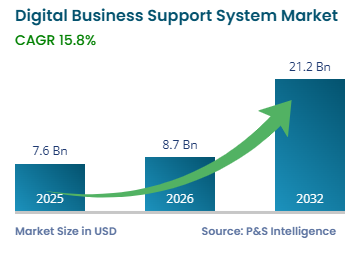
| Market Size in 2025 | USD 7.6 Billion |
| Market Size in 2026 | USD 8.7 Billion |
| Market Size by 2032 | USD 21.2 Billion |
| Projected CAGR | 15.8% |
| Largest Region | North America |
| Fastest-Growing Region | Asia-Pacific |
| Market Structure | Fragmented |
Market Size
Explore the market potential with our data-driven report
Digital Business Support System Market Key Insights
- Solutions are the larger component, holding a market share of 75%, as telecom operators rely on integrated platforms for billing, data, and service management.
- Services are the faster-growing component, registering a CAGR of approximately 16.0%, as companies require ongoing support for advanced BSS integration and customisation.
- Large enterprises are the larger category, holding a market share of 75%, due to extensive customer bases and high-volume digital service operations.
- North America is the largest regional market, holding a share of 40%, because telecom operators invested heavily in advanced BSS platforms and upgrades.
- Asia-Pacific is the fastest-growing regional market, registering a CAGR of approximately 16.7%, driven by expanding user bases and rapidly increasing digital service demand.
Digital Business Support System Market Future Outlook
The digital business support system market size was USD 7.6 billion for 2025, and it will grow by 15.8% during 2026–2032, to reach USD 21.2 billion by 2032.
The market expands as telecom and digital service providers manage increasingly complex customer offerings, billing structures, and high-volume data transactions. These operators require advanced platforms to process real-time service delivery and maintain operational efficiency. According to the International Telecommunication Union, an estimated 5.5 billion people used the Internet globally in 2024, significantly increasing the scale of digital interactions. As user participation rises, service providers continuously adopt cloud-based, real-time business support systems to efficiently handle growing transaction volumes and improve service delivery.
Digital Business Support System Market Emerging Trends and Growth Drivers
Shift Towards Cloud-Native and AI-Driven BSS Platforms Is Major Trend
The digital business support system market is shifting toward cloud-based, modular platforms that adapt quickly to evolving service requirements. Telecom operators are replacing rigid legacy systems with open-architecture solutions to support advanced network deployments and dynamic service models. According to the International Telecommunication Union, 5G network coverage reached an estimated 51% of the global population in 2024, significantly increasing network complexity. To manage this scale efficiently, companies integrate artificial intelligence to automate billing processes and customer support functions. Furthermore, more than one-third of individuals utilised generative AI tools in 2025, according to the Organisation for Economic Co-operation and Development. As digital interactions expand, vendors prioritise flexible, AI-driven platforms for real-time operations.
Rising Complexity of Digital Services and Customer Management Drives Market
The digital business support system market expands as telecom providers manage increasingly complex product bundles, dynamic pricing models, and on-demand subscription services. Legacy billing platforms fail to process these multi-layered customer interactions efficiently, leading to operational errors. According to the International Telecommunication Union, the world recorded 112 mobile-cellular subscriptions per 100 inhabitants globally in 2024, highlighting the massive scale of telecom connectivity. Furthermore, the enterprise segment maintained 10.7 billion internet of things connections globally in 2024, according to the Global System for Mobile Communications Association. As connected devices and enterprise endpoints expand rapidly, companies invest in advanced platforms to automate billing cycles and ensure seamless customer support.
High Cost and Risk in Replacing Legacy Systems Hamper Market Growth
The digital business support system market faces transition challenges as telecom operators continue relying on deeply integrated legacy infrastructure. Replacing these core systems requires substantial investment, extended timelines, and careful planning to avoid service disruptions. According to the International Telecommunication Union, global active mobile-broadband subscriptions reached 95 per 100 inhabitants in 2024, highlighting the massive scale of existing customer bases. Migrating such large subscriber volumes carries significant risk, as system errors can compromise billing accuracy and data integrity. As a result, operators delay upgrades and remain cautious about transitioning to modern platforms.
Expansion of Digital Services beyond Traditional Telcos Offers Opportunities
The digital business support system market expands as non-telecom industries, including fintech and streaming platforms, adopt these systems to manage complex subscription-based services. These sectors require flexible platforms to handle dynamic pricing, user accounts, and high-volume digital transactions. According to the World Bank, global fixed-broadband subscriptions reached 19 per 100 inhabitants in 2024, reflecting the rapid expansion of connected digital ecosystems. Furthermore, global cellular Internet of Things connections are expected to reach around 4.5 billion by 2025 and grow to nearly 8 billion by 2031, according to Ericsson. As digital services scale across industries, vendors capture new growth by delivering flexible, multi-service platforms.
Digital Business Support System Market Segmentation Analysis
Component Analysis
Solutions are the largest category, holding a market share of 75%, as telecom operators depend on integrated platforms to manage billing, customer data, and service operations at scale. According to the International Telecommunication Union, global 5G subscriptions reached an estimated 3 billion in 2025, significantly increasing the volume of network transactions. As service interactions grow in complexity, operators prioritise robust, centralised solutions to ensure stable and efficient system performance.
Services are the faster-growing category, registering a CAGR of approximately 16.0%, as companies need expert support to install, manage, and upgrade complex BSS platforms. Many businesses lack in-house skills to handle integration and customisation. As systems become more advanced, demand for consulting, maintenance, and managed services increases. Companies also prefer ongoing support to keep systems updated and running smoothly, which is driving faster growth in this segment.
The components analysed in this report are:
- Solutions (Larger Category)
- Revenue Management
- Customer Management
- Product & Order Management
- Partner Management
- Analytics & Reporting
- Services (Faster-Growing Category)
- Consulting & System Integration
- Deployment & Implementation
- Managed Services
- Support & Maintenance
Deployment Model Analysis
On-premises is the larger category, holding a market share of 70%, because many telecom providers still rely on internal systems for better control over data and operations. These companies handle sensitive customer and billing information, so they prefer secure environments. Existing infrastructure also makes it easier to continue with on-premises setups. This long-term reliance keeps this segment dominant despite new alternatives.
Cloud-based is the faster-growing category, registering a CAGR of approximately 16.2%, as enterprises increasingly demand flexible and rapidly deployable infrastructure. Telecom operators migrate to cloud platforms to reduce hardware dependency and enable real-time system scalability. According to the International Telecommunication Union, global mobile broadband traffic reached 1.3 Zettabytes in 2024, highlighting the exponential growth in network data volumes. As data consumption rises sharply, companies adopt cloud-based systems to support dynamic workloads, enable remote operations, and ensure seamless software deployment.
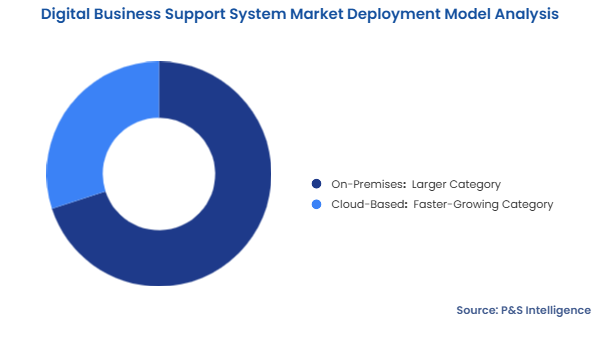
The deployment models analysed in this report are:
- On-Premises (Larger Category)
- Cloud-Based (Faster-Growing Category)
Enterprise Size Analysis
Large enterprises are the larger category, as these organisations manage extensive customer bases and complex service portfolios. Tier-1 telecom operators require high-capacity platforms to process large volumes of billing cycles and digital service interactions. According to the International Telecommunication Union, 78% of the global population aged 10 and over owned a mobile phone in 2024, reflecting the vast user base served by these enterprises. To manage this scale efficiently, large organisations deploy advanced systems, ensuring their continued dominance in the market.
Small & medium enterprises (SMEs) are the faster-growing category, registering a CAGR of approximately 16.7%, as smaller companies are rapidly adopting digital tools to compete with bigger players. They are moving toward modern BSS platforms to manage customers and services efficiently. Cloud-based options make it easier for them to adopt without heavy investment.
The enterprise sizes analysed in this report are:
- Large Enterprises (Larger Category)
- Small & Medium Enterprises (Faster-Growing Category)
Industry Analysis
Telecommunications is the largest category, because BSS systems were originally built to support telecom operations like billing, subscriptions, and customer management. Telecom companies deal with high data volumes and complex pricing models daily. Their constant need to manage large networks and users keeps demand strong. This makes telecom the main user of BSS platforms.
Media & entertainment is the fastest-growing category, as digital streaming platforms expand globally. These providers require flexible infrastructure to manage subscription tiers, concurrent users, and high on-demand content consumption. As streaming usage intensifies, companies adopt advanced business support systems to manage complex billing models and efficiently monetise digital content platforms.
The industries analysed in this report are:
- Telecommunications (Largest Category)
- Media & Entertainment (Fastest-Growing Category)
- Banking, Financial Services & Insurance (BFSI)
- Retail & E-commerce
- IT & IT-Enabled Services
- Healthcare
- Others
Drive strategic growth with comprehensive market analysis
Digital Business Support System Market Geographical Analysis
North America Digital Business Support System Market Analysis
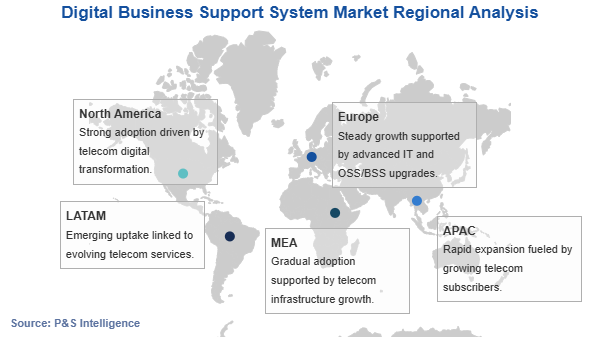
North America holds the largest share, of 40%, because telecom operators in this region have already invested heavily in advanced BSS platforms and continue to upgrade them for digital services. The market here is shaped by early adoption of 5G and bundled service models. Companies focus on improving customer lifecycle management and monetising new services. Strict data handling standards also push firms to maintain strong internal systems. Vendors in this region often lead in product innovation, which keeps demand steady and replacement cycles active.
U.S. Digital Business Support System Market Analysis
The U.S. is the largest market for digital business support systems, holding a significant share, as telecom operators compete to deliver complex bundled services and value-added offerings. Companies actively upgrade core infrastructure to support real-time billing and advanced customer management platforms. According to the Federal Communications Commission, 110 million homes and small businesses had access to terrestrial fixed internet service with speeds of 100/20 Mbps or higher in 2024, highlighting the scale of digital connectivity. Furthermore, the United States maintained 11.6 million 5G fixed wireless access connections in 2024, according to the Global System for Mobile Communications Association. As network complexity increases, telecom providers deploy flexible BSS platforms to support service innovation and monetise expanding digital ecosystems.
Canada Digital Business Support System Market Analysis
Canada is a key market for digital business support systems, as telecom operators manage vast geographic coverage areas with relatively concentrated service providers. These companies deploy centralised platforms to efficiently handle regional billing and service operations. According to the International Telecommunication Union, active mobile-broadband subscriptions reached 86.9 per 100 people in Canada in 2024, reflecting strong connectivity levels. As network expansion continues, operators adopt flexible business support systems to improve service transparency and support both legacy and next-generation offerings.
Asia-Pacific Digital Business Support System Market Analysis
Asia-Pacific has the highest CAGR, of approximately 16.7%, because telecom markets in this region are expanding quickly with large user bases and rising digital service demand. Operators here manage high-volume, low-cost services, which require efficient and scalable BSS systems. Many countries are building new telecom infrastructure, allowing direct adoption of modern platforms instead of upgrading old ones. Competitive pricing strategies and prepaid models also create demand for flexible billing systems. This fast-changing environment is pushing rapid adoption of advanced BSS solutions.
China Digital Business Support System Market Analysis
China is a major market for digital business support systems, as large state-backed telecom operators manage highly concentrated subscriber bases and extensive service volumes. These enterprises scale core infrastructure to process high daily transaction loads without service disruption. According to the Global System for Mobile Communications Association, China reached 1 billion active 5G connections in 2024, highlighting the scale of network usage. As digital ecosystems and mobile payment integration expand rapidly, operators deploy advanced platforms to manage complex billing and service operations. Consequently, vendors deliver customised, high-capacity solutions to support these large-scale requirements.
India Digital Business Support System Market Analysis
India is the fastest-growing market for digital business support systems, as intense price competition drives a predominantly prepaid subscriber ecosystem. Telecom operators upgrade billing infrastructure to manage dynamic pricing and high-volume recharge activity. Total wireless telecommunication subscribers in India reached 1.16 billion in 2024, according to the India Brand Equity Foundation, highlighting the scale of user demand. Processing this large volume of prepaid transactions requires highly flexible, real-time service platforms. As mobile usage expands nationwide, companies deploy advanced systems to efficiently manage billing complexity and support continuous service delivery.
Europe Digital Business Support System Market Analysis
Europe shows steady growth as telecom operators deal with multi-country operations and diverse regulatory requirements across markets. Managing different billing rules, tax systems, and customer policies increases the need for flexible BSS platforms. Operators are focusing on simplifying legacy systems while supporting digital services. Partnerships between telecom providers and digital service companies are also rising. The region’s push toward data protection and compliance plays a key role in shaping how BSS platforms are designed and deployed.
The regions and countries analysed in this report are:
- North America (Largest Regional Market)
- U.S. (Larger Country)
- Canada (Faster-Growing Country)
- Europe
- Germany (Largest Country)
- U.K. (Fastest-Growing Country)
- France
- Italy
- Spain
- Rest of Europe
- Asia-Pacific (Fastest-Growing Regional Market)
- China (Largest Country)
- India (Fastest-Growing Country)
- Japan
- South Korea
- Australia
- Rest of APAC
- Latin America
- Brazil (Largest Country)
- Mexico (Fastest-Growing Country)
- Rest of LATAM
- Middle East and Africa
- Saudi Arabia (Largest Country)
- South Africa
- U.A.E. (Fastest-Growing Country)
- Rest of MEA
Digital Business Support System Market Share
The market is fragmented because many technology vendors, telecom software providers, and cloud platform companies are competing in the same space. No single company controls the market completely. Different vendors focus on specific solutions such as billing, customer management, or digital service platforms, which creates more competition. Also, new players keep entering with cloud-based and modular offerings. Large companies are present, but smaller specialised providers still hold strong positions. This mix of global vendors and niche solution providers keeps the market highly competitive and spread across many players.
Key Players in the Digital Business Support System Market:
- Amdocs Limited
- Telefonaktiebolaget LM Ericsson
- Nokia Corporation
- Huawei Technologies Company Limited
- Netcracker Technology Corporation
- International Business Machines Corporation
- Oracle Corporation
- SAP SE
- Accenture plc
- Capgemini SE
- Tech Mahindra Limited
- Infosys Limited
- Wipro Limited
- Cognizant Technology Solutions Corporation
- Comarch SA
Digital Business Support System Market News
- In March 2026, Amdocs Limited introduced CES26 at MWC Barcelona as the latest Customer Experience Suite release for telco BSS, OSS, and network operations. The release added agent-led workflows across customer engagement, billing, ordering, assurance, and network operations. The company positioned it as part of its aOS operating system for telecom processes.
- In February 2026, LotusFlare announced that PNCC selected its DNO Cloud platform to deliver digital BSS and commerce capabilities for a new mobile network program. The deployment includes support for customer journey management, monetization, and product configuration across both consumer and enterprise services, reflecting continued operator adoption of cloud-native BSS solutions.
- In December 2025, Com4 launched a new Connectivity Management Platform developed with MAVOCO. The platform covers SIM lifecycle, subscriptions, diagnostics, account controls, reporting, automation, and API access. MAVOCO described its role as the software partner for the platform and noted that its system provides full-stack BSS functionality for IoT connectivity management.
- In October 2025, Cerillion plc launched Cerillion 25.2, a BSS/OSS suite update. The release added a Service Catalogue module, a refreshed Interconnect Manager, and AI agents for billing, sales, workflow, catalogue, and promotions. Cerillion also referenced its MCP Server and TM Forum Open Digital Architecture component certifications in the same company news item.