Major Companies in Digital Accessibility Testing and Compliance Software Market:
- Level Access, Inc.
- Siteimprove A/S
- Deque Systems Inc.
- AudioEye, Inc.
- accessiBe Ltd.
- Crownpeak Technology Inc.
- Silktide Ltd.
- Vispero (TPGi)
- UsableNet Inc.
- Evinced Inc.

| Study Period | 2022 - 2033 |
|---|---|
| Market Size in 2026 | USD 850.00 Million |
| Market Size in 2027 | USD 902.96 Million |
| Market Size by 2033 | USD 1,301.0 Million |
| Projected CAGR | 6.23% |
| Largest Region | North America |
| Fastest Growing Region | Asia-Pacific |
| Market Structure | Fragmented |
Explore the market potential with our data-driven report
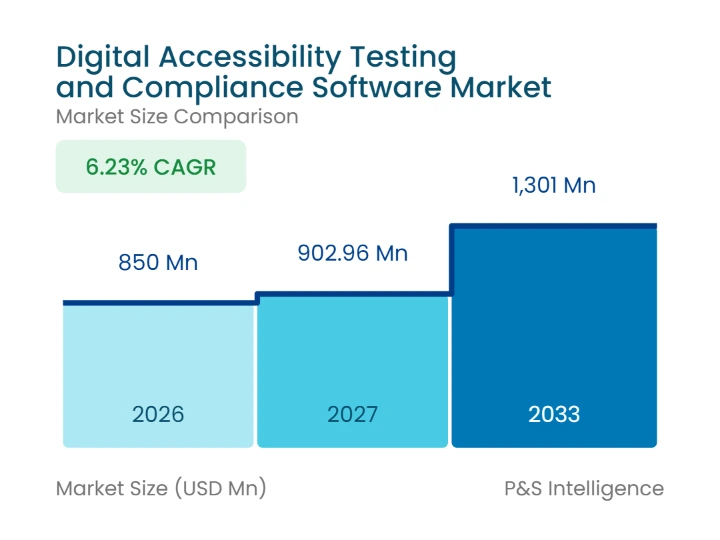
The global digital accessibility testing and compliance software market size is estimated at USD 850.00 Million in 2026 and is projected to reach USD 902.96 Million in 2027. Revenue is projected to climb to USD 1,301.0 Million by 2033, advancing at a CAGR of 6.23% during 2027-2033 as compliance programs widen from websites into mobile apps and documents. Retailers, banks, public agencies, hospitals, and universities are paying for automated scanning, continuous monitoring, and conformance reporting because inaccessible websites and apps now carry dated legal obligations and a steady stream of lawsuits.
Digital teams shipping new pages, campaigns, and app releases every week are the core source of demand for digital accessibility testing and compliance software, since a one-off audit can lose its value as soon as the next template goes live. WebAIM, a Utah State University initiative, found in its February 2026 scan of one million home pages that 95.9% had detectable WCAG 2 failures, averaging 56.1 errors per page. Defect volumes of that size exceed what manual review can handle, which favors vendors pairing automated detection with workflows that route each issue to the responsible developer or content owner.
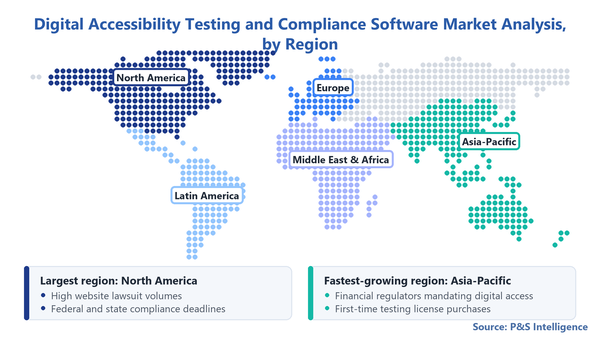
North America accounts for close to 40% of 2026 revenue, anchored by the United States, where website lawsuits and federal and state accessibility rules have made recurring testing a standing budget line. Asia-Pacific is projected to post the quickest growth among regions, at a 7.21% CAGR during 2027-2033. Much of that pace comes from first-time buyers, as financial regulators and public bodies in markets such as India bring digital services under disability-access rules and as multinational groups extend their testing standards to sites in Japan, Australia, and Singapore.
Website owners that bought a single script promising automatic accessibility fixes are moving part of that budget toward scanning, expert audits, and code-level remediation. Overlay widgets were sold as a one-line purchase to small retailers and service firms, but legal and procurement teams now ask for evidence that the underlying code meets WCAG, which a widget alone may not provide. That evidence requirement turns a low-priced plug-in into a recurring subscription for monitoring, issue tracking, and conformance documentation.
In April 2025 the Federal Trade Commission approved a final order requiring accessiBe to pay USD 1 Million and barring it from claiming that its automated products can make any website WCAG-compliant without supporting evidence. The order is likely to change how automated tools are marketed across the category, with vendors pairing automated fixes with human audits and documented test results. Platform vendors that already bundle scanning with expert review could gain a larger pool of accounts reconsidering their tools at renewal.
Retailers, restaurant chains, banks, and other consumer-facing businesses in the United States receive demand letters and federal lawsuits citing websites and apps that screen-reader and keyboard users cannot complete. Settling one claim does not necessarily end the exposure, since a site that slips out of conformance after its next redesign can be targeted again by a different plaintiff. Legal and risk teams therefore buy continuous monitoring, dated scan histories, and remediation records showing good-faith progress, converting one-time audit spending into annual software subscriptions.
Plaintiffs filed 3,117 website accessibility lawsuits in U.S. federal court in 2025, 27% more than in 2024, according to Seyfarth Shaw LLP, a count that leaves out state-court cases and private demand letters. Filing volumes of that size keep accessibility on the risk register of most companies selling online in the United States. Vendors whose dashboards produce audit trails that counsel can present are better positioned, because a dated record of testing and fixes gives a defendant something concrete to show when a claim arrives.
Hospitals, health systems, clinics, and other organizations receiving federal health funding in the United States must bring patient portals, appointment apps, and online forms up to a defined accessibility standard by set dates. Many of these organizations run large web estates with heavy volumes of PDFs and third-party scheduling and billing tools, so conformance requires inventorying, scanning, and fixing content at a scale that manual review struggles to handle. That workload creates room for vendors combining site scanning, document remediation, and checks on third-party software.
A Department of Health and Human Services rule issued in May 2026 moved the compliance date for funding recipients with 15 or more employees from May 11, 2026, to May 11, 2027, and gave recipients with fewer than 15 employees until May 10, 2028. The one-year shift leaves healthcare organizations a defined window to budget testing and remediation across 2026 and 2027. Suppliers with healthcare references and support for patient-facing mobile apps could convert that window into multi-year platform contracts.
State agencies, counties, cities, and public universities in the United States had been preparing for an April 2026 compliance date that was pushed back by a year, and some buying decisions are likely to move with it. Public bodies buy through annual budgets and formal procurement, so a later legal date lets finance offices defer licensing and remediation contracts into the next fiscal year. Smaller jurisdictions with thin IT staffing are the most likely to wait, since they were given an extra year beyond larger jurisdictions.
The Department of Justice published an interim final rule on April 20, 2026, moving the deadline for state and local governments serving 50,000 or more people from April 24, 2026, to April 26, 2027. Smaller entities and special district governments now have until April 26, 2028, and the WCAG 2.1 AA technical standard is unchanged. The delay pushes some public-sector revenue out of 2026, though the obligation itself remains. Vendors offering phased programs that begin with content inventories and priority scans can keep these accounts active until budgets are released.
Website Accessibility Platforms hold 36.32% of digital accessibility testing and compliance software revenue in 2026. Corporate websites, online storefronts, and public portals are where many legal claims and regulatory duties apply first, so they are typically the first digital estate an organization brings under monitoring. These platforms crawl large page counts on a schedule, assign defects to owners, and produce the reports compliance teams file, which often makes them the anchor license that document, mobile, and color-contrast tools are later added to.
Mobile and App Accessibility Suites are projected to grow fastest within the offering mix, at a 7.39% CAGR during 2027-2033. Banks, retailers, airlines, and transit operators serve many customers through native iOS and Android apps, which website crawlers cannot test, so separate SDKs and device-level automation are needed. The World Wide Web Consortium's WCAG 2.2, published as a Recommendation in October 2023, added nine success criteria, including touch-target size and focus visibility requirements that bear directly on touch interfaces. Vendors running these checks inside mobile build pipelines gain a budget line separate from website licensing.
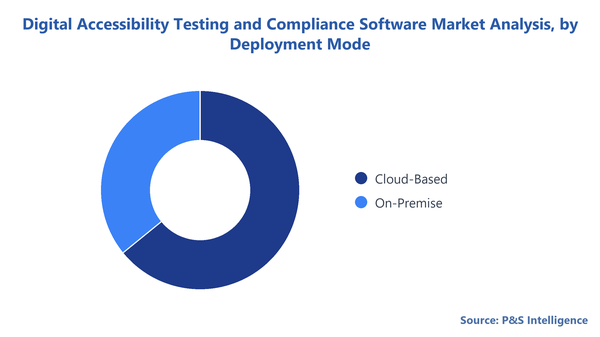
Cloud-Based deployment accounts for 64.13% of 2026 revenue. Accessibility rule sets change as WCAG versions, browsers, and assistive technologies evolve, and a hosted platform lets vendors push updated tests to every customer at once. Eurostat data show 52.74% of EU enterprises paid for cloud computing services in 2025, so most accounts already have a route for buying software by subscription. Cloud delivery also suits scans run against public URLs, with pricing tied to page counts or domains that can be expanded mid-contract.
Cloud-Based deployment is also projected to grow fastest, at a 6.61% CAGR during 2027-2033, as vendors build testing into hosted developer tools, design applications, and code repositories. Each new integration can add API-metered scanning on top of the site license, lifting revenue per account without a fresh procurement cycle. On-Premise installations stay in use where government agencies, defense contractors, and banks must test pages behind firewalls or keep defect data on their own networks, which sustains a smaller license-and-support business for vendors with self-hosted editions.
Large Enterprises hold 54.23% of 2026 revenue. Multinational retailers, banks, airlines, and software firms often run hundreds of domains, apps, and document libraries across several jurisdictions, and their legal teams need conformance evidence for all of them in one place. These organizations buy enterprise tiers with role-based dashboards, single sign-on, API access, and Accessibility Conformance Report tools for the products they sell to public-sector buyers, which raises average contract values above those of smaller accounts.
Small and Medium Enterprises are expected to record a 6.59% CAGR during 2027-2033, the quicker pace of the two size bands. Online shops, restaurants, clinics, and local service firms also receive demand letters, yet they seldom employ an accessibility specialist, so they rely on self-serve scanners priced per site. The U.S. Small Business Administration's Office of Advocacy counts 36.2 million small businesses, 99.9% of all U.S. firms, a pool reached through low-cost monthly plans sold inside website builders and hosting dashboards. That channel rewards vendors able to serve thousands of small accounts with limited human support.
E-Commerce and Retail holds 22.76% of 2026 revenue, the largest share among end-user industries. Checkout flows, product filters, and promotional pages change weekly, and each release can introduce new barriers, so retailers tend to scan continuously instead of auditing once a year. Figures from the U.S. Census Bureau put e-commerce at 17.1% of total U.S. retail sales in the second quarter of 2026, which raises the cost of any barrier in the purchase path. Retailers treat a blocked checkout as lost revenue and legal exposure at once, and budget for monitoring accordingly.
Government and Public Sector buyers are projected to record the fastest growth among end users, at a 7.41% CAGR during 2027-2033. Federal agencies must meet Section 508, and state and local governments face dated web and mobile app obligations, yet testing lags. The General Services Administration recorded an average conformance score of 1.96 on a 5-point scale in its FY2025 governmentwide Section 508 assessment, and approximately half of agencies said they do not routinely test their ICT for accessibility. Closing that gap requires scanning licenses, conformance reporting, and staff training, which suits vendors already listed on public-sector contract vehicles.
The following segments are analyzed in this report:
North America holds 39.87% of global revenue in 2026, and the United States is the region's largest market. Spending concentrates there because a plaintiffs' bar files website accessibility suits at volume, federal buyers commonly ask technology vendors for Accessibility Conformance Reports, and state and local governments and healthcare funding recipients face dated web and mobile obligations. Software companies selling to federal agencies buy conformance-reporting tools to support their bids, adding a vendor-side buyer group on top of website owners.
The Centers for Disease Control and Prevention estimates, from 2022 survey data, that 28.7% of U.S. adults report a functional disability, a population that includes both the customers businesses lose to inaccessible checkouts and the plaintiffs who bring claims. Canada adds banks, telecom carriers, and transport operators subject to federal accessibility legislation. North America's lead looks stable through 2033, though growth increasingly relies on renewals, upsells into mobile and document testing, and public-sector catch-up more than on first-time buyers.
Asia-Pacific is set to post the quickest growth of any region, a 7.21% CAGR during 2027-2033, as banks, brokers, and public agencies across the region buy their first accessibility testing licenses. Many organizations there are at an earlier stage of their accessibility programs than U.S. or European peers, so first-time licenses for site scanning and mobile testing account for much of new spending. Financial regulators tend to act as catalysts, because one supervisory rule reaches every regulated firm at once. In app-heavy consumer markets, demand also leans toward mobile testing earlier than it did in website-led regions.
India is among the region's quickest-moving markets. The Securities and Exchange Board of India issued a July 31, 2025 circular making compliance with the Rights of Persons with Disabilities Act, 2016 mandatory for all regulated entities, followed by digital accessibility compliance guidelines in September 2025 and a timeline extension on July 31, 2026. The circulars bring stock brokers, mutual funds, and other market intermediaries under a digital accessibility compliance regime, which could favor vendors with local delivery partners. Japan, Australia, and Singapore contribute steadier demand from multinational groups extending global testing standards to regional sites.
Europe trails North America in revenue, but its private-sector mandate is changing who buys. Banks, e-commerce operators, telecom providers, transport ticketing services, and e-book sellers across EU member states now face binding accessibility requirements for consumer-facing digital services, with national market-surveillance authorities responsible for enforcement. Many of these firms had not bought accessibility software before, so regional demand mixes first licenses with multinationals extending U.S. programs to European sites. Multilingual content adds to the testing workload, since each language version of a site or app needs its own checks.
The European Accessibility Act, Directive (EU) 2019/882, has applied across member states since June 28, 2025, with EN 301 549 as the harmonized technical reference, while microenterprises providing services are exempt. Buyers in Germany, France, the Netherlands, and the Nordic countries can require local-language rule sets, EU data hosting, and reporting mapped to each national transposition. Vendors with EU hosting and partner networks across member states are better positioned in these evaluations. The U.K., outside the directive, depends more on public-sector accessibility rules and the policies of multinational groups.
Latin America contributes a smaller share of global revenue, with Brazil and Mexico the main sources of regional demand from banks, retailers, and government portals. Subsidiaries of U.S. and European groups that apply one global accessibility standard bring their regional sites into existing enterprise licenses, which adds seats without a separate local sale. Currency swings can make subscriptions priced in U.S. dollars harder to sell to domestic mid-sized firms, which keeps local adoption slower than in the leading regions.
Brazil's Inclusion Law (Law No. 13,146 of 2015) makes accessibility mandatory on websites maintained by companies headquartered or commercially represented in the country and by government bodies, referencing internationally adopted accessibility practices. The obligation has been on the books for a decade, so growth depends more on how consistently regulators and courts enforce it. Vendors offering Portuguese and Spanish interfaces and selling through local resellers could reach mid-sized domestic accounts that global enterprise contracts leave out.
Middle East & Africa holds a modest position in the market, with demand led by government digital-service programs in Gulf states and by banks, airlines, and telecom operators serving international customers. Saudi Arabia, the U.A.E., and Qatar have built national e-government portals and app-based citizen services, and several public bodies there publish accessibility policies that cite WCAG, which brings scanning and audit tools into ministry and agency projects.
Israel is the clearest private-sector case. Its Equal Rights for Persons with Disabilities (Service Accessibility Adjustments) Regulations of 2013 require websites offering services to the public, private businesses included, to meet Israeli Standard 5568, which builds on W3C guidelines. In South Africa, Egypt, and Nigeria, testing purchases tend to follow multinational group policies and individual public-sector projects, because national rules for private digital services are less developed. Growth across the region depends on whether Gulf and African accessibility guidelines become binding on private providers, which would move demand from one-off public projects toward recurring commercial subscriptions.
The following geographies are analysed in this report.
The digital accessibility testing and compliance software market is fragmented, with a group of enterprise platform vendors competing alongside a long tail of self-serve scanners, browser extensions, and developer libraries. Entry is relatively easy at the low end, because open-source rule engines let new firms assemble a basic WCAG scanner quickly. Barriers rise at the enterprise tier, where accounts expect coverage of web, mobile, and documents, conformance reports that stand up in procurement and legal review, and access to expert auditors. Recent purchases of smaller widget and governance vendors by platform companies point to gradual consolidation at that tier.
Vendors compete in three clusters. Level Access, Siteimprove, Crownpeak, Silktide, Vispero's TPGi, and UsableNet sell governance-style platforms that combine scheduled scanning, manual audits, and conformance reporting for large enterprises and public bodies. Deque Systems and Evinced concentrate on engineering teams, embedding automated rules into browsers, test frameworks, and CI/CD pipelines so defects are caught before release. AudioEye and accessiBe serve high volumes of small and mid-sized websites through self-serve subscriptions, and both have added expert review or developer tools to automated detection.
For buyers, the clusters translate into a choice between a single platform covering monitoring, audits, and reporting, and a combination of developer tools with separately bought audit services. Some larger enterprises run both, using developer tools to stop new defects and a governance platform to document the conformance of what is already live. Switching costs build over time because scan histories, issue workflows, and conformance documentation are stored in the vendor's system, which tends to favor incumbents at renewal unless a vendor's results fail an external audit or legal review.
Want a report tailored exactly to your business need?
Request CustomizationEmpowering Leaders Across the Globe
Leading companies across industries trust us to deliver data-driven insights and innovative solutions for their most critical decisions. From data-driven strategies to actionable insights, we empower the decision-makers who shape industries and define the future. From Fortune 500 companies to innovative startups, we are proud to partner with organisations that drive progress in their industries.

Working with P&S Intelligence and their team was an absolute pleasure – their awareness of timelines and commitment to value greatly contributed to our project's success. Eagerly anticipating future collaborations.
McKinsey & Company
India
Our insights into the minutest levels of the markets, including the latest trends and competitive landscape, give you all the answers you need to take your business to new heights

We take a cautious approach to protecting your personal and confidential information. Trust is the strongest bond that connects us and our clients, and trust we build by complying with all international and domestic data protection and privacy laws

Customize the Report to Align with Your Business Objectives

Request the Free Sample Pages