This Report Provides In-Depth Analysis of the Dental Lasers Market Report Prepared by P&S Intelligence, Segmented by Product Type (Soft Tissue Dental Lasers, All Tissue Dental Lasers, Hard Tissue Dental Lasers, Dental Surgical Lasers, Dental Welding Lasers), Laser Technology (Diode Lasers, Er:YAG Lasers, Carbon Dioxide Lasers, Nd:YAG Lasers, Er,Cr:YSGG Lasers), Dental Specialty (Periodontics, Cosmetic Dentistry, General Dentistry, Pediatric Dentistry, Oral & Maxillofacial Surgery, Orthodontics), Portability (Portable Dental Lasers, Standalone / Fixed Dental Lasers), End User (Dental Clinics, Hospitals, Academic & Research Institutes, Ambulatory Surgical Centers), and Geographical Outlook for the Period of 2021 to 2032
Explore the market potential with our data-driven report
Dental Lasers Market Overview
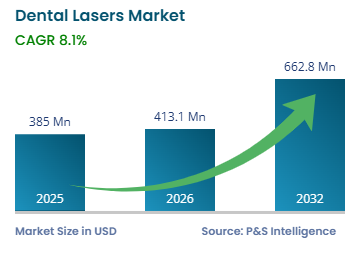
The dental lasers market size was USD 385.0 million for 2025, and it will grow by 8.1% during 2026-2032, to reach USD 662.8 million by 2032.
The dental lasers market is expanding as dental clinics and hospitals continue integrating laser-based systems into routine and specialized procedures. Dentists increasingly prefer laser-assisted treatments because they provide greater procedural precision, support soft- and hard-tissue applications, reduce bleeding, minimize tissue disruption, and promote faster healing than conventional instruments. These systems are widely used for periodontal therapy, cavity preparation, oral surgery, teeth whitening, implant procedures, and other restorative treatments. Additionally, patients are choosing minimally invasive dental care more frequently, particularly for cosmetic and soft-tissue procedures where treatment comfort and shorter recovery periods are valued. According to the World Health Organization, oral diseases affected nearly 3.7 billion people worldwide in 2025, while untreated dental caries in permanent teeth remained the most common health condition globally based on the Global Burden of Disease 2021 estimates.
Furthermore, dental technology manufacturers are introducing portable laser devices, all-tissue platforms, and software-integrated systems that support multiple dental specialties within a single clinical workflow. Many dental practices are also modernizing treatment infrastructure by combining dental lasers with CAD/CAM systems, digital imaging, and guided dentistry technologies to improve procedural planning and chairside efficiency. Similarly, academic institutions and professional training centers are strengthening laser dentistry education, enabling more practitioners to incorporate these systems into everyday clinical practice. Private dental networks and specialty oral care centers continue expanding treatment capacity with compact, multifunctional laser platforms that enhance workflow efficiency, support consistent clinical outcomes, and improve patient management across high-volume dental environments.
Key Market Insights
Soft Tissue Dental Lasers is the largest category, holding a market share of 35%, due to wider use across periodontal and soft-tissue procedures.
Er: YAG Lasers is the fastest-growing category, registering a CAGR of approximately 8.5%, driven by increasing demand for minimally invasive restorative dentistry procedures.
Dental Clinics is the largest and fastest-growing category, holding a market share of 40% and registering a CAGR of approximately 8.3%, due to rising adoption of chairside laser-assisted procedures.
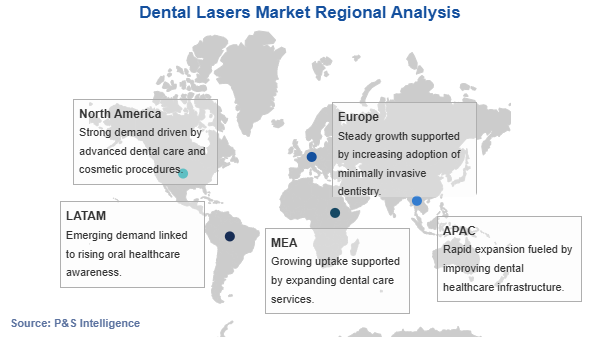
North America holds the largest share of 40%, due to early adoption of cosmetic dentistry technologies and strong private dental clinic infrastructure.
Asia-Pacific is the fastest-growing region, registering a CAGR of approximately 9.0%, driven by expanding urban dental-care networks and rising cosmetic dentistry demand.
Dental Lasers Market Trends and Drivers
Integration of Multi-Application and Portable Laser Platforms Is a Major Trend
Dental laser manufacturers are increasingly developing compact systems capable of supporting multiple procedures through a single platform. Clinics are preferring equipment that can handle periodontal treatment, soft-tissue surgery, whitening, and endodontic applications without requiring separate standalone systems. Manufacturers are also integrating touchscreen controls, preset treatment settings, wireless connectivity, and software-guided workflows to simplify chairside operation in smaller dental practices. In 2025, PIOON presented the UTU+ platform at IDS Cologne as a compact multi-functional laser system designed for dentistry and other clinical specialities, featuring preset workflows and an intuitive operating interface. Convergent Dental also expanded the Solea All-Tissue Dental Laser platform in 2025 through the launch of Solea Perioguide for periodontal procedures. These developments show that the market is shifting towards integrated, portable, and workflow-oriented dental laser systems with broader procedural flexibility.
Rising Preference for Minimally Invasive Dental Procedures Drives Market
The market is growing because patients and dental professionals are increasingly choosing procedures that reduce bleeding, discomfort, and recovery time. Dental lasers are gaining wider use across gum treatment, cavity preparation, oral surgery, and cosmetic dentistry because they improve treatment precision while limiting the need for sutures and conventional drilling tools. Clinics are also placing greater emphasis on patient comfort and procedural efficiency, particularly for anxiety-sensitive and cosmetic dental procedures. In 2025, Convergent Dental launched Solea Perioguide for minimally invasive periodontal therapy, supporting laser-assisted gum treatment workflows designed to reduce postoperative discomfort. In 2026, according to Fotona, the company launched the FotonaSMILE campaign featuring the “7 Secrets of the FotonaSMILE” educational framework, supporting laser-assisted tooth whitening, crown lengthening, depigmentation, lesion treatment, ceramic debonding, lip enhancement, and facial rejuvenation using its LightWalker laser platform. Furthermore, these developments are expanding clinical capabilities, strengthening practitioner education, broadening treatment portfolios, and encouraging wider integration of laser-assisted dentistry across cosmetic, periodontal, and restorative care settings.
High Equipment and Training Requirements Act as Market Restraint
The market faces challenges because dental laser systems require high initial investment and specialized clinical training before routine adoption. Many independent dental clinics and small oral care centers remain cautious about purchasing advanced laser equipment due to additional spending on maintenance, accessories, certification, and workflow integration. According to the World Health Organization Global Health Observatory, over 68% of WHO Member States report having fewer than 5 dentists per 10,000 population, while about 37% report fewer than 1 dentist per 10,000 population. Dentists also require practical training to safely operate different laser wavelengths across periodontal, surgical, and restorative procedures. Furthermore, these factors influence purchasing decisions, extend implementation timelines, and encourage continued reliance on conventional dental equipment, particularly in cost-sensitive clinics and rural practices where familiar workflows, lower operating expenses, and existing treatment infrastructure remain important considerations.
Expansion of Dental Care Infrastructure in Emerging Countries Creates Market Opportunities
The market has strong opportunities as private dental chains, specialty oral care centers, and modern dental clinics continue expanding across developing healthcare markets. Urban healthcare providers are increasingly upgrading treatment infrastructure with advanced technologies to improve procedural precision, patient comfort, and cosmetic treatment capabilities. Demand for compact and easy-to-use dental laser systems is also increasing in countries benefiting from dental tourism and rising investment in aesthetic dentistry services. According to the World Bank, population aged 65 years and above accounted for 10.2% of the global population in 2024, based on data published through the Federal Reserve Bank of St. Louis FRED database. Furthermore, academic institutions and training centers are strengthening laser dentistry education, helping younger practitioners integrate laser-assisted procedures into routine clinical practice. These developments are expanding manufacturer distribution networks, increasing product accessibility, supporting clinical adoption across emerging markets, and encouraging broader investment in advanced dental treatment capabilities for restorative, periodontal, and cosmetic procedures.
Dental Lasers Market Segmentation Analysis
Product Type Analysis
Soft Tissue Dental Lasers is the largest category, holding a market share of 35%, because these systems are widely used across gum reshaping, periodontal treatment, lesion removal, and soft-tissue surgical procedures. Dental clinics prefer soft tissue lasers due to reduced bleeding, faster healing, and improved patient comfort during treatment. Their operational simplicity and broader acceptance among general dentists also support wider adoption across cosmetic dentistry centres and hospital-based oral-care departments. The American Academy of Pediatric Dentistry’s 2025 Reference Manual identified diode 810–980 nm lasers for soft-tissue ablation across gingival contouring, frenectomy, gingivectomy, operculectomy, and biopsy procedures. This broad procedural applicability continues to strengthen demand for soft tissue laser systems across routine dental workflows.
All Tissue Dental Lasers is the fastest-growing category, registering a CAGR of approximately 8.8%, due to increasing demand for multifunctional systems that can handle both hard and soft tissue procedures within a single platform. Dental clinics are adopting these systems to improve workflow flexibility and reduce the need for multiple standalone devices. Growing interest in integrated treatment solutions, especially in cosmetic dentistry and advanced restorative procedures, is also supporting demand. Manufacturers are increasingly introducing compact all-tissue systems with software-guided applications and portable clinical designs.
The product types analysed in this report are:
Soft Tissue Dental Lasers (Largest Category)
All Tissue Dental Lasers (Fastest-Growing Category)
Hard Tissue Dental Lasers
Dental Surgical Lasers
Dental Welding Lasers
Others
Laser Technology Analysis
Diode lasers are the largest category, holding a market share of 35%, as these systems are commonly used for soft tissue procedures, periodontal treatments, and teeth whitening applications across general dental practices. Many dentists prefer diode lasers because they are compact, easier to operate, and more affordable compared to several other laser technologies. Their compatibility with minimally invasive dental procedures and increasing use in cosmetic dentistry also support wider adoption. Strong availability across private clinics and specialty dental centres further strengthens market demand.
Er: YAG Lasers is the fastest-growing category, because these systems are increasingly used for hard-tissue procedures, cavity preparation, and minimally invasive restorative dentistry. Dentists are showing a stronger interest in technologies that improve enamel and dentin treatment precision while reducing discomfort during procedures. Growing preference for conservative restorative methods and advanced cosmetic dentistry is also supporting adoption across specialised clinics and hospital dental departments. The Journal of Dentistry’s 2025 meta-analysis reviewed 20 in-vivo studies covering more than 2,263 teeth and over 1,090 patients for laser-assisted caries removal and hard-tissue preparation. These findings continue to support wider clinical confidence in Er: YAG laser-assisted restorative treatment applications.
The laser technologies analysed in this report are:
Diode Lasers (Largest Category)
Er: YAG Lasers (Fastest-Growing Category)
Carbon Dioxide (CO2) Lasers
Nd: YAG Lasers
Er, Cr: YSGG Lasers
Others
Dental Specialty Analysis
Periodontics is the largest category, due to the increasing use of dental lasers in gum disease treatment, soft-tissue management, and periodontal surgery. Laser-assisted periodontal procedures improve treatment precision, reduce bleeding, and support faster healing, making them widely adopted across specialty dental practices. According to the World Health Organization, severe periodontal diseases are estimated to affect more than 1 billion cases worldwide. Furthermore, this substantial patient population continues increasing demand for laser-assisted periodontal therapy, encouraging clinics to expand minimally invasive gum-care services and specialized treatment capabilities.
Cosmetic Dentistry is the fastest-growing category, registering a CAGR of approximately 8.6%, because more patients are seeking aesthetic dental procedures such as gum contouring, teeth whitening, and smile enhancement treatments. Dental lasers are increasingly used in cosmetic procedures due to their precision and ability to improve patient comfort during treatment. Rising social awareness around dental appearance and growing demand for minimally invasive cosmetic solutions are also driving adoption. Private dental clinics are expanding aesthetic treatment offerings, which is further increasing the use of laser-assisted cosmetic dentistry procedures.
The dental specialities analysed in this report are:
Periodontics (Largest Category)
Cosmetic Dentistry (Fastest-Growing Category)
General Dentistry
Pediatric Dentistry
Oral & Maxillofacial Surgery
Orthodontics
Others
Portability Analysis
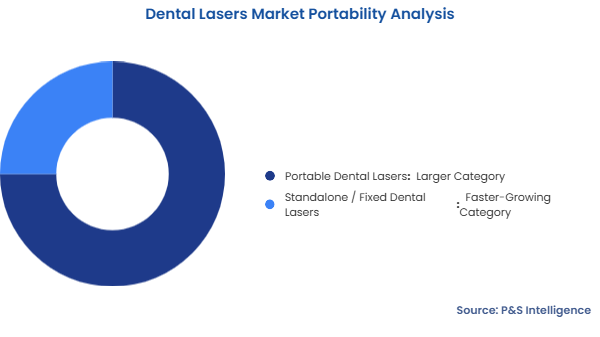
Portable Dental Lasers is the larger category, holding a market share of 75%, because many dental clinics prefer compact systems that can be easily moved between treatment rooms and integrated into chairside procedures. Portable devices are widely adopted in private practices due to easier handling, lower space requirements, and flexibility across multiple dental applications. Their suitability for cosmetic dentistry, periodontal treatment, and routine soft tissue procedures also supports a stronger demand. Smaller clinics especially favour portable systems for operational convenience and simplified workflow management.
Standalone / Fixed Dental Lasers is the faster-growing category, because large dental centres and hospital-based practices are increasingly investing in advanced laser systems designed for specialised and high-volume procedures. These devices support broader clinical functionality, treatment precision, and integration with digital dentistry workflows and advanced treatment software. Adoption is also increasing across oral surgery, restorative dentistry, and implant-related applications requiring stable multi-purpose systems. The American Academy of Pediatric Dentistry’s 2025 Reference Manual identified six application groups for Er, Cr: YSGG dental lasers, including hard tissue, osseous tissue, soft tissue, endodontic therapy, periodontal procedures, and oral ulcerative lesion treatment. This broad clinical utility continues to support the growth of fixed dental laser systems.
Dental Clinics is the largest and fastest-growing category, holding a market share of 40% because most laser-assisted dental procedures are performed across private clinics and specialty oral care centers. Clinics increasingly adopt laser systems to improve patient comfort, procedural precision, and cosmetic and periodontal treatment capabilities. According to the World Health Organization, its dentistry personnel density indicator covers 193 countries, areas, and territories. This broad clinical workforce base supports wider practitioner availability, routine adoption of advanced dental technologies, and continued investment in laser-assisted treatment services.
The end users analysed in this report are:
Dental Clinics (Largest Category and Fastest-Growing Category)
Hospitals
Academic & Research Institutes
Ambulatory Surgical Centers
Others
Drive strategic growth with comprehensive market analysis
Dental Lasers Market Regional Outlook
North America Dental Lasers Market Analysis
North America holds the largest share, of 40%, because the region has a well-established private dental care industry and early adoption of advanced treatment technologies across specialty clinics and hospital dental departments. Many dentists in the region already use digital dentistry systems, which support faster integration of laser-assisted procedures into routine workflows. Patient preference for minimally invasive cosmetic and periodontal treatments is also strong across the U.S. and Canada. In addition, dental education institutes and clinical associations actively support laser dentistry training and certification programs. The region also benefits from the presence of major dental equipment manufacturers and distributors that regularly introduce upgraded laser systems for soft tissue, surgical, and cosmetic applications. Insurance awareness, higher spending on dental aesthetics, and strong demand for chairside efficiency continue to support wider adoption of dental laser technologies across North America.
U.S. Dental Lasers Market Analysis
The U.S. is a leading country market because dental clinics adopt laser-assisted systems early across cosmetic dentistry, gum treatment, and minimally invasive oral surgery. Private dental practices invest in advanced equipment to improve patient comfort, reduce chairside time, and expand high-value treatment offerings. According to the U.S. Bureau of Labour Statistics, the country had 149,300 dentist jobs in 2024, and dentists use lasers, digital scanners, and other technologies in practice. This strong clinical workforce supports wider training, equipment replacement, and routine use of dental laser systems across general and specialty practices.
Canada Dental Lasers Market Analysis
Canada is seeing steady adoption of dental laser systems as clinics shift towards patient-focused and minimally invasive treatment approaches. Urban dental centres are using advanced technologies for cosmetic dentistry, periodontal care, and soft-tissue procedures where precision and comfort matter. According to Statistics Canada, 72% of Canadians aged 12 years and above visited an oral health professional in 2023–2024. This high routine-care utilisation supports regular demand for modern dental procedures, encouraging clinics to invest in laser systems that improve treatment efficiency, patient experience, and service differentiation across private dental networks.
Asia-Pacific Dental Lasers Market Analysis
Asia-Pacific has the highest CAGR of approximately 9.0% as dental care infrastructure continues expanding across urban healthcare networks and private dental chains in countries such as India, China, and South Korea. Many clinics are upgrading treatment facilities with advanced laser systems to provide precise, minimally invasive procedures and broaden cosmetic, periodontal, and restorative service portfolios. Growing demand for orthodontics, aesthetic dentistry, and preventive oral care among younger and middle-income populations is further strengthening laser adoption. Dental tourism also supports investment in modern clinical equipment across several regional markets. Furthermore, manufacturers are expanding regional distribution partnerships, clinical training programs, and after-sales support, enabling more specialty clinics and multi-chair dental centers to integrate laser-assisted dentistry into routine patient care and comprehensive treatment services.
Japan Dental Lasers Market Analysis
Japan has a developed dental-care system with a strong demand for precision-focused and technology-driven treatment procedures. Dental clinics use advanced equipment to support minimally invasive care, especially for elderly patients requiring periodontal, restorative, and soft-tissue treatment. According to Japan’s Ministry of Health, Labour and Welfare, the country had 66,378 dental clinics in 2024. This large clinical base creates a strong platform for dental laser adoption, as clinics continue integrating compact technologies that improve procedural accuracy, patient comfort, and treatment consistency across routine and specialty oral-care services.
India Dental Lasers Market Analysis
India is becoming an important growth market because private dental chains, cosmetic dentistry clinics, and urban oral care centers are expanding rapidly. Demand is increasing for laser-assisted whitening, gum contouring, periodontal treatment, and minimally invasive procedures among younger and aesthetics-focused patients. According to the National Dental Commission, India listed 330 dental colleges with BDS permitted-seat information for the academic year 2025–26. This expanding dental education network strengthens future practitioner training, increases familiarity with laser-assisted dentistry, and supports broader adoption across metropolitan clinics, specialty practices, and growing private dental networks.
Europe Dental Lasers Market Analysis
Europe has a mature dental care environment supported by strong clinical standards, preventive oral healthcare practices, and broad acceptance of advanced dental technologies. Countries such as Germany, the U.K., and France have well-developed dental clinic networks that increasingly use laser-assisted procedures for periodontal care, oral surgery, and cosmetic dentistry. Many dental professionals in the region focus on precision-based treatment methods that improve patient comfort and reduce procedural complications. The region also benefits from active participation in dental research, continuing education programs, and professional training related to laser dentistry. Demand for aesthetic dental procedures continues to grow, particularly in private clinics offering premium treatment services. In addition, regulatory emphasis on treatment safety and clinical efficiency is encouraging the adoption of modern laser systems across specialised dental practices and hospital-based oral care departments.
The regions and countries analysed in this report are:
North America (Largest Regional Market)
U.S. (Larger Country)
Canada (Faster-Growing Country)
Europe
Germany (Largest Country)
U.K. (Fastest-Growing Country)
France
Italy
Spain
Rest of Europe
Asia-Pacific (Fastest-Growing Regional Market)
China
India (Fastest-Growing Country)
Japan (Largest Country)
South Korea
Australia
Rest of APAC
Latin America
Brazil (Largest Country)
Mexico (Fastest-Growing Country)
Rest of LATAM
Middle East and Africa
Saudi Arabia (Largest Country)
U.A.E. (Fastest-Growing Country)
South Africa
Rest of MEA
Dental Lasers Market Share
The market is fragmented, comprising global dental technology companies, specialized laser manufacturers, and regional medical device suppliers serving different treatment applications. Competition is generally influenced by product innovation, clinical education, distribution partnerships, and portfolio expansion across periodontal, restorative, cosmetic, and oral surgery procedures. Several manufacturers emphasize dedicated laser technologies or application-specific systems designed for soft-tissue management, periodontal therapy, and aesthetic dentistry. Furthermore, mid-sized companies continue introducing portable platforms and compact laser systems suited for private dental clinics and specialty oral care centers. Industry participants are also strengthening collaboration with dental education institutions and professional training programs to increase clinical familiarity with laser-assisted procedures. Moreover, manufacturers are expanding regional distribution networks and service capabilities, supporting broader product availability while enabling dental practices to incorporate advanced laser technologies into routine clinical workflows and diverse treatment offerings.
Leading Companies in the Dental Lasers Market:
MegaGen Implant Company Limited
Dentsply Sirona Incorporated
Fotona Limited Liability Company
Convergent Dental Incorporated
AMD Lasers Limited Liability Company
CAO Group Incorporated
DenMat Holdings Limited Liability Company
Envista Holdings Corporation
Wuhan Gigaa Optronics Technology Company Limited
J Morita Manufacturing Corporation
Ivoclar Vivadent Aktiengesellschaft
Millennium Dental Technologies Incorporated
LightScalpel Incorporated
Zolar Technology and Manufacturing Company Incorporated
The Yoshida Dental Manufacturing Company Limited
Dental Lasers Market News
In March 2026, AMD Lasers, Inc. launched LEAP, a laser-assisted root canal disinfection system tied to its Picasso Pro diode laser. The release said the system combines a dedicated protocol, solution, software, and fibre tips for endodontic use and was scheduled for formal introduction at the American Association of Endodontists annual meeting.
In May 2025, Millennium Dental Technologies, Inc. launched the LANAP AI Workflow with Zyris, Inc. at the California Dental Association convention. The workflow connects the PerioLase MVP-7 dental laser with the Isolite Pro isolation system, giving LANAP-trained clinicians a defined setup for laser-assisted periodontal and related procedures in dental practices, including the LANAP protocol.
In April 2025, Convergent Dental, Inc. launched Solea Perioguide for periodontal therapy on the Solea all-tissue dental laser platform. The application is intended for moderate to severe periodontal cases and is positioned as a guided clinical use case for dentists already working with the Solea system in dental practices and periodontal treatment settings.
Frequently Asked Questions About This Report
What factors are driving demand in the dental lasers market?+
Demand is supported by minimally invasive procedures, oral disease treatment needs, cosmetic dentistry adoption, periodontal care, and improvements in laser dental equipment.
Which laser types are commonly used in modern dental treatments?+
Diode, erbium, carbon dioxide, neodymium doped yttrium aluminum garnet, and erbium chromium yttrium scandium gallium garnet lasers are widely used.
Why are diode lasers popular among dental practices and hygienists?+
Diode lasers are valued for soft tissue work because they offer easier handling, bleeding control, less swelling, reduced pain, and strong clinical versatility.
How are dental lasers used in clinical soft tissue procedures?+
They support gingivectomy, gingivoplasty, lesion removal, periodontal therapy, tissue reshaping, and bleeding control with precise cutting and coagulation benefits.
What role do lasers play in modern hard tissue dentistry?+
Erbium lasers help remove caries, prepare cavities, cut enamel and dentin, and support minimally invasive hard tissue procedures with limited thermal impact.
Want a report tailored exactly to your business need?
Leading companies across industries trust us to deliver data-driven insights and innovative solutions for their most critical decisions. From data-driven strategies to actionable insights, we empower the decision-makers who shape industries and define the future. From Fortune 500 companies to innovative startups, we are proud to partner with organisations that drive progress in their industries.
Client Testimonials
Working with P&S Intelligence and their team was an absolute pleasure – their awareness of timelines and commitment to value greatly contributed to our project's success. Eagerly anticipating future collaborations.
McKinsey & Company
India
Unmatched Standards
Our insights into the minutest levels of the markets, including the latest trends and competitive landscape, give you all the answers you need to take your business to new heights
Complete Data Security
We take a cautious approach to protecting your personal and confidential information. Trust is the strongest bond that connects us and our clients, and trust we build by complying with all international and domestic data protection and privacy laws