This Report Provides In-Depth Analysis of the Decentralized Clinical Trials Market Report Prepared by P&S Intelligence, Segmented by Component (Platforms/Technology Solutions, Operational & Support Services), Trial Execution Model (Hybrid, Fully Decentralized, Site-Centric with Digital Enablement), Trial Phase (Late, Post-Approval / Real-World Evidence, Early, Mid), Therapeutic Area (Oncology, Rare Diseases, Cardiovascular Disorders, Neurological & Psychiatric Conditions, Infectious Diseases, Metabolic & Endocrine Disorders), Organization Size (Large Enterprises, Small & Medium Enterprises), and Geographical Outlook for the Period of 2021 to 2032
Explore the market potential with our data-driven report
Key Market Insights
Hybrid trials hold the largest share at 60%, balancing remote flexibility with necessary in-person assessments for complex medical procedures.
Operational & support services are the fastest-growing component, addressing complex logistics for home healthcare, drug delivery, and patient engagement.
Oncology leads therapeutic adoption with 35% share, utilizing remote monitoring to frequently track symptoms and adverse events in long-term studies.
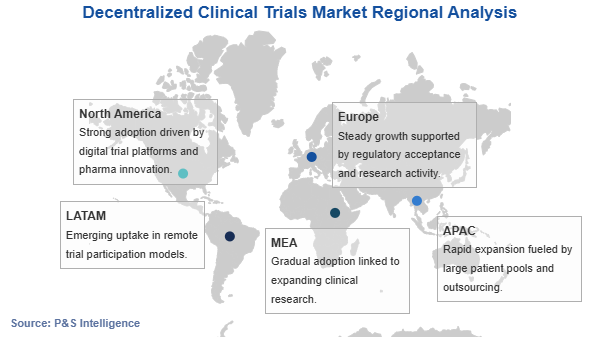
Asia-Pacific is the fastest-growing region with 13.9% CAGR, fuelled by regulatory modernization and expanding telemedicine access for rural populations.
North America remains the largest market with 40% share, supported by established regulatory frameworks and active research sponsor participation.
Decentralized Clinical Trials Market Future Outlook
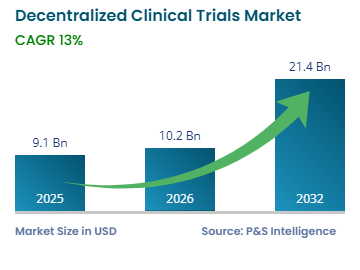
The decentralized clinical trials market size was USD 9.1 billion for 2025, and it will grow by 13.0% during 2026–2032, to reach USD 21.4 billion by 2032.
The market is expanding because of the trend of shifting away from traditional site-based clinical trials toward patient-centred clinical trials using digital health technologies. The U.S. FDA processed 1,690 PDUFA submissions in 2024, which reflects the intense volume of clinical evidence generation. In an effort to find and retain subjects without requiring multiple hospital visits, sponsors are using remote monitoring devices, telemedicine services, and electronic data collection to conduct studies from the subjects’ homes.
By reducing subject dropout rates and increasing diversity in study enrolment, this model offers better results, as evidenced during the COVID-19 pandemic. As the pharmaceutical & biotechnology industry seeks to generate evidence more quickly and obtain real-world insight into how their drugs are used and utilised, decentralized clinical trial models represent a viable and scalable way to accomplish this goal. The European Medicines Agency recommended a record 114 new medicines for human use in 2024. 52% of the drugs approved by the FDA in 2024 received the orphan drug designation.
Decentralized Clinical Trials Market Trends and Drivers
Shift Towards Hybrid and Continuous-Data Trials Is Major Trend
The major trend in the market is the shift towards patient-centred models, utilising digital tools to support the conduct of clinical research. The ClinicalTrials.gov registry surpassed 500,000 registered studies in 2024, according to the NLM. Sponsors are seeking to enrol participants into studies faster, engage with them remotely, and limit or eliminate the need for them to visit hospitals frequently. This is supported by the authorisation of 253 AI and machine learning-enabled medical devices by the U.S. FDA in 2024.
With advancements in remote monitoring technology and the use of telemedicine and electronic data capture, studies can be conducted in the participant's own home and still provide the sponsor with an adequate level of oversight. This approach helps reduce the risk of participants dropping out of a study and increases diversity among those who participate. Regulatory bodies also encourage the adoption of flexible and adaptable study designs due to the success seen during the pandemic regarding the ability of sponsors to complete studies virtually. As pharmaceutical & biotech companies seek ways to generate evidence more quickly and obtain real-world insights, they are turning to decentralized trial methods.
Need to Recruit and Retain Participants Faster Drives Market
Due to patients’ distance, work commitments, and medical restrictions, pharmaceutical companies find it challenging to recruit enough qualified participants for clinical trials and keep them engaged for the entire study. The average time from clinical trial start to enrolment completion increased by 26% between 2019 and 2023, according to the IFPMA. Decentralized clinical trials provide solutions for overcoming these barriers and enable individuals to be involved in a study from the comfort of their homes, interacting with researchers via cell phone or local health care providers. With alternative participation methods, there will likely be greater overall diversity in trial enrolment, a requirement imposed by regulators.
With 96% of the global population covered by mobile broadband in 2024, according to the International Telecommunication Union, remote trials become practical. Additionally, by reducing the number of missed appointments, the data quality and cost associated with delays improve. Since every additional month of delay pushes back the launch of a drug, pharmaceutical companies must hasten patient recruitment into trials. Utilizing decentralized clinical trial models can minimise patient dropouts and provide for continuity of the study across multiple geographic areas.
High Rare Disease Incidence Offers Opportunities
Rare diseases represent a substantial yet underserved global population, with more than 7,000–10,000 identified conditions and an estimated 400 million people affected worldwide, representing roughly 6% of the global population. Approximately 80% of these conditions are genetic in origin, and many present in childhood with chronic, progressive manifestations, which require long-term management. Despite this collective burden, more than 95% of rare diseases lack an approved disease-specific therapy.
Epidemiological data for individual conditions illustrate the structural complexity of rare disease research. Amyotrophic lateral sclerosis has an incidence of 1.5–2.5 per 100,000 person-years and a prevalence of 4–6 per 100,000 globally. Huntington’s disease shows a prevalence of 4–7 per 100,000, with notable regional variation across Europe and North America. Phenylketonuria occurs in 1 in 10,000 to 1 in 25,000 live births, depending on population background and screening coverage. Usher syndrome affects 2–8 per 100,000 people worldwide, reflecting similarly small and dispersed patient populations.
Rare disease trials frequently encounter slow enrolment, extended recruitment timelines, and high per-patient costs due to the limited and geographically fragmented patient base. Eligible participants are often concentrated around specialist academic centres, while many patients live far from research sites and face significant travel burdens that affect participation and retention.
Decentralized and hybrid trial models address these barriers by expanding geographic reach beyond traditional site networks and reducing patient burden through remote engagement. Telemedicine visits, home health assessments, wearable data capture, and direct-to-patient drug distribution enable broader access while maintaining protocol adherence and data integrity. By increasing the effective recruitment pool, DCT approaches can materially improve enrolment velocity in ultra-rare indications where every participant meaningfully impacts statistical power.
In addition, the chronic and progressive nature of many rare diseases supports the use of longitudinal remote monitoring, generating richer real-world and digital endpoint data that can strengthen regulatory submissions. As sponsors pursue accelerated development timelines under orphan drug frameworks and prioritize patient-centric trial design, decentralized infrastructure is strategically positioned to address structural inefficiencies inherent in rare disease research. Consequently, rare diseases represent a high-value and structurally aligned growth opportunity for the decentralized clinical trial market.
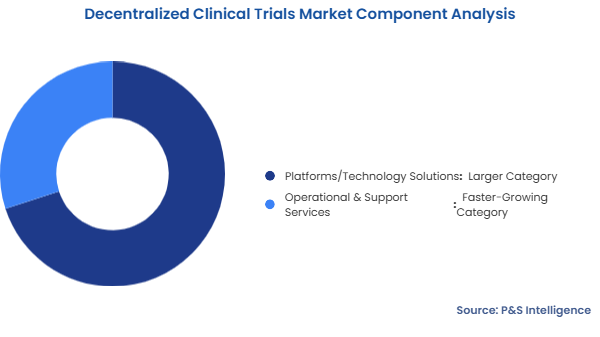
Platforms/technology solutions are the larger category, holding a market share of 70%, as most trials, decentralized or otherwise, require a centralized digital platform for managing consent, visit schedules, patient communications, and capturing study data. The U.S. FDA cleared 295 AI and machine learning-enabled medical devices in 2025, and a sponsor's first investment in software is typically the digital backbone of the trial, connecting patients, physicians, and site monitors from anywhere. The digital platform, once built out, can then be leveraged across numerous studies, becoming an infrastructure investment over time rather than a one-time cost.
Operational & support services are the faster-growing category, registering a CAGR of 13.4%. Companies now have to manage and support many aspects of the clinical trial process outside of the hospital, including at-home visit management, drug shipping, and patient onboarding. Most sponsors do not have internal teams for managing these operational elements at each location; so, service providers run daily trial activities, allowing sponsors to focus on the scientific components.
Operational & Support Services (Faster-Growing Category)
Patient recruitment and retention support
Home healthcare/mobile nursing visits
Logistics & direct-to-patient drug supply management
Data management, remote monitoring, & safety oversight
Regulatory consulting & study setup services
Technical implementation & training support
Trial Execution Model Analysis
Hybrid is the largest category, holding a market share of 60%, because studies still require laboratory testing, imaging, and other speciality processes, which can only be conducted at accredited clinical research sites. Therefore, companies use a combination of virtual remote monitoring and in-person visits to keep site investigators comfortable, improve patient convenience, and satisfy regulatory requirements. Critical safety assessments continue to occur at hospitals, especially since 26 of the 50 novel drugs approved by the FDA in 2024 were for rare diseases, requiring complex oversight.
Fully decentralized is the fastest-growing category, as researchers can now test their studies in homes across the world. With digital assessment, couriered drug delivery, and telehealth consultation capabilities, researchers can provide an opportunity for patients residing at distant locations from clinical research sites, while also providing for global enrolment strategies. All this is supported by 5G network coverage, which reached 51% of the global population in 2024, according to the ITU.
The trial execution models analysed in this report are:
Hybrid (Largest Category)
Fully Decentralized (Fastest-Growing Category)
Site-Centric with Digital Enablement
Trial Phase Analysis
Late-stage is the largest category, holding a market share of 45%, as it represents the largest group of patients being monitored for the longest period of time. The most significant burden in late-stage trials is travel, giving rise to the need to reduce follow-up visits and retain participants across various geographies. Sponsors are now using digital solutions as any delay associated with this stage can impact product approval timelines.
Post-approval/real-world evidence is the fastest-growing category, because drug developers require ongoing safety and efficacy data generated by the day-to-day use of a product once it has reached the marketplace. In FY 2024, there were 1,162 inter-center consulting reviews for combination products, reflecting FDA coordination in regulating combination therapies and related technologies. Remote monitoring and mobile applications allow for monitoring of patients in their daily lives, versus in a clinical setting. Regulatory agencies now place greater emphasis on real-world outcomes and encourage sponsors to develop digital follow-up studies.
Oncology is the largest category, due to the necessity for researchers to check symptoms frequently, monitor adverse events, and track treatments for extended periods of time. The FDA issued more than 60 oncology drug approvals in 2024, considering that cancer is the second-largest killer, accounting for almost 10 million human deaths each year, as per the World Health Organization. With remote reporting, patients have travel to hospitals less frequently and report their health details to the researchers online. By closely monitoring a patient's tolerance of the treatment via digital platforms and connected devices, researchers can retain patients and better manage the complexities of large clinical trials.
Rare diseases are the fastest-growing category, registering a CAGR of 13.3%, because of their rising incidence across countries. Moreover, it can be difficult for patients to access specialised clinical trial sites. The decentralized model allows for the ability to enrol patients no matter where they live, as advocacy groups help promote remote patient engagement to minimise the burden that travelling would place upon a frail patient. Therapies with orphan drug designations accounted for 52% of all novel FDA approvals in 2024.
The therapeutic areas analysed in this report are:
Oncology (Largest Category)
Rare Diseases (Fastest-Growing Category)
Cardiovascular Disorders
Neurological & Psychiatric Conditions
Infectious Diseases
Metabolic & Endocrine Disorders
Others
Organization Size Analysis
Large enterprises hold the larger market share, of 75%, as major pharmaceutical companies run numerous studies and can afford to build an enterprise-level digital platform to manage those studies. The large pharmaceuticals are held accountable for regulatory compliance, which is why they must use standardised decentralized systems to monitor compliance on all programs globally. Big pharma companies typically pilot the new model in one or two pipelines and then scale it to other pipelines.
Small & medium enterprises are the fastest-growing category, registering a CAGR of 13.6%, as small biotechnology companies want to rapidly get their products through to regulatory approval with limited resources. This allows SMEs to gain access to a wider pool of patients without having to physically build out additional infrastructure, as many small biotechnology companies rely upon outsourcing and ready-made solutions.
The organization sizes analysed in this report are:
Large Enterprises (Larger Category)
Small & Medium Enterprises (SMEs) (Faster-Growing Category)
Drive strategic growth with comprehensive market analysis
North America Decentralized Clinical Trials Market Analysis
North America dominates the market with 40% share as it is the largest base for decentralized trials because research sponsors and regulatory bodies accept remote participation as a standard component of trial designs. Ethical review committees and clinical guidelines have established clear procedures for telemedicine visits, electronic informed consents, and at-home sample collections. In addition, many hospitals have developed hybrid models of patient care, allowing for integration of treatment and research activity. Additionally, patient advocacy organizations actively promote enrolment in trials, creating increased trust among patients with regard to their participation in trials. Lastly, insurance companies now reimburse for remote consultation services; therefore, telemedicine visits are viewed as routine and no longer an experimental approach.
U.S. Decentralized Clinical Trials Market Analysis
The U.S. is the largest market in the continent and the world for decentralized clinical trial solutions. With an abundance of globally known contract research organisations and drug development sponsors, decentralized methods are now being applied to traditional drug development faster than before to support large-scale networks. ClinicalTrials.gov, maintained by the U.S. National Library of Medicine, now contains information on more than 500,000 clinical studies as of 2025, reflecting the scale of ongoing clinical research activity in the country. Digital health companies provide the FDA with a vehicle for validating remote monitoring protocols. In addition, telemedicine reduces anxiety associated with prolonged clinical trials and increases adherence to the clinical study's requirements.
Canada is expanding its decentralized trials into more rural areas. Provincial health systems are now supporting remote visits, allowing researchers to recruit patients from anywhere in Canada rather than just cities. Research networks can now work together on a provincial basis, allowing sponsors to test different models for patients to participate flexibly. Most growth should come from improving access for remote communities, rather than simply increasing the number of patients participating in studies. In 2024, 111 drugs received regulatory approval in Canada, marking a 15% decline compared to the average of the previous four years (131), according to CADTH (CDA-AMC) data. Moreover, the Canadian Radio-television and Telecommunications Commission (CRTC) Broadband Fund had committed over CAD 300 million by 2024 to improve high-speed Internet access in rural, remote, and Indigenous communities in Canada.
The Asia-Pacific region has the highest market CAGR, of 13.9%, because it is far from clinical research centres, making it difficult for patients to enrol in trials. Regional governments are establishing or modernizing their clinical trial regulations and permitting the use of electronic methods for collecting clinical trial data (e.g., remote monitoring). This is being done to attract multinational pharmaceutical companies to conduct clinical trials on local populations, considering that specific ethnicities are susceptible to certain diseases. At the same time, hospitals in cities across the region are expanding telemedicine programs to help manage overcrowding in urban areas and improve access to medical care for people living in rural areas.
China Decentralized Clinical Trials Market Analysis
China dominates the regional market as it is conducting large-scale patient studies with limited hospital capacity. The number of clinical trials registered in China was 4,900 in 2024, according to the CDE. Remote follow-ups can alleviate hospital overcapacity and reduce visit wait times for research centres. Technology platforms for mobile health are provided to all study participants, capitalising on the 365 million users accessing online medical services in China by 2024, according to the CNNIC. Decentralized monitoring allows pharmaceutical companies to effectively manage the large number of patients while allowing investigators to concentrate on making treatment decisions.
India Decentralized Clinical Trials Market Analysis
India will have the highest market CAGR in APAC as decentralized clinical trials bring clinical research to more varied population groups living far from specialised research centres. The eSanjeevani national telemedicine service recorded over 400 million patient consultations as of 2025, according to the Ministry of Health and Family Welfare, Government of India. The introduction of new and lower-cost digital tools by local digital startups has encouraged sponsors of clinical research to test virtual platforms for conducting clinical trials. AI-enabled diagnostic tools contributed to a 27% decline in adverse TB outcomes in 2025, according to the Ministry of Health.
Europe Decentralized Clinical Trials Market Analysis
The European market is advancing due to the surging need for collaboration among clinicians across countries and to protect the confidentiality of patient data. DCT sponsors, therefore, will have to build DCT systems that can support a variety of languages and healthcare systems. Public healthcare systems in Europe provide a mechanism for long-term follow-up of patients with chronic conditions, which is consistent with the model of remote monitoring used in many DCTs. In addition, public healthcare systems require clinicians and pharmaceutical sponsors to be transparent on patient interactions, supporting the use of structured digital engagement tools.
The regions and countries analysed in this report are:
North America (Largest Regional Market)
U.S. (Larger Country)
Canada (Faster-Growing Country)
Europe
Germany (Largest Country)
U.K. (Fastest-Growing Country)
France
Italy
Spain
Rest of Europe
Asia-Pacific (Fastest-Growing Regional Market)
China (Largest Country)
India (Fastest-Growing Country)
Japan
South Korea
Australia
Rest of APAC
Latin America
Brazil (Largest Country)
Mexico (Fastest-Growing Country)
Rest of LATAM
Middle East and Africa
Saudi Arabia (Largest Country)
South Africa
U.A.E. (Fastest-Growing Country)
Rest of MEA
Decentralized Clinical Trials Market Share
Decentralized clinical trials exist in an extremely fragmented marketplace. In most cases, there are multiple vendors providing individual components of a decentralized clinical trial versus a single vendor that delivers everything. Decentralized clinical trials typically require a sponsor to use several vendors to conduct a single clinical trial, which distributes the total revenue for each clinical trial among the participating vendors.
As such, technology startups, contract research organizations, and healthcare service organisations use their own specific business models to serve sponsors. Since decentralized clinical trials are driven by software and can be developed much faster than building new physical sites, new vendors will continue to enter this marketplace. Therefore, partnerships and integrations will become increasingly common as no single vendor has all of the capabilities necessary to support the entire clinical trial workflow.
Leading Companies in the Decentralized Clinical Trials Market:
Science 37, Inc.
Medable, Inc.
Oracle Corporation
IQVIA Holdings Inc.
Parexel International Corporation
ICON plc
Labcorp
Castor Research Inc.
Florence Healthcare, Inc.
Signant Health
Veeva Systems Inc.
Clinical Ink, Inc.
Medidata Solutions, Inc.
THREAD Research, Inc.
ObvioHealth, Inc.
Decentralized Clinical Trials Market Developments
In September 2025, Parexel International Corporation and Paradigm Health announced a collaboration to evolve clinical trial execution using an AI-powered digital platform. The initiative integrates clinical research operations with provider networks to improve trial access and efficiency and support more patient-centered study delivery.
In September 2025, Science 37, Inc. partnered with Catalent, Inc. to manage direct-to-patient investigational product logistics, supporting at-home participation in decentralized research studies across multiple locations.
In April 2024, ObvioHealth, Inc. launched ObvioGo 2.0, an updated clinical trial platform supporting hybrid and virtual study designs across multiple sites. The system enables site-specific workflows and supports virtual site teams to assist participants with tasks such as eConsent and trial coordination.
Frequently Asked Questions About This Report
What are the main advantages of decentralized clinical trials?+
They significantly improve patient retention and enhance demographic diversity by allowing participants to complete study requirements from home using remote monitoring devices and telemedicine.
How do hybrid clinical trials differ from fully decentralized models?+
Hybrid trials combine remote flexibility with necessary in-person clinic visits for complex medical procedures, making them the most widely adopted model in the industry today.
What are the biggest regulatory challenges for decentralized clinical trials?+
Navigating fragmented international data privacy laws and ensuring remote data collection meets strict FDA and EMA guidelines for accuracy and patient safety remains difficult.
How do wearable devices and IoT improve remote patient monitoring?+
Wearables provide continuous, real-time health data directly from the patient
Why are pharmaceutical companies increasingly adopting decentralized trial models?+
Sponsors use them to accelerate trial timelines, reduce clinical site costs, and generate real-world evidence more quickly to secure faster regulatory drug approvals.
Want a report tailored exactly to your business need?
Leading companies across industries trust us to deliver data-driven insights and innovative solutions for their most critical decisions. From data-driven strategies to actionable insights, we empower the decision-makers who shape industries and define the future. From Fortune 500 companies to innovative startups, we are proud to partner with organisations that drive progress in their industries.
Client Testimonials
Working with P&S Intelligence and their team was an absolute pleasure – their awareness of timelines and commitment to value greatly contributed to our project's success. Eagerly anticipating future collaborations.
McKinsey & Company
India
Unmatched Standards
Our insights into the minutest levels of the markets, including the latest trends and competitive landscape, give you all the answers you need to take your business to new heights
Complete Data Security
We take a cautious approach to protecting your personal and confidential information. Trust is the strongest bond that connects us and our clients, and trust we build by complying with all international and domestic data protection and privacy laws