This Report Provides In-Depth Analysis of the Decanter Centrifuge Market Report Prepared by P&S Intelligence, Segmented by Type (Two-Phase Centrifuge, Three-Phase Centrifuge), Design Type (Horizontal, Vertical), Operation (Continuous, Batch), Application (Chemical, Oil & Gas, Wastewater Treatment, Petrochemical, Pharmaceutical), and Geographical Outlook for the Period of 2019 to 2032
Explore the market potential with our data-driven report
Decanter Centrifuge Market Future Outlook
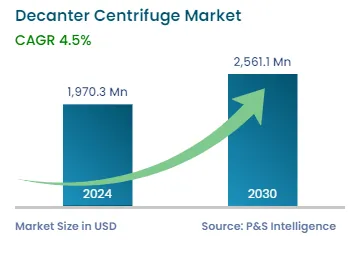
The decanter centrifuge market size was USD 1,970.3 million in 2024, which is predicted to reach USD 2769.6 million by 2032, growing at a CAGR of 4.5% during 2025–2032.
This is mainly due to the surging demand for decanter centrifuges in industries, the presence of strict regulatory standards in the case of product manufacturing, technological advancements, and the surging need for pharmaceutical separation in the food and beverage industry.
Moreover, there is an increase in the demand for solid-liquid separation, which is done by a decanter centrifuge, as it possesses good efficiency, great processing capacity, and enhanced product quality. A decanter centrifuge is used to separate substances with different densities or differentiate components such as solid, liquid, and gaseous. The working principle of this device is based on separation with the help of buoyancy. When components are put in a centrifuge, and after that, it rotates. Then, due to the gravitational force, heavy particles, such as sediments and solids, automatically fall to the bottom and lighter particles come up to the top.
In the operations of separating components, this device fastens the settling rate by the use of continuous rotation, achieving a g-force between 1,000 and 4,000 g. This helps in reducing the settling time by large fractions, resulting in mixtures settled in a matter of seconds as compared to previous ones. This type of separation facilitates rapid and controllable results.
Moreover, the decanter centrifuge is employed in processing raw materials in several industries, such as water treatment, mineral processing, chemical, pharmaceutical, and food processing. It can also help in raising the scope of the separation process by employing centrifugal force as a result of rotations, which can remove total moisture from solid products.
Solid bowl centrifuge is also a nickname for the decanter centrifuge. It has applications in the wastewater and sludge treatment industry, as there is a surge in waste products throughout the world. Further, the decanter centrifuge has a spotless appearance and little to no smell problems. In addition, fast start-up and shut-down time, easy installation, requires a small space for operation compared to other devices, low labor costs, and low continuous maintenance are some other reasons that make it a widely used device in different industries.
Decanter Centrifuge Market Trends & Drivers
Technological Innovation and Automation Integration Are Key Trends
Advanced machinery, robotics, and AI-driven systems are being implemented to improve production efficiency and precision.
The U.S. Department of Energy’s Natural Gas and Oil Technology Partnership Program has funded the development of a fuzzy-logic-based expert control system for a three-phase decanter centrifuge, aiming to automate operations and improve waste recovery and environmental safety.
Automated quality control processes are being integrated to minimize defects and ensure consistent output.
Smart sensors and IoT-enabled devices are being used for real-time monitoring, predictive maintenance, and operational optimization.
Innovative materials, products, or processes are being developed through continuous research and technological advancement.
According to a 2024 academic article, the global chemical industry’s total revenue in 2022 was approximately USD 5.72 trillion, marking the highest level observed in the past 15 years.
Data analytics and machine learning are being adopted to enhance decision-making, reduce downtime, and optimize resource utilization.
Workflows are being streamlined by combining automation with digital platforms, reducing manual labor requirements.
Safety and reliability in operations are being enhanced through automated hazard detection and preventive controls.
Rising Demand for Sustainable Wastewater Treatment Solutions Is Driving Market Growth
Globally, about 359 billion cubic meters of wastewater are produced annually, yet only 52% is treated, according to data published in Earth System Science Data by Utrecht University and the United Nations University.
Increasing environmental regulations are pushing industries to adopt eco-friendly wastewater treatment technologies.
Growing public awareness about water scarcity and pollution is boosting demand for sustainable treatment solutions.
Advancements in green chemistry and biological treatment methods are enabling more efficient and less harmful processes.
According to the World Health Organization, 57% of the global population, or 4.6 billion people, used safely managed sanitation services in 2022, while 33% (2.7 billion people) used private sanitation facilities connected to sewers requiring wastewater treatment.
Industrial and municipal sectors are investing in renewable energy-powered wastewater treatment plants to lower carbon footprints.
Adoption of water recycling and reuse systems is reducing dependence on freshwater resources.
Government incentives and funding programs are supporting the deployment of sustainable wastewater management infrastructure.
Companies are focusing on closed-loop systems and zero-liquid-discharge technologies to meet sustainability goals.
Decanter Centrifuge Market Segmentation Analysis
Type Analysis
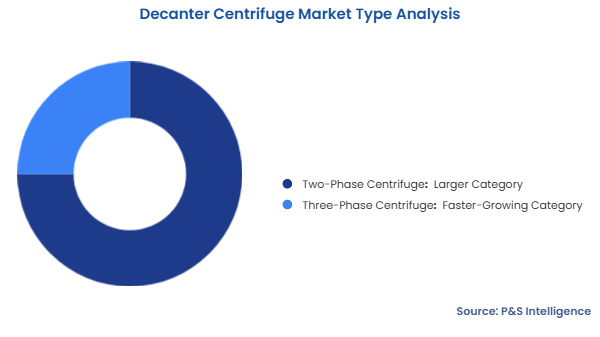
Two-phase centrifuges held the larger market share, of approximately 75%, in 2024, and they are expected to maintain their dominance throughout the forecast period. These systems excel in separating solid and liquid phases across diverse applications, including wastewater treatment, oil processing, chemical manufacturing, and food processing, where single-phase separation suffices.
The widespread adoption of two-phase decanter centrifuges stems from their simplicity, cost-effectiveness, and robust design, ensuring longer operational life with minimal maintenance requirements. Their versatility enables efficient handling of various feed materials while meeting regulatory compliance requirements across multiple industries.
Three-phase centrifuges are projected to witness the faster growth during 2025–2032, driven by increasing demand for separating two immiscible liquids and solids simultaneously. These advanced systems cater to specialized applications in oil refining, food processing, and biofuel production, where complex separation requirements justify the higher investment costs.
The types analyzed here are:
Two-Phase Centrifuge (Larger Category)
Three-Phase Centrifuge (Faster-Growing Category)
Design Type Analysis
Horizontal decanter centrifuges dominate the market with an approximately 70% share in 2024, attributable to their superior capacity and operational flexibility. The horizontal design facilitates easier maintenance, handles larger volumes efficiently, and provides enhanced durability for continuous operations in high-capacity applications across the wastewater treatment, oil & gas, and petrochemical sectors.
The horizontal configuration's rotating assembly, mounted horizontally with bearings on each end, provides excellent sealing surfaces for high-pressure applications. Feed capacities can reach up to 300 gallons per minute with solids handling up to 40,000 pounds per hour, making them preferred choices for large-scale industrial operations.
Vertical decanter centrifuges are experiencing steady growth due to their compact design and space-saving capabilities. Their vertical alignment enables operation in environments with limited floor space, making them ideal for pharmaceuticals, food & beverage, and chemical industries where space constraints are significant considerations.
These categories are covered:
Horizontal (Larger Category)
Vertical (Faster-Growing Category)
Operation Analysis
Continuous-operation centrifuges captured an approximately 80% market share in 2024, driven by their ability to handle large volumes with minimal human intervention. This operational mode is essential for industrial processes requiring uninterrupted production, particularly in chemical processing, wastewater treatment, and oil & gas applications, where downtime translates to significant operational losses.
Continuous operation systems provide consistent separation performance, automated discharge of separated materials, and integration capabilities with larger process systems. The technology's reliability and efficiency make it indispensable for industries emphasizing productivity and environmental compliance.
Batch-operation systems maintain relevance in specialized applications requiring precise control over separation parameters or handling of smaller volumes with varying feed characteristics. These systems are particularly valuable in pharmaceutical and biotechnology applications where product quality and contamination prevention are paramount.
These categories are covered:
Continuous (Larger Category)
Batch (Faster-Growing Category)
Application Analysis
Wastewater treatment emerged as the largest application category with approximately 35% market share in 2024, reflecting global emphasis on environmental protection and water resource management. Decanter centrifuges play crucial roles in municipal and industrial wastewater treatment plants for efficient sludge dewatering, solid-liquid separation, and water purification. The growing demand stems from increasing urbanization, stricter environmental regulations, and rising awareness about water scarcity. Municipal utilities worldwide are investing heavily in upgrading treatment infrastructure to meet regulatory compliance while optimizing operational efficiency.
In 2023, global investment in wastewater treatment infrastructure reached approximately USD 250 billion, up 7% from 2022. China has committed around USD 100 billion by 2030, while India plans to invest USD 30 billion to treat all urban sewage by then.
Oil & gas applications are projected to exhibit the highest CAGR during the forecast period, driven by expanding exploration activities, increasing focus on produced water treatment, and growing demand for drilling fluid recovery. The industry's emphasis on environmental compliance and operational efficiency is accelerating the adoption of advanced separation technologies. Chemical processing maintains a significant market presence due to diverse application requirements, including product purification, waste stream treatment, and solvent recovery. The pharmaceutical sector's stringent quality requirements and growing biotechnology applications are further expanding market opportunities.
In 2025, global crude oil production is projected to increase by approximately 2.5 million barrels per day (bpd), bringing total supply to around 104.9 million bpd, according to the IEA. This surge follows OPEC+ plans to unwind earlier output cuts, including a 547,000-bpd increase starting September 2025, and a 548,000-bpd hike in August, led by Saudi Arabia and allies.
These categories are covered:
Wastewater Treatment (Largest Category)
Oil & Gas (Fastest-Growing Category)
Chemical
Petrochemical
Pharmaceutical
Drive strategic growth with comprehensive market analysis
Decanter Centrifuge Market Regional Outlook
North America Decanter Centrifuge Market Size
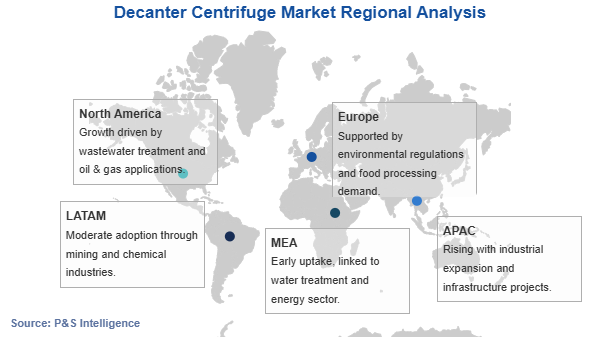
North America dominated the global market with an approximately 30% share in 2024, driven by stringent regulatory frameworks around wastewater management and a robust industrial base. The region's emphasis on environmental sustainability, combined with substantial investments in infrastructure modernization, creates favorable conditions for decanter centrifuge adoption across multiple sectors.
In January 2022, 17,544 publicly owned treatment works (POTWs) existed in the U.S., serving approximately 270 million Americans, which represents about 82% of the U.S. population. The region's mature industrial landscape, technological innovation capabilities, and presence of major equipment manufacturers contribute to market leadership. Ongoing investments in shale gas exploration and refining capacity expansion further drive demand for efficient separation technologies.
Asia-Pacific Decanter Centrifuge Market Outlook
Asia-Pacific is projected to exhibit the highest CAGR, of approx. 5.5%, during 2025–2032, driven by rapid industrialization and massive infrastructure development across emerging economies. China and India lead regional growth with substantial investments in wastewater treatment infrastructure, chemical processing capacity, and manufacturing expansion. Japan invested USD 7.6 billion in modernizing municipal water and sewage facilities between 2023 and 2027, with automation and energy-efficient centrifuges as part of its push for smart water infrastructure.
China Decanter Centrifuge Market
China's dominance in manufacturing, steel production, chemical processing, and power generation creates substantial demand for industrial separation equipment. The country's environmental protection initiatives and "Zero Waste City" programs are driving widespread adoption of advanced wastewater treatment technologies. For instance, the Chinese government allocated over USD 80 billion in its 14th Five-Year Plan (2021–2025) for urban wastewater treatment and water recycling facilities, including advanced sludge dewatering systems, where decanter centrifuges are commonly used.
The regions and countries analyzed in this report are:
North America (Largest Regional Market)
U.S. (Larger Country Market)
Canada (Faster-Growing Country Market)
Europe
Germany (Largest Country Market)
U.K. (Fastest-Growing Country Market)
France
Italy
Spain
Rest of Europe
Asia-Pacific (Fastest-Growing Regional Market)
Japan
China (Largest Country Market)
India (Fastest-Growing Country Market)
South Korea
Australia
Rest of APAC
Latin America
Brazil (Largest Country Market)
Mexico (Fastest-Growing Country Market)
Rest of LATAM
Middle East and Africa
Saudi Arabia (Largest Country Market)
South Africa
U.A.E. (Fastest-Growing Country Market)
Rest of MEA
Decanter Centrifuge Market Share
The global decanter centrifuge market is moderately fragmented, with competition spread across large industrial equipment manufacturers and specialized regional players. Leading companies differentiate themselves through technological innovation, strategic partnerships, and expansion into new geographic markets. While global brands leverage extensive production facilities, strong distribution networks, and significant research and development resources, many smaller manufacturers focus on niche applications or serve specific regional demands. The industry is experiencing steady technological advancements, including greater automation, improved energy efficiency, and integration of digital monitoring systems.
Although precise market share data varies by source, available research suggests that the top five players together account for just over half of global revenues, indicating moderate consolidation alongside a diverse base of smaller competitors.
Top Decanter Centrifuge Manufacturers:
Alfa Laval AB
Andritz AG
Flottweg SE
GEA Group AG
Mitsubishi Kakoki Kaisha Ltd.
Hiller GmbH
Pieralisi Group
SIEBTECHNIK TEMA
Tomoe Engineering Co. Ltd.
US Centrifuge Systems
Derrick Corporation
Sanborn Technologies
Decanter Centrifuge Market News
In July 2025, Alfa Laval AB revealed the Foodec Sigma decanter centrifuge installation at a Portuguese olive mill, which quadrupled processing capacity from 1,500 to 6,000 kg/hour by integrating advanced conveyor design and wear-resistant improvements.
In January 2025, Multotec introduced its containerized demonstration plant, featuring the TS 530L Tailings decanter centrifuge from its affiliate, Siebtechnik Tema. This system is designed to continuously separate fine solids from a liquid phase by utilizing centrifugal forces on a slurry stream over time.
In September 2024, GEA Group launched the StarchMaster CF 8000 decanter centrifuge in Europe, designed for starch extraction at 15–20 tons of wheat flour per hour. It supports two- and three-phase operations and features energy-efficient, automated systems, such as summationdrive, Active Torque Control, Varipond C, and GEA X Control, for real-time monitoring.
In July 2024, Flottweg introduced a modern rotor at the Vilsbiburg wastewater treatment plant in Germany, achieving up to 3% higher dry solids content, reducing disposal volume by up to 10%, and lowering energy consumption by 10%, thereby significantly cutting operational costs.
In July 2023, ANDRITZ launched enhanced three-phase decanter centrifuges specifically tailored for challenging industrial oil recovery applications. These robust units are engineered to separate solids, oil, and water simultaneously and are suitable for use in hazardous environments (ATEX Zone 1 and Zone 2), featuring heavy-duty construction and advanced automation capabilities.
In June 2023, Hiller GmbH reported that over 6,500 decanter centrifuges are in operation globally, delivering around 200 units annually from its production base in Vilsbiburg, Germany—illustrating sustained demand and manufacturing capacity.
Want a report tailored exactly to your business need?
Leading companies across industries trust us to deliver data-driven insights and innovative solutions for their most critical decisions. From data-driven strategies to actionable insights, we empower the decision-makers who shape industries and define the future. From Fortune 500 companies to innovative startups, we are proud to partner with organisations that drive progress in their industries.
Client Testimonials
Working with P&S Intelligence and their team was an absolute pleasure – their awareness of timelines and commitment to value greatly contributed to our project's success. Eagerly anticipating future collaborations.
McKinsey & Company
India
Unmatched Standards
Our insights into the minutest levels of the markets, including the latest trends and competitive landscape, give you all the answers you need to take your business to new heights
Complete Data Security
We take a cautious approach to protecting your personal and confidential information. Trust is the strongest bond that connects us and our clients, and trust we build by complying with all international and domestic data protection and privacy laws