Data Center Switchgear Market Size & Share Analysis - Trends, Drivers, Competitive Landscape, and Forecasts (2025 - 2032)
This Report Provides In-Depth Analysis of the Data Center Switchgear Market Report Prepared by P&S Intelligence, Segmented by Voltage Type (Low Voltage Switchgear, Medium Voltage Switchgear), Insulation Type (Gas Insulated Switchgear (GIS), Air Insulated Switchgear (AIS)), End User (Hyperscale Data Centers, Colocation Data Centers, Enterprise Data Centers), and Geographical Outlook for the Period of 2021 to 2032
Explore the market potential with our data-driven report
Data Center Switchgear Market Overview
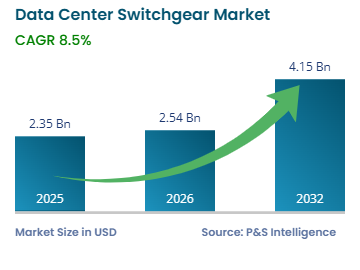
In 2025, the global data center switchgear market stood at USD 2.35 billion, rising to an estimated USD 2.54 billion in 2026 and on course for USD 4.15 billion by 2032, an 8.5% CAGR from 2026 through 2032. Hyperscale operators and colocation landlords are ordering more switchgear per building as AI server halls concentrate tens of megawatts behind a single utility feed. For manufacturers, that raises the switchgear content of every building sold and moves the order earlier in the project.
Electricity availability is what sets the order book. The International Energy Agency reports that data center electricity consumption reached 485 TWh in 2025, 17% higher than a year earlier, and expects it to roughly double to 950 TWh by 2030. Every contracted megawatt has to be switched, protected, and metered before it reaches a server, so switchgear volumes follow energization schedules instead of IT refresh cycles. Buyers increasingly place equipment orders before the building shell is finished, which pulls revenue forward for suppliers holding factory capacity.
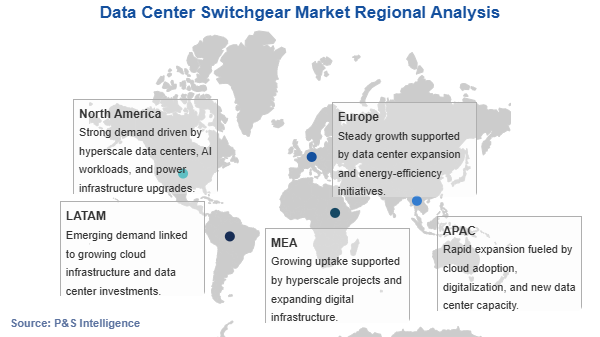
North America accounted for 42% of 2025 revenue, more than any other region, led by U.S. campus construction and by the replacement of aging distribution gear in older facilities. Asia-Pacific is projected to grow fastest, at a 9.2% CAGR over 2026-2032, as operators in China, India, Japan, and Australia fit out new buildings instead of re-powering existing ones. Those two paths give the Data Center Switchgear Market separate demand engines, one led by retrofit and expansion, the other by first-time installation.
Key Market Insights
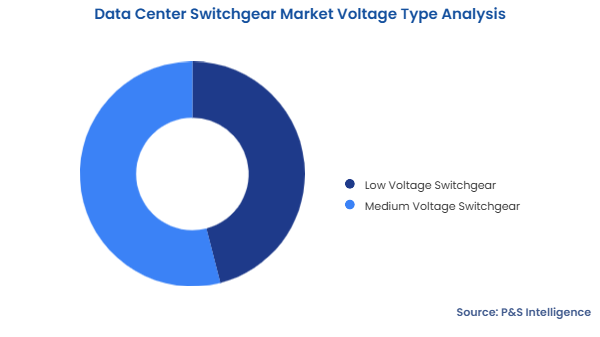
By voltage type, low voltage switchgear accounted for 46% of revenue in 2025, while medium-voltage switchgear is on course for the faster gain through 2026-2032.
By insulation type, gas insulated switchgear held 42% of revenue in 2025, and its share is climbing at a 10.6% CAGR through 2026-2032.
By end user, hyperscale data centers made up 56% of revenue in 2025, and they are climbing fastest among the three buyer groups between 2026 and 2032.
By geography, North America accounted for the largest share at 42% in 2025, and Asia-Pacific is advancing fastest, at a 9.2% CAGR from 2026 to 2032.
Data Center Switchgear Market Trends and Growth Drivers
Rising Rack Power Density Is Redefining Switchgear Content Per Building
AI training halls draw more power per square meter than any earlier generation of IT load, and that changes what operators buy. A hall built for 10 kW racks needed one low-voltage board per room. A hall built for racks ten times that size needs medium-voltage distribution carried into the white space, with transformation and protection repeated at every power block. Operators are therefore specifying more switchgear sections per megawatt, and specifying them at design stage, because the electrical room layout now decides how many racks the building can hold.
The Open Compute Project Foundation's Diablo rack and power specification, contributed by Google, Meta, and Microsoft, covers IT racks from 100 kW up to 1 MW and moves in-rack distribution to 800 V direct current, with more than 80 partners developing compatible equipment as of August 2026. Higher distribution voltage cuts the conductor needed per megawatt and pushes protection and metering duties back toward the switchgear. Suppliers that ship factory-assembled skids combining medium-voltage protection, transformation, and metering remove weeks of site electrical work, which is the part buyers will pay a premium for.
Record Data Center Construction Spending Is Accelerating Switchgear Orders
A new building cannot accept a single server until its whole electrical distribution chain is in place, and switchgear is the long-lead item in that chain. Operators now sign power contracts and release switchgear orders before the shell is complete, because the energization date, not the construction date, determines when a campus can bill a tenant. That sequencing moves switchgear purchasing to the front of the project and ties order volumes to announced capacity rather than to completed floor space.
The U.S. Census Bureau's construction survey shows data center construction running at a USD 75 billion annualized rate in July 2026, up 57% from a year earlier and the largest category within private office construction. Building at that pace commits electrical equipment orders years ahead of commissioning. Manufacturers with confirmed factory slots can hold firmer prices, and large buyers increasingly pay to reserve those slots, which favors suppliers that have already added plant capacity over those quoting from a queue.
Fluorinated Gas Phase-Downs Are Creating a Requalification Opening for Suppliers
Medium-voltage switchgear has long used sulfur hexafluoride as its insulating and switching medium, and rules removing that gas from new installations force operators to requalify products instead of reordering a catalog item. For an operator running one standardized global electrical design, a banned gas means redrawing the single-line diagram and re-approving vendors for every voltage class affected. Vendor lists therefore reopen at exactly the moment hyperscale buyers are placing their largest equipment packages.
Regulation (EU) 2024/573 prohibits putting into operation medium-voltage switchgear rated up to and including 24 kV that uses fluorinated greenhouse gases from January 1, 2026, and extends that prohibition to equipment above 24 kV and up to 52 kV from January 1, 2030. Operators building in Europe must specify gas-free or alternative-gas equipment now, and several are applying the same specification worldwide to keep one design. Manufacturers with qualified alternative-gas ranges can displace incumbents on framework agreements that would otherwise have renewed unchanged.
Shortages of Qualified Electrical Labor Are Constraining Installation Schedules
A switchgear order only becomes revenue once the lineup is installed, terminated, tested, and commissioned on site, and that work needs licensed electricians and testing technicians. Data center campuses compete for the same crews as utilities, factories, and grid upgrade programs, often in the same counties. When crews are unavailable, operators push delivery dates out, stage deliveries across quarters, or split a package between suppliers to match crew availability, and each of those responses delays when the manufacturer gets paid.
The U.S. Bureau of Labor Statistics projects employment of electricians to grow 9% over the decade to 2035, with about 72,700 openings each year, most of them replacing workers who retire or leave the trade. Openings driven mainly by replacement indicate the pool is not widening fast enough to absorb data center construction on top of existing utility and industrial work. Buyers respond by favoring pre-assembled, pre-tested equipment that needs fewer site hours, which shifts value toward manufacturers with integration capacity of their own.
Data Center Switchgear Market Segmentation Analysis
Voltage Type
Low voltage switchgear accounted for 46% of revenue in 2025. Most switchgear units in a data center sit downstream of the transformer, where 400 V and 480 V boards feed UPS inputs, mechanical plant, and floor-level distribution. Each white-space block and each chiller plant needs its own board, so unit volumes multiply with floor area rather than with contracted megawatts. IEEE's C37.20.1 standard, governing metal-enclosed low-voltage switchgear built around 480 V circuit breakers, gives operators one qualification path they can specify at every site, letting design teams copy a hall from one building to the next without re-engineering protection settings.
Medium-voltage switchgear is on track to outpace low voltage growth through 2026-2032. Campuses now take utility service at transmission or sub-transmission voltage and distribute internally at 13.8 kV or above, which adds medium-voltage sections at the utility yard, at each building, and increasingly at each power block. Behind-the-meter generation and storage create further interconnection points, each needing its own protection. NFPA 70, the electrical code governing every U.S. data center installation, treats a medium-voltage lineup as a distinct listed assembly, giving it a longer qualification cycle, a longer lead time, and a higher price than a low voltage board.
Insulation Type
Gas insulated switchgear held 42% of revenue in 2025. A sealed gas-insulated enclosure occupies less floor space than an air-insulated equivalent at the same voltage and fault rating, which matters when the electrical room competes with rack space inside a fixed footprint. The enclosure also keeps dust, humidity, and salt away from live parts, so coastal and dense urban sites specify it to cut maintenance outages. The EPA's SF6 Emission Reduction Partnership for Electric Power Systems identifies sulfur hexafluoride as the standard insulating medium in this equipment class, and a factory-sealed, factory-tested compartment shortens site commissioning versus an air-insulated bay.
Gas insulated switchgear also carries the fastest growth of the three insulation types, at a 10.6% CAGR during 2026-2032. The IEC's 62271-203 standard, updated in 2022, now accommodates alternative insulating gas mixtures alongside sulfur hexafluoride, removing the main regulatory objection to sealed designs and letting operators keep the compact footprint while meeting emissions rules. Retrofit work in older urban facilities favors the same technology, since a gas insulated lineup raises capacity inside an existing electrical room without extending the building. Vendors with qualified alternative-gas ranges are best placed to capture that replacement work.
End User
Hyperscale data centers accounted for 56% of revenue in 2025. A hyperscale campus is bought as one program covering several buildings, so a single procurement decision can commit hundreds of switchgear sections. These operators design their own electrical topology and qualify suppliers centrally, which concentrates spending with a short list of manufacturers able to deliver against a common specification in several countries at once. The U.S. Energy Information Administration projects data center electricity use will keep climbing through 2050 as server fleets grow power-intensive, and hyperscale power blocks draw more per building than any leased facility, deepening spending concentration.
Hyperscale data centers are set to add capacity faster than colocation and enterprise buyers through 2026-2032. Almost all new AI training capacity is being added at hyperscale sites, and those sites are built in multi-building phases that repeat one electrical design, which compounds equipment volumes with each phase. The Federal Energy Regulatory Commission ordered grid operators in June 2026 to rework interconnection rules that predate the several-hundred-megawatt requests hyperscale campuses now file, several at a time, across multiple regions. Manufacturers holding a hyperscale framework agreement gain volume visibility that colocation and enterprise accounts rarely provide from smaller buyers.
The complete segmentation hierarchy is as follows:
Voltage Type
Low Voltage Switchgear
Medium Voltage Switchgear
Insulation Type
Gas Insulated Switchgear (GIS)
Air Insulated Switchgear (AIS)
Others
End User
Hyperscale Data Centers
Colocation Data Centers
Enterprise Data Centers
Drive strategic growth with comprehensive market analysis
Data Center Switchgear Market Geographical Analysis
North America Data Center Switchgear Market Outlook
North America held 42% of the Data Center Switchgear Market in 2025. The U.S. is the region's largest market and holds most of the installed base, with campus clusters in Virginia and Texas taking utility service at transmission voltage. Long-standing qualification relationships between operators and electrical manufacturers shorten approval, so a design accepted on one campus repeats on the next. Utility interconnection timing, more than construction labor, generally sets how quickly that equipment moves from order to energization.
The Lawrence Berkeley National Laboratory's data center energy report shows that U.S. data centers consumed 176 TWh of electricity in 2023, or 4.4% of national consumption, and projects 325 to 580 TWh by 2028. A load that large concentrated in a handful of counties pushes operators to build their own substations and internal medium-voltage networks instead of relying on a simple utility drop. More of the electrical chain therefore sits inside the customer's own purchase scope, and more of it is switchgear.
The region's share is likely to hold as replacement work adds to new construction. The North American Electric Reliability Corporation's 2025 long-term reliability assessment, published in January 2026, projects summer peak demand across the bulk power system to rise by more than 224 GW between 2026 and 2035, with data centers the largest single contributor. Where connection capacity is scarce, operators add on-site generation and storage, and each addition needs its own medium-voltage switchgear. Suppliers with local service crews gain most from that work, since retrofits have to be done around live load.
Asia-Pacific is on track to outgrow every other region in the Data Center Switchgear Market, at a 9.2% CAGR during 2026-2032. Operators across the region are fitting out new buildings rather than re-powering old ones, so nearly every order carries a full electrical scope instead of a partial upgrade. Power tariffs and land availability are pushing campuses toward secondary cities where the utility connection has to be built from scratch. China accounts for the largest volume of regional capacity additions, while Japan, Australia, and Southeast Asia are each commissioning new hyperscale sites.
India shows how fast the installed base is expanding. The Ministry of Electronics and Information Technology reports that the country's data centre capacity rose from about 375 MW in 2020 to around 1,575 MW by 2025. Capacity added at that rate leaves almost nothing to replace, so switchgear demand is close to entirely incremental. Manufacturers with regional assembly and type-testing can meet delivery windows that imported lineups struggle to hit, which matters more to buyers here than catalog breadth.
Regional growth should stay ahead of other geographies while new markets keep adding first-time capacity. Local content requirements and national cloud programs in several countries favor suppliers that manufacture in-region, which is changing who wins the larger campus packages. Domestic Chinese and Japanese equipment makers are competing directly with European and American incumbents on lead time and price for that work.
Europe trails the two leading regions in switchgear volume but holds a steady claim on global demand, and its orders skew toward higher-specification equipment. Germany, the U.K., France, the Netherlands, and Ireland host most of the region's capacity, and each faces connection constraints in its main data center cluster. Emissions rules also move operators toward alternative-gas medium-voltage equipment earlier than buyers elsewhere, which raises the average value of each lineup ordered.
Ireland's Commission for Regulation of Utilities has set a connection policy for data centres that requires new sites to bring matching generation or storage capacity, on site or nearby, and to offer that capacity into the wholesale electricity market. A requirement of that kind adds interconnection, synchronizing, and protection equipment that a plain utility feed would never need. Operators building in constrained markets are consequently buying more switchgear per megawatt than operators in regions with spare grid headroom, which partly offsets the region's slower capacity growth.
Latin America contributes a smaller part of global demand, concentrated in Brazil. Low-cost hydro and wind generation is the region's main attraction, and operators siting near that generation still need a complete medium-voltage distribution chain because the connection point is far from the load. Import duties on electrical equipment have historically pushed buyers toward lower-specification boards, which held down the value of each project even where capacity was being added.
Brazil enacted a special tax regime for data center services in September 2026, suspending federal taxes on equipment and infrastructure bought or imported as fixed assets for qualifying facilities. Removing those taxes lowers the delivered cost of switchgear and makes the sealed, digitally monitored equipment specified elsewhere affordable for Brazilian projects. Manufacturers with local partners and stock held in country are best placed as announced campuses convert into firm orders.
The Middle East and Africa hold the smallest position among the regions covered, and demand comes from a handful of sovereign-backed programs rather than a broad operator base. Gulf states are building AI campuses next to their own generation, which means one buyer owns the substation, the internal medium-voltage network, and often the generating plant as well. High ambient temperatures force equipment derating, so buyers there specify larger or actively cooled lineups than a temperate site would need for the same load.
Saudi Arabia's Ministry of Communications and Information Technology runs a national data center strategy aiming to build gigawatt-scale capacity before 2030, anchored by hyperscale campuses intended to serve the wider region. Programs bought that way are tendered as large single packages, which favors manufacturers able to deliver a complete electrical scope on one schedule. South Africa and Kenya add steadier, smaller demand as operators build regional cloud and connectivity sites.
This report is categorized into the following geographies.
North America
U.S.
Canada
Asia-Pacific
China
India
Japan
Australia
Rest of Asia-Pacific
Europe
Germany
U.K.
France
Netherlands
Rest of Europe
Latin America
Brazil
Mexico
Rest of Latin America
Middle East and Africa
Saudi Arabia
U.A.E.
South Africa
Rest of Middle East & Africa
Data Center Switchgear Market Competitive Landscape
The Data Center Switchgear Market is moderately fragmented, with about ten manufacturers holding an established position and no single supplier able to win every regional or specification niche. Switchgear needs type-tested designs, short-circuit and arc-fault test facilities, and factories able to reserve slots for multi-building programs, all of which take years of heavy capital to establish, so the field stays limited to established manufacturers. Regional specialization, from North American build-to-order suppliers to China's domestic buildout, keeps the market wider than a handful of global majors, and supplier lists are now reopening as alternative-gas designs go through requalification.
Schneider Electric SE and Eaton Corporation plc lean on integrated, factory-assembled power skids that cut hours out of site installation, while ABB Ltd and Siemens AG compete on standardized designs replicated across countries for buyers running one global specification. Hitachi Energy Ltd. approaches the same campuses from the utility side, where its transmission and alternative-gas portfolio suits sites taking service at higher voltages. Vertiv Holdings Co. and Powell Industries Inc. build to order for North American data center programs and win on lead time and configurability rather than catalog breadth.
Mitsubishi Electric Corporation and GE Vernova Inc. bring switching and protection technology developed for utility networks into the same buildings, while Guangzhou Baiyun Electric Equipment Co. Ltd. serves China's domestic buildout on price and local delivery. For buyers, the practical result of a field this wide is that one campus package can be split across two or three qualified suppliers to protect the energization date, trading a single-vendor relationship for schedule certainty.
Leading Companies in the Data Center Switchgear Market:
Schneider Electric SE
Eaton Corporation plc
Siemens AG
ABB Ltd
Hitachi Energy Ltd.
Vertiv Holdings Co.
Powell Industries Inc.
Mitsubishi Electric Corporation
Guangzhou Baiyun Electric Equipment Co. Ltd.
GE Vernova Inc.
Data Center Switchgear Market Developments
In August 2026, GE Vernova Inc. launched a 170 kV gas-insulated switchgear range that uses no sulfur hexafluoride, manufactured in Europe and available to order from launch. The product extends alternative-gas switching to the higher voltages at which large data center campuses now take utility service.
In August 2026, Siemens AG committed more than USD 185 million to a 550,000-square-foot plant at Pendergrass in Jackson County, Georgia, to build low voltage electrical equipment for data centers, with more than 1,400 jobs planned. Adding U.S. capacity shortens lead times for the country's largest buyers.
In August 2026, Powell Industries Inc. reported an order backlog of USD 2.4 billion at June 30, 2026, up 69% year over year, including a single data center award worth more than USD 400 million tied to behind-the-meter on-site generation. The order shows operators buying generation-side switchgear as grid connections tighten.
In April 2026, Vertiv Holdings Co. acquired BMarko Structures to bring structural fabrication and modular enclosure engineering in house. Owning that capability lets the company ship more of its switchgear and power equipment as pre-tested assemblies rather than loose sections for site build-up.
In April 2026, Eaton Corporation plc committed more than USD 30 million to a 370,000-square-foot plant in Bellevue, Nebraska, to build medium-voltage switchgear, with air-insulated and gas-insulated production due to begin in the first half of 2027. The investment targets the lead-time gap that currently delays campus energization.
In November 2025, ABB Ltd. expanded its agreement with Applied Digital to supply low and medium voltage electrical architecture for the 300 MW Polaris Forge 2 campus near Harwood, North Dakota. Designing the electrical scope jointly with the operator locks the supplier in across both phases of the campus.
Frequently Asked Questions About This Report
What drives switchgear demand in data centers?+
Every contracted megawatt has to be switched, protected, and metered before it reaches a server, so switchgear volumes follow energization schedules instead of IT refresh cycles.
Which region is growing fastest in this market?+
Asia-Pacific is projected to grow fastest, at a 9.2% CAGR over 2026-2032, as operators in China, India, Japan, and Australia fit out new buildings instead of re-powering existing ones.
What is the largest voltage type segment?+
By voltage type, low voltage switchgear accounted for 46% of revenue in 2025, while medium-voltage switchgear is on course for the faster gain through 2026-2032.
How fragmented is the market?+
The data center switchgear market is moderately fragmented, with about ten manufacturers holding an established position and no single supplier able to win every regional or specification niche.
Why is switchgear a long-lead item in data center projects?+
A new building cannot accept a single server until its whole electrical distribution chain is in place, and switchgear is the long-lead item in that chain.
How is higher rack power density affecting switchgear requirements?+
AI training halls draw more power per square meter than any earlier generation of IT load, and that changes what operators buy.
What is the end-user composition of the market?+
Hyperscale data centers accounted for 56% of revenue in 2025. A hyperscale campus is bought as one program covering several buildings, so a single procurement decision can commit hundreds of switchgear sections.
How are regulatory changes opening up new vendor opportunities?+
For an operator running one standardized global electrical design, a banned gas means redrawing the single-line diagram and re-approving vendors for every voltage class affected.
Want a report tailored exactly to your business need?
Leading companies across industries trust us to deliver data-driven insights and innovative solutions for their most critical decisions. From data-driven strategies to actionable insights, we empower the decision-makers who shape industries and define the future. From Fortune 500 companies to innovative startups, we are proud to partner with organisations that drive progress in their industries.
Client Testimonials
Working with P&S Intelligence and their team was an absolute pleasure – their awareness of timelines and commitment to value greatly contributed to our project's success. Eagerly anticipating future collaborations.
McKinsey & Company
India
Unmatched Standards
Our insights into the minutest levels of the markets, including the latest trends and competitive landscape, give you all the answers you need to take your business to new heights
Complete Data Security
We take a cautious approach to protecting your personal and confidential information. Trust is the strongest bond that connects us and our clients, and trust we build by complying with all international and domestic data protection and privacy laws