Data Center Optical Transceiver Market Size & Share Analysis - Trends, Drivers, Competitive Landscape, and Forecasts (2026 - 2032)
This Report Provides In-Depth Analysis of the Data Center Optical Transceiver Market Report Prepared by P&S Intelligence, Segmented by Data Rate (Below 100G, 100G/200G, 400G, 800G, 1.6T and above), Form Factor (QSFP/QSFP-DD family, OSFP family, SFP/SFP-DD family, CFP/CFP2 family, Co-packaged optics/optical engines), Fiber Type (Single-mode fiber, Multimode fiber), Reach (Short reach up to 500 m, Medium reach 500 m to 10 km, Long-reach/data-center interconnect above 10 km), Data Center Type (Hyperscale/cloud data centers, Colocation data centers, Enterprise/private data centers, Edge data centers, Government/defense/research data centers), Technology Platform (EML/DML-based pluggable optics, Silicon photonics-based optics, VCSEL-based optics, Coherent pluggable optics, Linear pluggable optics), and Geographical Outlook for the Period of 2021 to 2032
Data Center Optical Transceiver Market Size Estimation
Key Highlights
Study Period
2021 - 2032
Market Size in 2025
USD 9.70 Billion
Market Size in 2026
USD 11.10 Billion
Market Size by 2032
USD 24.70 Billion
Projected CAGR
14.3%
Largest Region
North America
Fastest Growing Region
Asia-Pacific
Market Structure
gray-zone
Market Size
Explore the market potential with our data-driven report
Data Center Optical Transceiver Market Overview
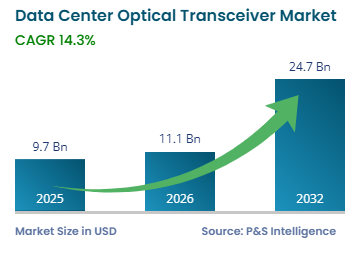
The Data Center Optical Transceiver Market size was USD 9.7 billion in 2025, is estimated at USD 11.1 billion in 2026, and is projected to reach USD 24.7 billion by 2032, advancing at a CAGR of 14.3% during 2026–2032. AI training and inference fabrics are increasing the number and speed of optical links required between accelerators, switches, and data-center campuses, making bandwidth density, power per bit, and qualification reliability central purchasing criteria.
High-speed migration is expanding the addressable mix beyond mature 400G deployments. IEEE 802.3df-2024 standardized 800 GbE implementations across eight electrical or optical lanes, and the ongoing IEEE P802.3dj work extends the roadmap to 1.6 Tb/s. IEEE 802.3df-2024 lets suppliers reuse established 100G-per-lane intellectual property, while P802.3dj advances 200G-per-lane designs for the next Ethernet rates. Buyers can stage upgrades around switch silicon, thermal limits, and application reach requirements.
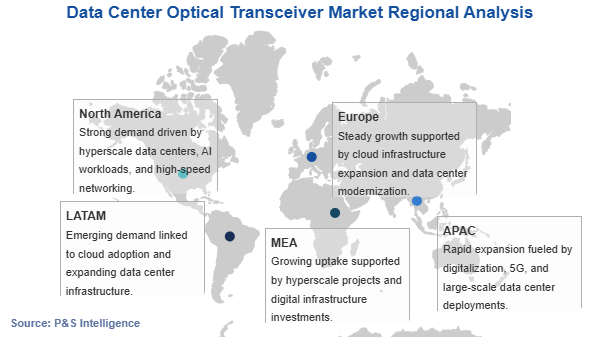
North America held 42.2% of the Data Center Optical Transceiver Market share in 2025, supported by dense hyperscale infrastructure and large AI capital programs. Microsoft stated that more than half of its approximately USD 80 billion fiscal 2025 AI-enabled data-center investment would be deployed in the U.S. for infrastructure used to train AI models and deploy AI and cloud applications, illustrating the scale of regional network buildouts.
Asia-Pacific is expected to record the fastest regional CAGR through 2032 as Chinese cloud and module ecosystems scale high-speed links and India adds data-center and AI compute capacity. The commercial contest is shifting from headline speed alone toward dependable volume delivery, interoperability, thermal performance, and a credible upgrade path from pluggable modules to linear or co-packaged architectures.
Key Market Insights
By data rate, 400G held 35.8% in 2025, while 1.6T and above is projected to record the fastest CAGR during 2026–2032.
By form factor, the QSFP/QSFP-DD family accounted for the largest share in 2025, while the OSFP family is expected to post the fastest CAGR during 2026–2032.
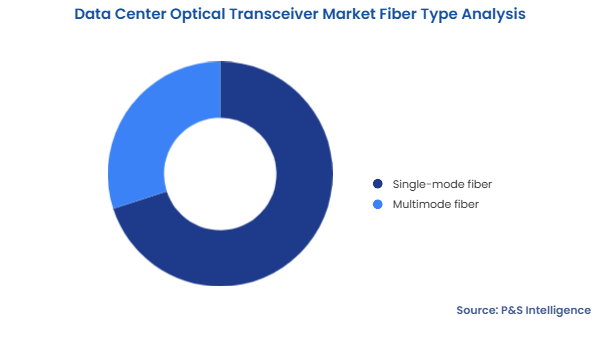
By fiber type, single-mode fiber accounted for the largest share in 2025 and is also projected to register the fastest CAGR during 2026–2032.
By reach, short reach up to 500 m accounted for the largest share in 2025, while medium reach from 500 m to 10 km is expected to record the fastest CAGR during 2026–2032.
By data center type, hyperscale/cloud data centers held 40.5% in 2025, while edge data centers are projected to register the fastest CAGR during 2026–2032.
By technology platform, EML/DML-based pluggable optics accounted for the largest share in 2025, while silicon photonics-based optics is expected to post the fastest CAGR during 2026–2032.
By geography, North America held 42.2% in 2025, while Asia-Pacific is projected to record the fastest regional CAGR during 2026–2032.
Data Center Optical Transceiver Market Trends and Growth Drivers
AI Cluster Scale-Out Raises Optical Bandwidth Density
AI clusters are the primary driver of Data Center Optical Transceiver Market growth because accelerator utilization depends on moving model parameters and training data across large east-west fabrics without persistent network bottlenecks. Each new switching generation raises aggregate throughput and increases the value of optics that can deliver more bandwidth within a fixed front-panel and power envelope. The bandwidth relationship links module demand to the pace of GPU and XPU deployment, switch refreshes, and the expansion of distributed training domains.
Microsoft planned approximately USD 80 billion of fiscal 2025 investment in AI-enabled data centers for model training and AI and cloud applications, with more than half allocated to the U.S. Such programs do not translate one-for-one into transceiver revenue, but they enlarge the installed base of high-radix switches and accelerator links that must be optically connected. Qualified 800G and 1.6T products can capture the resulting refresh and greenfield demand.
Linear and Co-Packaged Optics Open a Power-Efficiency Opportunity
The data center optical transceiver industry has a growing opportunity to reduce network power by shortening or removing power-intensive electrical signal-conditioning paths. Linear pluggable optics retain a replaceable front-panel module while transferring more signal processing to the host. Co-packaged optics place optical engines beside the switch ASIC, reducing electrical trace loss and creating another route to higher port density.
Cisco Systems Inc. reports that its 800G linear pluggable optics reduce module power consumption by 50% compared with retimed optical modules and can lower overall switch power by 30% in supported systems. Adoption will depend on link budgets, serviceability, ecosystem interoperability, and buyer comfort with new failure and replacement models. Vendors that offer both conventional pluggables and emerging architectures can address different operational preferences without forcing a single transition path.
1.6T Migration Reshapes Product and Qualification Roadmaps
Data center optical transceiver industry trends increasingly center on 200G-per-lane and 400G-per-lane building blocks that move 1.6T products from demonstration into sampling and volume qualification. The shift changes more than faceplate speed. It requires tighter coordination among switch SerDes, DSPs, laser technologies, thermal designs, connector choices, firmware telemetry, and fiber infrastructure.
Broadcom Inc.'s 3 nm Taurus BCM83640 uses 400G-per-lane serial optical interfaces, supports modules from 1.6T to 3.2T, and enables 102.4T switching capacity in a 1RU system when used in 1.6T pluggables. Broadcom Inc. identifies customer sampling as the current status. Buyers are likely to stage deployment by workload and rack architecture, leaving 400G and 800G as significant procurement pools while 1.6T qualifications expand.
Power and Infrastructure Bottlenecks Temper Deployment Pace
The main restraint is the mismatch between rapid demand for AI connectivity and the slower expansion of power, cooling, grid connections, and qualified component capacity. Faster transceivers improve bandwidth density, but higher aggregate port counts still add thermal load and increase the cost of validating signal integrity, firmware, and reliability across a large fabric. A delayed data-center energization or switch platform can consequently defer associated optics orders even when long-term bandwidth demand remains intact.
The International Energy Agency projects global data-center electricity consumption to rise from 485 TWh in 2025 to 950 TWh in 2030, while noting that energy-equipment, advanced-chip, and IT-component bottlenecks are limiting more aggressive near-term expansion. These constraints favor suppliers with efficient designs and dependable qualification support, but they also make deployment timing sensitive to infrastructure execution and capital availability.
Data Center Optical Transceiver Market Segmentation Analysis
Data Rate
The Data Center Optical Transceiver Market analysis shows that 400G held the largest data-rate share at 35.8% in 2025. Its position reflects deployed switch compatibility, mature module production, and a broad standards base spanning hyperscale, colocation, and cloud upgrades. IEEE Standards Association explains that IEEE 802.3df-2024 permits an eight-lane port to be configured for standardized 100G, 200G, 400G, or 800G operation, allowing operators to reuse ecosystem knowledge and stage capacity additions.
The 1.6T-and-above category is projected to grow fastest during 2026–2032. Its trajectory is tied to AI fabrics that need more bandwidth per switch port and to 200G- and 400G-per-lane optical development. Broadcom Inc.'s 400G-per-lane DSP supports 1.6T through 3.2T modules and can enable 102.4T switching in a 1RU system with 1.6T pluggables. Broadcom Inc. describes customer sampling, so volume adoption remains subject to qualification and system timing.
Form Factor
The QSFP/QSFP-DD family accounted for the largest form-factor share in 2025, supported by a wide installed base and compatibility with mainstream 400G switching. NVIDIA Corporation's current interconnect matrix pairs 400G QSFP-DD with a 50G PAM4 modulation profile and specifies optical reach to 500 m for DR and 2 km for FR, illustrating why the family remains practical for established data-center designs.
The OSFP family is expected to register the fastest CAGR during 2026–2032. Its larger power and thermal envelope suits 800G and 1.6T AI-network optics that combine high lane rates with demanding cooling requirements. The same NVIDIA Corporation matrix assigns OSFP to both 800G/400G and 1.6T/800G products, with InfiniBand and Ethernet support. Dual-protocol, multi-generation positioning can accelerate qualification in AI fabrics, although buyers will still weigh cage density, airflow, connector strategy, and interoperability against existing QSFP-DD infrastructure.
Fiber Type
Single-mode fiber held the largest share in 2025 as DR, FR, LR, and data-center-interconnect modules expanded across campus and cloud networks. NVIDIA Corporation specifies single-mode optical transceiver reach of up to 500 m for DR4 and 2 km for FR4 at speeds extending to 1.6 Tb/s. The available reach lets operators connect rows, halls, and nearby buildings without confining deployments to rack-local multimode links.
Single-mode fiber is also projected to post the fastest CAGR during 2026–2032. The same medium supports the growing mix of 800G and 1.6T pluggables, silicon-photonics implementations, and coherent links used beyond short campus spans. Reach flexibility and the ability to serve several network tiers with a common fiber type provide its forward advantage. Multimode fiber remains relevant for short links where installed cabling and VCSEL economics are favorable, but the broader reach requirements of distributed AI infrastructure support faster single-mode expansion.
Reach
Short reach up to 500 m accounted for the largest share in 2025 because dense AI and leaf-spine fabrics create many links inside data halls and campuses. NVIDIA Corporation's portfolio specifies DR4 optical reach to 500 m across CPO, 1.6T/800G OSFP, 800G/400G OSFP, and 400G QSFP-DD configurations. Repeated use of this distance class across speed generations supports high port volumes and familiar parallel-fiber deployment practices.
Medium reach 500 m to 10 km is projected to record the fastest CAGR during 2026–2032. Growth comes from larger multi-building AI campuses, cloud availability zones, and colocation environments that need links beyond the short-reach category. NVIDIA Corporation specifies FR4 optical reach to 2 km, providing a verified product example within this range. Adoption will vary with campus topology, available fiber, qualification timing, and the link budget required for each connection.
Data Center Type
Hyperscale/cloud data centers held the largest share at 40.5% in 2025. These operators concentrate accelerator clusters, high-radix switching, and frequent network refreshes, producing large qualification programs for optical modules. Microsoft planned approximately USD 80 billion of fiscal 2025 investment in AI-enabled data centers, with more than half directed to the U.S. The figure is not a transceiver spending measure, but it demonstrates the capital intensity behind hyperscale optical demand.
Edge data centers are expected to register the fastest CAGR during 2026–2032 from a smaller base. AI inference, low-latency services, content delivery, and distributed compute are pushing capacity closer to users and industrial locations. A broader distribution of smaller facilities increases the number of network connection points, supporting demand for compact, manageable, and cost-conscious optical designs.
Technology Platform
EML/DML-based pluggable optics accounted for the largest technology-platform share in 2025 as mature laser supply chains supported 400G and 800G DR and FR modules. Broadcom Inc.'s 3 nm Taurus DSP interoperates with a 400G EML and photodiode and supports optical modules from 1.6T to 3.2T. Continued EML and DML development extends the useful range of established transmitter technologies into higher lane rates.
Silicon photonics-based optics is projected to grow fastest during 2026–2032 as suppliers pursue higher integration, bandwidth density, and power efficiency for AI fabrics. Coherent Corp. demonstrated 1.6T transceivers using silicon-photonics photonic integrated circuits and 3.2T links based on 400G-per-lane silicon modulators in March 2026. Coherent Corp. identifies these as demonstrations, not volume shipments. Adoption will depend on yield, external-laser strategy, packaging, reliability, and the timing of CPO and high-speed pluggable qualifications.
The complete segmentation hierarchy is as follows:
Data Rate
Below 100G
100G/200G
400G
800G
1.6T and above
Form Factor
QSFP/QSFP-DD family
OSFP family
SFP/SFP-DD family
CFP/CFP2 family
Co-packaged optics/optical engines
Fiber Type
Single-mode fiber
Multimode fiber
Reach
Short reach up to 500 m
Medium reach 500 m to 10 km
Long-reach/data-center interconnect above 10 km
Data Center Type
Hyperscale/cloud data centers
Colocation data centers
Enterprise/private data centers
Edge data centers
Government/defense/research data centers
Technology Platform
EML/DML-based pluggable optics
Silicon photonics-based optics
VCSEL-based optics
Coherent pluggable optics
Linear pluggable optics
Drive strategic growth with comprehensive market analysis
Data Center Optical Transceiver Market Geographical Analysis
North America held 42.2% of global revenue in 2025, making it the largest regional market. Hyperscaler concentration, AI accelerator deployments, and a mature cloud and silicon ecosystem shorten the feedback loop among switch designers, optical suppliers, and large buyers. Microsoft planned approximately USD 80 billion of fiscal 2025 investment in AI-enabled data centers, with more than half allocated to the U.S. for infrastructure used to train AI models and deploy AI and cloud applications. Regional demand should continue shifting from 400G toward 800G and 1.6T, although the pace will vary with power availability, cluster architecture, and customer qualification cycles. North America's lead would narrow if grid constraints materially delay campus energization or if Asia-Pacific accelerates domestic cloud deployment and high-speed module adoption faster than expected.
Asia-Pacific opens the fastest Data Center Optical Transceiver Market growth path through 2032, with a projected CAGR in the mid-teens. China combines large AI compute demand with concentrated optical-module manufacturing, while India is expanding cloud capacity from a lower installed base. National Data Administration of China reported 1.59 million PFLOPS of intelligent computing capacity at the end of 2025, with more than 80% located in eight national computing hubs and their ten clusters. Regional optics demand should progress from high-volume 400G toward broader 800G and 1.6T qualification. Momentum could weaken if power delivery, export controls, or slower cloud spending constrain equipment deployment.
China is the largest selected country market in Asia-Pacific. Domestic hyperscaler demand and a deep module-production base support volume deployment, while government-backed computing hubs concentrate the switching and fiber infrastructure needed for larger AI clusters. National Data Administration of China recorded 1.59 million PFLOPS of intelligent computing capacity at the end of 2025 and reported that national AI training and inference data volume rose 42.86% during the year. The country is moving from 400G scale toward 800G and 1.6T qualification, but the transition remains sensitive to advanced-component access, customer concentration, domestic substitution speed, and the ability of local ecosystems to meet interoperability and reliability requirements.
India is the fastest selected country market in Asia-Pacific. Expansion is being driven by new hyperscale regions, AI compute programs, data-localization requirements, and a relatively low starting base for data-center capacity. Press Information Bureau of India reported that national data-center capacity increased from about 375 MW in 2020 to around 1,500 MW in 2025, while 38,231 GPUs had been onboarded through 14 approved service providers and data centers. The resulting need for leaf-spine, campus, and cloud interconnects supports optical demand, provided grid connections, land, permitting, fiber routes, and high-density cooling projects remain on schedule.
North America
U.S.
Canada
Asia-Pacific
China
Japan
South Korea
India
Taiwan
Singapore
Australia
Rest of APAC
Europe
Germany
U.K.
France
Italy
Spain
Rest of Europe
Latin America
Brazil
Mexico
Rest of Latin America
Middle East & Africa
Saudi Arabia
U.A.E.
South Africa
Rest of MEA
Data Center Optical Transceiver Market Competitive Landscape
The competitive structure is gray-zone, with a broad supplier field at the module and component levels but concentrated influence among hyperscale buyers, switch-silicon providers, and a limited number of qualified high-speed platforms. The data center optical transceiver industry therefore combines price competition in mature rates with high technical barriers at 800G, 1.6T, coherent, and co-packaged interfaces. Buyers benefit from multiple sourcing options, yet qualification time, firmware behavior, thermal performance, and field reliability can narrow the practical vendor pool for a specific switch or cluster design.
Coherent Corp. competes through a multi-material platform spanning silicon photonics, indium phosphide, and VCSEL implementations. Lumentum Holdings Inc. links high-power lasers and photonic components with module-level designs, giving it exposure across conventional pluggables and emerging co-packaged architectures. Broadcom Inc. and Marvell Technology, Inc. shape module economics through optical DSP, PHY, SerDes, and silicon-photonics platforms. Their position upstream means transceiver makers compete partly on how effectively they integrate these enabling components into qualified, manufacturable modules.
Cisco Systems, Inc. differentiates through coordination among switching silicon, systems, optics, and network operations. NVIDIA Corporation combines LinkX transceivers and co-packaged optics with its InfiniBand and Ethernet platforms, making end-to-end validation a central competitive dimension. Module specialists compete through manufacturing yield, customer qualification, form-factor breadth, and speed of scaling new rates. Entry remains difficult because a credible supplier must fund optical design, packaging, firmware, compliance, reliability testing, and capacity before winning large programs. Competitive positions can shift quickly when a vendor achieves volume qualification at a new lane rate or when buyers change their preferred balance among retimed pluggables, linear optics, and CPO.
Leading Companies in Data Center Optical Transceiver Market:
Data Center Optical Transceiver Market Developments
In March 2026, Lumentum Holdings Inc. demonstrated a 1.6T DR4 OSFP prototype using four 400G differential EML lasers and a 4x400 Gbps optical interface. The demonstration showed a potential route from current 1.6T designs toward future 3.2T modules without establishing commercial-volume availability.
In March 2026, Coherent Corp. demonstrated multiple 1.6T transceivers using silicon photonics, InP EML, and VCSEL technologies, along with 3.2T 400G-per-lane links. The event validated platform breadth for next-generation data-center connectivity, while leaving customer qualification and production timing open.
In March 2026, Marvell Technology Inc. began customer sampling of its Ara X, Ara T, Petra, and Aquila M 3 nm DSP products after Ara entered mass-volume shipments. The portfolio broadens 1.6T choices across retimed, reliability-focused, gearbox, and coherent-lite applications.
In March 2026, Broadcom Inc. began early-access sampling of the Taurus BCM83640, a 3 nm 400G-per-lane optical PAM-4 DSP supporting 1.6T through 3.2T modules. The sampling milestone advances higher lane-rate qualification but does not indicate general production availability.
Frequently Asked Questions About This Report
Why are buyers staging data center optical transceiver upgrades?+
High-speed migration is expanding the addressable mix beyond mature 400G deployments. IEEE 802.3df-2024 standardized 800 GbE implementations across eight electrical or optical lanes, and the ongoing IEEE P802.3dj work extends the roadmap to 1.6 Tb/s.
What is driving data center optical transceiver market growth?+
AI training and inference fabrics are increasing the number and speed of optical links required between accelerators, switches, and data-center campuses, making bandwidth density, power per bit, and qualification reliability central purchasing criteria.
Which region led the data center optical transceiver market in 2025?+
North America is leading the market, supported by dense hyperscale infrastructure and large AI capital programs.
Which region is growing fastest in the data center optical transceiver market?+
Asia-Pacific is expected to record the fastest regional CAGR through 2032 as Chinese cloud and module ecosystems scale high-speed links and India adds data-center and AI compute capacity.
Want a report tailored exactly to your business need?
Leading companies across industries trust us to deliver data-driven insights and innovative solutions for their most critical decisions. From data-driven strategies to actionable insights, we empower the decision-makers who shape industries and define the future. From Fortune 500 companies to innovative startups, we are proud to partner with organisations that drive progress in their industries.
Client Testimonials
Working with P&S Intelligence and their team was an absolute pleasure – their awareness of timelines and commitment to value greatly contributed to our project's success. Eagerly anticipating future collaborations.
McKinsey & Company
India
Unmatched Standards
Our insights into the minutest levels of the markets, including the latest trends and competitive landscape, give you all the answers you need to take your business to new heights
Complete Data Security
We take a cautious approach to protecting your personal and confidential information. Trust is the strongest bond that connects us and our clients, and trust we build by complying with all international and domestic data protection and privacy laws