Data Center Liquid Cooling Market Size & Share Analysis - Emerging Trends, Growth Opportunities, Competitive Landscape, and Forecasts (2026 - 2032)
This Report Provides In-Depth Analysis of the Data Center Liquid Cooling Market Report Prepared by P&S Intelligence, Segmented by Component (Equipment, Control & Monitoring Software, Services), Workload (High-Performance Computing (HPC), Artificial Intelligence / Machine Learning, Big Data & Analytics, Cloud Computing, Blockchain / Cryptocurrency Mining, Scientific Research & Simulation, Content Delivery & Media Processing), Cooling Technology (Cold Plate / Direct-to-Chip, Immersion Cooling, Rear Door Heat Exchanger), Data Center Type (Hyperscale Data Centers, Enterprise Data Centers, Colocation Data Centers), Industry (IT & Telecom, Banking, Financial Services & Insurance (BFSI), Healthcare, Government & Defence, Retail, Energy & Manufacturing), Facility Size (Large Data Centers, Medium-Sized Data Centers, Small Sized Data Centers), and Geographical Outlook for the Period of 2021 to 2032
Data Center Liquid Cooling Market Revenue Insights
Key Highlights
Study Period
2021 - 2032
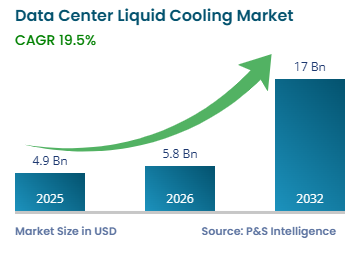
Market Size in 2025
USD 4.9 Billion
Market Size in 2026
USD 5.8 Billion
Market Size by 2032
USD 17.0 Billion
Projected CAGR
19.5%
Largest Region
North America
Fastest-Growing Region
Asia-Pacific
Market Structure
Consolidated
Market Size
Explore the market potential with our data-driven report
Data Center Liquid Cooling Market Future Outlook
The data center liquid cooling market size was USD 4.9 billion for 2025, and it will grow by 19.5% during 2026–2032, to reach USD 17.0 billion by 2032.
Due to the boom in generative AI workloads, rack densities have gone beyond 50kW, at which level the traditional air cooling systems are unable to remove heat effectively. Today’s AI processors draw more than 700 Watts on one chip, which makes liquid cooling necessary to eliminate the risk of hardware failure. Furthermore, the regulatory pressure to lower power usage effectiveness (PUE) is compelling operators to abandon the energy-intensive mechanical chillers.
Energy consumption for cooling can be reduced by 40% through liquid cooling, which offers superior thermal conductivity and thus, sustainable for high-performance computing. As per the International Energy Agency (IEA), Global energy demand attributable to data center electricity consumption (excluding crypto) is estimated to be between 240 and 340 TWh, representing 1–1.3% of final global electricity demand.
Data Center Liquid Cooling Market Trends & Drivers
Switch to Direct-to-Chip Liquid Cooling Is Major Trend
The switch to direct-to-chip liquid cooling is a major trend. Today’s modern AI GPUs consume more than 1,000 Watts of power, and traditional air cooling cannot remove this much heat efficiently. In DTC, a cold metal plate is directly placed on the silicon chip, where a liquid absorbs the heat, offering 1,000 times more effective than air. Using this, the chip does not overheat, and there is no performance throttling during critical workloads.
Additionally, as per the American Society of Heating, Refrigerating and Air-Conditioning Engineers, liquid coolants possess approximately 3,500 times the volumetric heat capacity of air, making direct contact the only viable method for dissipating such extreme heat densities without throttling performance.
Studies suggest that liquid cooling will account for 30% of all new installations globally to support these new densities. This shift is important because the latest hardware has breached the thermal limit of air; technical specifications from AI chip architects and infrastructure partners confirm that next-generation GPUs now run at a thermal design power (TDP) of 1,000 Watts per chip, which air cooling systems physically cannot manage.
This type of cooling is being used by 40 to 50% of all liquid-cooled data centers around the world. Moreover, about 20 to 25% of the AI and hyperscale data centers are currently utilizing direct chip-to-chip cooling, with an additional percentage of operations in pilot or staged deployment of direct chip-to-chip cooling. Approximately 30% of new data centers optimized for AI that were built between 2024 and 2025 included direct chip-to-chip cooling in their basic design. In recent operator surveys, more than 50% of respondents indicated plans to implement direct chip-to-chip cooling in their data centers within the next three years.
Growing Adoption of High-Performance Computing Drives Market
This market is driven by the shift of supercomputing from government labs to commercial companies. Running scientific-level workloads, such as high-frequency trading, drug discovery, and crash simulations in the automotive sector, needs massive computing power, creating a structural, long-term demand for cooling systems to handle supercomputers. In this era of active intelligence, every server must think, not just store.
Studies reveal that the computational power used to train top AI models is now doubling every 5 months, a pace that far outstrips traditional Moore's Law. This explosion is global and corporate-driven; 90% of the notable AI models are now produced by industry rather than academia. This proves that supercomputing has transformed from a niche academic pursuit into a mass-market commercial requirement.
The increasing adoption of direct-to-chip cooling in high-performance computing environments is being seen as an alternative solution to the extreme power density created by most HPC applications, making the use of traditional air cooling impractical. Approximately 30–35% of the global HPC installations currently utilize direct-to-chip liquid cooling technology to address extreme thermal loads. In top-tier supercomputer facilities, nearly 50% of new or upgraded existing systems are now using some form of direct-to-chip solutions, specifically to address clusters with many GPUs.
Surveys have shown that more than 55% of HPC operators anticipate expanding their utilization of direct-to-chip cooling technology in the next 2 to 3 years to support future AI and simulation workloads. Most HPC systems utilizing this technology are located within North America, Europe, and East Asia, which together comprise approximately 70% of all active direct-to-chip–cooled HPC systems.
Data Center Liquid Cooling Market Segmentation and Category Analysis
Component Analysis
Equipment is the largest category, holding a market share of 65%. This is because implementing liquid cooling needs a massive upfront spending on physical hardware, such as coolant distribution units (CDUs), manifolds, and complex copper or aluminum cold plates. Unlike software, which entails a licensing fee, physical infrastructure upgrades account for the vast majority of the initial bill of materials for any data center retrofit. This cost reality is also validated by industry guidelines, which highlight physical cooling loop components as the most expensive, mainly because of the precision engineering required to prevent leaks.
Services are the fastest-growing category, registering a CAGR of 19.8% because the primary driver here is the critical skills gap. Technicians of traditional data centers are trained only to manage airflow, not fluid dynamics; hence, when facilities deploy cooling loops, they do not have the internal capability to install and maintain piping system without risking leakage. Therefore, operators have to rely heavily on specialized third-party service providers for commissioning, leak detection, and preventative maintenance. Recent surveys show that staff training and maintenance issues are cited by over a quarter of the operators as top barriers, directly fueling the demand for outsourced services.
The components analyzed in this report are:
Equipment (Largest Category)
Services (Fastest-Growing Category)
Control & Monitoring Software
Workload Analysis
High-performance computing is the largest category, holding a market share of 35%, because liquid cooling has historically been used for supercomputers deployed in weather modelling and nuclear simulations. These domains have been operating on liquid cooling for decades to manage extreme thermal density, creating a massive installed base that still dwarfs newer applications in terms of total deployed footprint.
AI/ML is the fastest-growing category, registering a CAGR of 20.0%, because the explosion of Generative AI is forcing a thermal reset across the industry. Training LLM model requires GPUs to run continuously for weeks and at 100% capacity, which generates so much heat that air cooling fails. Liquid cooling has become the default installation for new AI facilities to accommodate chips that consume up to 300% more power than previous generations. The worldwide automated machine learning market achieved a revenue of USD 866.3 million in 2023, and it is projected to expand at a CAGR of 52.8% from 2024 to 2030.
Cold-plate/direct-to-chip is the largest category, holding a market share of 50%, because it is compatible with retrofit systems. This allows operator to maintain their rack architecture and can just replace heat sinks with cold plates without disturbing the whole setup. It has become easier and more practical after installing immersion tanks, which is why hyperscalers prefer it when upgrading thousands of servers. Direct liquid cooling is popular because almost 50% of the operators prioritize systems that easily integrate into existing infrastructure over more radical designs.
Immersion cooling is the fastest-growing category, registering a CAGR of 19.7%, because of the need for density optimization. Where power and physical space are limited, immersion cooling allows operators to remove fans and pack servers tightly, achieving rack densities of over 100 kW. This is why it is ideal for greenfield projects that need to maximize the efficiency per square foot. Immersion is being adopted rapidly in new facilities that target densities of 150 kW per rack.
The cooling technologies analyzed in this report are:
Cold-Plate/Direct-to-Chip (Largest Category)
Immersion Cooling (Fastest-Growing Category)
Rear-Door Heat Exchanger
Data Center Type Analysis
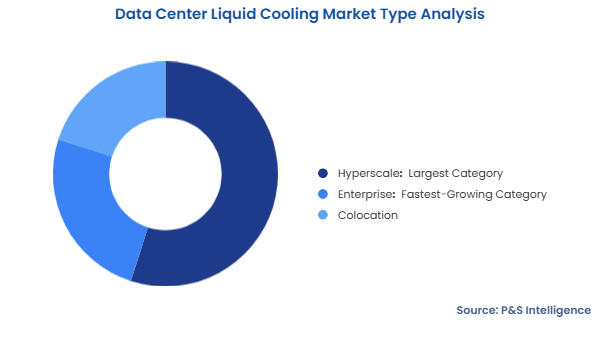
Hyperscale is the largest category, holding a market share of 55%, driven by the increasing server rack power density caused by the large number of GPUs within these systems for both AI, deep learning, cloud computing, and other workloads. Most major Hyperscalers in North America, Europe, and Asia have deployed liquid cooling technologies, specifically DTC and immersion cooling, to support an average power consumption of greater than 40–50 kW per rack. Surveys indicate that approximately 30% of the new hyperscale construction projects incorporate liquid cooling into their base design. Approximately 50% of hyperscale facility construction will include a phased implementation of liquid cooling over the next two to three years.
Colocation is the fastest-growing category, registering a CAGR of 19.6%, because of the booming trend of AI-ready leasing. Many enterprises want to use AI, but do not want to build and have their own liquid-cooled data center, so they rent space. To attract customers with value, colocation providers are rapidly upgrading their facilities with liquid cooling abilities so that they can market themselves as AI-ready providers. The revenue of the data center colocation market was USD 42.1 billion in 2019, and it is anticipated that the market will expand at a compound annual growth rate of 14.8% from 2020 to 2030.
The data center types analyzed in this report are:
Hyperscale (Largest Category)
Enterprise (Fastest-Growing Category)
Colocation
Industry Analysis
IT & telecom is the largest category, because hyperscalers, cloud service providers, and telecommunication giants form the internet’s backbone and run massive server farms. Their sheer operational scale makes them the biggest volume buyers of cooling components. Telecommunications networks and data centers account for roughly half of all energy consumption within the ICT sector as a whole. In 2023, the ICT sector consumed a total of 1,000 TWh of electricity, with data centers and telecommunications networks consuming about 550 TWh of that total. According to European Union statistics from 2022, data centers consumed approximately 45–65 TWh of electricity in Europe, while telecom networks consumed an estimated 25–30 TWh, highlighting the significant energy demand across both segments.
BFSI is the fastest-growing category, because of the growing adoption of high-frequency trading. In finance, microseconds can decide the profit, which is why banks overclock the processors to maximize speed. This generates massive amounts of heat, making liquid cooling essential for trading clusters. Financial institutions are aggressively adopting green AI and efficient cooling to manage the computational intensity of real-time fraud detection and algorithmic trading.
Approximately 10% of the BFSI sector’s IT workload runs globally on the cloud today, because a great number of core systems are running on premises due to regulatory and legacy issues. However, there has been significant growth in cloud adoption for BFSI, and it is expected that cloud adoption will double over the next few years. A survey found that approximately 91% of banks and insurers have created cloud strategies; however, most of these cloud strategies relate to non-core business applications, including analytics and customer service, which represents an estimated 37% of BFSI application workloads currently hosted on cloud platforms. Therefore, in the context of data center liquid cooling, the BFSI sector reflects a major future opportunity.
Large data centers hold the dominant market share, because liquid cooling benefits from economies of scale. The complex infrastructure of pumps, chillers, and coolant loops becomes most cost-effective when shared across thousands of racks. Larger facility operators are significantly more likely to adopt direct liquid cooling compared to smaller sites due to these specialized infrastructure requirements
Small data centers are the fastest growing category, primarily due to Edge deployments, 5G infrastructure, IoT workloads, and local cloud services, requiring thermal management to be efficient. The worldwide edge AI hardware market size was USD 23.8 billion in 2024, and it is projected to attain USD 87.9 billion by 2032, experiencing a CAGR of 17.9% from 2025 to 2032.
As the power density of edge data centers continues to increase, the limited space renders the traditional air cooling useless. Liquid cooling enables small data centers to run denser hardware, increase energy efficiency, and maintain high levels of performance despite their compact footprint. Additionally, as the usage of AI, analytics, and other real-time applications continues to grow, liquid cooling allows small data centers to provide enterprise-level reliability and sustainability.
The facility sizes analyzed in this report are:
Large (Largest Category)
Small (Fastest-Growing Category)
Mid-Sized
Drive strategic growth with comprehensive market analysis
Data Center Liquid Cooling Market Geographical Analysis
North America Data Center Liquid Cooling Market Analysis
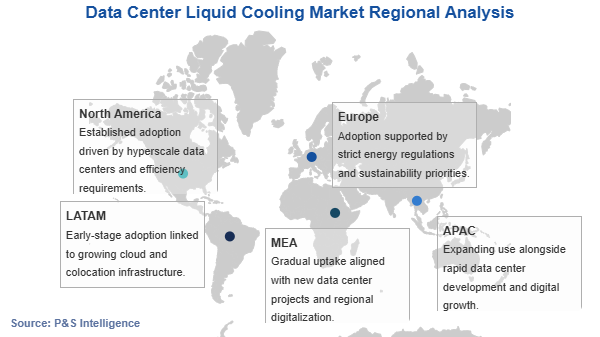
North America is the largest regional market, capturing a share of 40%, because it remains the global epicenter of hyperscale innovation. Most of the world’s data centers are located in this region, specially Northern Virginia, where the big three cloud providers are retrofitting massive facilities aggressively to support Generative AI workloads.
U.S. Data Center Liquid Cooling Market Growth
The U.S. has the larger share in North America, as its power crisis is forcing it to adopt liquid cooling. The electrical grid in major Northern Virginia and Silicon Valley has reached its maximum capacity, which means operators cannot draw additional power easily and have to maximize the efficiency of the existing interconnects. Liquid cooling allows data centers to run high-density AI racks (100 kW+) within the same power envelope that previously supported low-density air racks.
This structural shift is reinforced by federal efficiency analyses reporting that U.S. data centers now consume roughly 4.4% of the national electricity, a figure projected to nearly double by 2028. To ease this load, federal best practice guidelines explicitly categorize traditional air cooling as insufficient for HPc, mandating a pivot toward liquid solutions to prevent regional grid instability.
Asia-Pacific Data Center Liquid Cooling Market Analysis
Asia-Pacific is the fastest-growing regional market, because the region is benefiting from a greenfield advantage. Unlike the West, which must renovate old buildings, developing economies in APAC are building massive new data centers from scratch, allowing them to design facilities specifically for liquid immersion tanks from day one.
China Data Center Liquid Cooling Market Growth
The market is driven by the government’s strictly enforced East-Data, West-Computing strategy, which mandates moving heavy compute infrastructure from the humid eastern coast to the cooler, energy-rich western provinces. To enforce efficiency, regulators have set aggressive green mandates, which air cooling cannot meet. Since traditional air cooling typically stagnates at a PUE of 1.4, this federal cap effectively creates a legal ban on air cooling for new AI clusters, forcing 100% adoption of liquid solutions.
As per the latest regulations, all newly constructed and expanded data centers should have a PUE of 1.3 for a project with an annual power usage of less than 50 Million kWh; less than 1.25 for projects with annual power usage between 50 Million kWh and 100 Million kWh; less than 1.2 for projects with annual power usage between 100 Million and 150 Million kWh; and less than 1.15 for all other projects with an annual power usage greater than 150 Million kWh.
India Data Center Liquid Cooling Market Growth
India is becoming a critical market due to its tropical nature, where ambient temperatures frequently exceed 45°C, making air-cooled servers energy-intensive. Consequently, India is moving directly to liquid cooling not just for performance, but for basic operational survival too. Government reports indicate that India’s installed data center capacity is on track to doubling within three years. To support this growth without collapsing the power grid, new greenfield projects are aggressively adopting liquid cooling, as it reduces cooling energy overhead by 30–40%. Additionally, data center IT power capacity in India was reported at 942 MW in mid‑2024, representing an increase of approximately 21% year-over-year.
The regions and countries analyzed in this report are:
North America (Largest Regional Market)
U.S. (Largest and Fastest-Growing Country)
Canada
Europe
Germany (Largest Country)
U.K. (Fastest-Growing Country)
France
Italy
Spain
Rest of Europe
Asia-Pacific (Fastest-Growing Regional Market)
China (Largest Country)
India (Fastest-Growing Country)
Japan
South Korea
Australia
Rest of APAC
Latin America
Brazil (Largest Country)
Mexico (Fastest-Growing Country)
Rest of LATAM
Middle East and Africa
Saudi Arabia (Largest Country)
U.A.E. (Fastest-Growing Country)
South Africa
Rest of MEA
Data Center Liquid Cooling Market Competitive Landscape
The data center liquid cooling market is consolidated because of a strong barrier of liability. Liquid cooling components, such as vacuum-sealed cold plates and dripless disconnects, demand high engineering precision. Even a small fluid leak can cause catastrophic failure in high-value AI server racks, which can lead to damage worth millions of dollars. That is why data center operators prefer only established Tier 1 vendors, which provide comprehensive insurance indemnification and global service guarantees. In this scenario, it becomes very difficult for startups to displace incumbents, especially in critical deployments where operational reliability cannot be compromised.
Top Data Center Liquid Cooling Producers:
Schneider Electric
Vertiv Holdings Co.
nVent Electric plc
CoolIT Systems
Asetek A/S
Green Revolution Cooling (GRC)
Iceotope Technologies
Submer
Asperitas
LiquidStack
Midas Green Technologies
Fujitsu Limited
Rittal GmbH & Co. KG
Alfa Laval
Wiwynn Corporation
Data Center Liquid Cooling Market News & Updates
In January 2026, Nvidia Corporation launched its next-generation Vera Rubin supercomputing platform, designed to operate with hot-water cooling at 45°C (113°F), at CES 2026.
In December 2025, Microsoft Corporation confirmed that all future Maia AI accelerator deployments will utilize a liquid-default architecture, effectively ending the era of air-cooled hyperscale training clusters.
In November 2025, nVent Electric plc launched new modular CDUs, specifically designed to support next-generation AI chips, at the SC25 Supercomputing Conference. The release aligns with the industry's shift toward flexible infrastructure that can scale up alongside growing AI model parameters.
In October 2025, Wiwynn launched fully integrated Rack-Level liquid cooling solutions designed specifically for the NVIDIA GB200 NVL72 platform, at the OCP Summit. These new turnkey racks come pre-plumbed and pressure-tested from the factory, removing the complexity barrier for hyperscalers and allowing them to deploy liquid-cooled rows as easily as standard server cabinets.
In September 2025, Schneider Electric introduced the EcoStruxure Pod, a prefabricated modular data center solution that integrates Motivair’s liquid cooling technology directly into the rack design.
In June 2025, Equinix announced an expansion of its liquid-ready colocation services across Singapore, Melbourne, and Tokyo, coinciding with a USD 240-million investment in high-density capacity.
Frequently Asked Questions About This Report
What is the Data Centre Liquid Cooling market size in 2025?+
In 2025, the market size was valued at USD 4.9 Billion, and it is projected to grow at a CAGR of 19.5% through 2032.
What is the primary driver for the adoption of Liquid Cooling?+
The main driver is the need to manage escalating rack densities caused by Generative AI training, where chip thermal output exceeds the physical limits of air cooling (often above 50kW per rack).
Which cooling technology segment dominates the market?+
Direct-to-Chip (DTC) is the largest category with a market share of 50%, primarily because it offers better compatibility with existing "Brownfield" data center infrastructure than immersion tanks.
Which region is the largest market for Data Centre Liquid Cooling?+
North America holds the largest market share, driven by the high concentration of hyperscale data centers and early adoption of high-performance AI computing.
Is the Liquid Cooling market fragmented or consolidated?+
The market is consolidated, dominated by a few major industrial players due to the high "Barrier of Liability" and the aerospace-grade engineering required to prevent catastrophic leaks.
Want a report tailored exactly to your business need?
Leading companies across industries trust us to deliver data-driven insights and innovative solutions for their most critical decisions. From data-driven strategies to actionable insights, we empower the decision-makers who shape industries and define the future. From Fortune 500 companies to innovative startups, we are proud to partner with organisations that drive progress in their industries.
Client Testimonials
Working with P&S Intelligence and their team was an absolute pleasure – their awareness of timelines and commitment to value greatly contributed to our project's success. Eagerly anticipating future collaborations.
McKinsey & Company
India
Unmatched Standards
Our insights into the minutest levels of the markets, including the latest trends and competitive landscape, give you all the answers you need to take your business to new heights
Complete Data Security
We take a cautious approach to protecting your personal and confidential information. Trust is the strongest bond that connects us and our clients, and trust we build by complying with all international and domestic data protection and privacy laws