Data Center Chiller Market Size & Share Analysis - Trends, Drivers, Competitive Landscape, and Forecasts (2025 - 2032)
This Report Provides In-Depth Analysis of the Data Center Chiller Market Report Prepared by P&S Intelligence, Segmented by Condenser Type (Air-Cooled, Water-Cooled), Product Type (Centrifugal Chillers, Screw Chillers, Scroll Chillers), Cooling Capacity (Below 150 RT, 150-700 RT, 700-3,000 RT, Above 3,000 RT), Data Center Type (Hyperscale, Colocation, Enterprise, Edge), End User (Cloud Service Providers, IT & Telecom, BFSI, Government, Healthcare), and Geographical Outlook for the Period of 2021 to 2032
Explore the market potential with our data-driven report
Data Center Chiller Market Overview
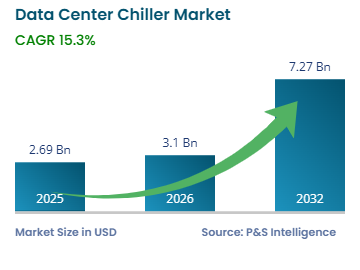
The global data center chiller market reached USD 2.69 billion in 2025, an estimated USD 3.10 billion in 2026, and is projected to climb to USD 7.27 billion by 2032, a 15.3% CAGR over 2026-2032. Hyperscale and colocation operators are ordering larger chiller plants to keep pace with the heat loads that AI training clusters generate, and each new hall built for high-density racks typically needs its own dedicated cooling capacity. For equipment suppliers, that shift turns facility engineering teams into buyers of repeat, higher-tonnage orders instead of one-off replacement units.
Demand follows the buildout of AI-optimized data halls, where each new rack pulls far more power, and therefore rejects far more heat, than a conventional server row. The International Energy Agency projects global data center electricity consumption will exceed 1,000 terawatt-hours in 2026, roughly double the 2022 level, with cooling among the largest single loads inside every facility. That scale pushes operators toward higher-tonnage, higher-efficiency chiller plants instead of adding more small units, favoring suppliers that can deliver capacity at hyperscale volumes.
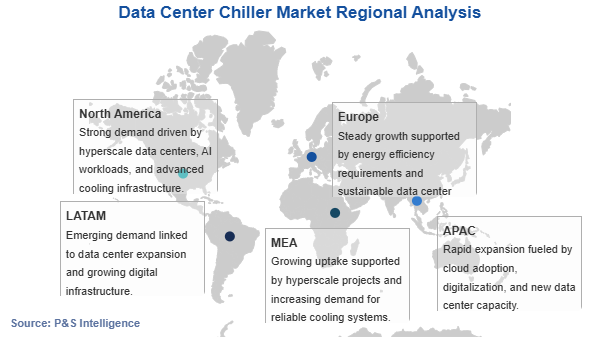
North America accounted for 39.0% of 2025 revenue, led by hyperscale campuses across the U.S. that are already replacing early chiller plants with higher-density units as AI workloads expand. Asia-Pacific is the fastest-growing region, with data center chiller revenue set to climb at a 17.9% CAGR over 2026-2032, as China, Japan, and India commission new hyperscale and colocation capacity instead of retrofitting older sites. That contrast leaves North American suppliers competing chiefly on replacement cycles, while vendors entering Asia-Pacific compete for new-build specification instead.
Key market insights
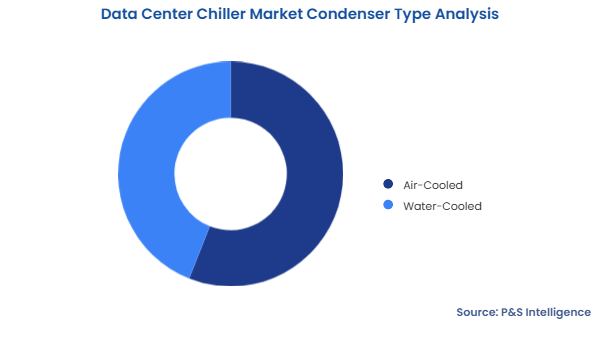
By condenser type, air-cooled chillers held 56.0% of 2025 revenue, while the segment is also projected to grow fastest, at a 16.6% CAGR during 2026-2032.
By product type, centrifugal chillers accounted for 47.0% of 2025 revenue, while the segment is also projected to remain the fastest-growing category, at a 16.9% CAGR during 2026-2032.
By cooling capacity, the 700-3,000 RT band held 43.0% of 2025 revenue, while chillers above 3,000 RT are projected to grow fastest, at a 17.8% CAGR during 2026-2032.
By data center type, hyperscale facilities accounted for 51.0% of 2025 revenue, while the segment is also projected to keep growing fastest, at a 16.7% CAGR during 2026-2032.
By end user, cloud service providers held 44.0% of 2025 revenue, while the segment is also projected to grow fastest among end users, at a 16.6% CAGR during 2026-2032.
By geography, North America accounted for 39.0% of 2025 revenue, while Asia-Pacific is projected to grow fastest, at a 17.9% CAGR during 2026-2032.
Data Center Chiller Market Trends and Growth Drivers
Rising AI rack heat loads are driving demand for higher-capacity chiller plants
Data halls built for AI training and inference now pack far more compute per rack than a conventional cloud server room, and each added kilowatt of IT load raises the heat a facility's cooling plant must reject. Operators responding to that shift are specifying chillers in the 700 ton-plus range instead of the smaller, modular units that served general-purpose colocation halls, pulling purchase decisions toward fewer, larger-capacity units per site over many small ones.
ASHRAE's technical committee for data center thermal guidelines added new supply-temperature classes for technology cooling systems in its most recent guidance update, giving operators higher-density design targets that push chilled-water plants to run at greater capacity per unit. Chiller manufacturers that already build magnetic-bearing and centrifugal units at the top of the new capacity bands can qualify for hyperscale specification sooner, while suppliers still selling smaller packaged units risk being designed out of new AI-focused builds.
Low-GWP refrigerant transitions are creating a chiller upgrade opportunity
Regulatory phase-downs of high-global-warming-potential refrigerants are forcing operators to requalify existing chiller fleets, turning a compliance deadline into a purchasing decision. Facilities still running chillers charged with older HFC refrigerants face rising replacement costs and limited refrigerant supply as production caps tighten, making a planned upgrade cheaper over time than servicing an aging unit. Many operators evaluating a refrigerant swap now choose to replace the whole chiller instead of retrofitting it, since a like-for-like conversion rarely matches the efficiency of a unit engineered around the replacement gas from the start.
The US Environmental Protection Agency's Technology Transitions rule under the AIM Act sets a 700 global-warming-potential limit for new comfort-cooling chillers beginning in 2026, effectively barring new installations of higher-GWP equipment. That deadline gives chiller vendors with qualified low-GWP product lines, including units built around HFOs, a defined opening to win replacement orders from operators that would otherwise have kept older equipment running past its typical service life.
Hybrid liquid-air cooling architectures are redefining chiller plant design
Direct-to-chip and rear-door liquid cooling are moving from pilot deployments to standard specification inside new AI data halls, and that shift changes what a chiller plant is built to do. Instead of conditioning room air directly, the chiller increasingly serves as the primary heat-rejection loop for coolant distribution units that circulate liquid straight to the processor, making the chiller plant a shared utility for both air-cooled and liquid-cooled racks in the same hall.
Because the chiller now serves as the thermal backbone for both the room and the coolant loop instead of air handling alone, its design tonnage rises accordingly. Facility teams sizing a new hall increasingly write coolant distribution unit compatibility into the chiller specification itself, turning a single procurement decision into the anchor for both cooling loops. Vendors that already sell chillers pre-integrated with coolant distribution units are positioned to capture a larger share of each new AI hall's cooling budget, while suppliers offering the chiller in isolation compete for a shrinking piece of the same project.
Grid interconnection delays are constraining new data center chiller orders
New hyperscale and colocation campuses cannot commission cooling equipment until utility interconnection is secured, and that approval step has become the longest item on many project timelines. A chiller order tied to a specific site typically ships only once construction financing and a firm energization date are in place, so any slippage in grid access pushes the equipment purchase back with it.
Lawrence Berkeley National Laboratory's annual review of US interconnection queues found that projects reaching commercial operation in 2024 spent an average of 55 months waiting for grid access, with some Northern Virginia sites waiting roughly seven years. Delays of that length can separate a chiller order from the facility's original planning schedule by several years, and suppliers that rely on a steady cadence of new-build orders are more exposed to this timing risk than those with a larger base of replacement business.
Data Center Chiller Market Segmentation Analysis
Condenser Type
Air-cooled chillers held 56.0% of 2025 revenue, the largest share among condenser types. Air-cooled units need no cooling tower, make-up water treatment, or water piping, which shortens installation time on new hyperscale campuses and removes a recurring water-procurement cost from the facility's operating budget. That simplicity matters most in regions where water rights are contested or a site sits far from a municipal water main, conditions increasingly common as new campuses move to secondary and tertiary markets.
Air-cooled chillers are also projected to grow fastest among condenser types, at a 16.6% CAGR during 2026-2032. Water-scarce regions and drought-prone states are tightening permits for new water withdrawal, pushing operators to specify air-cooled or adiabatic units even where a water-cooled plant would otherwise cost less to run. Vendors building air-cooled units in the largest tonnage bands stand to capture a growing share of hyperscale orders that previously defaulted to water-cooled plants.
Product Type
Centrifugal chillers accounted for 47.0% of 2025 revenue, more than either screw or scroll units. Centrifugal compressors deliver the highest tonnage per unit footprint of the three technologies, letting a single machine cover the cooling load that would otherwise need several screw or scroll chillers wired together. That footprint advantage matters directly to campus operators trying to fit more IT capacity onto a fixed data hall floor plate.
Centrifugal chillers are also projected to add revenue fastest, at a 16.9% CAGR during 2026-2032. Magnetic-bearing and variable-speed centrifugal compressors now hold efficiency advantages at partial load that older fixed-speed designs cannot match, and operators replacing aging plants are specifying these newer centrifugal units instead of like-for-like swaps. That upgrade path gives centrifugal-focused manufacturers a growing base of replacement orders on top of new-build demand.
Cooling Capacity
Chillers in the 700-3,000 refrigeration ton band held 43.0% of 2025 revenue, the largest of the four capacity classes tracked in this report. That range matches the typical single-unit output that hyperscale and large colocation operators specify for a central plant serving one data hall, balancing equipment redundancy against the cost of running fewer, larger machines. Standardizing on this band also lets operators build N+1 redundancy into a plant without adding an impractical number of separate units, a design choice that keeps this capacity class dominant across most new campus builds.
Units above 3,000 RT are projected to grow fastest, at a 17.8% CAGR during 2026-2032. The largest AI training clusters now draw tens of megawatts inside a single building, and meeting that load with fewer, higher-tonnage chillers cuts the piping, controls, and floor space a smaller-unit array would need. Manufacturers that already build in this top band are best placed to win orders as more campuses scale past the 3,000 RT threshold.
Data Center Type
Hyperscale facilities accounted for 51.0% of 2025 revenue, more than colocation, enterprise, and edge sites combined. Hyperscale operators build campuses with dozens of chillers per site and repeat that order across every new region they enter, giving this buyer class the largest aggregate equipment spend of any facility type. Hyperscale facilities also standardize equipment specifications across their global portfolios, so a chiller qualified for one campus can often be ordered again for the next site with little additional engineering review.
Hyperscale demand is also projected to grow fastest, at a 16.7% CAGR during 2026-2032. Capital budgets tied to AI training capacity are expanding faster inside hyperscale operators than at colocation or enterprise facilities, and each new campus typically orders chiller capacity in bulk ahead of a defined energization date. That bulk, scheduled buying pattern gives suppliers with hyperscale relationships more predictable order volume than those selling into single-site enterprise projects.
End User
Cloud service providers held 44.0% of 2025 revenue, the largest end-user category. Cloud providers operate most of the hyperscale and large colocation capacity that houses chiller plants at scale, and their in-house facilities teams typically negotiate multi-unit, multi-site equipment contracts that individual enterprise or government buyers rarely match in volume.
Cloud service providers are also projected to grow fastest among end users, at a 16.6% CAGR during 2026-2032. Cloud providers are adding AI training and inference capacity faster than enterprise IT departments or telecom operators are expanding their own owned facilities, and each new region a provider enters brings another round of chiller orders. Suppliers already qualified with a major cloud provider's engineering standards can carry that qualification into each new site the provider builds.
The following segments are analysed in this report.
Condenser Type
Air-Cooled
Water-Cooled
Product Type
Centrifugal Chillers
Screw Chillers
Scroll Chillers
Cooling Capacity
Below 150 RT
150-700 RT
700-3,000 RT
Above 3,000 RT
Data Center Type
Hyperscale
Colocation
Enterprise
Edge
End User
Cloud Service Providers
IT & Telecom
BFSI
Government
Healthcare
Drive strategic growth with comprehensive market analysis
Data Center Chiller Market Geographical Analysis
North America Data Center Chiller Market outlook
North America held 39.0% of Data Center Chiller Market revenue in 2025, the largest regional share this report tracks. Hyperscale operators and cloud providers across the region run the largest concentration of AI training campuses worldwide, and each new campus typically orders chiller capacity well ahead of its energization date, giving North American suppliers a steady base of large, scheduled equipment purchases. Established relationships between facility engineering teams and chiller manufacturers also shorten the path from a site's design phase to a signed equipment order, an advantage newer markets have not yet built.
The U.S. hosts the bulk of this installed base as the region's largest market, while Canada's hyperscale campuses in Ontario and Quebec add a smaller, growing share tied to the country's cooler climate and available hydroelectric power. The US Energy Information Administration projects total US electricity sales will reach 4,135 billion kilowatt-hours in 2026, up almost 2% over 2025, with data center development named as a primary growth driver. Each incremental megawatt of new data center load brings a matching chiller order, keeping North America's equipment pipeline tied to the pace of new capacity coming online.
Purchasing in the region has moved past first-time installations, with operators now replacing early chiller plants with higher-tonnage, lower-refrigerant-GWP units at existing campuses. That replacement pattern should hold North America's share steady even though newer markets are growing faster. Vendors with strong service networks already on site are best placed to win this replacement cycle.
Asia-Pacific Data Center Chiller Market growth
Asia-Pacific is projected to expand faster than every other region tracked in this report, at a 17.9% CAGR during 2026-2032. Governments across China, India, Japan, and South Korea are backing large-scale computing infrastructure programs that route new data center capacity toward provinces and states with available land, power, and, increasingly, water for cooling. Cloud providers and colocation operators in the region are building new campuses instead of retrofitting older facilities, so most new chiller orders in Asia-Pacific come from first-time installations instead of replacement of aging plants.
China, the region's fastest-growing market, is directing new computing capacity toward its western provinces under a national program that pairs new data halls with dedicated on-site cooling infrastructure. China's National Development and Reform Commission reports that the country's eight designated national computing hubs had attracted direct investment exceeding CNY 43.5 billion and supported 1.95 million standard equipment racks by the end of 2024. Each rack added under that program represents incremental chilled-water cooling load, giving regional chiller manufacturers a steady, publicly tracked run of new deployment sites to bid into.
That pipeline should keep expanding as India, Japan, and South Korea advance their own national digital infrastructure plans alongside China's build-out, putting Asia-Pacific years ahead of other regions on committed project volume. Falling equipment costs are also bringing more mid-size operators in Malaysia, Thailand, and Indonesia within reach of a dedicated chilled-water plant, broadening the region's buyer base beyond its largest hyperscale campuses. Manufacturers that build production and service capability inside the region hold an edge over suppliers exporting equipment from outside it.
Europe holds a steady, mid-sized slice of global revenue behind North America and Asia-Pacific, and that share is growing as more operators commission new colocation and hyperscale campuses. Regulators across the region have folded data center energy performance into broader efficiency rules, pushing operators to specify high-efficiency, variable-speed chillers over fixed-capacity units nearing the end of their service life. Water-cooled and hybrid designs also see wider use in Northern Europe, where operators can route waste heat from the chiller loop into district heating networks rather than rejecting it to atmosphere.
The European Commission's Joint Research Centre reports that more than 500 data centers have joined its voluntary Code of Conduct on Data Centre Energy Efficiency since the program's 2008 launch, committing participants to best-practice cooling and power-management standards. Equipment that meets those benchmarks has an easier path into new European tenders than chillers built only to a facility's minimum local code. Germany's automotive and industrial base continues to anchor regional demand, with the United Kingdom and France following as their own colocation markets mature.
Latin America accounts for a modest but rising share of global revenue, concentrated in Brazil's hyperscale and AI campus buildout. Grid capacity in parts of the region remains limited, so new campuses are increasingly sited near dedicated power connections, and each of those large, single-site projects typically brings a correspondingly large chiller order rather than a series of smaller ones.
Brazil's Ministry of Mines and Energy authorized a 5-gigawatt grid connection for the Scala AI City campus in May 2025, one of the largest single data center power allocations approved in the country to date. A project of that scale needs chilled-water cooling capacity sized to match its full power draw, giving regional suppliers a defined, large-volume order tied to the connection's build-out schedule. Mexico's export-manufacturing corridor near the US border represents a smaller, second pocket of demand, as assembly plants there pursue similar automation and colocation projects.
The Middle East and Africa hold a smaller slice of global revenue, anchored by sovereign-backed AI and cloud campuses across the Gulf states. Extreme ambient temperatures across the region push operators toward hybrid and water-cooled plants that can maintain chilled-water output through summer peaks that would strain air-cooled equipment alone, keeping average chiller tonnage per site higher than in temperate markets.
Saudi Arabia's Communications, Space and Technology Commission brought its Data Center Services Regulations into force in January 2024, setting service-quality and investment standards for providers as part of a wider push to establish the country as a regional data center hub. Chiller vendors that can meet those qualification standards gain a more direct path into new Saudi campuses than suppliers entering the market for the first time. The United Arab Emirates' Dubai and Abu Dhabi campuses add a second concentration of demand, while South Africa's smaller data center sector is a longer-term source of growth for the region.
The following geographies are analyzed in this report:
North America
U.S.
Canada
Asia-Pacific
China
Japan
India
South Korea
Malaysia
Thailand
Indonesia
Rest of APAC
Europe
Germany
U.K.
France
Italy
Spain
Rest of Europe
Latin America
Brazil
Mexico
Rest of Latin America
Middle East & Africa
Saudi Arabia
U.A.E.
South Africa
Rest of Middle East & Africa
Data Center Chiller Market Share Analysis
The global data center chiller market is moderately fragmented, with more than a dozen manufacturers holding meaningful positions and no single supplier controlling the majority of orders. Building large-tonnage chillers to hyperscale specification requires deep engineering and testing capability, which keeps new entrants out, but that barrier is offset by a customer base spread across many independent hyperscale, colocation, and enterprise buyers, each running its own qualification process. That structure has stayed stable as new capacity keeps arriving across enough sites to support multiple qualified suppliers instead of concentrating around one or two.
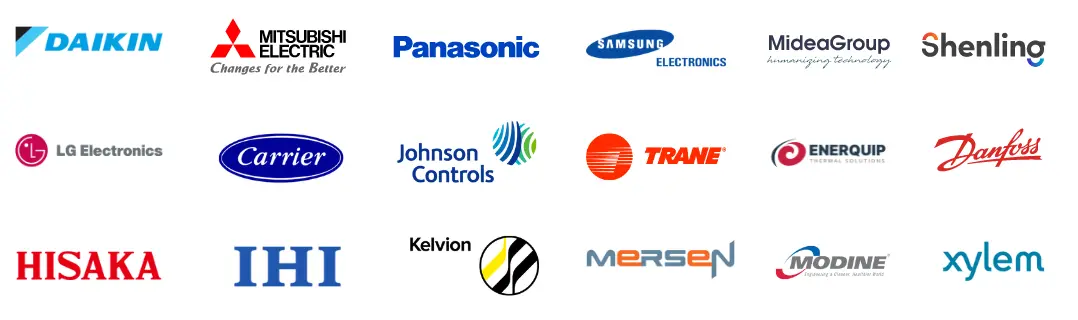
Diversified HVAC manufacturers, including Johnson Controls International, Trane Technologies, Carrier Global, Daikin Industries, Mitsubishi Electric, and Schneider Electric, compete on the breadth of their commercial HVAC portfolios and the ability to bundle chillers with building controls, service contracts, and global logistics that a hyperscale operator can standardize across many sites worldwide, from initial specification through multi-year service agreements.
Specialists focused on precision and data center cooling, including Vertiv Holdings, Stulz, Rittal, and Airedale International, compete instead on faster customization, purpose-built controls for chilled-water plant integration, and closer working relationships with facility design teams during a campus's earliest planning stages. Buyers increasingly draw from both groups on the same project, pairing a diversified vendor's global service network with a specialist's site-specific engineering.
Refrigerant-transition rules are becoming a growing point of competitive differentiation, since manufacturers that already qualify chillers on low-global-warming-potential refrigerants can bid into replacement projects that older product lines cannot meet. That qualification requirement is adding a technical barrier on top of the capital and testing barriers that already limit new entrants, without changing the market's broader multi-supplier structure.
Top Companies in Data Center Chiller Market:
Vertiv Holdings Co.
Johnson Controls International plc
Trane Technologies plc
Carrier Global Corporation
Daikin Industries Ltd.
Mitsubishi Electric Corporation
Schneider Electric SE
Stulz GmbH
Rittal GmbH & Co. KG
Airedale International Air Conditioning Limited
Smardt Chiller Group Inc.
Mitsubishi Electric Hydronics & IT Cooling Systems S.p.A.
LG Electronics Inc.
Data Center Chiller Market Developments
In July 2026, Vertiv Holdings Co. expanded chiller manufacturing capacity at its Tognana campus near Padua, Italy, targeting double regional chiller output by the end of 2026, ahead of a new large-scale chiller testing laboratory due in early 2027. The expansion lets Vertiv qualify larger chiller units for AI-scale campuses without relying on test capacity outside Europe.
In July 2026, Trane Technologies plc launched the HSWE magnetic bearing centrifugal chiller for Asia-Pacific data centers, rated above 1,500 refrigeration tons with a full-load COP up to 7.3 and a leaving chilled water temperature up to 35 degrees Celsius. The launch gives Trane a high-tonnage option built specifically for the region's largest hyperscale campus orders.
In June 2026, Schneider Electric SE introduced the Uniflair XCA chiller line, spanning 1,200 to 2,500 kW across six models with an Energy Efficiency Ratio of 4.66 and low-global-warming-potential refrigerants. The line positions Schneider Electric to bid into replacement projects that stricter refrigerant rules close to older product lines.
In April 2026, Johnson Controls International plc launched the YDAM magnetic bearing chiller, delivering 3.5 MW of cooling capacity at 20% higher capacity density than prior alternatives, with shipments to customers set for late 2026. The launch gives Johnson Controls a denser option for operators retrofitting existing chiller plant space.
In January 2026, Daikin Industries Ltd., through its Daikin Applied unit, opened a 200,000-square-foot modular manufacturing facility in Phoenix, Arizona dedicated to large-tonnage data center cooling systems. The facility triples Daikin Applied's modular manufacturing space, shortening lead times on the large-tonnage chiller plants hyperscale campuses order in bulk.
Frequently Asked Questions About This Report
What is driving the demand for larger chiller capacity in data centers?+
Demand follows the buildout of AI-optimized data halls, where each new rack pulls far more power, and therefore rejects far more heat, than a conventional server row.
How much is global data center cooling expected to grow?+
The International Energy Agency projects global data center electricity consumption will exceed 1,000 terawatt-hours in 2026, roughly double the 2022 level, with cooling among the largest single loads inside every facility.
Why are air-cooled chillers becoming preferred in new data center builds?+
Air-cooled units need no cooling tower, make-up water treatment, or water piping, which shortens installation time on new hyperscale campuses and removes a recurring water-procurement cost from the facility's operating budget.
What advantages do centrifugal compressors offer in chiller systems?+
Centrifugal compressors deliver the highest tonnage per unit footprint of the three technologies, letting a single machine cover the cooling load that would otherwise need several screw or scroll chillers wired together.
Which chiller capacity range is most common in the market?+
Chillers in the 700-3,000 refrigeration ton band held 43.0% of 2025 revenue, the largest of the four capacity classes tracked in this report.
How are refrigerant regulations creating new market opportunities?+
Regulatory phase-downs of high-global-warming-potential refrigerants are forcing operators to requalify existing chiller fleets, turning a compliance deadline into a purchasing decision.
Which data center facility type drives the most chiller equipment spending?+
Hyperscale operators build campuses with dozens of chillers per site and repeat that order across every new region they enter, giving this buyer class the largest aggregate equipment spend of any facility type.
What external factors can delay chiller equipment orders?+
New hyperscale and colocation campuses cannot commission cooling equipment until utility interconnection is secured, and that approval step has become the longest item on many project timelines.
Want a report tailored exactly to your business need?
Leading companies across industries trust us to deliver data-driven insights and innovative solutions for their most critical decisions. From data-driven strategies to actionable insights, we empower the decision-makers who shape industries and define the future. From Fortune 500 companies to innovative startups, we are proud to partner with organisations that drive progress in their industries.
Client Testimonials
Working with P&S Intelligence and their team was an absolute pleasure – their awareness of timelines and commitment to value greatly contributed to our project's success. Eagerly anticipating future collaborations.
McKinsey & Company
India
Unmatched Standards
Our insights into the minutest levels of the markets, including the latest trends and competitive landscape, give you all the answers you need to take your business to new heights
Complete Data Security
We take a cautious approach to protecting your personal and confidential information. Trust is the strongest bond that connects us and our clients, and trust we build by complying with all international and domestic data protection and privacy laws