Data Center Accelerator Market Size & Opportunities Analysis - Growth Strategies, Competitiveness, and Forecasts (2025 - 2032)
This Report Provides In-Depth Analysis of the Data Center Accelerator Market Report Prepared by P&S Intelligence, Segmented by Data Center Type (High-Performance Computing, Cloud), Processor (GPU, CPU, FPGA), Application (Deep Learning Training, Public Cloud Interface, Enterprise Interface), and Geographical Outlook for the Period of 2019 to 2032
Explore the market potential with our data-driven report
Data Center Accelerator Market Outlook
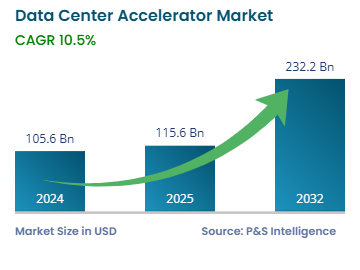
The global data center accelerator market generated an estimated revenue of USD 105.6 billion in 2024, which is expected to witness a CAGR of 10.5% during 2025–2032, to reach USD 232.2 billion by 2032.
This growth can be ascribed to the increasing demand for high-performance computing in data centers, driven by the rise in data generation and the adoption of cloud computing, artificial intelligence, and machine learning applications. Data center accelerators, such as graphics processing units (GPUs) and field-programmable gate arrays (FPGAs), are becoming essential in optimizing workloads and enhancing processing speeds, enabling data centers to handle vast amounts of data more efficiently.
Global data generation is surging, with approximately 181 zettabytes projected annually by 2025—equivalent to about 2.5 quintillion bytes per day. This explosive growth is driving increasing demand for data center accelerators such as GPUs, FPGAs, and ASICs, which enable real-time AI processing, analytics, and high-performance workloads at massive scale.
Additionally, the growing adoption of AI and big data analytics is fueling the demand for more powerful, energy-efficient computing solutions, which data center accelerators provide. With advancements in accelerator technologies and the ongoing digital transformation across industries, the global data center accelerator market is positioned for significant expansion in the coming years.
Data Center Accelerator Market Emerging Trends
Growing Demand for Cloud-Based Services Is Key Driver
A key driver of the global data center accelerator market is the growing demand for cloud-based services.
Studies predict that compared to USD 882.5 billion in 2024, companies, government agencies, and individuals across the world will spend USD 2,273.8 billion on cloud computing services by 2030.
Over 90% of enterprises globally have adopted cloud services, with 94% of large organizations running workloads on cloud platforms.
Around 60% of corporate data is now stored in the cloud—double the share in 2015.
Additionally, 89% of companies use a multi-cloud strategy, while 80% rely on hybrid cloud models.
The average enterprise operates more than 30 cloud services, with employees using dozens of cloud-based tools daily.
As businesses across various industries continue to embrace digital transformation, the need for scalable, efficient, and high-performance computing has surged.
Cloud service providers are under increasing pressure to manage and process vast amounts of data quickly and efficiently, driving the need for advanced data center technologies, including accelerators.
The rapid growth of cloud computing, particularly in areas like Software-as-a-Service (SaaS), Infrastructure-as-a-Service (IaaS), and Platform-as-a-Service (PaaS), has intensified the need for high-performance hardware that can meet the demands of modern cloud-based applications.
Data center accelerators enable cloud providers to support a wide range of services, including AI and machine learning, big data analytics, and real-time processing, by improving throughput and reducing latency.
Emergence of FPGA-Based Accelerators Is a Key Opportunity
The emergence of FPGA-based accelerators presents a significant market opportunity for the global data center accelerator market.
Field-Programmable Gate Arrays (FPGAs) offer distinct advantages over traditional processors, such as flexibility, parallel processing capabilities, and low-latency performance, making them ideal for high-performance computing tasks in data centers.
These accelerators can be customized to meet specific workloads, offering tailored solutions for industries like finance, healthcare, telecommunications, and cloud computing.
Their ability to handle complex, compute-intensive applications, such as real-time analytics, machine learning, and artificial intelligence, has made them increasingly popular in modern data centers.
FPGAs provide a cost-effective alternative to other accelerators like GPUs, especially for applications that require high-speed data processing but not the full power of GPUs.
Shortage of AI Hardware Experts Poses Challenges
A significant challenge facing the global data center accelerator market is the shortage of AI hardware experts.
As data centers increasingly adopt advanced technologies like artificial intelligence (AI), machine learning, and deep learning, the demand for specialized hardware accelerators, such as GPUs and FPGAs, has increased.
However, there is a limited pool of skilled professionals with expertise in AI hardware development, optimization, and integration.
The U.S. faces a shortage of over 80,000 computer hardware engineers, according to the U.S. Bureau of Labor Statistics.
India reports a lack of 100,000+ skilled hardware professionals, as per NASSCOM.
China, despite aggressive tech investments, faces a skills gap exceeding 200,000, especially in semiconductors and embedded systems, reports China's Ministry of Education.
This skills gap poses a major obstacle for organizations seeking to fully leverage the capabilities of data center accelerators.
AI hardware experts are essential for designing and implementing efficient accelerator solutions that can handle complex workloads.
The shortage of these specialists can lead to delays in deploying cutting-edge technologies, higher labor costs, and potential inefficiencies in accelerator utilization.
Additionally, organizations may face challenges in optimizing AI models for hardware accelerators, which is crucial for achieving maximum performance and energy efficiency.
Data Center Accelerator Market Segmentation Analysis
Data Center Type Insights
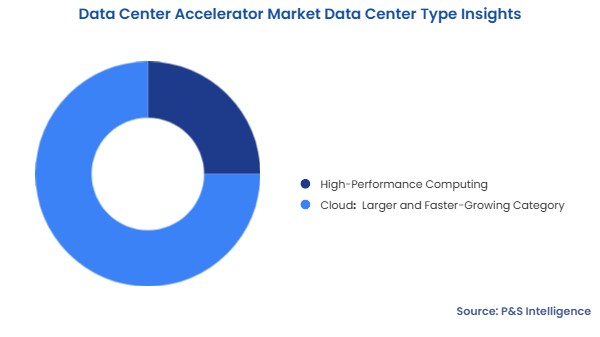
The cloud data center type category is projected to grow at the higher CAGR, of 11.5%, during forecast period, after holding the larger share in 2024, of 75%. This is due to several key factors. Cloud computing continues to see widespread adoption across industries as businesses increasingly shift their operations to the cloud for enhanced scalability, flexibility, and cost efficiency.
This shift is driving significant demand for cloud data centers, which provide the infrastructure necessary to support a growing number of cloud-based services. Additionally, the ongoing growth of public and private cloud adoption, along with the rise of hybrid and multi-cloud environments, further contributes to the robust demand for cloud data center infrastructure.
As enterprises adopt more data-intensive applications, such as artificial intelligence, machine learning, and big data analytics, cloud data centers are becoming essential for managing the massive amounts of data generated and processed by these applications.
During the study, we have analyzed the following data center types in the report:
High-Performance Computing
Cloud (Larger and Faster-Growing Category)
Processor Analysis
The GPU category holds the largest market share, of 40%, in 2024. This is driven by its ability to handle parallel processing tasks and support high-performance computing applications. GPUs are highly efficient at managing the complex and data-intensive workloads associated with artificial intelligence (AI), machine learning, deep learning, big data analytics, and cloud computing.
These workloads require significant computational power for the simultaneous processing of multiple data points, making them ideal for modern data centers. As industries continue to embrace AI and machine learning, GPUs are increasingly critical in powering these applications, which are used across sectors like finance, healthcare, automotive, and telecommunications.
FPGA is the fastest-growing category, during the forecast period. Data center accelerators based on FPGAs offer customizable, low-latency processing for specialized workloads like AI inference, encryption, and high-frequency trading. Their reconfigurable architecture enables real-time adaptability, while consuming less power than GPUs for certain tasks. FPGAs also support parallelism and hardware-level optimization, enhancing performance in dynamic, high-throughput environments.
The FPGA architecture offers data center accelerators flexibility through reconfigurable logic, enabling tailored, workload-specific optimization. This adaptability supports rapid deployment of evolving AI and data processing tasks with low latency and high energy efficiency. FPGAs facilitate parallel processing and hardware-level customization, making them ideal for dynamic, scalable data center environments.
Below are the processors analyzed:
GPU (Largest Category)
CPU
FPGA (Faster-Growing Category)
ASIC
Application Insights
The deep learning training category accounts for the largest share in 2024. This is primarily due to the increasing reliance on deep learning models in a wide range of industries. Deep learning requires substantial computational power to train neural networks on large datasets, making it a key driver of demand for data center accelerators, particularly GPUs and FPGAs.
These accelerators enable faster training of deep learning models by handling the complex matrix operations and vast amounts of data involved in the process. As industries like healthcare, finance, autonomous vehicles, and natural language processing (NLP) continue to integrate deep learning into their operations, the demand for high-performance computing resources to support training has grown exponentially.
Enterprise interface will have the highest CAGR during the forecast period, of 11.5%, due to the rising demand for seamless connectivity between diverse systems and cloud platforms. It enables real-time data exchange, supports complex workflows, and enhances operational agility. Increasing digital transformation and hybrid IT environments drive adoption, making enterprise interfaces critical for integrating legacy infrastructure with modern applications efficiently.
The following applications are included in the report:
Deep Learning Training (Largest Category)
Public Cloud Interface
Enterprise Interface (Faster-Growing Category)
Drive strategic growth with comprehensive market analysis
Data Center Accelerator Market Regional Growth Dynamics
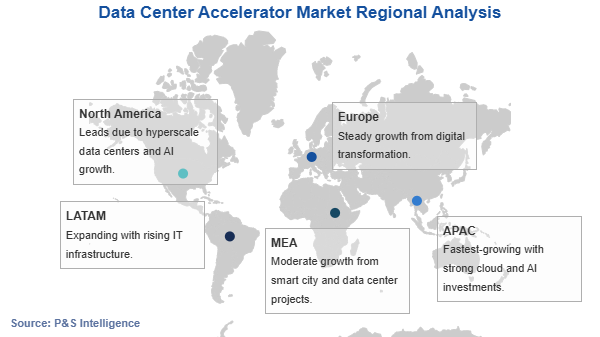
Geographically, North America holds the largest market share, of 35%, in 2024. This is driven by several key factors. The region is home to some of the world’s largest technology companies, including major cloud service providers, AI and machine learning innovators, and data-intensive industries, all of which are significant consumers of data center accelerators.
With an established and advanced IT infrastructure, North America is at the forefront of adopting cutting-edge technologies, including GPUs, FPGAs, and other data center accelerators, to meet the growing demands of modern applications such as AI, big data analytics, and high-performance computing.
Additionally, the increasing reliance on cloud computing services, coupled with the ongoing digital transformation across industries in North America, has spurred the expansion of data centers and the need for advanced processing solutions. The region’s strong emphasis on innovation, coupled with substantial investments in research and development by leading tech companies, further accelerates the adoption of these technologies.
APAC is the fastest-growing region, driven by surging data volumes and substantial infrastructure investments. China leads with over 70 data center projects and an estimated USD 35 billion investment from 2022 to 2027. India follows with 950 MW installed capacity and plans to add 850 MW by 2026, attracting over USD 40 billion in investments between 2018 and 2023. Japan's capacity is expected to double from 2 GW in 2024 to 4 GW by 2030. South Korea is also expanding rapidly, with a 19% increase in capacity from 2022 to 2023.
APAC’s rapid growth is fueled by applications in AI, cloud computing, and 5G, demanding advanced data center accelerators. China leads AI deployment with over 400 AI startups, while India’s cloud market is expanding rapidly. Japan and South Korea focus on smart manufacturing and autonomous vehicles, driving specialized accelerator adoption in data centers.
Further, regions and countries analyzed for this report include:
Brazil (Largest and Fastest-Growing Country Market)
Mexico
Rest of LATAM
Middle East and Africa (MEA)
Saudi Arabia (Largest Country Market)
South Africa
U.A.E. (Fastest-Growing Country Market)
Rest of MEA
Data Center Accelerator Market Share Analysis
The market is fragmented, characterized by the presence of numerous players offering a variety of solutions for different industries and applications. This is driven by the diverse range of data center requirements and the rapid technological advancements within the market. Companies operate across different segments such as GPUs, FPGAs, ASICs, and CPUs, each catering to specific computational needs, from high-performance computing to artificial intelligence and machine learning workloads.
The wide variety of accelerators available allows companies to choose solutions that best fit their processing needs, resulting in a competitive landscape with multiple players. On the other hand, large companies like NVIDIA, Intel, and AMD dominate the market in terms of market share, particularly in the GPU and CPU segments.
Key Data Center Accelerator Companies:
Advanced Micro Devices, Inc.
Dell Technologies Inc.
IBM Corporation
Intel Corporation
Lenovo Group Ltd.
Marvell Technology Inc.
Microchip Technology Inc.
Micron Technology Inc.
NEC Corporation
NVIDIA Corporation
Qualcomm Incorporated
Synopsys Inc.
Data Center Accelerator Market Developments
In July 2025, MTN Nigeria inaugurated the USD 150-million Dabengwa Data Centre in partnership with Dell Technologies Inc. to enhance access to cloud services across West Africa. The data facility integrates AI-powered energy optimization and strong hybrid cloud functionalities, guaranteeing exceptional performance and adaptability for its clients, as stated by MTNN.
In May 2025, EnCharge AI introduced its EN100 AI accelerator chip with precise and scalable analog in-memory computing, to enhance AI functionalities in laptops, workstations, and Edge devices. The EN100 is offered in two configurations: the M.2 for laptops and the PCIe for workstations.
In October 2024, Advanced Micro Devices Inc. launched its third-generation commercial AI mobile processors, the new Ryzen AI PRO 300 Series. It enhances business productivity through Copilot+ features, such as live captioning, language translation during conference calls, and advanced AI-driven image generation. These processors offer three times better AI performance than previous generation, along with superior performance for daily tasks.
In September 2024, Intel Corporation launched the Xeon 6 processors featuring Performance-cores (P-cores), delivering double the performance for AI and high-performance computing (HPC) workloads. The new Gaudi 3 AI accelerators offer 20% greater throughput and twice the performance of the H100 for the inference of LLaMa 2 70B1 variants.
In May 2024, NVIDIA Corporation partnered with Microsoft Corporation to accelerate the development and deployment of AI applications by providing new optimizations and integrations for Windows developers.
Want a report tailored exactly to your business need?
Leading companies across industries trust us to deliver data-driven insights and innovative solutions for their most critical decisions. From data-driven strategies to actionable insights, we empower the decision-makers who shape industries and define the future. From Fortune 500 companies to innovative startups, we are proud to partner with organisations that drive progress in their industries.
Client Testimonials
Working with P&S Intelligence and their team was an absolute pleasure – their awareness of timelines and commitment to value greatly contributed to our project's success. Eagerly anticipating future collaborations.
McKinsey & Company
India
Unmatched Standards
Our insights into the minutest levels of the markets, including the latest trends and competitive landscape, give you all the answers you need to take your business to new heights
Complete Data Security
We take a cautious approach to protecting your personal and confidential information. Trust is the strongest bond that connects us and our clients, and trust we build by complying with all international and domestic data protection and privacy laws