This Report Provides In-Depth Analysis of the Cybersecurity Certification Market Report Prepared by P&S Intelligence, Segmented by Component (Certification Programs, Training and Exam Preparation Services), Certification Type (Network Security Certification, Cloud Security Certification, Application Security Certification, Endpoint and Infrastructure Security Certification, Identity and Access Management Certification), Delivery Mode (Instructor-Led Training, Online Learning, Self-Paced Learning, Blended Learning), End User (IT and Telecom, Healthcare, Banking, Financial Services, and Insurance, Government and Defence, Retail and E-commerce, Energy and Utilities), Certification Level (Professional Level Certification, Entry-Level Certification, Advanced and Expert Level Certification), Target User (Enterprises / Corporate Training, Individual Professionals), Organization Size (Large Enterprises, Small and Medium Enterprises), and Geographical Outlook for the Period of 2021 to 2032
Explore the market potential with our data-driven report
Cybersecurity Certification Market Future Outlook
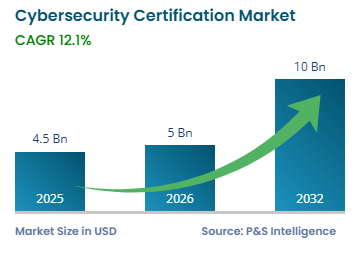
The cybersecurity certification market size was USD 4.5 billion in 2025, and it will grow by 12.1% during 2026-2032 to reach USD 10.0 billion by 2032.
The market is expanding as organizations increasingly treat cybersecurity as a core operational requirement rather than an optional safeguard. Security capabilities are now integrated into enterprise risk management, digital transformation strategies, regulatory compliance programs, and business continuity planning across industries. This shift is being driven by the growing complexity of cyber threats, broader adoption of cloud computing, hybrid work environments, connected devices, and expanding digital ecosystems that create larger attack surfaces. Organizations are also managing more third-party relationships, software dependencies, and data-intensive operations, increasing the need for skilled cybersecurity personnel capable of protecting critical systems and sensitive information. As cybersecurity responsibilities become more specialized, employers are placing greater emphasis on validated technical expertise across security operations, cloud security, governance, risk management, and incident response functions.
According to Cybersecurity Ventures, the number of unfilled cybersecurity jobs reached 3.5 million globally in 2025, highlighting a persistent shortage of skilled professionals. Furthermore, the shortage is increasing competition for qualified talent and making workforce development a strategic priority for employers. Organizations are expanding investments in certification programs, structured training pathways, and continuous professional development to strengthen internal capabilities and reduce skills gaps. Certification credentials are increasingly used to assess technical competency, support hiring decisions, and align workforce skills with evolving security requirements. This growing reliance on validated expertise is encouraging broader adoption of cybersecurity certification programs across enterprises, government agencies, and critical infrastructure operators while strengthening long-term demand for certified cybersecurity professionals.
Key Market Insights
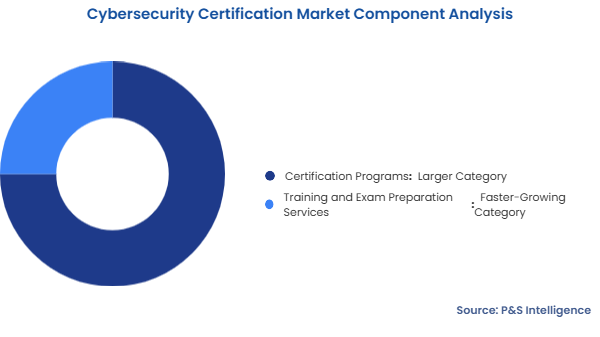
Certification Programs are the larger category, holding a market share of 75%, due to global standardisation frameworks supporting recognised cybersecurity credential adoption across industries.
Cloud Security Certification is the fastest-growing category, registering a CAGR of approximately 12.7%, driven by rising enterprise reliance on cloud-based security systems and hybrid infrastructure protection needs.
Instructor-Led Training is the largest category, holding a market share of 45%, due to institutional training programmes supporting structured cybersecurity skill development across multiple countries.
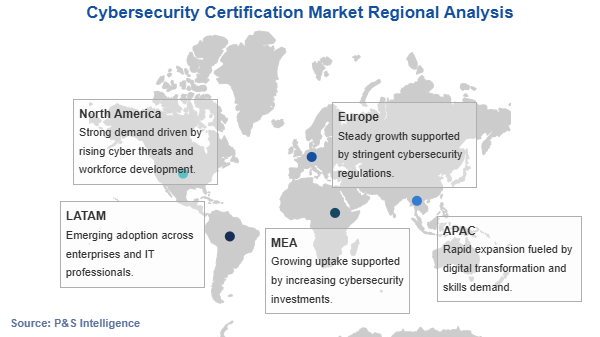
North America is the largest region, holding a market share of 40%, due to a high concentration of cybersecurity professionals and advanced enterprise security infrastructure.
Asia-Pacific is the fastest-growing region, registering a CAGR of approximately 13.0%, driven by expanding national cybersecurity training initiatives and rapid digital infrastructure development across emerging economies.
Cybersecurity Certification Market Trends and Drivers
Shift toward Role-Based and Continuous Cybersecurity Certification Models Is a Major Trend
The industry is shifting from one-time certifications toward continuous learning pathways aligned with specific cybersecurity roles, technology domains, and operational responsibilities. Organizations increasingly require validated expertise in cloud security, identity and access management, security operations, threat intelligence, and artificial intelligence security rather than relying solely on broad cybersecurity credentials. According to the International Information System Security Certification Consortium, 73% of cybersecurity professionals believed artificial intelligence would create more specialized cybersecurity skills in 2025.
Furthermore, 70% of security professionals expected demand for technical cybersecurity contributors to rise, according to ISACA. These workforce expectations are encouraging certification providers to introduce role-based learning tracks, modular credentials, and continuous upskilling frameworks. Employers are also prioritizing certifications that demonstrate practical capabilities relevant to evolving security environments, creating stronger alignment between certification pathways, workforce development strategies, and day-to-day cybersecurity functions.
Rising Frequency and Impact of Cyberattacks Drive Market
The market is expanding due to the increasing frequency, scale, and sophistication of cyber threats affecting organizations across critical infrastructure, healthcare, financial services, government, and technology sectors. Enterprises are facing growing exposure to ransomware, phishing campaigns, identity-based attacks, supply chain compromises, and nation-state cyber activity that require advanced security capabilities. According to Microsoft, its customers faced more than 600 million cybercriminal and nation-state attacks every day in 2024.
Furthermore, threat actors are using increasingly sophisticated techniques that target cloud environments, digital identities, and interconnected business systems. Organizations are therefore strengthening workforce development strategies and prioritizing certifications that validate practical cybersecurity skills. Demand is rising for certified professionals capable of threat detection, incident response, cloud security, governance, and risk management, supporting greater investment in structured certification programs, technical training, and continuous cybersecurity education initiatives.
High Cost and Limited Accessibility of Certification Programs Restrain Adoption
The market faces constraints as cybersecurity certification programmes remain costly and difficult to access for many individuals and smaller organisations. This limitation is driven by cumulative expenses, including training fees, examination costs, and recurring certification renewals, alongside time constraints for working professionals. According to the World Economic Forum, 52% of public organisations reported that the lack of resources and skills was their biggest challenge in achieving cyber resilience in 2024. This imbalance between demand and accessibility slows participation rates, limiting the expansion of certified talent pools and creating uneven workforce development across regions with differing financial and institutional capacities.
Expansion of Cybersecurity Education in Emerging and Non-Technical Workforce Segments
The market presents strong growth potential as cybersecurity education expands beyond traditional IT roles into broader workforce segments. This development is supported by increasing organisational focus on training non-technical staff, alongside rising integration of cybersecurity courses within academic institutions and digital learning platforms. According to the International Telecommunication Union, 123 countries implemented formal cybersecurity training programmes in 2024, rising from 105 countries in 2021, reflecting a global expansion of structured learning frameworks. This widening access is enabling greater participation across industries and regions, strengthening the pipeline of certified professionals and supporting long-term market growth through scalable and inclusive training models.
Certification Programs are the larger category, holding a market share of 75%, as employers and enterprises increasingly require recognized credentials to validate cybersecurity competencies across network security, cloud security, governance, and risk management functions. Organizations use certifications to establish consistent skill benchmarks for hiring, workforce development, and compliance initiatives. According to the International Telecommunication Union, 110 countries implemented frameworks for nationally or internationally recognized cybersecurity standards in 2024, reinforcing the value of structured credentialing systems. This standardization strengthens enterprise confidence in certified talent and supports continued investment in formal cybersecurity certification pathways.
Training and Exam Preparation Services are the faster-growing category, registering a CAGR of approximately 12.4%, as cybersecurity certifications increasingly emphasize practical skills, hands-on exercises, and role-specific knowledge. Candidates are seeking structured learning environments that include virtual labs, instructor guidance, practice assessments, and exam-focused preparation. Growth is further supported by rising demand for cloud security certifications and professional-level credentials that require deeper technical expertise. Additionally, flexible online delivery models are expanding access to specialized training resources. This is increasing enrollment in preparation programs designed to improve certification readiness and professional competency.
The components analysed in this report are:
Certification Programs (Larger Category)
Training and Exam Preparation Services (Faster-Growing Category)
Certification Type Analysis
Network Security Certification is the largest category, holding a market share of 35%, as network protection remains a foundational requirement across enterprise, government, healthcare, and telecommunications environments. Organizations continue to prioritize skills related to secure connectivity, network monitoring, access control, and threat detection because these functions support broader cybersecurity operations. Network security credentials also serve as entry points into advanced specializations, including cloud security and infrastructure protection. Their applicability across organizations of all sizes and industries sustains consistent demand from both new entrants and experienced cybersecurity professionals seeking career progression.
Cloud Security Certification is the fastest-growing category, as organizations increasingly migrate applications, workloads, and sensitive data to cloud environments that require specialized security expertise. Demand is rising for professionals skilled in identity and access management, cloud governance, workload protection, and data security across hybrid and multi-cloud infrastructures. According to the European Commission's Eurostat, 65.5% of enterprises purchasing cloud services used security software applications delivered through the cloud in 2025. Furthermore, growing enterprise reliance on cloud-based security controls is increasing the need for certified professionals capable of securing modern cloud architectures and supporting compliance requirements.
The certification types analysed in this report are:
Instructor-Led Training is the largest category, holding a market share of 45%, as enterprises prefer structured learning environments for developing cybersecurity capabilities aligned with certification requirements and operational responsibilities. Instructor-led programs provide direct interaction, practical demonstrations, and guided support for complex domains such as network security, cloud security, and risk management. According to the International Telecommunication Union, 123 countries implemented formal cybersecurity training programs in 2024, increasing from 105 countries in 2021, reflecting an expanding global training infrastructure. This institutional emphasis on workforce development continues to support demand for instructor-led certification training across organizations.
Online Learning is the fastest-growing category, registering a CAGR of approximately 12.6%, as cybersecurity professionals increasingly seek flexible training options that accommodate work schedules and continuous skill development. Digital learning platforms provide access to certification courses, virtual laboratories, recorded sessions, and assessment tools from any location. Growth is also supported by rising enrollment in cloud security certifications and entry-level cybersecurity programs among individual learners. Furthermore, organizations are incorporating online training into workforce development strategies to scale certification preparation efficiently. This accessibility is accelerating adoption across both enterprise-sponsored and self-funded certification pathways.
The delivery modes analysed in this report are:
Instructor-Led Training (Largest Category)
Online Learning (Fastest-Growing Category)
Self-Paced Learning
Blended Learning
End User Analysis
IT and Telecom are the largest category, as the sector operates critical digital infrastructure, large-scale communication networks, cloud platforms, and data-intensive environments that require advanced cybersecurity capabilities. Organizations continuously invest in certified professionals to secure network operations, manage cyber risks, and maintain service availability across distributed systems. The sector is also a major adopter of network security, cloud security, and professional-level certifications due to evolving technology architectures. This sustained focus on workforce development and operational resilience supports consistent demand for cybersecurity certification programs across IT and telecommunications organizations.
Healthcare is the fastest-growing category, registering a CAGR of approximately 12.8%, as healthcare providers continue expanding digital health records, connected medical devices, telehealth platforms, and cloud-based patient management systems. These environments require cybersecurity professionals capable of protecting sensitive health information, maintaining regulatory compliance, and securing critical clinical operations. According to the World Economic Forum, 49% of public-sector organizations reported lacking the necessary cybersecurity talent to meet their cybersecurity goals in 2025. Furthermore, workforce shortages across highly regulated sectors are increasing investment in professional development and specialized cybersecurity training. Healthcare organizations are placing greater emphasis on certifications covering privacy, risk management, and incident response.
The end users analysed in this report are:
IT and Telecom (Largest Category)
Healthcare (Fastest-Growing Category)
Banking, Financial Services, and Insurance
Government and Defence
Retail and E-commerce
Energy and Utilities
Others
Certification Level Analysis
Professional Level Certification is the largest category, holding a market share of 60%, as employers prioritize experienced cybersecurity professionals capable of managing security operations, governance frameworks, compliance requirements, and enterprise risk programs. These certifications align closely with mid-career and senior-level positions that carry greater operational responsibility and decision-making authority. According to ISACA, 39% of organizations reported in 2025 that hiring for non-entry-level cybersecurity positions takes three to six months, highlighting ongoing shortages of experienced talent. This hiring challenge increases the value of professional-level certifications as recognized indicators of job readiness and specialized expertise.
Entry-Level Certification is the fastest-growing category, as increasing numbers of students, career changers, and early-stage technology professionals are entering the cybersecurity workforce. These certifications provide foundational knowledge in security principles, risk management, network protection, and threat awareness, creating pathways into more advanced specializations. Growing demand for cybersecurity talent across healthcare, IT, telecom, financial services, and government sectors is encouraging new entrants to obtain recognized credentials. Furthermore, online learning platforms and affordable training resources are improving accessibility, supporting higher enrollment in entry-level certification programs and expanding the cybersecurity talent pipeline.
The certification levels analysed in this report are:
Professional Level Certification (Largest Category)
Enterprises / Corporate Training is the larger category, as organizations increasingly integrate cybersecurity certifications into workforce development, compliance programs, and security governance initiatives. Large enterprises and regulated industries require standardized skill levels across security teams to manage operational risks and support cyber resilience objectives. Corporate training programs also align with professional-level certifications and instructor-led learning models that address enterprise security requirements. This ongoing investment in employee capability development strengthens certification adoption across network security, cloud security, governance, risk management, and incident response functions.
Individual Professionals are the faster-growing category, as more learners pursue cybersecurity certifications independently to improve employability, career mobility, and technical specialization. Growth is supported by flexible online learning platforms, self-paced training resources, and increasing awareness of cybersecurity career opportunities across industries. According to the World Economic Forum, the global cybersecurity skills gap increased by 8% in 2025, while only 14% of organizations reported confidence in their workforce capabilities, indicating persistent talent shortages. This environment is encouraging professionals to obtain recognized certifications that strengthen credentials and improve access to cybersecurity roles.
The target users analysed in this report are:
Enterprises / Corporate Training (Larger Category)
Large Enterprises are the largest category, holding a market share of 75%, because they operate complex digital infrastructures, global business networks, and extensive third-party ecosystems that require advanced cybersecurity governance. These organizations maintain dedicated security teams across multiple functions, creating sustained demand for role-based certifications and continuous workforce development. According to the World Economic Forum, 54% of large organizations identified supply chain challenges as the biggest barrier to achieving cyber resilience in 2025. Furthermore, managing cybersecurity risks across suppliers, cloud providers, and distributed operations requires standardized security expertise. This supports ongoing adoption of certifications focused on security operations, risk management, governance, and cyber resilience.
Small and Medium Enterprises (SMEs) are the faster-growing category, as digital transformation is increasing their reliance on cloud platforms, online services, remote work environments, and connected business applications. As cybersecurity incidents increasingly affect smaller organizations, SMEs are investing in workforce training to strengthen internal security capabilities and reduce operational risks. Growth is also supported by the availability of online learning platforms, entry-level certifications, and cost-effective training programs tailored to smaller teams. This is encouraging broader adoption of cybersecurity certifications among SMEs seeking practical skills in network security, cloud security, and threat management.
The organization sizes analysed in this report are:
Large Enterprises (Larger Category)
Small and Medium Enterprises (SMEs) (Faster-Growing Category)
Drive strategic growth with comprehensive market analysis
Cybersecurity Certification Market Regional Outlook
North America Cybersecurity Certification Market Analysis
North America holds the largest share of 40% due to the strong integration of cybersecurity certifications into workforce development, regulatory compliance, and enterprise security programs. Organisations across financial services, defence, healthcare, energy, and critical infrastructure sectors rely on certified professionals to manage security operations, risk assessment, incident response, and governance requirements. Additionally, the region benefits from the presence of globally recognised certification bodies, specialised training institutions, and corporate learning platforms that support continuous professional development. Furthermore, enterprises increasingly require certifications for security-focused job roles and contract eligibility. Similarly, ongoing adoption of cloud computing, artificial intelligence, and zero trust security frameworks is expanding certification requirements. Moreover, frequent cyber incidents and evolving threat landscapes encourage professionals to pursue advanced credentials, supporting consistent participation in certification programs across the region.
U.S. Cybersecurity Certification Market Analysis
The United States leads the cybersecurity certification market due to established cybersecurity practices, mature workforce development programs, and strong employer emphasis on professional credentials. Certifications are widely used to validate technical expertise in security operations, risk management, compliance, cloud security, and incident response across regulated industries. According to the United States Bureau of Labor Statistics, information security analysts held approximately 182,800 jobs in 2024. Additionally, employers frequently incorporate certifications into hiring, promotion, and workforce development strategies. Furthermore, expanding adoption of cloud computing, artificial intelligence, and zero trust architectures is increasing the need for specialized security skills, supporting sustained enrollment in cybersecurity certification programs throughout the country.
Canada shows steady growth as organisations strengthen cybersecurity capabilities while facing a limited skilled workforce. This demand is driven by employer reliance on certifications to validate expertise and government efforts to promote national cyber awareness. According to the Communications Security Establishment Canada, enrolments in its Learning Hub courses reached 11,895 in 2024, indicating rising participation in formal cybersecurity training programmes. This increasing engagement supports workforce development and reinforces the adoption of recognised certification pathways across industries.
Asia-Pacific is the fastest-growing region, registering a CAGR of approximately 13.0%, driven by rapid digital transformation, expanding technology sectors, and significant investments in cybersecurity workforce development. Governments across the region are implementing national cybersecurity strategies, digital economy programs, and skill development initiatives to strengthen domestic security capabilities. Additionally, organisations are increasingly adopting internationally recognised certifications to improve workforce credibility and support participation in global technology markets. Furthermore, the region benefits from a large population entering information technology, cloud computing, and cybersecurity-related careers. Similarly, expansion of managed services, software development, e-commerce, and digital banking activities is creating sustained demand for certified professionals. Moreover, rising awareness of cyber resilience, threat management, and regulatory preparedness is encouraging broader certification adoption among enterprises, educational institutions, and technology professionals across the region.
China Cybersecurity Certification Market Analysis
China is expanding its certification landscape as tighter cyber governance and industrial data protection requirements increase the need for trained security professionals. Enterprises are strengthening internal controls across digital infrastructure, while regulators are pushing broader implementation of compliance and operational safeguards. According to Reuters, China’s Ministry of Industry and Information Technology set a target in 2024 of more than 30,000 data security training sessions and the development of 5,000 data security experts by 2026, reflecting a significant national push towards capability building. This is supporting demand for recognised cybersecurity qualifications across the domestic market.
India Cybersecurity Certification Market Analysis
India is expanding rapidly as a cybersecurity certification market due to increasing digitalization, growth in technology services, and rising investment in cyber defense capabilities across public and private sectors. Organizations are strengthening security teams to manage cloud environments, digital platforms, and critical business systems, creating demand for validated technical skills. According to the Data Security Council of India, the cybersecurity talent pool stood at approximately 60,000 cybersecurity professionals in 2025. Furthermore, collaboration between industry, academic institutions, and training providers is expanding access to cybersecurity education. This growing professional workforce increases participation in certification programs focused on security operations, cloud security, governance, risk management, and threat detection across BFSI, government, and technology sectors.
Europe Cybersecurity Certification Market Analysis
Europe demonstrates steady growth due to its mature cybersecurity governance framework and widespread adoption of regulatory compliance standards across public and private sectors. Organisations operating in banking, healthcare, telecommunications, manufacturing, and government services require professionals with validated expertise in data protection, cyber risk management, and security operations. Additionally, certification programs are increasingly aligned with regional cybersecurity strategies, privacy regulations, and digital resilience initiatives. Furthermore, enterprises invest in structured workforce training to strengthen internal security capabilities and maintain compliance readiness. Similarly, educational institutions and professional associations continue expanding cybersecurity learning pathways to address growing skills requirements. Moreover, increased focus on supply chain security, cloud governance, and critical infrastructure protection is supporting demand for specialised certifications, ensuring sustained participation from professionals and organisations throughout the region.
The regions and countries analysed in this report are:
The market is fragmented, characterised by a diverse ecosystem of cybersecurity certification providers serving professionals, enterprises, government agencies, and educational institutions across multiple security disciplines. International certification bodies, specialised cybersecurity training organisations, technology vendors, and digital learning platforms collectively contribute to the market landscape. Certification programs cover areas such as network security, cloud security, ethical hacking, risk management, digital forensics, and security operations, supporting a broad range of workforce development needs. Additionally, technology companies increasingly offer vendor-specific certifications aligned with their cybersecurity products and platforms. Furthermore, online education providers are expanding access through instructor-led, self-paced, and hybrid learning models. Similarly, professional associations continue to strengthen certification portfolios to address evolving security requirements. Moreover, growing demand for specialised cybersecurity skills is encouraging continuous program development, creating a dynamic market environment with extensive certification choices for learners and organisations.
Leading Companies in the Cybersecurity Certification Market:
SGS Societe Generale de Surveillance SA
DEKRA SE
Intertek Group plc
Bureau Veritas SA
DNV AS
TUV SUD AG
UL Solutions Inc
Eurofins Scientific SE
TUV NORD AG
Element Materials Technology Group Limited
Keysight Technologies Inc
The British Standards Institution
TUV Rheinland AG
Schellman Compliance LLC
Coalfire Systems Inc
Cybersecurity Certification Market News
In February 2026, CompTIA officially launched the SecAI+ certification, a vendor-neutral credential focused on securing artificial intelligence systems and applying AI in cybersecurity operations, covering domains such as AI governance, risk management, and practical security use cases.
In September 2025, ISC2 launched the Threat Handling Foundations Certificate for cybersecurity professionals. The certificate combined multiple on-demand courses and an assessment into a structured path covering incident management, response, recovery, threat hunting, and digital forensics, including one course that had been introduced earlier in February 2025.
In August 2025, ISACA launched the Advanced in AI Security Management credential. The certification was introduced for professionals responsible for managing AI-related risk and governance, and it defined domains covering AI governance and program management, risk management, and AI technologies and controls within enterprise environments.
In April 2025, CompTIA introduced SecAI+, a vendor-neutral certification focused on securing artificial intelligence systems and applying AI in cybersecurity tasks. The certification was positioned within the Expansion Series and covered AI-related security operations, risk management, governance, and practical use of AI tools in cybersecurity environments.
Frequently Asked Questions About This Report
What makes cybersecurity certification important for modern digital organizations today?+
Cybersecurity certification helps organizations prove security competence, improve risk controls, build customer confidence, and support safer handling of sensitive business information.
How does cybersecurity certification help organizations improve information security governance?+
It gives organizations a structured way to identify risks, apply controls, monitor improvements, and keep information security aligned with changing business needs.
What steps are usually involved in cybersecurity certification audit processes?+
The process usually includes scope review, readiness checks, formal audit stages, certification decision, and continuing surveillance to confirm ongoing security performance.
Why do companies seek independent cybersecurity certification before enterprise contracts?+
Companies seek certification to show clients that security practices are verified by an external body, reducing trust barriers during vendor selection.
Which industries benefit most from adopting cybersecurity certification programs?+
Financial services, healthcare, information technology, cloud services, manufacturing, and government suppliers benefit because they manage sensitive data and face strict security expectations.
Want a report tailored exactly to your business need?
Leading companies across industries trust us to deliver data-driven insights and innovative solutions for their most critical decisions. From data-driven strategies to actionable insights, we empower the decision-makers who shape industries and define the future. From Fortune 500 companies to innovative startups, we are proud to partner with organisations that drive progress in their industries.
Client Testimonials
Working with P&S Intelligence and their team was an absolute pleasure – their awareness of timelines and commitment to value greatly contributed to our project's success. Eagerly anticipating future collaborations.
McKinsey & Company
India
Unmatched Standards
Our insights into the minutest levels of the markets, including the latest trends and competitive landscape, give you all the answers you need to take your business to new heights
Complete Data Security
We take a cautious approach to protecting your personal and confidential information. Trust is the strongest bond that connects us and our clients, and trust we build by complying with all international and domestic data protection and privacy laws