This Report Provides In-Depth Analysis of the Current Sensor Market Report Prepared by P&S Intelligence, Segmented by Loop Type / Architecture (Open-Loop Current Sensors, Closed-Loop Current Sensors), Technology / Sensing Principle (Hall-Effect Sensors, Shunt Resistors, Current Transformers (CT), Fluxgate Sensors, Magnetoresistive Sensors (TMR/AMR/GMR)), End-Use Industry / Application (Automotive, Industrial Automation, Energy & Power Infrastructure, Consumer Electronics & Appliances, Telecommunications & Data Centers), and Geographical Outlook for the Period of 2022 to 2033
Explore the market potential with our data-driven report
Current Sensor Market Overview
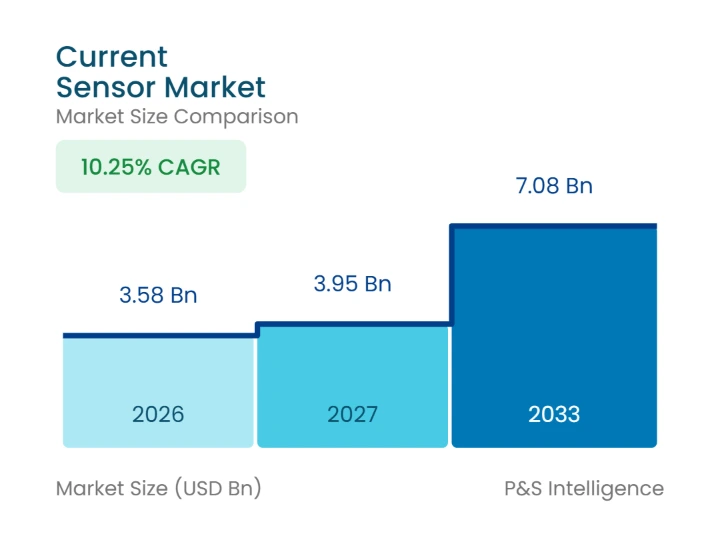
Global current sensor market revenue is estimated at USD 3.58 Billion in 2026 and is projected to reach USD 3.95 Billion in 2027. Annual sales are projected to climb to USD 7.08 Billion by 2033, with the market expanding at a CAGR of 10.25% during 2027-2033. Carmakers and their inverter, charger, and battery-pack suppliers place the most orders, because each high-voltage stage needs a measured current signal to switch, protect, and balance cells. Operators of AI server halls, solar plants, and automated factories add a second stream of orders as their power electronics move to higher voltages and faster switching.
Battery electric and plug-in hybrid platforms supply the largest pool of new design sockets, since the traction inverter, onboard charger, DC-DC converter, and battery disconnect unit each carry their own sensing points. According to the IEA, global electric car sales passed 20 million in 2025 and took 25% of new car sales, with more than 13 million sold in China alone. Those volumes size the vehicle platform base, not sensor content per car. Their commercial weight comes from design-in timing, because a sensor qualified at the start of a vehicle program usually ships for that program's full production run.
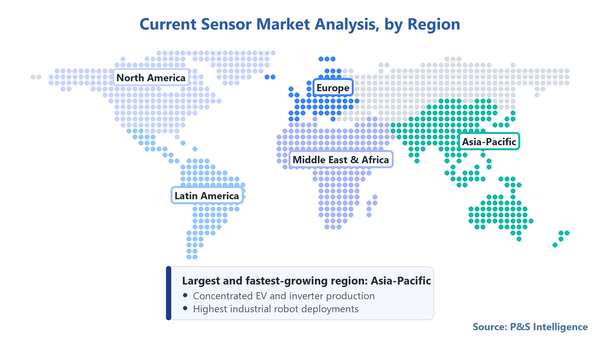
Asia-Pacific accounted for 38.5% of the current sensor market in 2026 and is projected to grow fastest, at an 11.4% CAGR during 2027-2033. China leads global electric car production, while Japan, South Korea, and Taiwan add power-semiconductor and module manufacturing, so sensor orders follow new production lines into the region. North America, the second-largest region, depends more on upgrades within an established base, with data-center power systems and grid batteries setting the specifications. That contrast favors volume manufacturing in Asia and higher-specification design wins in the United States.
Key market insights
By loop type, open-loop sensors held 54.5% in 2026, while closed-loop sensors are projected to grow at an 11.8% CAGR during 2027-2033.
By technology, Hall-effect sensors held 43.5% in 2026, while magnetoresistive sensors (TMR/AMR/GMR) are projected to grow at a 14.2% CAGR during 2027-2033.
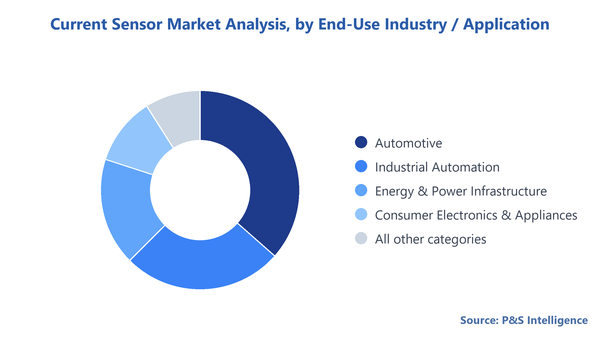
By end-use industry, automotive held 36.5% in 2026 and is also projected to grow fastest, at a 12.6% CAGR during 2027-2033.
By geography, Asia-Pacific held 38.5% in 2026 and is also projected to grow fastest, at an 11.4% CAGR during 2027-2033.
Current Sensor Market Trends & Drivers
Safety-certified sensor ICs are redefining battery-pack protection designs
Battery-pack engineers at carmakers and tier-one suppliers are moving toward single sensor ICs that measure current, flag faults, and support the pack's functional-safety case, instead of pairing a bare shunt with separate amplifiers and monitoring logic. That change tends to shift spending from passive parts toward higher-value integrated sensors, because the sensor vendor now supplies part of the safety evidence a battery disconnect unit or smart pyrofuse needs before release. Integration also removes board area and assembly steps, which can help sensor value per pack hold up while vehicle prices fall.
As per Melexis, its MLX91230 Hall-effect and MLX91231 shunt-interface smart sensor ICs reached ISO 26262 ASIL C(D) compliance in August 2024 for battery management systems and smart pyrofuses, and an external NTC thermistor input for measuring nearby component temperature followed in September 2025. A safety-rated part that reads both current and temperature can let pack designers drop components and shorten safety validation. Vendors with certified, multi-parameter ICs are better positioned in new pack programs, while suppliers of plain shunt resistors are likely to face pressure to bundle conditioning electronics.
Rising data-center power loads are accelerating demand for high-bandwidth sensing
Operators of AI and cloud data centers are adding current measurement at the rack, the power shelf, and the uninterruptible power supply as new racks draw far more power than the general-purpose servers they replace. Each increase in rack load raises the cost of an undetected overcurrent or an inefficient conversion stage, so hyperscale operators and power-supply makers specify faster, isolated sensors for real-time telemetry and load balancing. The move toward 48 V distribution inside racks favors compact integrated ICs placed beside each conversion stage, which adds sensing points per rack.
U.S. Department of Energy figures put data-center electricity use at 176 TWh in 2023, or 4.4% of national consumption, and project a rise to between 6.7% and 12% of U.S. electricity by 2028. Electricity use measures power drawn, not sensors bought, but more conversion capacity per site means more converter channels to monitor. Power-supply designers serving these sites are likely to buy on bandwidth, isolation rating, and footprint, which could favor semiconductor vendors with integrated-conductor packages over module makers built around larger magnetic cores.
Record solar and storage additions are opening demand for bidirectional inverter sensing
Solar inverter makers and battery storage integrators need isolated sensing at string inputs, DC links, and grid connection points, and storage adds a bidirectional requirement because the same converter both charges and discharges. Each utility-scale project therefore brings a bill of materials with several measurement points, and low offset drift helps operators hold protection and metering settings within grid-connection limits. The result is a large volume pool outside automotive, with design cycles tied to inverter platform refreshes instead of vehicle launches.
IRENA counted more than 500 GW of new solar capacity worldwide in 2025, roughly three-quarters of all renewable additions that year. Capacity additions size the inverter base, not sensor demand directly, and every site that pairs solar with batteries adds bidirectional converters to monitor. Inverter suppliers and storage integrators tend to prefer sensors with a track record at high DC voltages, which gives closed-loop and fluxgate specialists an opening in utility projects where measurement accuracy affects revenue settlement.
Price competition in China is limiting margins on standard sensor designs
Sensor vendors selling into China's EV, solar, and industrial-drive programs face procurement teams that tend to rebid mature designs often and can treat standard Hall-effect and shunt-based parts as interchangeable once the footprint and rating match. Each rebid round compresses unit prices, so revenue can stall even while shipments rise. Pressure is sharpest on commodity-specification sockets, where a competing supplier needs little application support to win, and it reaches global vendors because China hosts a large share of EV and inverter production.
LEM's results for its 2025/26 financial year, released May 26, 2026, described continued price pressure in China against more stable pricing in Western markets, and its first-quarter update of July 28, 2026 said gross margin held at the full-year level despite that pressure, helped by pricing initiatives and supply productivity gains. One company's figures do not set an industry-wide rate, but they show the pressure is concentrated in China and can be partly offset. The likely consequence is a wider gap between commodity sockets, where price decides awards, and safety-rated sockets, where qualification history still carries weight.
Segmentation Analysis
Loop Type
Open-loop designs accounted for 54.5% of current sensor market revenue in 2026, because they serve many high-volume sockets in vehicles, appliances, and industrial drives at a lower bill-of-materials cost. An open-loop design needs no compensation winding or driver stage, so it draws less power and fits smaller packages, which suits traction inverters and onboard chargers with tight space and thermal limits. Integrated Hall ICs with an internal conductor have also pushed the format into current ratings that once required larger modules, letting volume buyers sense every phase at an acceptable unit price.
Closed-loop designs are expected to post the faster growth, at an 11.8% CAGR during 2027-2033, as designers of storage inverters, DC charging stations, and precision drives accept a higher unit price for better accuracy and lower drift over temperature. Feedback compensation holds the magnetic core near zero flux, which keeps linearity and bandwidth high at large currents, a requirement where measured energy feeds a billing meter or a grid protection setting. These applications buy fewer units but pay more for each one, which helps closed-loop specialists protect revenue while standard parts face price pressure.
Technology
Hall-effect sensors held 43.5% of 2026 revenue, supported by long automotive qualification histories, a large base of existing designs, and low cost per channel in standard CMOS production. Engineers can carry a qualified Hall sensor across inverter, charger, and battery programs, which shortens validation and keeps incumbent part numbers on approved vendor lists. Core-based, coreless, and concentrator variants span a few amperes to several hundred, so a buyer can standardize on one supplier family across power classes. Shunt resistors count in this axis only when sold with isolated or digital monitoring electronics, never as bare resistors.
Magnetoresistive sensors, covering TMR, AMR, and GMR elements, are projected to record the highest growth among sensing principles, at a 14.2% CAGR during 2027-2033, because their higher sensitivity supports lower noise and wider bandwidth in fast-switching silicon carbide and gallium nitride stages. Allegro MicroSystems introduced its CT455 and CT456 TMR sensors in September 2024 for AI data-center and automotive powertrain designs, while TDK agreed in October 2023 to develop custom TMR dies for LEM's next-generation integrated sensors. Shared die supply of this kind could lower the entry cost for module makers without their own magnetoresistive production.
End-Use Industry
Automotive applications generated 36.5% of 2026 revenue, the largest share of any end-use industry, because an electrified powertrain places sensing points in the traction inverter, battery management system, onboard charger, DC-DC converter, and charging interface. Each of those sockets must pass automotive qualification and, for battery management and protection, functional-safety review, which lifts unit value above consumer-grade parts. Vehicle programs that run for several years then turn a single design win into recurring orders for the sensor supplier.
Automotive is also projected to grow fastest, at a 12.6% CAGR during 2027-2033, as carmakers move premium and mid-range models to 800 V architectures with silicon carbide inverters that switch faster than earlier designs. Faster switching shortens the time a sensor has to flag an overcurrent, which steers buyers toward coreless and high-bandwidth parts with higher isolation ratings. DC fast chargers add a further channel at power modules and metering points. Tier-one inverter suppliers often act as the specifiers, so sensor vendors included in their power-module reference designs see volumes early.
Industrial automation, at 26.0% of 2026 revenue, depends on variable frequency drives, servo amplifiers, robots, and welding power supplies, each of which measures phase current for torque control and overload protection. Drive makers buy on accuracy and noise immunity inside electrically harsh cabinets, which keeps isolated Hall and closed-loop transducers in steady demand. Purchases follow machine-building cycles and factory capital budgets, so the segment moves with industrial investment more than with consumer spending, and suppliers with catalog breadth across current ratings are better able to serve a drive maker's full product range.
The following segments are analyzed in this report.
Loop Type / Architecture
Open-Loop Current Sensors
Closed-Loop Current Sensors
Technology / Sensing Principle
Hall-Effect Sensors
Shunt Resistors
Current Transformers (CT)
Fluxgate Sensors
Magnetoresistive Sensors (TMR/AMR/GMR)
End-Use Industry / Application
Automotive
Industrial Automation
Energy & Power Infrastructure
Consumer Electronics & Appliances
Telecommunications & Data Centers
Aerospace & Others
Copyright P&S Intelligence. Reuse requires attribution under CC BY 4.0.
Geographical Outlook
Asia-Pacific current sensor market outlook
Asia-Pacific held 38.5% of global revenue in 2026 and is set to expand faster than any other region, at an 11.4% CAGR during 2027-2033. The region concentrates EV assembly, inverter and power-module production, and factory automation, so sensors are bought close to where boards and modules are built. China, the region's largest market, supplies the bulk of that volume, while Japan, South Korea, and Taiwan contribute automotive-grade semiconductor design and module packaging that sensor makers qualify against.
China's National Energy Administration recorded about 315 GW of new solar capacity in 2025, a national record for annual additions. Solar capacity built at that pace depends on string and central inverters that carry isolated current sensing, although installed capacity sizes the inverter base, not sensor purchases. For sensor makers, inverter design wins in China carry very large volumes, yet they are also the sockets where price competition is fiercest, which keeps margins thin on standard parts and rewards suppliers that can localize production and support.
Factory automation adds a steadier channel. China alone took 59% of the more than 600,000 industrial robots installed worldwide in 2025, according to the International Federation of Robotics, and each robot axis uses a servo drive that measures phase current. Robot counts size the machine base, not sensor content per robot. Asia-Pacific's position in the current sensor market is likely to strengthen as EV, solar, and automation output expand within the same regional supply chains, which favors suppliers with production and application engineering inside the region.
Europe market analysis
Europe trails North America in revenue and grows at a steadier pace, with demand led by premium vehicle platforms, industrial drives, and grid equipment that specify tight accuracy and long service lives. Carmakers and tier-one suppliers headquartered in Germany, France, and Italy run much of their inverter and charger engineering in the region, which keeps sensor design-in decisions close to European engineering centers. Machinery builders in Germany and Italy add steady orders for closed-loop transducers used in drives and automation equipment.
Figures from ACEA put EU registrations of new battery-electric cars at 1,880,370 units in 2025. Registrations measure domestic demand and size the vehicle platform base, not the number of sensors per car. Growth in Europe therefore depends on value per vehicle and on industrial and grid demand, which favors suppliers able to document accuracy, functional safety, and lifetime drift for the specification reviews that European carmakers and machine builders run before awarding a platform.
Latin America market analysis
Latin America accounts for a small part of global demand, built mainly on vehicle assembly, appliance manufacturing, and power infrastructure in Brazil and Mexico. Mexico's position as an export assembly base for automotive and electronics production means that many sensors are likely to arrive inside finished modules, while Brazil's domestic vehicle market is adding electrified models. Utilities and solar developers across Brazil and Chile add orders for current transformers and metering-grade sensors as grids expand.
Per ABVE, Brazil's electric vehicle association, sales of electrified light vehicles reached a record 223,912 units in 2025. Those sales include battery-electric cars, plug-in hybrids, and full hybrids, and they size the vehicle platform base, not sensor adoption. Electrification in the region is likely to reach sensor makers mostly through imported vehicles and modules at first, which favors suppliers already designed into global platforms that carmakers build or ship into Brazil and Mexico.
Middle East and Africa market analysis
The Middle East and Africa contributes the smallest regional share, with demand tied to utility, oil and gas, and new data-center projects in Saudi Arabia, the U.A.E., and South Africa. Gulf utilities are adding solar plants and grid batteries, which brings orders for inverter and protection sensors, while South African mining and process industries buy current transformers and transducers for motor protection. Project award timing therefore shapes regional demand more than local electronics manufacturing does.
Saudi Energy Company, formerly Saudi Electricity Company, confirmed in its first-quarter 2026 results that battery energy storage systems totaling 8 GWh, commissioned in 2025, are operating. Utility-scale storage at that scale needs bidirectional converters with current sensing at each battery block and grid connection. Because such projects are typically tendered as large engineering packages, sensors mostly reach the region through inverter and power-conversion system suppliers, so design wins with those integrators matter more than local distribution.
North America market analysis
North America ranks second behind Asia-Pacific and grows mainly through upgrades and new capacity inside an established industrial and digital base. Hyperscale data-center builds, grid-scale battery projects, and EV programs at U.S. and Canadian plants set demand for isolated, high-bandwidth sensors. Buyers in the region tend to pay for specification and certification, which supports value per unit more than unit count, and keeps closed-loop and fluxgate suppliers relevant alongside high-volume IC vendors.
EIA data show U.S. operators added 8.3 GW of battery storage in the first six months of 2026, with another 14 GW planned for the second half and 26 GW planned for 2027. Each storage system relies on bidirectional converters with current sensing at the battery and grid interfaces, so these plans, if built, enlarge the installed base of sensing points. Suppliers with closed-loop and fluxgate designs proven in utility-scale converters could benefit from this pipeline as projects reach procurement.
The following geographies are analyzed in this report.
Asia-Pacific
China
Japan
South Korea
Taiwan
India
Australia
Rest of Asia-Pacific
Europe
Germany
U.K.
France
Italy
Netherlands
Spain
Rest of Europe
Latin America
Brazil
Mexico
Rest of Latin America
Middle East & Africa
Saudi Arabia
U.A.E.
South Africa
Rest of Middle East & Africa
North America
U.S.
Canada
Copyright P&S Intelligence. Reuse requires attribution under CC BY 4.0.
Current Sensor Market Competition Analysis
Competition in the current sensor market runs across two supplier layers with different economics. Semiconductor companies sell packaged sensor ICs in very large volumes, where wafer capacity, automotive qualification, and functional-safety documentation take years and capital to build. Transducer and module makers sell open- and closed-loop assemblies for higher currents, where application engineering, magnetic core design, and certification to traction, grid, and industrial standards count for more than wafer scale. The boundary between the two is moving, because integrated ICs with internal conductors now reach current ratings that only modules used to serve.
In the IC layer, Allegro MicroSystems, Infineon Technologies, and Melexis compete for inverter, charger, and battery sockets, and they differentiate on isolation rating, bandwidth, and safety certification. LEM and Tamura concentrate on transducers and modules for drives, renewable energy, and charging equipment, where custom mechanical fit and long qualification records keep them on approved vendor lists. TDK works across both layers, selling Hall-effect sensor ICs while developing TMR sensing dies for module makers. Each group defends its position through program qualification more than through list price.
For buyers, switching costs depend on the socket. An automotive sensor that has passed safety validation is costly to replace mid-program, because requalification repeats much of the original test work, so competition concentrates at each new platform launch. Standard industrial and appliance sensors with common footprints and pinouts can be second-sourced more easily, which keeps price competition sharper in those sockets and gives newer entrants their most practical route into the market.
Major Companies in Current Sensor Market:
Allegro MicroSystems Inc.
LEM Holding SA
Infineon Technologies AG
Melexis NV
TDK Corporation
Asahi Kasei Corporation
Texas Instruments Incorporated
Sensata Technologies Holding plc
Tamura Corporation
Kohshin Electric Corporation
Current Sensor Market News
In October 2026, TDK Corporation introduced the Micronas CUR 3020, a customer-programmable linear Hall-effect IC for current measurement with C-core concentrators, offering selectable 250 kHz or 500 kHz bandwidth and short-term operation up to 165°C, with wafers made at its Freiburg, Germany fab. The part targets xEV traction inverters, battery disconnect systems, and industrial sensor modules.
In September 2026, Melexis NV launched the MLX91241, a high-speed Hall-effect IC for current measurement and its first such product manufactured locally in China by foundry HHGrace, with engineering samples available. Local production is intended to shorten development cycles and strengthen supply resilience for Chinese EV and inverter makers.
In June 2026, LEM Holding SA presented the CDTL Type B residual current monitoring solution for AC charging and the CTSRL, a new sensor with high surge current capability and low temperature drift, at Power2Drive Europe in Munich. The CDTL helps charging station makers meet residual-current requirements, while the CTSRL targets demanding power electronics.
In March 2026, Infineon Technologies AG introduced the XENSIV TLE4978 family of coreless, isolated magnetic sensors for current measurement with 9 MHz bandwidth, 100 ns overcurrent detection, and integrated zero-crossing detection, with samples available. The family targets onboard chargers, PV inverters, and AI data-center power supplies built on fast-switching SiC and GaN stages.
In January 2026, Allegro MicroSystems Inc. launched the ACS37200, a galvanically isolated sensor IC with a 50 µΩ conductor, which the company says cuts power loss by 90% compared with a typical 0.5 mΩ shunt, with datasheets and samples available. The part targets EV, industrial automation, solar inverter, and AI data-center designs where shunt losses waste power.
Last Updated: October 2026
Frequently Asked Questions About This Report
What is the size of the current sensor market?+
Global current sensor market revenue is estimated at USD 3.58 Billion in 2026 and is projected to reach USD 3.95 Billion in 2027.
What is the growth rate of the current sensor market?+
Annual sales are projected to climb to USD 7.08 Billion by 2033, with the market expanding at a CAGR of 10.25% during 2027-2033.
Which region dominates the current sensor market?+
Asia-Pacific accounted for 38.5% of the current sensor market in 2026 and is projected to grow fastest, at an 11.4% CAGR during 2027-2033.
Which industry uses the most current sensors?+
Automotive applications generated 36.5% of 2026 revenue, the largest share of any end-use industry, because an electrified powertrain places sensing points in the traction inverter, battery management system, onboard charger, DC-DC converter, and charging interface.
Why are open-loop current sensors used in electric vehicles?+
An open-loop design needs no compensation winding or driver stage, so it draws less power and fits smaller packages, which suits traction inverters and onboard chargers with tight space and thermal limits.
Who are the key players in the current sensor market?+
In the IC layer, Allegro MicroSystems, Infineon Technologies, and Melexis compete for inverter, charger, and battery sockets, and they differentiate on isolation rating, bandwidth, and safety certification.
How do data centers affect current sensor demand?+
Each increase in rack load raises the cost of an undetected overcurrent or an inefficient conversion stage, so hyperscale operators and power-supply makers specify faster, isolated sensors for real-time telemetry and load balancing.
Want a report tailored exactly to your business need?
Leading companies across industries trust us to deliver data-driven insights and innovative solutions for their most critical decisions. From data-driven strategies to actionable insights, we empower the decision-makers who shape industries and define the future. From Fortune 500 companies to innovative startups, we are proud to partner with organisations that drive progress in their industries.
Client Testimonials
Working with P&S Intelligence and their team was an absolute pleasure – their awareness of timelines and commitment to value greatly contributed to our project's success. Eagerly anticipating future collaborations.
McKinsey & Company
India
Unmatched Standards
Our insights into the minutest levels of the markets, including the latest trends and competitive landscape, give you all the answers you need to take your business to new heights
Complete Data Security
We take a cautious approach to protecting your personal and confidential information. Trust is the strongest bond that connects us and our clients, and trust we build by complying with all international and domestic data protection and privacy laws