This Report Provides In-Depth Analysis of the Counter-UAS RF Detection Market Report Prepared by P&S Intelligence, Segmented by Component (Hardware, Software, Services), Deployment (Fixed/site-based, Vehicle-mounted, Portable/man-portable, UAV-mounted), Detection range (Up to 1 km, 1, 6, More than 10 km), End user (Military & defense, Homeland security & law enforcement, Critical infrastructure, Airports & civil aviation, Commercial enterprises & event security), and Geographical Outlook for the Period of 2021 to 2032
Explore the market potential with our data-driven report
Counter-UAS RF Detection Market Overview
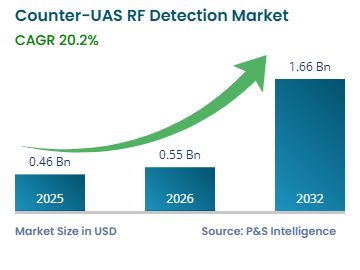
The Counter-UAS RF Detection Market size was USD 0.46 billion in 2025 and is projected to reach USD 0.55 billion in 2026 and USD 1.66 billion by 2032. Revenue in the Counter-UAS RF Detection Market is forecast to advance at a CAGR of 20.2% during 2026–2032 as buyers add passive sensing nodes, threat-library software, direction-finding capability, and support contracts to layered counter-drone programs.
RF detection occupies a distinct position in the sensor stack. It can alert on control, telemetry, and video emissions without transmitting energy, and some systems can identify a drone family, estimate bearing, or locate the aircraft and its operator. Combining passive alerting with signal analysis supports early warning and threat classification, although the result depends on the target emitting a detectable signal. Procurement is consequently shifting from isolated receivers toward connected RF nodes, protocol analytics, and interfaces that pass tracks to radar, cameras, and command systems.
Key Market Insights
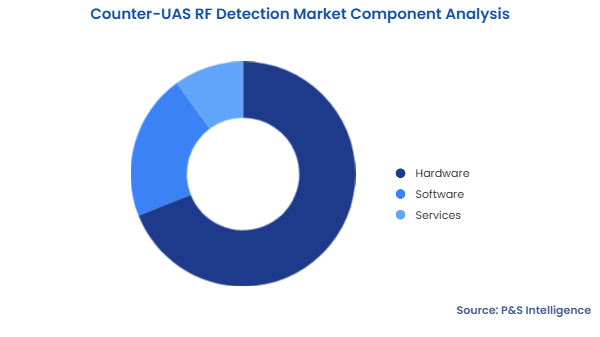
Component, hardware held 69.0% in 2025, and software is forecast to grow at 25% during 2026–2032.
Deployment, fixed/site-based systems held 52.0% in 2025, and UAV-mounted systems are forecast to grow at 26.0% during 2026–2032.
Detection range, more than 1–5 km systems held 45.0% in 2025, and more than 10 km systems are forecast to grow at 24.0% during 2026–2032.
End user, military & defense held 47.0% in 2025, and critical infrastructure is forecast to grow at 24% during 2026–2032.
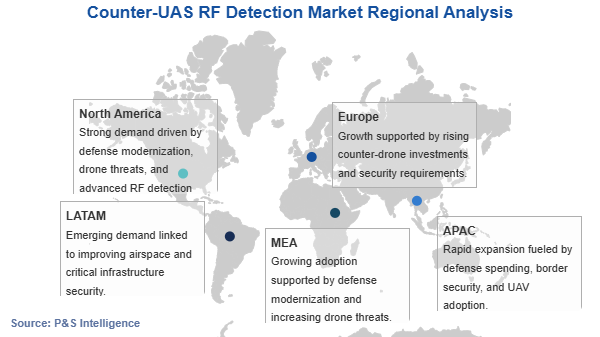
Geography, North America held 40.0% in 2025, and Asia-Pacific is forecast to grow at 24% during 2026–2032.
Counter-UAS RF Detection Market Trends and Drivers
Defense Programs Expand Sensor Demand
Growth in the Counter-UAS RF Detection Market is being driven by defense organizations that need more sensors at bases, borders, ports, and deployed formations. The immediate purchase is rarely an RF receiver alone. A usable capability also requires direction finding, signal classification, software updates, rugged computing, communications, training, and integration with a wider command structure. Each protected location can therefore create demand for several nodes plus recurring support.
The U.S. fiscal 2026 request placed USD 3.1 billion across the services into the broader counter-UAS mission, the U.S. Department of Defense reported. The request does not disclose an RF-detection allocation. It does show that counter-drone procurement has moved beyond experiments into service-level portfolios covering lethal and nonlethal systems.
For suppliers, the commercial test is compatibility with the buyer’s existing sensor and command architecture. A receiver that produces a proprietary alert but cannot share bearing, identity, confidence, and timing data has less value in a layered defense. Defense demand thus favors vendors that can qualify hardware, maintain signal libraries, and expose stable interfaces over the life of the deployment.
Civil Infrastructure Opens a New Opportunity
The largest opportunity in the Counter-UAS RF Detection Market comes from critical infrastructure that needs warning and classification but may have limited authority to interfere with a drone. Passive RF sensing gives airports, ports, utilities, event operators, and public agencies a way to build an airspace picture before deciding whether police, military, or another authorized body must respond.
The European Commission linked a EUR 250 million border-management call to its 2026 counter-drone deployment initiative and proposed voluntary joint purchasing for critical infrastructure. The amount covers broader counter-drone capacity rather than RF sensors alone. Its commercial importance lies in the move from policy discussion toward shared testing, procurement preparation, and deployment programs across civil and defense users.
Civil projects place extra weight on false-alert control, data governance, and the ability to separate authorized from unauthorized operations. They also reward modular purchasing. A site can begin with passive coverage, connect multiple receivers for localization, and later add radar or cameras where non-emitting targets or obstructed paths create gaps.
Software-Defined Detection Shapes Industry Trends
Current industry trends in the Counter-UAS RF Detection Market center on software that extracts more information from the same electromagnetic environment. Frequency hopping, proprietary protocols, cellular links, improvised video transmitters, and new drone models make a static signature catalogue less useful over time. Vendors are responding with faster scanning, protocol-level analysis, machine learning, remote updates, and software that combines observations from several receivers.
NATO’s May 2026 Technical Interoperability Exercise assembled about 300 participants, 40 companies from 11 Allied nations, more than 60 commercial systems, and 40 command-and-control applications, the NATO Communications and Information Agency reported. The scale of the test shows why data exchange has become a purchasing requirement. A buyer must compare sensor quality and the ability to pass usable tracks into a multi-vendor operating picture.
Software also changes revenue timing. Hardware still produces most current sales, but subscriptions, threat-library updates, analytics, and integration releases can generate value after installation. Suppliers that fail to refresh detection logic risk losing performance as protocols and operating tactics change.
Non-Emitting Drones Limit RF Coverage
Passive RF detection needs a signal or exploitable emission. Autonomous aircraft following preloaded routes, fiber-controlled first-person-view drones, and carefully managed low-power links can reduce the information available to an RF sensor. Terrain, antenna placement, dense urban spectrum use, and intentional frequency changes further affect range and classification.
Fiber-controlled drones introduced in combat since late 2024 are resistant to electronic warfare because control and video travel through a physical cable, NATO Allied Command Transformation stated. Its published challenge sought detection from radar, optical, acoustic, thermal, or hybrid sensors for targets as small as 300 by 300 by 100 mm, with an open-terrain detection objective of 500 meters. Those requirements concern a particular fiber-drone challenge and do not measure the RF market.
The constraint directs spending toward layered systems instead of eliminating RF demand. RF sensors remain useful against emitting commercial, improvised, and military links, yet buyers increasingly evaluate them as one part of a detection chain. Vendors must state test conditions precisely and avoid presenting a maximum range or catalogue count as universal performance.
In the Counter-UAS RF Detection Market, hardware accounted for 69.0% of revenue in 2025 because every operational node requires antennas, receivers or spectrum analyzers, processing hardware, power, communications, and environmental protection. Direction finding raises equipment content further by adding calibrated antenna arrays or multiple synchronized sites. An AARTOS X9 configuration can contain as many as six real-time spectrum analyzers and up to 32 tracking antennas, Aaronia AG’s 2026 specification states. The configuration supports a 10 MHz to 6 GHz analyzer range with an 8 GHz option, and the vendor qualifies its distance and accuracy figures by target and line-of-sight conditions.
Hardware demand also grows through density. A single receiver may warn that a compatible signal is present, but several nodes can improve bearing intersection, geolocation, and coverage around obstructions. Buyers protecting a base, airport, port, or industrial campus therefore purchase an architecture made of field nodes, backhaul, edge processing, and central software instead of judging a detector only by its unit price.
Software is forecast to advance at a CAGR of 25% during 2026–2032. The driver is the shortening useful life of static detection logic as drone models, firmware, frequencies, and control methods change. DroneShield Limited states that customers enrolled in its software plans receive quarterly firmware updates for RF devices. Its current software portfolio also connects field detectors to tactical mapping and third-party command systems. Recurring updates let installed hardware address more signals without complete replacement, although each claimed detection improvement still requires operational validation.
Analysis of the Counter-UAS RF Detection Market therefore treats the installed receiver base and its evolving software layer as related purchasing decisions with different replacement cycles.
Deployment
Fixed/site-based systems held 52.0% of revenue in 2025. Persistent protection requires continuous power, elevated antennas, resilient communications, and repeatable coverage, which favor permanent nodes or networked grids. Aaronia AG reported more than 700 permanently installed AARTOS systems worldwide in June 2026. The vendor cited airports among the deployments, so the figure demonstrates installed-site scale but does not establish market share or audited RF-only revenue.
The fixed model supports a different buying decision from a handheld detector. Site operators can connect several receivers, retain event history, define alert zones, and cue other sensors. Installation and integration increase initial cost, but a permanent network can monitor continuously without assigning a detector to each patrol. Vehicle-mounted and portable systems remain important where teams must change location or cannot install infrastructure.
UAV-mounted systems are projected to grow at a CAGR of 26.0% during 2026–2032 from a small base. Elevating the RF payload can reduce terrain masking and move the receiver toward an area of interest without installing towers. Aaronia AG’s AARTOS Hawk T1, introduced in June 2026, weighs under 5 kg and covers 10 MHz to 8 GHz, with an option extending from 9 kHz to 18 GHz. The company reports 245 MHz of real-time bandwidth and a sweep rate of 1,100 GHz per second. These are vendor specifications, not independent field averages.
Airborne RF payloads face their own constraints, including aircraft endurance, payload weight, communications security, airspace permission, and the need to distinguish host-platform emissions from targets. Growth depends on buyers proving that the additional vantage point supplies enough operational value to justify another aircraft, crew, and data link.
Detection Range
Systems rated for 1–5 km generated 45.0% of 2025 revenue. A 1–5 km envelope matches many perimeter, event, prison, port, and tactical warning tasks without requiring a wide-area fixed grid. India’s V.O. Chidambaranar Port Authority selected an integrated RF and radar detection and jamming system with 360-degree coverage and an effective range up to 5 km, India’s Press Information Bureau reported in February 2026.
Range labels need careful interpretation. The distance at which a receiver detects a high-power controller in clear terrain may differ from the distance for a low-power video link behind buildings. Frequency, antenna height, transmitter output, congestion, line of sight, waveform, and the vendor’s detection threshold all matter. Buyers increasingly ask for scenario-based trials instead of accepting one maximum figure.
The more than 10 km category is forecast to expand at a CAGR of 24.0% during 2026–2032. Border corridors, maritime approaches, air bases, and distributed military positions create demand for earlier warning and wider geolocation baselines. Aaronia AG lists a 14 km standard range and a 40 km long-range mode for consumer-UAV targets on the AARTOS X9, plus an 80 km maximum for its stated military-UAV case. Those figures are vendor-rated maxima under specified reference conditions and should not be compared directly with another supplier’s nominal range.
Long-range growth will depend on validated performance against relevant emitters, not a single brochure endpoint. A wide receiver range can increase the number of unrelated signals that software must classify. Effective systems combine antenna gain, scan speed, time synchronization, signal processing, and multiple-site geometry so greater reach does not produce an unusable alert load.
End User
Military & defense buyers accounted for 47.0% of revenue in 2025. Their demand spans fixed-base protection, mobile formations, naval vessels, border operations, and body-worn warning. The NATO Support and Procurement Agency established five framework contracts for tactical and deployable counter-UAS systems in July 2026 and preselected five contractors. The frameworks cover modular sensing and effectors rather than RF detection alone, but they provide defense buyers with a shorter route to qualified multi-vendor capability.
Defense programs also create demanding technical requirements. Receivers may need to operate without emitting, connect to military command networks, function in congested or jammed spectrum, and update quickly when adversaries change links. Qualification therefore tests the sensor as part of an operating chain instead of treating catalogue range as a complete measure of utility.
Critical infrastructure is forecast to grow at a CAGR of 24% during 2026–2032. The European Commission’s counter-drone plan connected a EUR 250 million border-management call with deployment activity and proposed voluntary joint purchasing for critical infrastructure. The program does not disclose an RF-only allocation, but it shows civil protection moving from risk reviews toward procurement preparation and installation.
Infrastructure buyers often require passive detection first because authority to jam, spoof, seize, or destroy an aircraft is restricted. Passive-first workflows create room for RF warning, identification, evidence capture, and escalation. Growth could slow if operators cannot secure budgets, share data with authorized responders, or demonstrate acceptable performance against both emitting and non-emitting targets.
The complete segmentation hierarchy is as follows.
Component
Hardware
Antennas and arrays
Receivers and spectrum analyzers
Edge processors and rugged enclosures
Software
RF-signature and protocol libraries
Detection, classification, and geolocation analytics
Sensor management and RF-native C2 interfaces
Threat-library and feature-update subscriptions
Services
Design and integration
Installation and commissioning
Training
Maintenance and technical support
Deployment
Fixed/site-based
Single-site node
Networked/multilateration grid
Vehicle-mounted
Land vehicle
Maritime vessel
Portable/man-portable
Handheld
Body-worn
Transportable tripod/case
UAV-mounted
Multirotor payload
Fixed-wing payload
Detection range
Up to 1 km
1–5 km
6–10 km
More than 10 km
End user
Military & defense
Land
Air
Naval
Joint/base protection
Homeland security & law enforcement
Border
Police and public safety
Corrections
Critical infrastructure
Energy and utilities
Oil and gas
Ports and logistics
Government facilities
Communications and data centers
Airports & civil aviation
Commercial airports
Air-navigation and aviation-security agencies
Commercial enterprises & event security
Stadiums and events
Corporate campuses
Private security and VIP protection
Drive strategic growth with comprehensive market analysis
North America generated 40% of Counter-UAS RF Detection Market revenue in 2025 and is forecast to grow at 19% during 2026–2032. Its lead derives from a large defense procurement base, established counter-UAS testing organizations, major-event security funding, and specialist suppliers serving military and public-safety users. The region’s buying pattern is cumulative. Existing fielded detectors require software updates, sustainment, replacement, and integration, while new sites add fixed and portable coverage.
North America’s share could decline even while regional revenue grows if Asia-Pacific and Europe deploy networks faster. It would also face pressure if U.S. state and local users cannot obtain durable operating authority or if procurement favors radar and camera layers for non-emitting drones. The region retains an advantage where installed systems and recurring software create follow-on spending.
Asia-Pacific accounted for 23.0% in 2025 and is projected to record Counter-UAS RF Detection Market growth of 24% through 2032, the fastest regional rate. The regional base is forming through different national routes. Defense modernization drives integrated systems, ports and airports buy perimeter security, police agencies procure vehicle-mounted and portable equipment, and domestic electronics suppliers compete for localized contracts. These activities do not follow a single regional procurement framework, which makes country execution more important than policy announcements.
India’s V.O. Chidambaranar Port Authority began implementing an integrated RF, radar, and jamming system in February 2026. The installation was specified for 360-degree coverage and a range up to 5 km, India’s Press Information Bureau stated. China’s public procurement records also show purchases of radio receiving equipment within counter-drone packages.
Asia-Pacific’s rate could change if defense approvals fail to convert into orders, domestic qualification extends delivery cycles, or restrictions limit access to imported receivers and processing components. Faster commissioning at ports, bases, and public venues would move spending forward. Delayed interoperability standards would spread purchases across incompatible systems and raise integration cost.
China represented 31.0% of Asia-Pacific revenue in 2025. Domestic electronics manufacturing, public-security procurement, airport and event security, and demand for locally controlled spectrum systems support its modeled position. The Hainan award offers unusually detailed unit evidence, but one municipal project cannot establish national sales. China’s position would strengthen if comparable public awards show repeated deployment across airports, police organizations, ports, and strategic sites. Greater opacity, purchasing delays, or a shift toward non-RF sensors could reduce the country’s regional share.
India is forecast to grow at 27.0% during 2026–2032, the fastest country rate allocated for analysis. The Indian Defence Acquisition Council approved proposals worth about INR 79,000 crore in December 2025, including the Integrated Drone Detection & Interdiction System Mk-II for the Army, India’s Press Information Bureau reported. The combined amount covers numerous weapons and support systems and does not identify the RF portion of the counter-drone item.
The procurement path continued in July 2026 when the council approved a separate INR 52,000 crore package containing the AKASH TARANG anti-UAV electronic-warfare system among several other capabilities. India also moved counter-drone protection into civil infrastructure through the 5 km V.O. Chidambaranar port project. India’s forecast depends on those approvals becoming delivered systems, domestic suppliers meeting operational tests, and installations receiving continuing software and support funding. Slower contracting or unsuccessful field qualification would weaken the projected rate.
The Counter-UAS RF Detection industry is fragmented. International specialists, defense-electronics groups, integrators, and country-level vendors all compete in the Counter-UAS RF Detection Market for projects that differ across military, airport, police, border, port, and industrial sites. Fragmentation persists because buyers combine RF sensors with different command systems and non-RF layers.
Supplier groups compete on different technical and commercial dimensions. DroneShield Limited spans body-worn detection, vehicle and fixed nodes, RF intelligence hardware, and recurring software updates. Axon Enterprise Inc. connects Dedrone RF sensing with a broader public-safety software and evidence platform. Rohde & Schwarz GmbH & Co. KG brings spectrum-monitoring receivers, antennas, direction finding, and standardized interfaces into the ARDRONIS family. Aaronia AG emphasizes wideband scanning, configurable antenna arrays, fixed grids, and airborne RF geolocation.
D-Fend Solutions AD Ltd. competes through protocol-level RF cyber analysis that links detection with drone and controller identification. Sentrycs Ltd. also works at the protocol layer and positions its detection inside multi-vendor defense architectures. CERBAIR SAS uses modular RF direction finding across site and naval installations. Sensofusion Oy concentrates on persistent passive sensing for government users, and MyDefence Communication ApS supplies portable RF warning for tactical teams.
Entry barriers arise from RF engineering, representative signal data, security qualification, environmental testing, and integration work. A new supplier can build a receiver, yet it must also classify signals in crowded spectrum, update the system as targets change, and prove that alerts can enter the buyer’s command process. Government purchasing adds export controls, local-content requirements, cybersecurity reviews, training, and long support periods.
Market power remains limited by substitution and system architecture. Buyers can combine radar, cameras, acoustic sensors, and several RF products through an open command layer. They can also demand trials against defined targets before scaling. Suppliers gain leverage where installed hardware depends on proprietary updates, but interoperability requirements and multi-vendor frameworks constrain lock-in. The strongest commercial position comes from verified detection performance, maintainable software, and reliable delivery across several deployment forms.
Top Companies in the Counter-UAS RF Detection Market:
DroneShield Limited
Axon Enterprise Inc. (Dedrone)
Rohde & Schwarz GmbH & Co. KG
Aaronia AG
D-Fend Solutions AD Ltd.
Sentrycs Ltd. (Ondas Holdings Inc.)
Sensofusion Oy
MyDefence Communication ApS
CERBAIR SAS
Metis Aerospace Ltd
TRD Systems Pte. Ltd.
Counter-UAS RF Detection Market Developments
August 2026: DroneShield Limited launched RfRecon with claimed sixfold spectrum coverage, fourfold processing and AI compute, 31-fold storage, and eightfold memory gains over earlier industry-adopted solutions. The portable product adds wideband sensing, direction finding, onboard processing, and open command-system interfaces.
July 2026: Axon Enterprise Inc., through Dedrone, was named among five contractors preselected under NATO Support and Procurement Agency framework contracts for tactical and deployable counter-UAS systems. The frameworks create a faster acquisition route while retaining multiple suppliers for resilience and through-life support.
June 2026: Aaronia AG introduced the under-5 kg AARTOS Hawk T1 airborne RF payload at Eurosatory. The vendor specifies coverage from 10 MHz to 8 GHz, 245 MHz of real-time bandwidth, and a 1,100 GHz-per-second sweep rate for mobile geolocation missions.
May 2026: Rohde & Schwarz GmbH & Co. KG demonstrated ARDRONIS during NATO’s Technical Interoperability Exercise, which brought together about 300 participants, 40 companies, more than 60 commercial systems, and 40 command-and-control applications to test multi-vendor counter-drone interoperability.
Frequently Asked Questions About This Report
What is the projected size of the Counter-UAS RF Detection Market?+
The Counter-UAS RF Detection market size was USD 0.46 billion in 2025 and is projected to reach USD 0.55 billion in 2026 and USD 1.66 billion by 2032.
Which regions lead the Counter-UAS RF Detection Market?+
North America accounted for 40% of Counter-UAS RF Detection market share in 2025 and is projected to expand at 19% during 2026-2032.
Why does hardware hold the largest component share?+
In the Counter-UAS RF Detection Market, hardware accounted for 69.0% of revenue in 2025 because every operational node requires antennas, receivers or spectrum analyzers, processing hardware, power, communications, and environmental protection.
How are buyers addressing the limitations of RF detection?+
RF sensors remain useful against emitting commercial, improvised, and military links, yet buyers increasingly evaluate them as one part of a detection chain.
Want a report tailored exactly to your business need?
Leading companies across industries trust us to deliver data-driven insights and innovative solutions for their most critical decisions. From data-driven strategies to actionable insights, we empower the decision-makers who shape industries and define the future. From Fortune 500 companies to innovative startups, we are proud to partner with organisations that drive progress in their industries.
Client Testimonials
Working with P&S Intelligence and their team was an absolute pleasure – their awareness of timelines and commitment to value greatly contributed to our project's success. Eagerly anticipating future collaborations.
McKinsey & Company
India
Unmatched Standards
Our insights into the minutest levels of the markets, including the latest trends and competitive landscape, give you all the answers you need to take your business to new heights
Complete Data Security
We take a cautious approach to protecting your personal and confidential information. Trust is the strongest bond that connects us and our clients, and trust we build by complying with all international and domestic data protection and privacy laws