This Report Provides In-Depth Analysis of the Corporate Wellness Market Report Prepared by P&S Intelligence, Segmented by Service Type (Health Risk Assessment, Fitness, Smoking Cessation, Health Screening, Nutrition & Weight Management, Stress Management), End User (Small-Scale Organizations, Medium-Scale Organizations, Large-Scale Organizations), and Geographical Outlook for the Period of 2021 to 2032
Explore the market potential with our data-driven report
Corporate Wellness Market Overview
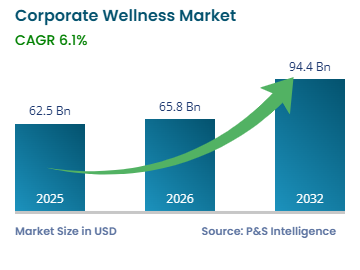
The corporate wellness market size was USD 62.5 billion for 2025, and it will grow by 6.1% during 2026–2032, to reach USD 94.4 billion by 2032.
The market is driven by the growing focus of employers on employee health, productivity, retention, and healthcare cost management. Companies are increasingly expanding wellness initiatives beyond traditional fitness programs to include mental health support, preventive healthcare, nutrition, stress management, financial wellness, and employee assistance programs. The WHO estimates that 12 billion working days are lost annually due to depression and anxiety, costing the global economy around USD 1 trillion in lost productivity, highlighting the economic impact of poor employee well-being.
Employer commitment to wellness programs is also strengthening demand as organizations increasingly integrate well-being into their broader workforce strategies. According to the Business Group on Health’s 2025 Employer Well-being Strategy Survey, 93% of employers planned to maintain or increase their well-being offerings, with 20% planning to increase investment and 73% maintaining existing programs. Employers are also shifting toward more comprehensive and measurable programs, with greater emphasis on mental health, physical health, financial well-being, and data-driven evaluation of program outcomes.
Key Market Insights
The health risk assessment category holds the largest market share, of 35%, in 2025, driven by its role in identifying employee health risks and guiding preventive wellness programs.
The stress management category will have the highest CAGR, of approximately 6.6%, driven by rising workplace stress, burnout, and mental-health concerns.
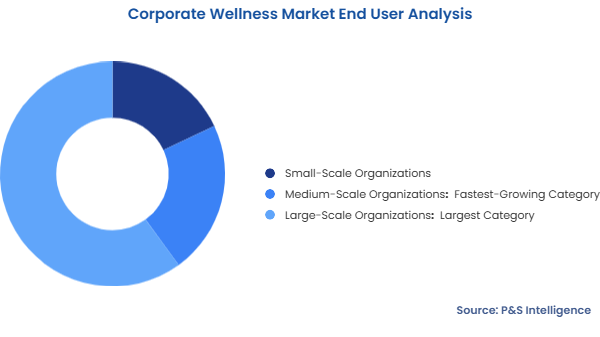
The large-scale organizations category holds the largest market share, of 60%, in 2025, driven by larger employee bases, greater resources, and established HR structures.
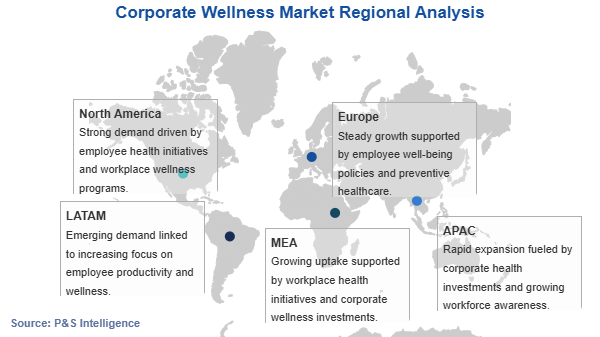
North America holds the largest market share, of 40%, in 2025, supported by strong employer-sponsored healthcare, high corporate wellness spending, and widespread program adoption.
Asia-Pacific will have the highest CAGR, of approximately 7.0%, driven by rising employee wellness awareness, healthcare spending, and adoption of digital wellness solutions.
Corporate Wellness Market Trends and Drivers
Shift toward Data-Driven and Personalized Wellness Programs Are Key Trends
Employers are increasingly moving away from traditional, standardized wellness programs toward personalized and data-driven solutions designed around employees’ individual health and well-being needs. Wellness providers are integrating digital platforms, health assessments, wearable data, dashboards, and AI-enabled tools to deliver personalized interventions, improve employee engagement, and track program effectiveness.
This trend is being reinforced by the growing demand for measurable wellness outcomes and return on investment (ROI). Employers are increasingly requiring wellness providers to demonstrate program effectiveness through employee health data, participation metrics, and outcome measurement. According to the Business Group on Health’s 2026 Employer Well-being Strategy Survey, employers are increasingly using data and dashboards to track health trends and evaluate well-being programs, while AI is emerging as a tool for personalization.
Growing Focus on Employee Mental Health Is Biggest Driver
The growing focus on employee mental health is a major driver, as employers increasingly recognize that stress, anxiety, depression, and burnout can reduce productivity, increase absenteeism, and affect employee retention. This is encouraging organizations to expand spending on mental health counseling, employee assistance programs (EAPs), stress-management services, mindfulness programs, and digital mental-health solutions. The growing use of these services is also evident among employers, with 73% reporting an increase in employee use of mental health and substance-use disorder services, according to the Business Group on Health’s 2026 Employer Health Care Strategy Survey.
The economic impact of poor workplace mental health further strengthens the need for employer-supported wellness programs. The WHO estimates that 12 billion working days are lost annually due to depression and anxiety, costing the global economy approximately USD 1 trillion in lost productivity. The employers are increasingly integrating mental health into broader employee well-being strategies, creating sustained demand for corporate wellness services.
Data Privacy and Regulatory Compliance Concerns Are Key Restraints
Data privacy and regulatory compliance concerns are a major restraint, as corporate wellness programs increasingly collect sensitive employee information through health assessments, biometric screenings, wearable devices, mental-health services, and digital platforms. Employees may be reluctant to participate if they are concerned about how their health information will be collected, stored, or shared, while employers and wellness providers must establish appropriate safeguards and comply with applicable privacy and employment regulations. The U.S. Department of Health and Human Services notes that the privacy protections applicable to wellness programs depend on how the program is structured, creating additional compliance complexity.
These concerns can reduce employee participation and increase implementation and compliance costs, particularly as wellness programs become more personalized and data-intensive. Employers must ensure that health information is appropriately protected and that wellness initiatives do not create discrimination or confidentiality risks. SHRM also highlights the complex privacy and discrimination requirements that employers need to consider when implementing workplace wellness programs.
Integration of AI and Digital Wellness Solutions Are Biggest Opportunities
The growing integration of AI and digital technologies into corporate wellness programs presents a significant opportunity, as employers seek scalable solutions that can personalize employee experiences, improve engagement, and provide convenient access to health and well-being services. AI-enabled platforms can support personalized recommendations, wellness assessments, employee communications, and navigation of available resources, while digital platforms can extend services to remote, hybrid, and geographically dispersed workforces. The opportunity is particularly relevant as employers increasingly seek technology that can improve both employee experience and program effectiveness.
The opportunity is further supported by the growing use of data and demand for measurable outcomes. The Business Group on Health's 2026 Employer Well-being Strategy Survey found that 156 employers collectively representing 12.4 million employees worldwide participated in the survey, while its findings show that data and dashboards now play a central role in employer well-being decisions, including tracking employee health trends and assessing program performance. In addition, the 2025 survey found that 94% of employers planned to increase expectations of wellness vendors to demonstrate improved outcomes, creating an opportunity for providers offering AI, analytics, personalization, and measurable outcome tracking.
Corporate Wellness Market Segmentation Analysis
Service Type Analysis
The health risk assessment category holds the largest market share, of 35%, in 2025, as it provides employers with an initial understanding of employees’ health risks and helps them design targeted preventive and wellness interventions. Its broad applicability across employee populations, combined with increasing employer focus on preventive healthcare and early identification of chronic health risks, supports its widespread adoption.
The stress management category will have the highest CAGR, of approximately 6.6%, driven by the growing impact of workplace stress, burnout, and mental-health concerns on employee productivity and retention. Employers are increasingly expanding wellness offerings to include mindfulness, resilience training, counseling, employee assistance programs, and digital mental-health services, making stress management one of the fastest-expanding areas of corporate wellness spending. According to the Business Group on Health, 100% of surveyed employers included mental health in their well-being strategies in 2025, highlighting the growing importance of mental health support in workplace wellness programs.
The service types analyzed in this report are:
Health Risk Assessment (Largest Category)
Fitness
Smoking Cessation
Health Screening
Nutrition & Weight Management
Stress Management (Fastest-Growing Category)
Others
End User Analysis
The large-scale organizations category holds the largest market share, of 60%, in 2025, driven by their larger employee populations, greater financial resources, and more established HR and employee-benefit structures. Larger employers are generally better positioned to offer comprehensive wellness programs across multiple areas, including physical health, mental health, preventive care, nutrition, and financial well-being. CDC research also indicates that larger worksites are more likely to offer workplace health programs; for example, 75.8% of worksites with 500 or more employees offered physical activity programs, compared with 24.7% among worksites with 10–24 employees.
The medium-scale organizations category will have the highest CAGR, as these organizations increasingly recognize wellness benefits as a tool for attracting and retaining employees while expanding access to structured programs. SHRM's 2025 Employee Benefits Survey, based on responses from 3,969 HR professionals across organizations of different sizes, found that 88% of employers rated health-related benefits as very or extremely important, highlighting the importance of health benefits across the employer landscape. At the same time, digital and flexible wellness solutions are making programs easier for mid-sized organizations to implement without the infrastructure required by very large employers. CDC guidance specifically supports workplace health programs for employers of different sizes, including small businesses.
Drive strategic growth with comprehensive market analysis
Corporate Wellness Market Regional Analysis
North America Corporate Wellness Market Size
North America holds the largest market share, of 40%, in 2025, driven by a highly developed employer-sponsored healthcare and employee benefits system, substantial corporate spending on employee health, and widespread adoption of comprehensive wellness programs, particularly in the U.S. In the U.S., 97% of large firms offered health benefits to at least some workers in 2025, creating a large employer-funded ecosystem in which wellness solutions can be integrated with healthcare and benefits programs.
Another major factor is high healthcare costs, which encourage employers to invest in preventive health, mental health, weight management, and other wellness initiatives to improve employee outcomes and manage healthcare expenditure. U.S. employer-sponsored family health insurance premiums reached USD 26,993 per year in 2025, up 6% from 2024. In addition, the Business Group on Health reported that 93% of surveyed employers planned to maintain or increase their well-being offerings in 2025, demonstrating strong corporate commitment to wellness spending.
U.S. Corporate Wellness Market Size
The U.S. is the largest country market, driven by its highly developed employer-sponsored healthcare system, high corporate healthcare spending, and widespread adoption of workplace wellness programs. In 2025, 97% of U.S. firms with 200 or more employees offered health benefits to at least some workers, creating a large employer-funded base for wellness services. High healthcare costs further encourage employers to invest in preventive health, chronic-disease management, mental health, and lifestyle programs. Average employer-sponsored family health insurance premiums reached approximately USD 26,993 in 2025, increasing the focus on managing employee health and healthcare expenditure.
Asia-Pacific Corporate Wellness Market Size
Asia-Pacific will have the highest CAGR, of approximately 7.0%, driven by increasing awareness of employee well-being, rising corporate healthcare spending, growing demand for mental health and preventive healthcare services, and rapid adoption of digital wellness solutions. The region also has a large and expanding workforce, with the ILO estimating that employment in Asia and the Pacific would grow by 1.7% in 2025, equivalent to around 34 million additional jobs, the fastest employment growth among the major global regions.
Growth is further supported by the increasing adoption of corporate wellness programs in India, China, Japan, South Korea, and Southeast Asia, as employers seek to improve employee productivity, engagement, and retention while addressing workplace stress and lifestyle-related health risks. Digital platforms, mobile health applications, virtual wellness programs, and personalized health solutions are also improving accessibility and scalability across the region.
China Corporate Wellness Market Size
China holds the largest share of the Asia-Pacific Corporate Wellness Market, driven by its large corporate workforce, expanding business sector, increasing focus on employee well-being, and growing demand for mental health, preventive healthcare, and workplace wellness programs. The country's large employee base provides a substantial addressable population for corporate wellness providers. China had 725.04 million employed people at the end of 2025, including 475.35 million urban employees, according to the National Bureau of Statistics of China. This large urban workforce, combined with the concentration of employees in corporate and service-sector industries, supports strong demand for workplace health and wellness solutions.
The regions and countries analyzed in this report are:
North America (Largest Regional Market)
U.S. (Larger Country)
Canada (Faster-Growing Country)
Europe
Germany (Largest Country)
U.K. (Fastest-Growing Country)
France
Italy
Spain
Rest of Europe
Asia-Pacific (Fastest-Growing Regional Market)
China (Largest Country)
India (Fastest-Growing Country)
Japan
South Korea
Australia
Rest of APAC
Latin America
Brazil (Largest Country)
Mexico (Fastest-Growing Country)
Rest of LATAM
Middle East & Africa
Saudi Arabia
South Africa
U.A.E. (Largest and Fastest-Growing Country)
Rest of MEA
Corporate Wellness Market Competitive Landscape
The market is fragmented, with the presence of numerous global, regional, and specialized providers offering services across health risk assessment, fitness, mental health, nutrition, stress management, preventive screening, and employee assistance. The market remains fragmented because wellness requirements vary by employer, workforce size, geography, and employee needs, allowing specialized providers to compete alongside integrated platforms. At the same time, mergers, acquisitions, and partnerships are gradually increasing consolidation, as larger companies seek to broaden their service portfolios and provide more integrated wellness solutions.
Top Companies in the Corporate Wellness Market:
Personify Health
Wellhub
ComPsych Corporation
Wellable, LLC
The Vitality Group, Inc.
EXOS
Headspace, Inc.
Calm.com, Inc.
Lyra Health, Inc.
Spring Health, Inc.
TELUS Health
Truworth Health Technologies Private Limited
Corporate Wellness Market Developments
In June 2026, Personify Health partnered with Solera Health to create a managed, performance-based digital health network, integrating Solera’s digital health solutions into the Personify member experience.
In January 2026, Wellhub, LLC launched Wellhub AI, an AI-powered conversational wellness coach, alongside international gym and studio check-ins, expanding its technology-enabled corporate wellness offering.
In May 2025, TELUS Health completed its acquisition of Workplace Options, strengthening its global employee and family assistance and well-being capabilities. The transaction created a network of more than 180,000 providers across 200+ countries and territories.
In April 2025, Lyra Health, Inc. launched Lyra Empower, an AI-powered platform designed to provide personalized mental-health care, actionable insights for HR leaders, and more efficient provider workflows.
Frequently Asked Questions About This Report
What are the key factors driving the corporate wellness market?+
The market is driven by growing employer focus on employee health, productivity, retention, and healthcare cost management, along with rising demand for preventive healthcare and mental health support.
What are the major trends shaping the corporate wellness market?+
Major trends include personalized and data-driven wellness programs, greater focus on mental health, digital wellness platforms, wearable technologies, and broader wellness offerings beyond traditional fitness.
What are the major challenges facing the corporate wellness market?+
Key challenges include data privacy and regulatory concerns, employee participation, implementation costs, and difficulties in measuring program outcomes and return on investment.
What are the key opportunities in the corporate wellness market?+
Key opportunities include AI-enabled wellness solutions, digital platforms, personalized interventions, health analytics, and integrated physical and mental wellness programs.
How is technology transforming the corporate wellness market?+
Technology is enabling digital wellness platforms, wearable-data integration, AI-based personalization, virtual wellness services, and data-driven tracking of employee engagement and outcomes.
Want a report tailored exactly to your business need?
Leading companies across industries trust us to deliver data-driven insights and innovative solutions for their most critical decisions. From data-driven strategies to actionable insights, we empower the decision-makers who shape industries and define the future. From Fortune 500 companies to innovative startups, we are proud to partner with organisations that drive progress in their industries.
Client Testimonials
Working with P&S Intelligence and their team was an absolute pleasure – their awareness of timelines and commitment to value greatly contributed to our project's success. Eagerly anticipating future collaborations.
McKinsey & Company
India
Unmatched Standards
Our insights into the minutest levels of the markets, including the latest trends and competitive landscape, give you all the answers you need to take your business to new heights
Complete Data Security
We take a cautious approach to protecting your personal and confidential information. Trust is the strongest bond that connects us and our clients, and trust we build by complying with all international and domestic data protection and privacy laws