This Report Provides In-Depth Analysis of the Contact Lenses Market Report Prepared by P&S Intelligence, Segmented by Usage (Daily Wear, Extended Wear, Traditional Wear), Design (Spherical, Toric, Multifocal, Monovision, Cosmetic), Type (Opaque Contact Lenses, Enhanced Contact Lenses, Tinted Contact Lenses), Application (Conventional, Orthokeratology, Decorative), Distribution Channel (Retail Stores, Hospitals & Clinics, E-Commerce), and Geographical Outlook for the Period of 2021 to 2032
Explore the market potential with our data-driven report
Contact Lenses Market Overview
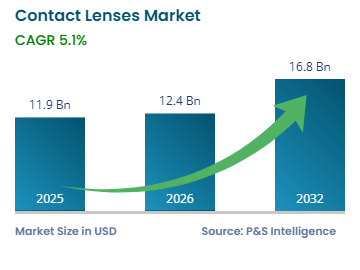
The contact lenses market size was USD 11.9 billion for 2025, and it will grow by 5.1% during 2026–2032, to reach USD 16.8 billion by 2032.
The market is driven by the growing need for vision-correction solutions associated with refractive errors, including myopia, hyperopia, astigmatism, and presbyopia. According to the World Health Organization (WHO), at least 2.2 billion people globally have near or distance vision impairment, with uncorrected refractive errors representing a significant cause of vision impairment. The substantial population requiring vision correction provides a strong underlying demand base for contact lenses. Market growth is further supported by increasing awareness of eye health, greater access to vision-care services, rising frequency of eye examinations, and consumer preference for contact lenses as an alternative to spectacles. Contact lenses offer advantages such as a wider field of vision and greater suitability for certain lifestyle and occupational activities, while cosmetic applications, particularly colored lenses, are also contributing to demand among younger consumers.
Technological advancements in lens materials and designs are further strengthening market adoption by addressing requirements related to comfort, oxygen permeability, convenience, and specialized vision correction. The U.S. Food and Drug Administration (FDA) notes that silicone-hydrogel materials enable greater oxygen transmission to the cornea, while daily disposable lenses allow users to replace lenses each day, supporting improved convenience and hygiene. These developments have contributed to the increasing adoption of advanced products, including silicone-hydrogel, daily disposable, toric, and multifocal lenses, which cater to a broader range of consumer and clinical requirements. In addition, the growing prevalence of myopia, the aging population requiring multifocal correction, increasing demand for astigmatism-correction lenses, and continued product innovation are creating opportunities for manufacturers to expand their product portfolios and address previously underserved vision-correction needs.
Key Market Insights
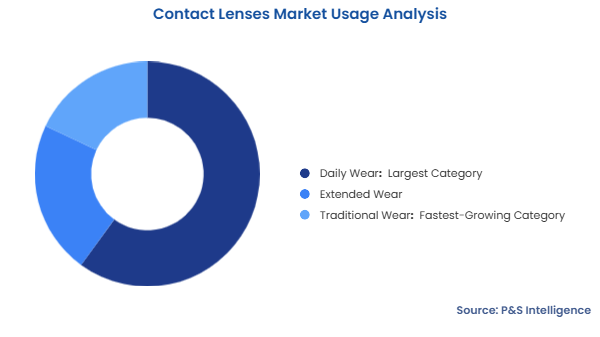
The daily wear category holds the largest market share, of 60%, in 2025, driven by its suitability for routine daytime vision correction.
The toric category will have the highest CAGR, of approximately 5.7%, driven by rising demand for astigmatism correction.
The opaque contact lenses category holds the largest market share, of 55%, in 2025, driven by their strong eye-color transformation.
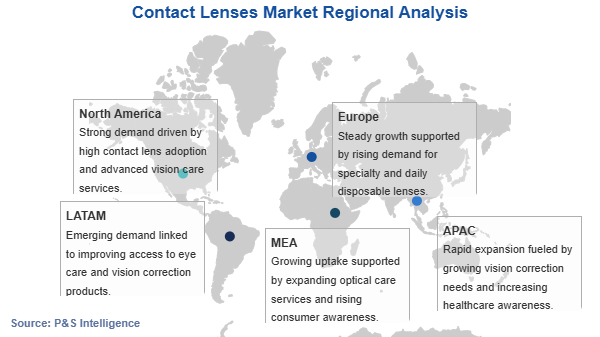
North America holds the largest market share, of 40%, in 2025, supported by its established user base and advanced eye-care infrastructure.
Asia-Pacific will have the highest CAGR of approximately 6.0%, driven by rising refractive errors, urbanization, awareness, and improved eye-care access.
Contact Lenses Market Trends and Drivers
Growing Adoption of Myopia-Control Contact Lenses Are Key Trends
The contact lenses market is increasingly moving beyond traditional vision correction toward myopia management, particularly among children and adolescents. Rising prevalence of myopia, greater awareness of its long-term risks, and increasing focus on early intervention are encouraging eye-care professionals to prescribe specialized soft contact lenses and orthokeratology lenses. These products are designed to slow myopia progression while providing vision correction, creating a growing specialty segment and opening opportunities for manufacturers to develop more advanced, comfortable, and child-friendly lens designs.
The trend is clearly visible in prescribing patterns. Soft myopia-control lens fittings increased from 0% in 2011 to 30.4% in 2024, while orthokeratology myopia-control fittings increased from 40.8% to 86.9% of rigid-lens fits during the same period. This growth reflects increasing awareness among practitioners and parents and is encouraging manufacturers to invest in specialized myopia-control products, creating opportunities for product innovation and premiumization within the market.
Growing Aging Population and Rising Presbyopia Are Biggest Drivers
The aging population and increasing prevalence of presbyopia are creating new opportunities for multifocal and other presbyopia-correcting contact lenses. As consumers remain active for longer and continue to seek alternatives to reading glasses and progressive spectacles, demand is shifting toward lenses that can provide clear vision at multiple distances. Manufacturers are responding with more advanced multifocal designs, including products designed for patients with both presbyopia and astigmatism, expanding the range of patients who can be fitted with contact lenses.
Recent prescribing data demonstrates this growing adoption. The 2025 International Contact Lens Prescribing survey, covering 11,264 contact-lens fits across 24 countries, found that multifocal designs accounted for 17% of soft contact-lens fits in 2025. This trend is also supported by recent product innovation in 2025, Johnson & Johnson introduced a daily disposable multifocal toric lens for patients with both presbyopia and astigmatism, illustrating how manufacturers are expanding specialty offerings to address the needs of an aging contact-lens population.
Risk of Eye Infections and Complications Are Key Restraints
The risk of eye infections and other ocular complications associated with contact lens use is a significant restraint on market growth. Contact lenses are placed directly on the eye, requiring proper fitting, handling, cleaning, storage, and replacement to maintain ocular health. Failure to follow recommended wearing and hygiene practices can increase the risk of complications such as corneal infections, irritation, inflammation, and other adverse eye conditions. Unlike spectacles, contact lenses therefore require a higher level of user compliance and ongoing care, which can discourage some consumers from adopting or continuing to use them.
The need for regular lens care and responsible wearing practices can also limit long-term user retention. Consumers may experience discomfort, dryness, or irritation, particularly when lenses are worn for extended periods or when the appropriate lens type and replacement schedule are not followed. These concerns can lead users to reduce their wearing frequency or switch back to spectacles, limiting repeat usage and adoption. In addition, the requirement for professional fitting and periodic eye examinations adds to the overall effort associated with contact lens use, making convenience and ease of maintenance important considerations when consumers choose between contact lenses and alternative vision-correction methods.
Expansion of Scleral and Specialty Contact Lenses Are Biggest Opportunities
The expansion of scleral and other specialty contact lenses represents a significant opportunity because these products address complex vision-correction and ocular-surface needs that conventional soft lenses may not adequately address. Scleral lenses are particularly useful for patients with irregular corneas, keratoconus, and severe dry-eye or ocular-surface conditions. Unlike conventional lenses, scleral lenses vault over the cornea and rest on the sclera, creating a fluid reservoir that can support the ocular surface while also providing vision correction. This enables manufacturers to target specialized patient groups through customized lens designs.
Recent prescribing evidence highlights the growing potential of this segment. The 2025 International Contact Lens Prescribing Survey reported that scleral lenses accounted for 19% of rigid-lens fits across the markets surveyed. In addition, a 2025 peer-reviewed study of 27,430 scleral lenses found that mini-scleral lenses increased from 44% of scleral lenses in 2016 to 74% in 2022, indicating a shift toward smaller and more refined specialty designs. These developments create opportunities for manufacturers to expand customized specialty portfolios and address increasingly diverse and complex ocular needs.
Contact Lenses Market Segmentation Analysis
Usage Analysis
The daily wear category holds the largest market share, of 60%, in 2025, as these lenses are intended for daytime use and removed before sleeping, making them suitable for routine vision correction. Their broad applicability across different users, combined with the availability of both reusable and disposable formats, supports their widespread adoption. According to the 2025 International Contact Lens Prescribing Survey, daily-wear reusable lenses accounted for 40% of all reported lens fits, while daily disposable lenses accounted for 44%, highlighting the strong position of daytime-use modalities in contact-lens prescribing.
Traditional wear category will have the highest CAGR, of approximately 5.3%, supported by continued demand for reusable lenses among consumers who prefer established wearing and replacement routines. Traditional lenses can be attractive to users seeking reusable options with a lower frequency of replacement, while their established use and availability through eye-care channels support continued demand.
The usages analyzed in this report are:
Daily Wear (Largest Category)
Extended Wear
Traditional Wear (Fastest-Growing Category)
Design Analysis
The spherical category holds the largest market share, of 40%, in 2025, as these lenses are designed to correct common refractive errors such as myopia and hyperopia and therefore address a broad base of contact-lens users. Their simple design, wide prescription availability, and established use in routine vision correction support their dominant position within the design segment. About half of all soft lenses prescribed in 2025 were spherical, making them the most widely prescribed soft-lens design.
The toric category will have the highest CAGR, of approximately 5.7%, supported by increasing demand for contact lenses that correct astigmatism alongside myopia or hyperopia. Improvements in lens design, stabilization, fitting accuracy, and product availability have expanded the suitability of toric lenses for patients requiring astigmatic correction. An international prescribing study published in 2024, covering 220,934 soft daily-wear single-vision lens fits across 20 countries, found that toric-lens prescribing increased from 24.4% in 2000 to 46.2% in 2023, demonstrating substantial growth in the adoption of toric designs.
The designs analyzed in this report are:
Spherical (Largest Category)
Toric (Fastest-Growing Category)
Multifocal
Monovision
Cosmetic
Type Analysis
The opaque contact lenses category holds the largest market share, of 55%, in 2025, driven by their ability to provide a more pronounced change in natural eye color and create a visible color transformation across different iris colors. Their higher pigmentation and broader visual effect make them suitable for consumers seeking noticeable cosmetic enhancement, including fashion, beauty, theatrical, and costume applications. According to the FDA, opaque iris patterns can reduce visible-light transmission, with the amount of transmission depending on the lens design, highlighting the higher degree of pigmentation used to create the desired color-changing effect.
The tinted contact lenses category will have the highest CAGR, supported by increasing consumer interest in subtle eye-color enhancement and personalized appearance. Unlike opaque lenses, tinted lenses can enhance or modify the natural eye color while maintaining a comparatively natural appearance, making them suitable for consumers seeking everyday cosmetic use rather than a dramatic transformation. ACUVUE identifies enhancement-tint lenses as a distinct colored-contact-lens type and notes their use for making natural eye colors appear more vibrant, reflecting the growing range of aesthetic applications for tinted lenses.
The types analyzed in this report are:
Opaque Contact Lenses (Largest Category)
Enhanced Contact Lenses
Tinted Contact Lenses (Fastest-Growing Category)
Application Analysis
The conventional category holds the largest market share in 2025, as conventional contact lenses are primarily used for routine refractive correction and address the broadest range of everyday vision-correction requirements. Their established clinical use, broad prescription availability, and suitability for common refractive errors support their dominant position within the application segment. In the 2025 international contact-lens prescribing survey, conventional/non-myopia-control lenses represented 59% of all contact-lens fits recorded during 2020–2024 among the countries included in the current myopia-control analysis, indicating that conventional applications continue to account for a substantial share of prescribing.
The orthokeratology category will have the highest CAGR, of approximately 5.5%, supported by increasing interest in overnight lenses that temporarily reshape the cornea and provide functional vision correction during the daytime without wearing lenses. Its use is also expanding in myopia-management applications, particularly among children and adolescents. A 2025 international study covering 8,578 contact-lens fits across 20 countries found that orthokeratology myopia-control fits increased from 40.8% of rigid-lens fits in 2011 to 86.9% in 2024, demonstrating substantial growth in the use of orthokeratology within myopia-control prescribing.
The applications analyzed in this report are:
Conventional (Largest Category)
Orthokeratology (Fastest-Growing Category)
Decorative
Distribution Channel Analysis
The retail stores category holds the largest market share, of 65%, in 2025, as physical retail outlets provide consumers with convenient access to contact lenses along with product selection, fitting support, and assistance from optical professionals. The channel remains particularly relevant for new users and consumers purchasing lenses that require professional guidance. According to Contact Lens Spectrum’s 2025 industry data, practitioners estimated that 61% of their patients purchased contact lenses directly from their practice, compared with 28% purchasing online and 8% through third-party retailers.
The e-commerce category will have the highest CAGR, supported by increasing consumer preference for convenient online ordering, price comparison, home delivery, and repeat purchasing. The growing familiarity of existing contact-lens users with online replenishment is strengthening this channel, particularly for consumers who already have an established prescription and know their preferred lens brand and specifications. Contact Lens Institute research conducted in 2024 found that 33% of U.S. consumers purchased their contact lenses online, while its consumer research showed that approximately one-third of contact-lens wearers purchased from online retailers not affiliated with their eye doctor.
The distribution channels analyzed in this report are:
Retail Stores (Largest Category)
Hospitals & Clinics
E-Commerce (Fastest-Growing Category)
Drive strategic growth with comprehensive market analysis
Contact Lenses Market Geographical Analysis
North America Contact Lenses Market Size
North America holds the largest market share, of 40%, in 2025, supported by a large established user base, developed eye-care infrastructure, and high accessibility to contact-lens fitting and prescription services. The U.S. CDC reports that approximately 45 million people in the United States wear contact lenses, demonstrating the substantial scale of the regional consumer base. The United States also benefits from a mature network of optometrists, ophthalmologists, optical retailers, and contact-lens providers, supporting both prescription and replacement purchases. The combination of a large contact-lens-wearing population and established professional eye-care infrastructure creates strong underlying demand for contact lenses across the region.
Canada further strengthens the regional market through its established optical and eye-care infrastructure. Statistics Canada reported 6,665 optometrist offices and 3,646 optical-goods retail locations across Canada in December 2023, with these businesses providing services including the prescription, fitting, and sale of contact lenses. Canada also had 6,400 optometrists and 11,700 opticians in 2023, supporting access to professional vision-care services. In addition, nationwide retail sales of prescription eyewear, including contact lenses and prescription sunglasses, reached CAD 695 million in Q4 2023. These figures demonstrate the strength of the region's established vision-care ecosystem, with the United States providing the largest consumer base and Canada contributing through its developed optical and professional eye-care infrastructure.
Asia-Pacific Contact Lenses Market Size
Asia-Pacific will have the highest CAGR of approximately 6.0%, supported by the region's high prevalence of refractive errors, expanding urban population, increasing awareness of vision correction, and improving access to eye-care services. The World Health Organization's Western Pacific Region reports that myopia has reached epidemic levels in parts of East and Southeast Asia, with prevalence approaching 50% among adolescents in countries such as China and Singapore and reaching around 80% among young adults in some areas. This creates a large and expanding population requiring vision-correction solutions and provides a strong base for contact-lens adoption. The region also includes several large and rapidly developing consumer markets, where rising disposable incomes and greater awareness of alternatives to spectacles are increasing the accessibility of contact lenses.
The growth opportunity is particularly strong in China, India, and other emerging Asian markets, where improvements in healthcare access and changing consumer preferences are expanding the addressable customer base. A 2024 analysis published in the Asia-Pacific Journal of Ophthalmology highlighted the increasing concern surrounding myopia in Southeast Asia and noted that myopia prevalence among young adults in countries such as Thailand and Indonesia may be approaching levels observed in East Asian myopia epidemics. In addition, a 2025 international contact-lens prescribing study found that the proportion of orthokeratology myopia-control fits among rigid-lens fits increased from 40.8% in 2011 to 86.9% in 2024, demonstrating the increasing use of contact-lens-based myopia-management solutions internationally, including markets across the Asia-Pacific region.
China Contact Lenses Market Size
China represents a significant market within Asia-Pacific, supported by the country's large population with refractive errors and increasing emphasis on myopia prevention and management. The high prevalence of myopia, particularly among children and adolescents, creates a substantial need for vision-correction products, including specialized contact lenses and orthokeratology. In 2024, China's Ministry of Education, National Health Commission, and National Disease Control and Prevention Administration issued a joint directive strengthening myopia prevention among children and primary-school students, including regular vision screening, monitoring, eye-health education, and increased outdoor activity. The clinical application of contact lenses is also developing in this market; a 2024 real-world study of 212 Chinese children found that orthokeratology lenses produced an average axial-length increase of 0.18–0.20 mm over one year, demonstrating their established use as a myopia-management option in Chinese clinical practice.
The regions and countries analyzed in this report are:
North America (Largest Regional Market)
U.S. (Larger & Faster-Growing Country)
Canada
Europe
Germany (Largest Country)
U.K.
France (Fastest-Growing Country)
Italy
Spain
Rest of Europe
Asia-Pacific (Fastest-Growing Regional Market)
China (Largest Country)
India (Fastest-Growing Country)
Japan
South Korea
Australia
Rest of APAC
Latin America
Brazil (Largest Country)
Mexico (Fastest-Growing Country)
Rest of LATAM
Middle East & Africa
Saudi Arabia (Largest Country)
South Africa
U.A.E. (Fastest-Growing Country)
Rest of MEA
Contact Lenses Market Competitive Landscape
The market is semi-consolidated, with a small group of established multinational manufacturers accounting for a significant portion of global demand, while several regional and specialty-lens companies compete across specific product categories and geographic markets. Leading companies such as Johnson & Johnson Vision, Alcon, CooperVision, and Bausch + Lomb have extensive product portfolios spanning spherical, toric, multifocal, daily disposable, myopia-management, and specialty lenses. Their established brands, broad distribution networks, manufacturing capabilities, and relationships with eye-care professionals create substantial barriers for smaller competitors. At the same time, the market remains open to competition from companies specializing in particular technologies, geographic markets, or niche applications such as orthokeratology and scleral lenses. The presence of both dominant multinational manufacturers and specialized competitors creates a competitive environment with strong established players alongside opportunities for smaller companies to differentiate through product innovation and specialized applications.
Key Players in the Contact Lenses Market:
Johnson & Johnson Vision Care, Inc.
Alcon Laboratories, Inc.
CooperVision, Inc.
Bausch + Lomb Incorporated
EssilorLuxottica S.A.
Menicon Co., Ltd.
HOYA Corporation
SEED Co., Ltd.
Contamac Ltd.
Euclid Vision Corporation
Carl Zeiss AG
Blanchard Contact Lens, Inc.
X-Cel Specialty Contacts
Visioneering Technologies, Inc.
Mark'ennovy Personalized Care, S.L.
Contact Lenses Market Developments
In February 2026, Alcon Laboratories, Inc. launched TOTAL30 Multifocal for Astigmatism, a monthly multifocal toric contact lens incorporating its Water Gradient Technology. The product expands Alcon's portfolio for patients requiring correction for both presbyopia and astigmatism and strengthens its position in the specialty contact-lens segment.
In June 2025, Johnson & Johnson Vision Care, Inc. launched ACUVUE OASYS MAX 1-Day MULTIFOCAL for ASTIGMATISM in the United States and Canada. The company positioned the product as a daily disposable multifocal toric lens, combining correction for presbyopia and astigmatism in a single lens and expanding its ACUVUE OASYS MAX portfolio.
In August 2025, CooperVision, Inc. expanded its plastic-neutral contact-lens initiative to Hong Kong, bringing the program to 34 countries and territories. The initiative, implemented in collaboration with Plastic Bank, supports the collection and recycling of ocean-bound plastic equivalent to the amount of plastic used in participating CooperVision products.
In September 2025, Bausch + Lomb Incorporated launched its ASANA Gas Permeable (GP) contact lenses in the United States, expanding its specialty lens portfolio with spherical, aspheric, toric, multifocal, multifocal toric, reverse-geometry, and keratoconic designs. The portfolio is designed to address patients with complex vision-correction requirements, including astigmatism, keratoconus, and post-surgical conditions.
Frequently Asked Questions About This Report
What are the major factors driving the contact lenses market?+
Rising vision-correction needs, myopia and presbyopia prevalence, greater eye-health awareness, improved access to eye care, and product innovation are driving demand.
Why are daily disposable contact lenses gaining popularity?+
Daily disposables offer greater convenience and hygiene because they are worn once and discarded without requiring cleaning or storage.
How is myopia management creating opportunities for contact lenses?+
Myopia-control lenses correct vision while helping slow myopia progression, creating demand for specialized lenses, particularly among children.
Why are scleral and specialty contact lenses growing?+
Scleral and specialty lenses address complex conditions such as irregular corneas and ocular-surface disorders that conventional lenses may not adequately address.
How is e-commerce changing the contact lenses market?+
E-commerce makes prescription-lens replenishment more convenient by allowing existing users to order contact lenses online.
What are the major challenges facing the contact lenses market?+
Eye infections, discomfort, improper hygiene, replacement requirements, and the need for regular professional care can limit contact lens adoption.
Want a report tailored exactly to your business need?
Leading companies across industries trust us to deliver data-driven insights and innovative solutions for their most critical decisions. From data-driven strategies to actionable insights, we empower the decision-makers who shape industries and define the future. From Fortune 500 companies to innovative startups, we are proud to partner with organisations that drive progress in their industries.
Client Testimonials
Working with P&S Intelligence and their team was an absolute pleasure – their awareness of timelines and commitment to value greatly contributed to our project's success. Eagerly anticipating future collaborations.
McKinsey & Company
India
Unmatched Standards
Our insights into the minutest levels of the markets, including the latest trends and competitive landscape, give you all the answers you need to take your business to new heights
Complete Data Security
We take a cautious approach to protecting your personal and confidential information. Trust is the strongest bond that connects us and our clients, and trust we build by complying with all international and domestic data protection and privacy laws