This Report Provides In-Depth Analysis of the Connected Enterprise Market Report Prepared by P&S Intelligence, Segmented by Platform (Solution, Service, Platform), Application (Real-Time Collaboration, Enterprise Infrastructure Management, Streaming Analytics, Security, Data Management, Remote Monitoring, Network Management, Mobile Workforce Management), End User (Manufacturing, BFSI, Healthcare and Life Sciences, Retail and E-commerce, Telecommunication and IT, Government, Energy and Utilities, Media and Enterprises), and Geographical Outlook for the Period of 2019 to 2032
Explore the market potential with our data-driven report
Connected Enterprise Market Future Outlook
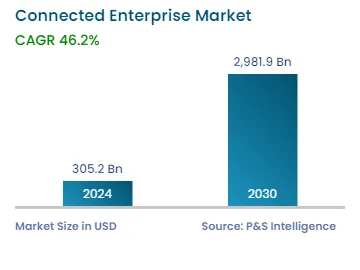
The global connected enterprise market was valued at USD 305.2 billion in 2024 and is projected to reach USD 6,317.9 billion by 2032, exhibiting a CAGR of 46.2% during 2025–2032. This remarkable growth reflects the accelerating digital transformation initiatives across industries as organizations increasingly adopt IoT, AI, and cloud computing technologies to create seamless ecosystems of interconnected processes, devices, and people.
The connected enterprise concept has gained significant momentum as businesses recognize the critical importance of real-time data exchange, automation, and enhanced operational efficiency. Organizations are leveraging these solutions to break down traditional silos, enabling cross-functional collaboration and data-driven decision-making that drives competitive advantage.
The surge in remote work environments has particularly accelerated market adoption, as companies invest heavily in advanced connectivity solutions and cloud-based platforms to ensure seamless communication and collaboration across distributed teams. This shift has intensified demand for IoT devices, network infrastructure, and cybersecurity solutions to support remote workforce productivity. Furthermore, the implementation of Industry 4.0 initiatives and smart manufacturing practices continues to drive significant investments in connected enterprise technologies, with manufacturers seeking to optimize production processes, enable predictive maintenance, and enhance supply chain visibility.
Connected Enterprise Market Trends & Drivers
Digital Transformation Initiatives Are Propelling Market Growth
The accelerating pace of digital transformation across industries represents the primary growth driver for the connected enterprise market. Organizations are increasingly recognizing that digital connectivity is no longer optional but essential for maintaining competitive positioning in today's rapidly evolving business landscape. Companies are investing heavily in IoT, AI, and cloud computing technologies to create unified operating models that eliminate traditional operational silos and enable data-driven decision-making across all business functions.
According to the European Commission, the Europe DIGITAL program has been allocated a budget of EUR 8.1 billion to drive digital transformation of society and economy, focusing on improving digital skills, connectivity, and innovation to strengthen European digital sovereignty through investments in artificial intelligence, cybersecurity, and cloud computing. This substantial government support demonstrates the strategic importance placed on connected enterprise technologies at the policy level, further accelerating adoption across public and private sectors.
The Digital India initiative, launched in July 2015, aims to build secure digital infrastructure, deliver government services electronically, and promote digital literacy across India. A major component is the Pradhan Mantri Gramin Digital Saksharta Abhiyan, which mobilized about INR 2,351 crore to make six million rural households digitally literate, empowering citizens through connectivity and inclusion.
Government Smart City and Industry 4.0 Initiatives Offer Opportunities
Government-backed smart city projects and Industry 4.0 initiatives worldwide are creating substantial demand for connected enterprise solutions across public infrastructure and industrial sectors. Compared to USD 166.1 billion in 2024, USD 339.5 billion will be spent on industrial automation globally by 2032. These programs focus on improving urban efficiency, sustainability, and citizen services through integrated technology platforms that connect transportation, energy, waste management, and communication systems. The integration of 5G networks, private wireless infrastructure, and cloud-native platforms enables municipalities and industrial operators to deploy scalable connected enterprise solutions.
China's "Made in China 2025" initiative exemplifies this trend, encouraging manufacturers to adopt smart technologies and develop intelligent factories to enhance production efficiency and reduce operational costs. Similarly, the European Union's Green Deal and various smart city projects are driving significant investments in connected technologies to meet sustainability goals and improve resource management. These large-scale government programs provide substantial market opportunities while establishing connected enterprise standards and best practices across industries.
Studies predict global smart city spending to rise massively from USD 588.4 billion in 2024 to USD 1,610.1 billion by 2030. NEOM’s The Line in Saudi Arabia is envisioned as a zero-carbon, AI-driven city with an estimated spending of up to USD 500 billion. Thailand’s Eastern Economic Corridor is backed by USD 44 billion to develop a futuristic smart region.
Masdar City in the U.A.E. is designed as a sustainable innovation hub with planned investments of USD 22 billion. Msheireb Downtown in Doha, Qatar, is to be a smart urban regeneration project costing around USD 5.5 billion. Ellinikon Smart City in Greece involves the redevelopment of an old airport into a high-tech urban hub with a total investment of USD 8 billion.
High Implementation Costs and Integration Complexity Restrain Market Growth
Despite the substantial benefits of connected enterprise solutions, high capital expenditure requirements for deployment and integration represent significant barriers to market adoption, particularly for small and medium-sized enterprises with limited budgets. The implementation of comprehensive connected enterprise systems requires substantial investments in IoT devices, cloud infrastructure, data analytics platforms, and cybersecurity measures, with retrofitting legacy brownfield equipment often costing up to USD 12,000 per machine according to industry estimates.
Integration complexity poses additional challenges as organizations struggle to connect disparate systems, legacy infrastructure, and modern IoT technologies within unified platforms. Many enterprises face compatibility issues when attempting to integrate existing operational technology with new information technology systems, requiring extensive customization, lengthy implementation timelines, and specialized technical expertise.
Connected Enterprise Market Segmentation Analysis
Platform Analysis
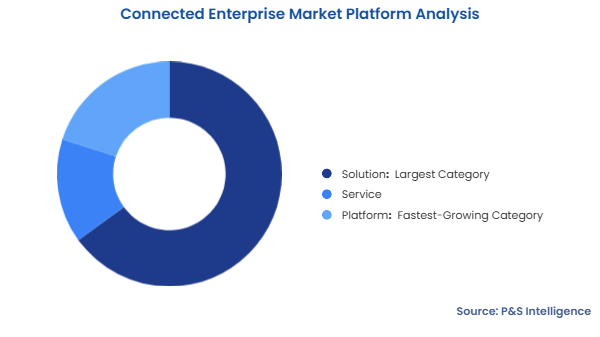
The solution category dominated the connected enterprise market in 2024 with 65% market share, driven by the increasing enterprise demand for comprehensive software platforms that enable IoT integration, data analytics, and process automation. Organizations are prioritizing investments in Manufacturing Execution Systems (MES), Customer Experience Management platforms, and Enterprise Infrastructure Management solutions that provide immediate operational improvements and measurable return on investment.
The platform category will experience the fastest growth during 2025–2032, with a CAGR of 46.5%, as enterprises recognize the need for foundational data fabrics and device management layers before implementing advanced analytics capabilities. Platform solutions provide multi-tenant architectures that enable vendors to amortize research and development costs across multiple customers while offering secure, tenant-specific data boundaries.
These platforms are covered:
Solution (Largest Category)
Manufacturing Execution System (MES)
Customer Experience Management
Enterprise Infrastructure Management
Asset Performance Management
Remote Monitoring System
Service
Managed Services
Professional Services
Platform (Fastest-Growing Category)
Device Management
Connectivity Management
Application Enablement
Application Analysis
Enterprise infrastructure management held the largest share in the connected enterprise market in 2024, of 20%, as organizations prioritize foundational connectivity and systems integration capabilities that enable comprehensive digital transformation initiatives. This category's dominance reflects the critical need for robust infrastructure platforms that can support diverse connected devices, ensure seamless data flow, and provide the scalability required for enterprise-wide deployment.
Streaming analytics is projected to exhibit the fastest growth during the forecast period, driven by the increasing demand for real-time data processing and immediate decision-making capabilities across industries. The proliferation of IoT sensors and connected devices generates massive data volumes that require sophisticated analytics platforms capable of processing information at the edge and providing actionable insights within milliseconds. Organizations are investing heavily in streaming analytics to enable predictive maintenance, optimize supply chain operations, and enhance customer experiences through immediate response capabilities.
The manufacturing sector dominated the connected enterprise market in 2024, with 30% share, as industrial organizations lead the adoption of Industry 4.0 technologies to optimize production processes, implement predictive maintenance programs, and enhance supply chain visibility. Manufacturing companies are investing heavily in connected enterprise solutions to achieve operational excellence, reduce downtime, and improve product quality through real-time monitoring and automated control systems.
The BFSI sector is experiencing the fastest growth during 2025–2032, driven by the increasing demand for digital banking services, enhanced cybersecurity measures, and improved customer experience platforms. Financial institutions are deploying connected enterprise solutions to enable secure remote transactions, implement real-time fraud detection systems, and provide personalized services through AI-powered analytics.
These end user categories are covered:
Manufacturing (Largest Category)
BFSI (Fastest-Growing Category)
Healthcare and Life Sciences
Retail and E-commerce
Telecommunication and IT
Government
Energy and Utilities
Media and Enterprises
Others
Drive strategic growth with comprehensive market analysis
Connected Enterprise Market Geographical Analysis
North America Connected Enterprise Market Size
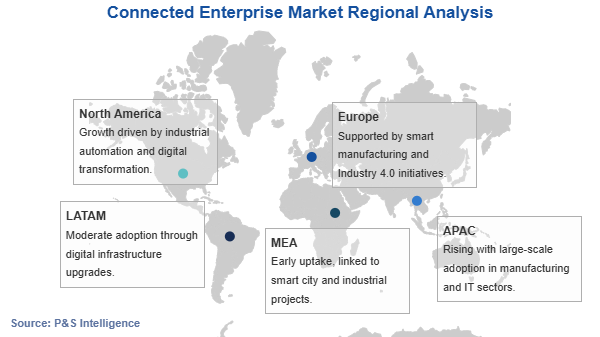
North America held the largest market share in 2024, of 40%, and it is expected to maintain its leadership position throughout the forecast period. This dominance is attributed to the region's robust technological infrastructure, high concentration of major industry players, and strong government support for digital transformation initiatives. The United States leads regional growth through significant investments in IoT, AI, and cloud computing technologies, with major corporations, including Microsoft, IBM, and Cisco Systems, driving innovation and market adoption.
The region benefits from a well-developed ecosystem of connectivity infrastructure, skilled workforce, and favorable regulatory environment that supports connected enterprise deployment across industries. According to the U.S. Department of Commerce, American businesses have invested over USD 2.2 trillion in digital transformation initiatives since 2020, with 78% of enterprises reporting improved operational efficiency through connected technology adoption. The presence of leading technology companies and established research institutions creates a collaborative environment that accelerates innovation and facilitates rapid commercialization of connected enterprise solutions.
Furthermore, North America's early adoption of 5G networks and private wireless infrastructure provides the high-speed, low-latency connectivity required for advanced connected enterprise applications, including autonomous systems, real-time analytics, and edge computing. The region's strong focus on cybersecurity and data privacy regulations also drives demand for secure connected enterprise platforms that comply with stringent regulatory requirements while enabling seamless business operations.
Asia-Pacific Connected Enterprise Market Size
Asia-Pacific is projected to experience the fastest growth during 2025–2032, with a CAGR of 46.8%, driven by rapid industrialization, government smart city initiatives, and expanding 5G network infrastructure across the region. Countries , including China, India, Japan, and South Korea are making substantial investments in connected enterprise technologies to improve business efficiency, enhance manufacturing capabilities, and develop world-class digital infrastructure that supports economic growth and innovation.
China Connected Enterprise Market
China's connected enterprise market is experiencing particularly robust growth, supported by the "Made in China 2025" initiative that encourages manufacturers to adopt smart technologies and develop intelligent factories to enhance production efficiency and reduce operational costs. According to the International Telecommunication Union, Asia Pacific accounts for 62% of global IoT connections, with China alone representing 36% of worldwide IoT devices, demonstrating the region's leadership in connected technology adoption and deployment.
India Connected Enterprise Market
India's rapidly expanding digital economy and government initiatives, including "Digital India" and "Smart Cities Mission" are creating significant opportunities for connected enterprise solution providers. The country's large manufacturing base, growing IT services sector, and increasing focus on automation and digitalization drive substantial demand for connected enterprise platforms that enable operational optimization and competitive advantage in global markets.
Based on geography, the market has the following categories:
North America (Largest Regional Market)
U.S. (Larger-Country Market)
Canada (Faster-Growing Country Market)
Europe
Germany (Largest Country Market)
U.K. (Fastest-Country Market)
France
Italy
Spain
Rest of Europe
Asia-Pacific (Fastest-Growing Regional Market)
Japan
China (Largest Country Market)
India (Fastest-Growing Country Market)
South Korea
Australia
Rest of APAC
Latin America
Brazil (Largest Country Market)
Mexico (Fastest-Growing Country Market)
Rest of LATAM
Middle East and Africa
Saudi Arabia (Largest Country Market)
South Africa
U.A.E. (Fastest-Growing Country Market)
Rest of MEA
Connected Enterprise Market Share
The connected enterprise market exhibits a fragmented competitive structure, with a large number of players competing across different segments and regions, and no single company holding a dominant share of the global market. This fragmentation reflects the diverse range of applications, technology stacks, and industry-specific requirements involved in implementing connected enterprise solutions.
Numerous regional and specialized technology firms coexist with larger global players, offering niche solutions focused on areas such as industrial IoT, cloud integration, cybersecurity, and edge computing. These vendors often concentrate on specific industry verticals, such as manufacturing, logistics, healthcare, or energy, providing tailored offerings that address unique operational needs.
The market’s low-to-moderate entry barriers, combined with the growing adoption of cloud-based platforms and open-source technologies, have allowed smaller companies to gain traction by offering cost-effective, agile, and innovative solutions. Many organizations prefer working with vendors that offer flexibility, rapid customization, and domain-specific expertise over one-size-fits-all platforms.
Intense competition is driving continuous innovation, with both established and emerging players investing in AI, machine learning, data analytics, and digital twin capabilities. However, the lack of standardization and integration challenges across platforms has made interoperability a key concern for enterprise customers. Despite the fragmented landscape, the market is gradually moving toward consolidation in certain sub-segments, as players form strategic alliances or pursue acquisitions to expand their technology portfolios, customer bases, and geographic footprints.
Key Connected Enterprise Companies:
HARMAN International Industries, Incorporated
Honeywell International Inc.
International Business Machines Corporation (IBM)
Jacobs Solutions Inc.
Cisco Systems, Inc.
Microsoft Corporation
PTC Inc. (formerly Parametric Technology Corporation)
Rockwell Automation, Inc.
Verizon Communications Inc.
Wipro Limited
Accelerite, Inc. (subsidiary of Persistent Systems)
General Electric Company
Connected Enterprise Market News
In November 2024, Rockwell Automation, Inc. and Microsoft Corporation expanded their collaboration, rolling out Azure IoT Operations and generative AI coding tools for programmable logic controller design to accelerate industrial automation development and reduce time-to-market for connected manufacturing solutions.
In July 2024, International Business Machines Corporation (IBM) and Telefónica Tech S.A. announced a collaborative agreement to advance AI, analytics, and data management solutions for enterprises, including the deployment of SHARK.X hybrid multi-cloud platform and establishment of joint customer pilot development offices.
In April 2024, Larsen & Toubro Infotech Mindtree Limited (LTIMindtree) announced a collaboration with Vodafone Group PLC to deliver connected smart IoT solutions, enabling Industry X.0 and digital transformation across multiple vertical sectors while addressing complex business challenges and sustainability objectives.
In March 2023, Wipro Limited launched the 5G Def-i platform to accelerate connected enterprise solutions, facilitating IoT deployment, data analytics, and real-time communication to help businesses optimize operations and enhance productivity in connected enterprise environments.
Want a report tailored exactly to your business need?
Leading companies across industries trust us to deliver data-driven insights and innovative solutions for their most critical decisions. From data-driven strategies to actionable insights, we empower the decision-makers who shape industries and define the future. From Fortune 500 companies to innovative startups, we are proud to partner with organisations that drive progress in their industries.
Client Testimonials
Working with P&S Intelligence and their team was an absolute pleasure – their awareness of timelines and commitment to value greatly contributed to our project's success. Eagerly anticipating future collaborations.
McKinsey & Company
India
Unmatched Standards
Our insights into the minutest levels of the markets, including the latest trends and competitive landscape, give you all the answers you need to take your business to new heights
Complete Data Security
We take a cautious approach to protecting your personal and confidential information. Trust is the strongest bond that connects us and our clients, and trust we build by complying with all international and domestic data protection and privacy laws