Explore the market potential with our data-driven report
Concrete Superplasticizers Market Overview
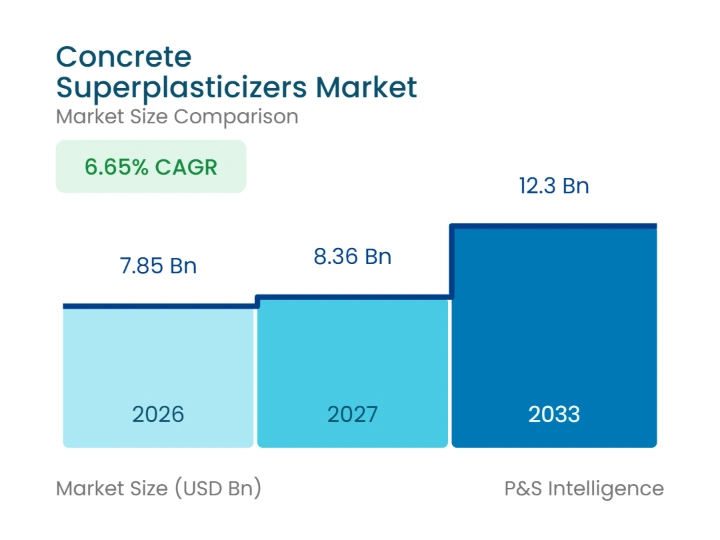
The global concrete superplasticizers market is estimated at USD 7.85 Billion in 2026 and is projected to reach USD 8.36 Billion in 2027. Sales are projected to climb to USD 12.30 Billion by 2033, advancing at a CAGR of 6.65% during 2027-2033. Ready-mix producers, precast plants, and heavy civil contractors are buying more high-range water reducer per cubic meter because leaner, lower-clinker mixes lose strength when workability is restored with extra water. For formulators, each change in a customer's cement or sand becomes a re-tuned product and a longer supply relationship.
Decarbonization commitments by cement and concrete producers are turning high-range water reducers into a routine part of mix designs. The Global Cement and Concrete Association's net-zero roadmap commits its members to a 25% cut in CO2 per cubic meter of concrete by 2030 against a 2020 baseline, and it attributes 11% of the industry's 2050 emission savings to efficiency in concrete production, including optimized mix design. Clinker substitution and leaner mixes both depend on dispersants to keep concrete placeable, which favors formulators that can match polymers to each producer's binder.
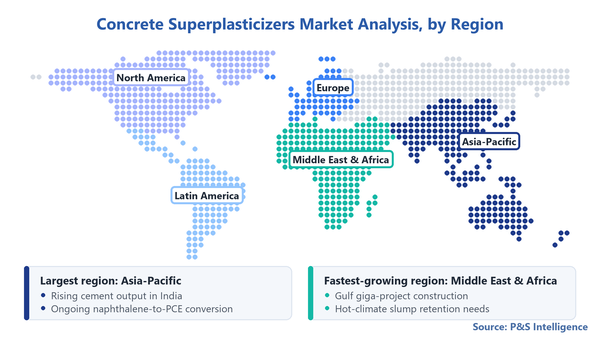
Asia-Pacific accounts for 46.5% of 2026 revenue, built on the volume of concrete poured in China and India and on the ongoing replacement of naphthalene grades with polycarboxylate grades in both countries. Middle East & Africa is set to expand faster than any other region, at a 7.95% CAGR during 2027-2033, as Saudi Arabia, the U.A.E., and Qatar build new cities and transport links. Asian demand depends on volume and chemistry substitution, while Gulf demand comes from new megaproject capacity, where hot-weather placing and high-rise pumping steer concrete superplasticizers market growth toward premium grades.
Key market insights
By chemistry / product type, polycarboxylate ether (PCE) accounts for 66.0% of 2026 revenue and is also projected to grow fastest, at a 7.15% CAGR during 2027-2033.
By form, liquid formulations account for 82.5% of 2026 revenue and are also projected to grow fastest, at a 6.85% CAGR during 2027-2033.
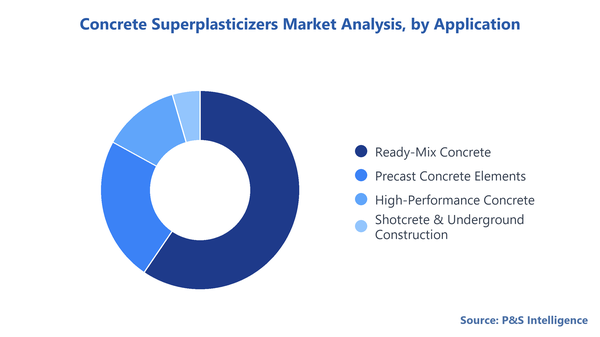
By application, ready-mix concrete (RMC) accounts for 59.5% of 2026 revenue, while high-performance concrete (HPC & UHPC) is projected to expand at a 7.85% CAGR during 2027-2033.
By end-use sector, infrastructure construction accounts for 45.5% of 2026 revenue and is also projected to grow fastest, at a 7.1% CAGR during 2027-2033.
By geography, Asia-Pacific accounts for 46.5% of 2026 revenue, while Middle East & Africa is projected to expand at a 7.95% CAGR during 2027-2033.
Formaldehyde hazard labeling is shifting specifications toward polycarboxylate chemistry
Ready-mix and precast producers in regulated markets are moving their remaining sulfonated naphthalene and melamine volumes onto polycarboxylate ether grades. Both condensate chemistries are made with formaldehyde, so their producers must keep residual free formaldehyde low to avoid a hazard classification, while standard PCE synthesis uses no formaldehyde. Plant operators who store admixtures in bulk tanks also face lighter exposure controls when a product carries no carcinogen label, which tilts approvals toward PCE even where condensates remain cheaper per kilogram.
Formaldehyde has been classified as a Category 1B carcinogen under the EU's CLP Regulation since January 1, 2016, and mixtures containing 0.1% or more fall under that classification. Condensate producers selling into Europe therefore carry added process-control and testing costs to stay below the threshold. Contractors and precast producers with corporate chemical-safety policies can favor PCE when they write specifications, and multinational contractors could carry the same preference into the Middle East and Asia. Condensates keep a place in price-led markets where labeling enforcement is lighter.
Lower-clinker cements are accelerating demand for high-range water reducers
Cement producers cutting clinker content are changing the water demand, set time, and early strength of the binders that ready-mix plants receive. Quality managers respond by raising or re-tuning high-range water reducer doses so concrete reaches its specified slump and strength without extra water. Because the binder change starts at the cement plant, the admixture adjustment follows at every batching plant that the cement plant supplies, which spreads new demand across the customer base instead of concentrating it in a few large projects.
American Cement Association figures put lower-carbon blended cement at 60% of total US cement consumption, and all 50 state transportation departments now accept portland-limestone cement. A conversion at that scale leaves few US ready-mix plants untouched, and comparable binder shifts are likely wherever cement producers have pledged clinker cuts. Admixture suppliers with field technicians who can re-tune doses whenever a cement plant changes its blend are better positioned to keep accounts through the transition, while suppliers selling on price alone risk losing plants at each requalification.
Prefabricated bridge connections are opening a high-value outlet for ultra-high-performance mixes
Highway agencies that replace bridges with prefabricated deck and beam elements need field-cast joints that reach high strength quickly, and ultra-high-performance concrete (UHPC) has become a common answer. UHPC runs at very low water-to-binder ratios and typically depends on high-performance PCE dosed well above ordinary ready-mix levels, so each cubic meter carries far more admixture value than a standard pour. Project volumes are small, but the value per cubic meter and the qualification hurdles make this a margin-rich niche for formulators.
According to the Federal Highway Administration, more than 400 US bridges had incorporated UHPC by mid-2024, mostly for field-cast connections between prefabricated components or for preservation and repair. Connection and repair jobs recur across an aging bridge inventory, which turns UHPC from a one-off specialty into repeat business with state transportation departments and precast producers. Admixture makers that hold state approvals and supply proprietary UHPC premixes could convert this outlet into specification-protected revenue, and bridge owners in Canada, Europe, and Asia can adopt the same approach.
Shrinking construction volumes in China are limiting sales in the largest producing base
China's property downturn has cut the volume of concrete poured in the world's largest cement market, and admixture sales move closely with concrete volume. Ready-mix plants running below capacity press admixture suppliers hard on price, and China's many domestic PCE producers compete for a shrinking pool of orders. The resulting margin pressure can spill into export markets in Southeast Asia, Africa, and the Middle East as Chinese producers seek outlets for idle capacity, which could cap price increases for international suppliers there.
The National Bureau of Statistics of China recorded 2025 cement output of 1.69 billion tons, 6.9% below 2024 and the lowest annual total in more than a decade. Fewer tons of cement mean fewer cubic meters to dose, so domestic formulators can grow revenue only by raising PCE content per cubic meter or by taking share from rivals. Suppliers with most of their sales outside China are less exposed, while those tied to Chinese ready-mix face a recovery that depends on property starts stabilizing.
Segmentation Analysis
Chemistry / Product Type
Polycarboxylate ether (PCE) grades account for 66.0% of 2026 revenue in the concrete superplasticizers market. Ready-mix and precast producers favor PCE because formulators can tailor one polymer backbone, through side-chain length and charge density, to deliver fast early strength for a precast yard or extended slump retention for a long ready-mix haul, which condensates struggle to match. PCE also reaches its water reduction at lower dosages, cutting the volume a plant must store and meter. Naphthalene, melamine, and modified lignosulfonate grades serve price-led and specialty niches.
PCE is also expected to post the quickest growth, at a 7.15% CAGR during 2027-2033. Most of the added volume is likely to come from substitution, as ready-mix plants in India, Southeast Asia, Latin America, and Africa move from naphthalene grades to PCE once the cost gap per cubic meter of concrete narrows. The spread of lower-clinker binders adds a second push, because each new cement blend needs a re-tuned polymer that PCE chemistry handles most readily. Producers that make their own polyether macromonomers control a major cost input and can price closer to condensates.
Form
Liquid formulations account for 82.5% of 2026 revenue. Ready-mix and precast plants dose admixtures through automated dispensers tied to batch controllers, and those systems are built to meter aqueous polymer solutions straight into the mixer or truck. Liquids also arrive in bulk tankers and intermediate bulk containers, which cuts handling labor at high-throughput plants. Because PCE is usually synthesized in water, selling it as a solution avoids a spray-drying step and its energy cost, which keeps liquid grades cheaper per unit of active polymer.
Liquid formulations are also projected to outgrow dry powder, at a 6.85% CAGR during 2027-2033. New volume comes mainly from central batching plants in India, Southeast Asia, and Africa, as more urban projects switch from site-mixed concrete to plant-made ready-mix with automated dosing. In-transit slump management systems that inject admixture from a truck-mounted tank also run on liquid product. Dry powder formulations keep a steady role in packaged mortars, grouts, and self-leveling compounds, where the polymer must be pre-blended into a bag before it reaches the site.
Application
Ready-mix concrete (RMC) accounts for 59.5% of 2026 revenue, because central batching and truck delivery supply most structural concrete in urban markets. Every load needs enough slump retention to survive haul times, traffic, and waiting on site, and producers dose high-range water reducers to deliver that without adding water. Ready-mix producers usually buy on annual or multi-year supply agreements that bundle product, dispensing equipment, and plant-level technical service, which makes accounts hard to dislodge once a formulator wins them.
High-performance concrete (HPC & UHPC) is projected to post the fastest growth among applications, a 7.85% CAGR during 2027-2033. Owners of bridges, tall buildings, tunnels, and marine structures are specifying low permeability and long service lives, which requires very low water content and therefore high PCE dosage per cubic meter. Thinner sections in high-strength mixes also reduce the cement and steel a structure needs, an argument that carries weight with owners who report embodied carbon. For admixture suppliers, this application carries the highest value per cubic meter and the strictest qualification testing.
Copyright P&S Intelligence. Reuse requires attribution under CC BY 4.0.
End-Use Sector
Infrastructure construction accounts for 45.5% of 2026 revenue. Roads, bridges, rail, ports, and water works are specified by public owners who set high strength and durability requirements, which in practice means high-range water reducers in most structural pours. Public budgets also tend to hold up when private building slows. US Census Bureau data show public construction spending rose 5.4% to USD 536.8 Billion in 2025, while private construction spending fell 1.4%, a pattern that can steady admixture orders through a private-sector downturn.
Infrastructure construction is also projected to grow fastest, at a 7.1% CAGR during 2027-2033. Rail, metro, highway, and port programs in India, Southeast Asia, and the Gulf states use large volumes of precast segments, piles, and pumped structural concrete, all of which carry above-average admixture content. India's Ministry of Finance has budgeted central public capital expenditure of USD 128.55 Billion (INR 12.2 Lakh Crore) for fiscal 2026-27, an outlay that supports highway, rail, and metro tendering. Suppliers with project-site technical teams and transport-agency approvals are better placed to win these long-duration contracts.
The following segments are analysed in this report.
Chemistry / Product Type
Polycarboxylate Ether (PCE)
Sulfonated Naphthalene Formaldehyde (SNF)
Sulfonated Melamine Formaldehyde (SMF)
Modified Lignosulfonates (MLS)
Form
Liquid Formulations
Dry Powder Formulations
Application
Ready-Mix Concrete (RMC)
Precast Concrete Elements
High-Performance Concrete (HPC & UHPC)
Shotcrete & Underground Construction
End-Use Sector
Infrastructure Construction
Commercial & Industrial Buildings
Residential Construction
Geographical Outlook
Asia-Pacific concrete superplasticizers market outlook
Asia-Pacific accounts for 46.5% of 2026 revenue, the largest share of any region. The region produces most of the world's cement, and its ready-mix and precast industries are still converting naphthalene volumes to PCE, which raises value per cubic meter even where tonnage is flat. China is the region's largest market, with a deep base of domestic PCE producers that integrate back into polyether macromonomers and compete hard on price. India adds growth from highways, metro lines, and rail viaducts built largely from precast and pumped concrete.
India's Office of the Economic Adviser confirms that the country's cement production rose 12.5% year on year in August 2026, after growing in every month between August 2025 and July 2026. Growth in India and Southeast Asia offsets weaker Chinese volumes and favors suppliers with local blending plants and technical staff in those markets. The region's lead looks secure through 2033, although its share of value depends on how quickly Chinese formulators can pass higher PCE content per cubic meter into their prices.
Middle East & Africa concrete superplasticizers market growth
Middle East & Africa leads all regions on growth, with a 7.95% CAGR during 2027-2033. Gulf states are building new cities, transport links, and tourism districts, and much of that concrete is placed in summer heat often above 40°C, pumped to great heights, or hauled long distances to remote sites. Those conditions need PCE grades with extended slump retention and retarding functions, which sell at higher prices than standard ready-mix grades. Saudi Arabia is the region's fastest-growing market, as giga-project construction under Vision 2030 adds new ready-mix batching capacity.
U.S. Geological Survey estimates put Egypt's cement production at 64 million tons in 2025, up from 53 million in 2024, and Saudi Arabia's at 54 million tons, up from 51 million. Egypt, Morocco, Nigeria, and South Africa are expanding ready-mix supply in their largest cities, and international formulators are adding local production there to cut freight and duty on imported admixtures. Formulators with Gulf blending sites and hot-weather application teams are better positioned to serve both sub-regions. Growth could moderate if Gulf governments re-phase giga-projects, so heavy exposure to a single Saudi program carries timing risk.
Copyright P&S Intelligence. Reuse requires attribution under CC BY 4.0.
Europe market analysis
Europe trails Asia-Pacific and North America in share and grows at a slower, specification-led pace, with demand anchored in existing ready-mix and precast volumes. PCE is the dominant chemistry across Western Europe, so growth depends more on value per cubic meter than on new volume. Germany, France, Italy, and the U.K. host the region's largest ready-mix and precast industries, and their precast plants buy early-strength grades that let them cut heat curing and the energy it consumes.
The European standard EN 197-5, issued in 2021, created CEM VI composite cements with clinker contents of 35-49%, giving cement producers a formal route to market far leaner binders. Concrete made with those cements depends on carefully matched dispersants to reach target workability and early strength, which raises admixture spend per cubic meter as the new cement types gain approval in national codes. Formulators with cement-specific laboratories close to major European cement producers are better positioned to capture that upgrade.
Latin America market analysis
Latin America holds a modest share of global revenue, and its demand moves with the construction cycles of Brazil and Mexico more than with chemistry change. Naphthalene and lignosulfonate grades still serve a meaningful part of the region's ready-mix volume, so conversions to PCE in São Paulo, Mexico City, Santiago, and Bogotá add value even when cement volumes are flat. Mining, hydropower, and tunneling projects in Chile, Peru, and Colombia also buy superplasticizers for shotcrete in underground work.
Brazil's cement sales came to 67 million tons in 2025, up 3.7% on 2024, according to SNIC, the country's national cement industry association. That steady recovery supports ready-mix volume, and it gives regional producers with local polymer blending room to raise PCE share at their customers. Currency swings remain the main risk for the region, because many formulators import PCE polymer or macromonomer priced in US dollars and must reprice local-currency contracts when exchange rates move sharply.
North America market analysis
North America holds the second-largest regional share, and growth there depends on higher value per cubic meter more than on new concrete volume. The US move to blended cements has pushed ready-mix producers to re-tune high-range water reducer doses across their plants, while federal and state highway programs keep public work steady. The U.S. accounts for most regional demand, with Canada adding volume from transit, energy, and resource projects.
The National Ready Mixed Concrete Association estimates US ready-mixed concrete production at 379.1 million cubic yards in 2024, down from 400.0 million in 2023. Softer volume shifts the burden of growth onto dosage and product mix, which favors suppliers selling PCE grades engineered for portland-limestone cement and in-transit slump management. Producers with national dispensing-equipment fleets and field technical service hold an advantage when multi-plant ready-mix groups consolidate their admixture purchasing.
The following geographies are analysed in this report.
The concrete superplasticizers market is moderately fragmented, and competition runs on two layers. At the top, a small group of multinational construction chemicals formulators has grown through acquisitions, and competition authorities have treated those positions as sensitive enough to require an admixture divestment as a condition of one major merger. Below that layer, many regional blenders and Chinese PCE producers compete on price and proximity, because admixtures are water-heavy products that travel poorly and need local technical support. Acquisitions keep consolidating the top layer, while freight costs keep the lower layer local and crowded.
The multinational group, made up of Sika AG, Compagnie de Saint-Gobain S.A. (through Chryso, GCP, and Fosroc), Master Builders Solutions Holdings GmbH, and MAPEI S.p.A., competes on polymer design, key accounts with cement and ready-mix groups, and dispensing and slump-control services that tie plants to one supplier. Sobute New Materials Co., Ltd. and Lets Holdings Group Co., Ltd. (KZJ) compete on scale in China and on approvals for rail, bridge, and marine projects, while Kao Corporation, RPM International Inc. (through The Euclid Chemical Company), and MC-Bauchemie Müller GmbH & Co. KG win on specialty polymers and local technical service.
For ready-mix and precast buyers, switching admixture suppliers is technically simple but operationally costly, since each change means requalifying mixes, recalibrating dispensers, and retraining plant staff. That friction protects incumbents on large accounts, while price competition stays intense on spot and single-plant business. Multi-plant producers also value suppliers that can guarantee identical formulations across regions, which favors the global groups, whereas independent ready-mix operators often choose on delivered price and responsiveness, which keeps regional blenders competitive in their home markets.
Major Companies in Concrete Superplasticizers Market:
Sika AG
Compagnie de Saint-Gobain S.A.
Master Builders Solutions Holdings GmbH
MAPEI S.p.A.
Sobute New Materials Co. Ltd.
Lets Holdings Group Co. Ltd.
Kao Corporation
Arkema S.A.
RPM International Inc.
Ha-Be Betonchemie GmbH & Co. KG
MC-Bauchemie Müller GmbH & Co. KG
Concrete Superplasticizers Market News
In June 2026, Compagnie de Saint-Gobain S.A., through its Turkish construction chemicals unit, laid the foundation for a Chryso concrete and cement admixture plant of about 10,000 square meters in Adana, Türkiye, with start-up planned for the end of the year. The larger site is intended to raise admixture capacity and serve as an export base.
In April 2026, MAPEI Corporation, the U.S. subsidiary of MAPEI S.p.A., introduced Dynamon XTEND 4047, a high-solids, polycarboxylate-based high-range water-reducing admixture for precast and ready-mix concrete that meets ASTM C494 Type F requirements and targets higher strength at all ages with extended slump life. One product serving both early-strength and long-haul needs simplifies inventory for producers running precast and ready-mix operations.
In March 2026, Master Builders Solutions Holdings GmbH completed its acquisition of Arkaz Al Sharq Building Materials from Alturki Holding, adding concrete admixture production sites in Dammam and Jeddah, Saudi Arabia, each with its own laboratory and warehouse. Local production in both of the Kingdom's main coastal hubs shortens supply to Vision 2030 giga-projects and gives the company a base for wider Middle East expansion.
In December 2025, Sika Corporation, the U.S. subsidiary of Sika AG, opened an admixture plant in Haines City, Florida, producing ViscoCrete and ViscoFlow high-performance superplasticizers for customers in Florida and the Southeastern U.S., at a site Sika describes as having the highest level of digitalization and automation of any U.S. admixture plant. Local output shortens delivery routes to ready-mix and precast producers across the region.
Last Updated: October 2026
Frequently Asked Questions About This Report
How big is the concrete superplasticizers market?+
The global concrete superplasticizers market is estimated at USD 7.85 Billion in 2026 and is projected to reach USD 8.36 Billion in 2027.
What is driving demand for concrete superplasticizers?+
Ready-mix producers, precast plants, and heavy civil contractors are buying more high-range water reducer per cubic meter because leaner, lower-clinker mixes lose strength when workability is restored with extra water.
Which type of superplasticizer is most widely used in concrete?+
By chemistry / product type, polycarboxylate ether (PCE) accounts for 66.0% of 2026 revenue and is also projected to grow fastest, at a 7.15% CAGR during 2027-2033.
Why is PCE replacing naphthalene and melamine superplasticizers?+
Both condensate chemistries are made with formaldehyde, so their producers must keep residual free formaldehyde low to avoid a hazard classification, while standard PCE synthesis uses no formaldehyde.
How does low-carbon cement affect superplasticizer demand?+
Clinker substitution and leaner mixes both depend on dispersants to keep concrete placeable, which favors formulators that can match polymers to each producer's binder.
Which region dominates the concrete superplasticizer market?+
By geography, Asia-Pacific accounts for 46.5% of 2026 revenue, while Middle East & Africa is projected to expand at a 7.95% CAGR during 2027-2033.
Want a report tailored exactly to your business need?
Leading companies across industries trust us to deliver data-driven insights and innovative solutions for their most critical decisions. From data-driven strategies to actionable insights, we empower the decision-makers who shape industries and define the future. From Fortune 500 companies to innovative startups, we are proud to partner with organisations that drive progress in their industries.
Client Testimonials
Working with P&S Intelligence and their team was an absolute pleasure – their awareness of timelines and commitment to value greatly contributed to our project's success. Eagerly anticipating future collaborations.
McKinsey & Company
India
Unmatched Standards
Our insights into the minutest levels of the markets, including the latest trends and competitive landscape, give you all the answers you need to take your business to new heights
Complete Data Security
We take a cautious approach to protecting your personal and confidential information. Trust is the strongest bond that connects us and our clients, and trust we build by complying with all international and domestic data protection and privacy laws