This Report Provides In-Depth Analysis of the Computational Storage Market Report Prepared by P&S Intelligence, Segmented by Component (Hardware, Software & Firmware, Services), Processing Architecture (Fixed-Function Architecture, Programmable Architecture), Storage Interface (PCIe / NVMe, Compute Express Link (CXL), NVMe over Fabrics (NVMe-oF), SATA / SAS), Application (AI & Machine Learning Acceleration, Big Data Analytics & Database Processing, Data Compression & Deduplication, Video & Media Processing, Storage Security & Cryptography), End-Use Industry (Cloud Service Providers & Hyperscale Data Centers, Enterprise IT & Telecommunications, Financial Services & BFSI, Healthcare & Life Sciences, Automotive & Autonomous Systems, Government, Defense & HPC), and Geographical Outlook for the Period of 2022 to 2033
Explore the market potential with our data-driven report
Computational Storage Market Overview
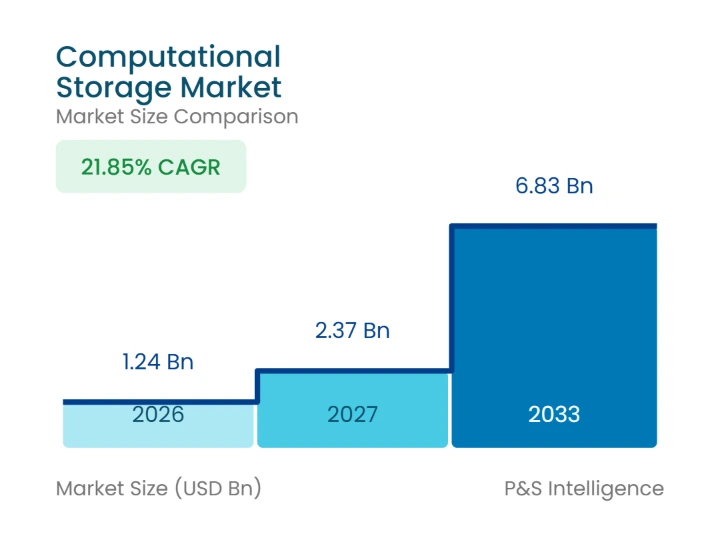
The global computational storage market size is estimated at USD 1.24 Billion in 2026 and is projected to reach USD 2.37 Billion in 2027. Market revenue is expected to climb to USD 6.83 Billion by 2033, advancing at a CAGR of 21.85% during 2027-2033. Hyperscale cloud operators, AI infrastructure builders, and database-heavy enterprises are paying for drives and accelerator cards that compress, filter, and encrypt data where it is stored, because every host processor core freed from that work can return to billable workloads.
Power limits at AI data centers are turning storage-side processing into a budgeted purchase for cloud and colocation operators. According to the International Energy Agency, global data center electricity demand rose about 17% in 2025 to 485 TWh, and the agency expects consumption to reach about 950 TWh by 2030. Where grid connections cap the number of servers an operator can energize, moving compression and query filtering onto the drive raises useful work per watt. Operators now judge storage on output per rack as well as cost per terabyte, which favors vendors able to prove savings on customer workloads.
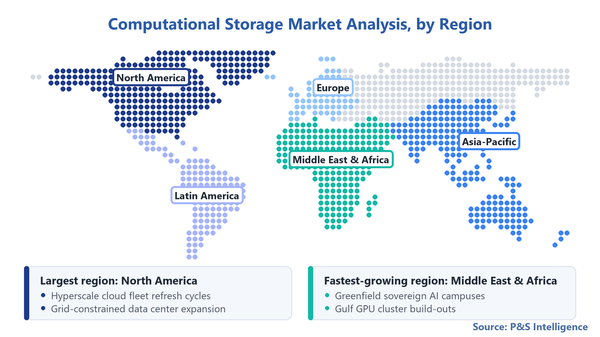
North America accounts for 41.0% of 2026 revenue, led by the U.S., where hyperscale campuses buy computational drives and offload cards in fleet volumes and enterprises use them to speed database and analytics work. The Middle East & Africa is projected to grow fastest, at a 24.5% CAGR during 2027-2033, as Saudi Arabia and the U.A.E. build sovereign AI data centers whose storage tiers are chosen at the design stage. Computational storage market demand in North America therefore comes largely from refresh cycles, while Gulf orders tend to arrive as large, project-based specifications.
Key market insights
By component, hardware accounts for 68.5% in 2026, while software & firmware is projected to post a 31.4% CAGR during 2027-2033.
By processing architecture, fixed-function architecture accounts for 63.5% in 2026, while programmable architecture is projected to expand at a 28.6% CAGR during 2027-2033.
By storage interface, PCIe / NVMe accounts for 64.0% in 2026, while Compute Express Link (CXL) is projected to advance at a 34.2% CAGR during 2027-2033.
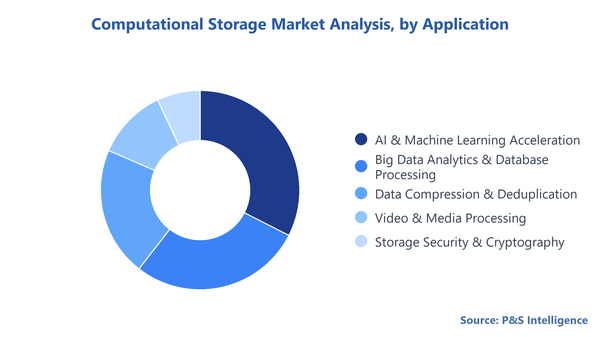
By application, AI & machine learning acceleration accounts for 32.5% in 2026 and is also projected to grow fastest, at a 29.5% CAGR during 2027-2033.
By end-use industry, cloud service providers & hyperscale data centers account for 42.0% in 2026, while automotive & autonomous systems is forecast to log a 27.8% CAGR during 2027-2033.
By geography, North America accounts for 41.0% in 2026, while Middle East & Africa is projected to record a 24.5% CAGR during 2027-2033.
Computational Storage Market Trends & Drivers
Standardized on-drive program execution is redefining how operators qualify offload hardware
Cloud operators that held back from computational drives because each vendor needed its own driver and toolchain now have a common way to load and run code on the device. Once a drive exposes compute through the same host interface it uses for reads and writes, an operator can qualify one software path and buy hardware from several vendors against it. That change could move purchasing from single-supplier pilots toward multi-vendor framework contracts.
NVM Express lists a Computational Programs Command Set and a Subsystem Local Memory Command Set, both at revision 1.0, among the eleven specifications that made up the NVMe family as of August 2024. The first set lets a host execute programs on the device, and the second gives those programs memory inside the drive. Drive and controller vendors that implement both sets could see shorter qualification cycles at large buyers, while proprietary offload cards are likely to face closer price comparison as standards-based alternatives reach the market.
Host processor time lost to data movement is propelling drive-level offload in analytics and AI clusters
Database and AI operators pay for server processor time that is spent decompressing, scanning, and discarding data before any useful query runs. Moving those filter and compression steps into the drive returns host cores to revenue-earning work and cuts the volume of data crossing the PCIe bus. For a cloud provider renting compute by the hour, each freed core can be resold, so drive-level offload becomes a measurable cost line in server design instead of a niche performance option.
Samsung's own testing of its second-generation SmartSSD, announced in July 2022, found that scan-heavy database queries ran in less than half the time, with energy use cut by up to 70% and processor utilization by up to 97%, compared with conventional data center SSDs. Results of that kind come from vendor benchmarks on favorable workloads, so operators typically rerun them on their own query mix before committing to volume orders. Suppliers that publish reproducible test kits and support open benchmarking are likely to move through that evaluation stage faster.
Post-quantum cryptography migration is opening a cryptographic offload channel for storage processors
Storage arrays, backup appliances, and drive firmware rely on public-key cryptography for key exchange, firmware signing, and secure boot, and those functions are expected to move to post-quantum algorithms. The new schemes use larger keys and signatures, and some need more computation per operation, which adds load to host processors already busy with storage services. Storage processors that run these operations in hardware give array makers a way to adopt the new algorithms without adding server cores, creating a second purchase reason beyond compression.
NIST published the initial public draft of its report on the transition to post-quantum cryptography standards, NIST IR 8547, on November 12, 2024, identifying the quantum-vulnerable standards that information technology products and services will need to move away from. Eideticom already promotes a Silicom crypto adapter running its NoLoad engine as ready for post-quantum cryptography, so the offload function exists in commercial form. The opening is widest among federal agencies, defense contractors, and banks, where cryptographic transition plans tend to be audited and funded.
Software integration costs are limiting adoption outside hyperscale operators
Enterprises without large in-house engineering teams find it hard to justify in-storage processing when each offload function must be wired into their database, file system, or AI pipeline. A hyperscaler can spread that porting cost across thousands of servers, but a mid-sized bank or hospital IT department pays it on a few racks, so the payback period stretches. Many enterprise IT teams therefore stay with standard NVMe drives and host-based software compression, which keeps a large part of the server base outside the market.
The common software interface arrived late. SNIA released version 1.0 of its Computational Storage API in October 2023, more than a year after it published version 1.0 of its architecture and programming model, so independent software vendors have had a short window to build support. Drives that compress data transparently, with no change to host software, avoid this barrier, which lowers the adoption hurdle for enterprise IT teams. Programmable offload is likely to stay concentrated among operators with their own software teams until database and storage software vendors ship native support.
Segmentation Outlook
Component
Hardware accounts for 68.5% of computational storage market revenue in 2026, because operators buy the capability as a physical device, whether a drive, an add-in card, or an array with compute built in. Only units with on-board compute are counted, so standard SSDs installed alongside them fall outside this category. The processing silicon is priced into each unit, so a deployment carries a premium over a standard SSD of the same capacity. Hyperscale buyers typically qualify computational drives through their usual server-validation process, which keeps spending flowing through hardware purchase orders.
Software & firmware is set to post the fastest growth, at a 31.4% CAGR during 2027-2033, as value shifts toward the code that runs on the device. Arm states that its Cortex-R82 processor supports rich operating systems such as Linux and simplifies computational storage development, which lets drive makers offer on-drive runtimes, containers, and application libraries. Those layers can be licensed or sold as subscriptions on top of hardware already installed, giving vendors recurring revenue from each drive across its service life.
Processing Architecture
Fixed-function architecture holds 63.5% of 2026 revenue, because hardwired compression, encryption, and erasure coding deliver savings without changes to applications. As per ScaleFlux, the compression features of its CSD 3000 drives require zero application changes. Buyers can drop such drives into existing server fleets, measure the capacity and endurance gain, and expand orders without retraining developers, which shortens procurement cycles in both enterprise and cloud accounts.
Programmable architecture is forecast to rise at a 28.6% CAGR during 2027-2033, driven by workloads where the offload logic changes over time. AI retrieval, vector search, and database query pushdown need filters that are rewritten as models and schemas change, which hardwired engines handle poorly. FPGA- and processor-based devices let operators update that logic in the field, so the same hardware stays useful across several software generations. Hyperscalers with in-house engineering teams can recover the higher unit price through workload-specific gains.
Storage Interface
PCIe / NVMe accounts for 64.0% of 2026 revenue, since most enterprise servers shipped recently already provide NVMe drive bays and PCIe slots. Computational drives in U.2, E1.S, and E3.S form factors fit those bays directly, so buyers add compute to storage without redesigning servers or changing cabling. The installed base of NVMe hosts and operating system drivers also lowers qualification effort, which keeps this interface the default for new deployments of compute-enabled drives.
Compute Express Link (CXL) should see the strongest expansion, at a 34.2% CAGR during 2027-2033, as AI clusters seek memory-semantic access to data held near the processor. The CXL Consortium released the CXL 4.0 specification on November 18, 2025, doubling bandwidth to 128 GT/s from 64 GT/s while keeping backward compatibility with earlier versions. Faster links make near-memory computing devices more practical for AI inference, and suppliers with CXL controller and memory expertise are better positioned as server platforms adopt newer link generations.
Application
AI & machine learning acceleration accounts for 32.5% of 2026 revenue, the largest share, because AI clusters move very large volumes of data per server. Training pipelines read datasets repeatedly, and inference systems need fast access to model context, which makes pre-filtering and caching near the storage tier worth paying for. GPU time is the most expensive resource in these clusters, so a device that keeps accelerators supplied with data can pay back quickly.
The same category is also projected to grow fastest, at a 29.5% CAGR during 2027-2033, as large language model inference and retrieval-augmented generation push more AI working data from memory onto flash. KIOXIA's AiSAQ software, issued in a new open-source version in July 2025, runs vector searches directly on SSDs and reduces host memory requirements. Once vector indexes and cached model context sit on drives, processing inside those drives can cut traffic back to GPU servers, so storage-side caching and filtering are likely to become standard line items in inference cluster designs.
Copyright P&S Intelligence. Reuse requires attribution under CC BY 4.0.
End-Use Industry
Cloud service providers & hyperscale data centers account for 42.0% of 2026 revenue, because they operate at the scale where offload savings justify custom qualification. A hyperscaler can test a computational drive against its own database or AI services and then deploy it across tens of thousands of servers, multiplying the per-server gain. These operators also design their own server and storage platforms, so they can write compute features directly into drive orders placed with NAND flash and controller suppliers.
Automotive & autonomous systems is set to expand fastest, at a 27.8% CAGR during 2027-2033, from a smaller base. Development fleets and driver-assistance programs record camera, radar, and lidar data continuously, and in-vehicle drives that filter or compress that data before upload reduce the cost of moving and storing it in the cloud. Automotive-qualified products take longer to design in, so suppliers that win early vehicle programs tend to keep the business over several model years.
The following segments are analysed in this report.
Component
Hardware
Software & Firmware
Services
Processing Architecture
Fixed-Function Architecture
Programmable Architecture
Storage Interface
PCIe / NVMe
Compute Express Link (CXL)
NVMe over Fabrics (NVMe-oF)
SATA / SAS
Application
AI & Machine Learning Acceleration
Big Data Analytics & Database Processing
Data Compression & Deduplication
Video & Media Processing
Storage Security & Cryptography
End-Use Industry
Cloud Service Providers & Hyperscale Data Centers
Enterprise IT & Telecommunications
Financial Services & BFSI
Healthcare & Life Sciences
Automotive & Autonomous Systems
Government, Defense & HPC
Geographical Outlook
North America computational storage market outlook
North America holds 41.0% of global revenue in 2026, the largest regional position, because the operators that buy offload drives and cards at fleet scale are concentrated there. U.S. hyperscale cloud providers design their own servers and qualify drives directly with suppliers, and many of the companies selling computational drives, controllers, and accelerators are based in California. The U.S. is the region's largest market, supported by AI data center construction and by financial and healthcare organizations running large analytics workloads.
Electricity supply shapes how that spending develops. The U.S. Department of Energy, drawing on a Lawrence Berkeley National Laboratory study, estimates that data centers used about 4.4% of total U.S. electricity in 2023 and could use 6.7% to 12% by 2028. Where new grid connections are slow to obtain, operators look to raise output from capacity already connected, and offload devices that cut processor work per query serve that goal. North American demand is therefore likely to remain refresh-led and efficiency-driven, with Canada adding a smaller base of cloud and enterprise buyers.
Middle East & Africa computational storage market growth
The Middle East & Africa is set to expand fastest, at a 24.5% CAGR during 2027-2033, as Gulf governments fund national AI computing capacity from the ground up. In Saudi Arabia, the Public Investment Fund launched HUMAIN in May 2025 to consolidate the country's data center initiatives and buy the hardware they need, the fund states. New AI campuses there and in the U.A.E. select their storage architecture at the design stage, so offload-capable storage can be specified into the first build. The U.A.E. stands out as the region's fastest-growing market, with Israel and South Africa providing established enterprise demand.
OpenAI announced in May 2025 that a 1 GW Stargate UAE cluster would be built in Abu Dhabi, with the first 200 MW expected to go live in 2026. Clusters of that size need high-throughput storage close to the GPUs from the first day of operation, and greenfield builds let operators choose offload-capable drives and data processing units without replacing installed equipment. Suppliers that sell through the U.S. cloud providers and integrators building these sites have a route in, although export-licensing conditions for advanced chips could shift project timelines.
Copyright P&S Intelligence. Reuse requires attribution under CC BY 4.0.
Asia-Pacific market analysis
Asia-Pacific draws on two sources of demand at once, a memory and drive manufacturing base and a fast-expanding group of cloud and AI users. South Korea and Japan host leading NAND flash producers whose drives form the hardware base for in-storage processing, and their engineering teams work closely with regional server builders. China, India, and Southeast Asian markets add the user side, as cloud providers and public programs expand AI computing capacity that needs fast data pipelines.
India shows the pace of public investment. The Press Information Bureau reported on February 17, 2026 that the government would expand IndiaAI compute capacity beyond the existing 38,000 GPUs, with 20,000 more to be added in the coming weeks. That figure sizes the GPU base, not purchases of offload storage, but shared GPU clusters of that scale need fast storage, which creates openings for offload drives and cards as these facilities grow. Suppliers with local support teams are likely to compete well in such publicly funded tenders.
Europe market analysis
Europe trails North America in scale but faces closer regulatory attention to data center energy use, which strengthens the case for offload hardware. Operators in Germany, the Netherlands, and the U.K. run colocation and cloud campuses where electricity is costly and grid capacity is limited, so efficiency gains translate directly into lower operating costs. Banks, automotive engineering groups, and research institutes also keep analytics on premises, which holds part of the region's demand outside hyperscale accounts.
Under Commission Delegated Regulation (EU) 2024/1364, operators of data centers with an installed IT power demand of at least 500 kW must report energy and sustainability indicators to a European database. The rule requires disclosure and does not mandate any particular storage technology, but published indicators give operators a reason to show lower energy per unit of work. Storage suppliers that document power savings in a form operators can feed into these reports could gain an advantage in European tenders.
Latin America market analysis
Latin America accounts for a smaller part of global demand, with purchases concentrated among cloud regions, telecom operators, and large banks in Brazil, Mexico, and Chile. Much of the new capacity is colocation built for international cloud providers, so in-storage processing enters the region largely through hardware specifications those providers set elsewhere. Local enterprises tend to adopt later, once offload features ship as standard in the arrays and servers they already buy.
Tax policy is now working in favor of data center investment in Brazil. According to the Chamber of Deputies, Lei 15.504/2026, signed on September 15, 2026, created the REDATA regime, which suspends federal taxes on equipment and components bought for qualifying data centers that use renewable or low-emission power and direct at least 10% of their processing and storage capacity to the domestic market. Lower equipment taxes reduce the landed cost of servers and drives, which could favor storage suppliers with local channel partners once the regime's implementing rules are in place.
The following geographies are analysed in this report.
North America
U.S.
Canada
Middle East & Africa
Saudi Arabia
U.A.E.
South Africa
Rest of Middle East & Africa
Asia-Pacific
Japan
South Korea
Taiwan
China
India
Australia
Rest of Asia-Pacific
Europe
Germany
U.K.
France
Italy
Spain
Rest of Europe
Latin America
Brazil
Mexico
Rest of Latin America
Computational Storage Market Competition Analysis
Competition in the computational storage market is moderately fragmented, with no supplier leading across every layer. NAND flash supply is held by a small group of memory makers, which gives drive vendors with their own flash an advantage in cost and supply security, while the controller, accelerator, and software layers remain open to specialists. Switching costs come mainly from qualification, because an operator that has validated a drive, its firmware, and its software path is slow to repeat that work. The structure is evolving, as open command sets and programming interfaces lower the cost of adding a second source.
Suppliers fall into three groups that compete in different ways. Memory and drive makers such as Samsung Electronics, SK hynix, and KIOXIA compete on flash cost, capacity, and the ability to build compute into drives that buyers already qualify. Specialists including ScaleFlux and Eideticom compete on specific offload functions, such as transparent compression and cryptographic processing, and often reach customers through server and storage OEMs. Silicon platform providers, including NVIDIA, Marvell Technology, AMD, and Arm, supply the processors, controllers, and data processing units on which much of the market's hardware is built.
For buyers, this layering puts the strongest negotiating position with hyperscale operators that can qualify several drive and accelerator sources against a common software interface. Smaller enterprises usually buy computational features inside arrays and servers from established system vendors, which gives those vendors a route to package offload capability into existing contracts. New entrants face a long qualification cycle at each large account, and the specialists' main exposure is that memory makers and platform providers can fold comparable functions into their own drives and processors.
Major Companies in Computational Storage Market:
Samsung Electronics Co. Ltd.
SK hynix Inc.
ScaleFlux Inc.
Arm Holdings plc
Advanced Micro Devices Inc.
Eideticom Inc.
Micron Technology Inc.
Kioxia Holdings Corporation
Marvell Technology Inc.
Microchip Technology Inc.
NVIDIA Corporation
NetApp, Inc.
Computational Storage Market News & Developments
In October 2026, Microchip Technology Inc. updated its Flashtec NVMe 5016 PCIe Gen 5 SSD controller with CNSA 2.0 post-quantum algorithm support and dual-port capability, and introduced a PCIe 6.0 Switchtec switch with up to 64 lanes and 32 ports. The CNSA 2.0 update readies drives built on the controller for emerging post-quantum security requirements.
In August 2026, Marvell Technology Inc. showcased a PCIe 6.0 enterprise SSD controller, CXL near-memory acceleration, CXL memory expansion and compression, and an Octeon DPU for network storage at FMS 2026, held August 4 to 6 in Santa Clara. The portfolio targets the memory and storage demands of agentic AI inference.
In July 2026, ScaleFlux Inc. introduced an SSD platform for NVIDIA CMX and key-value cache offload, rated for 7 to more than 10 effective drive writes per day on KV cache workloads and supporting more than 200 Flexible Data Placement write streams per drive. The platform addresses the endurance and write-amplification load that inference context storage places on flash.
January 2026, NVIDIA Corporation announced the Inference Context Memory Storage Platform built on its BlueField-4 data processor, claiming up to 5x more tokens per second and 5x greater power efficiency than traditional storage, with partner systems set for the second half of 2026. Its twelve named partners, including Dell Technologies and HPE, are set to bring DPU-based offload into mainstream storage systems.
January 2026, SK hynix Inc. presented its Data-aware CSD, a drive that processes data on its own, in an AI System Demo Zone at CES 2026 in Las Vegas, alongside CMM-Ax, which adds computing capabilities to CXL memory. The showing places in-storage processing within the group's AI memory roadmap for next-generation server platforms.
Last Updated: October 2026
Frequently Asked Questions About This Report
How big is the computational storage market?+
The global computational storage market size is estimated at USD 1.24 Billion in 2026 and is projected to reach USD 2.37 Billion in 2027.
What is the growth rate of the computational storage market?+
Market revenue is expected to climb to USD 6.83 Billion by 2033, advancing at a CAGR of 21.85% during 2027-2033.
What is driving demand for computational storage?+
Where grid connections cap the number of servers an operator can energize, moving compression and query filtering onto the drive raises useful work per watt.
Which region leads the computational storage market?+
North America accounts for 41.0% of 2026 revenue, led by the U.S., where hyperscale campuses buy computational drives and offload cards in fleet volumes and enterprises use them to speed database and analytics work.
What are the challenges of adopting computational storage?+
Enterprises without large in-house engineering teams find it hard to justify in-storage processing when each offload function must be wired into their database, file system, or AI pipeline.
Which application uses computational storage the most?+
AI & machine learning acceleration accounts for 32.5% of 2026 revenue, the largest share, because AI clusters move very large volumes of data per server.
How does CXL affect computational storage?+
Compute Express Link (CXL) should see the strongest expansion, at a 34.2% CAGR during 2027-2033, as AI clusters seek memory-semantic access to data held near the processor.
Who are the key companies in computational storage?+
Memory and drive makers such as Samsung Electronics, SK hynix, and KIOXIA compete on flash cost, capacity, and the ability to build compute into drives that buyers already qualify.
Want a report tailored exactly to your business need?
Leading companies across industries trust us to deliver data-driven insights and innovative solutions for their most critical decisions. From data-driven strategies to actionable insights, we empower the decision-makers who shape industries and define the future. From Fortune 500 companies to innovative startups, we are proud to partner with organisations that drive progress in their industries.
Client Testimonials
Working with P&S Intelligence and their team was an absolute pleasure – their awareness of timelines and commitment to value greatly contributed to our project's success. Eagerly anticipating future collaborations.
McKinsey & Company
India
Unmatched Standards
Our insights into the minutest levels of the markets, including the latest trends and competitive landscape, give you all the answers you need to take your business to new heights
Complete Data Security
We take a cautious approach to protecting your personal and confidential information. Trust is the strongest bond that connects us and our clients, and trust we build by complying with all international and domestic data protection and privacy laws