Compressed Air Filter and Dryer Market Size & Share Analysis - Trends, Drivers, Competitive Landscape, and Forecasts (2026 - 2032)
This Report Provides In-Depth Analysis of the Compressed Air Filter and Dryer Market Report Prepared by P&S Intelligence, Segmented by Product Type (Air Filters, Air Dryers), Industry (Automotive, Food & Beverages, Oil & Gas, Chemicals, Power Generation, Metals & Machinery, Pharmaceuticals, Electronics), Application (Stationary Compressed Air Systems, Critical Process Systems, Portable/Mobile Compressed Air Systems, High-Pressure Systems), and Geographical Outlook for the Period of 2021 to 2032
Compressed Air Filter and Dryer Market Size Forecast
Key Highlights
Study Period
2021 - 2032
Market Size in 2025
USD 6.7 Billion
Market Size in 2026
USD 7.0 Billion
Market Size by 2032
USD 9.9 Billion
Projected CAGR
5.8%
Largest Region
North America
Fastest-Growing Region
Asia-Pacific
Market Structure
Fragmented
Market Size
Explore the market potential with our data-driven report
Compressed Air Filter and Dryer Market Future Prospects
Compressed Air Filter and Dryer Market Key Insights
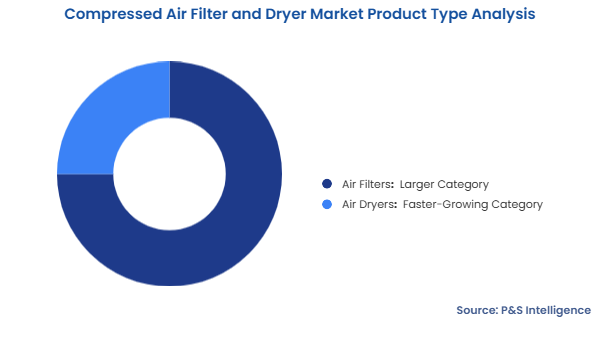
Air filters are the largest product with 75% share, essential for removing contaminants in all industrial compressed air applications.
Air dryers are the fastest-growing product with 6.1% CAGR, essential for preventing moisture damage in automated manufacturing and sensitive tools.
Automotive leads industry adoption with 25% share, requiring high-volume compressed air for painting, assembly, and powering pneumatic tools.
Food & beverages are the fastest-growing category, registering a CAGR of 6.0%.
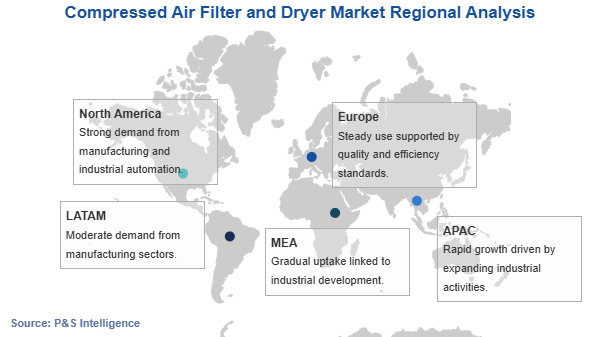
North America is the largest with 40% share, due to a large number of existing manufacturing facilities.
Compressed Air Filter and Dryer Market Overview
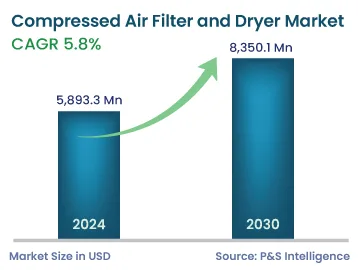
The compressed air filter and dryer market size was USD 6.7 billion for 2025, and it will grow by 5.8% during 2026-2032, to reach USD 9.9 billion by 2032.
The compressed air filter and dryer market is expanding because factories and workshops need clean, dry air to keep machines running without damage. With automation used in a greater number of plants than ever before, air quality is becoming a critical daily requirement rather than a luxury. In addition to the cost associated with maintaining a system, dirty and/or wet air can cause corrosion, leakage, and premature failures. This creates additional pressure on maintenance teams to improve their air filtration and drying capabilities, to minimise downtime.
In addition, due to the increasing energy costs, manufacturers are buying equipment that reduces electricity usage and improves overall facility efficiency. Owing to the tighter regulations related to workplace safety and quality, a greater emphasis is being placed upon more efficient and reliable compressed air treatment systems. As per the International Federation of Robotics, the operational stock of industrial robots worldwide reached 4.66 million units in 2024. This highlights the rapid expansion of automated production lines that demand reliable compressed air quality.
Compressed Air Filter and Dryer Market Trends & Drivers
Intelligent Automation in Air Treatment Systems Is Major Trend
Industrialists are increasingly integrating smarter and connected systems that can monitor their performance. The new filters & dryers contain sensors, which continuously monitor the pressure drop, moisture content, and dirt build-up and notify personnel of a potential problem before it causes an equipment shutdown. There is an increasing preference for compact modular units as they are simple to install or replace as production lines are altered. Energy-saving designs have become a standard vs special feature. Service models are also evolving with remote check/PM (predictive maintenance) replacing routine manual inspections.
The overall direction of Suppliers has transitioned from simply selling basic hardware to providing smarter systems that will be easier to operate daily. According to the International Energy Agency, global investment in energy-efficiency-related technologies reached USD 660 billion in 2024, driven by the industrial sector’s push to reduce operating costs and improve utility infrastructure efficiency. Manufacturers are increasingly using or evaluating smart manufacturing technologies, reflecting the rapid industry-wide shift toward connected operations, which require intelligent monitoring systems.
Demand for Machine Integrity and Product Quality Drives Market
The primary driving force behind this expanding market is the need for companies manufacturing in today's high-speed, high-volume manufacturing facilities to maintain machine integrity and ensure product quality. As production speeds increase, even small amounts of moisture or debris in the air can cause equipment failure or significant production losses, increasing the need for reliable air treatment systems. In addition, more stringent quality control and regulatory requirements are forcing manufacturers to make the use of dry, clean air a necessity rather than a luxury.
As facilities continue to grow and become more complex, manufacturers are increasingly seeking solutions to air contamination to prevent losses and ensure continuity of operation. Manufacturing facilities experienced an average of 25 unplanned downtime incidents per month in 2024, highlighting the frequency of operational failures that increase dependence on reliable utility infrastructure. According to the United Nations Industrial Development Organisation, global manufacturing output grew by 1.0% in 2024, reflecting the continued expansion of high-volume industrial activity that demands consistent machine integrity.
Compressed Air Filter and Dryer Market Segmentation Analysis
Product Type Analysis
Air filters are the larger category, holding a market share of 75%, because every compressed air system requires at least one level of filtration to remove dust, oil and particulate matter from the compressed air supply. As a result, an air filter is included in nearly all industrial applications, ranging from small workshops to larger production facilities. In addition, the relatively short replacement cycle of air filters due to wear or plugging provides consistent demand for this type of equipment. Buyers view air filters as required components, rather than optional accessories, due to their impact on machine life and performance.
Additionally, the relatively low price point of air filters, along with their widespread application across many different types of industry, provides for the highest usage of air filters in day-to-day operations. According to the U.S. Department of Energy, compressed air systems accounted for 10% of total manufacturing electricity consumption in 2024, with poor system management causing 20–30% efficiency losses.
Air dryers are the faster-growing category, registering a CAGR of 6.1%, as more and more manufacturing companies have adopted processes that cannot be operated with even trace amounts of moisture in the air. Moisture in air lines can cause corrosion, ice-up and damage to expensive and sensitive tools and control systems. As automation continues to grow in manufacturing, production plants require reliable air quality to prevent sudden unplanned shutdowns. Therefore, as plants continue to modernise, they are investing in new dryers that are more efficient and easier to install. According to the IEA, global energy efficiency initiatives reached 1.8% in 2025.
The product types analyzed in this report are:
Air Filters (Larger Category)
Coalescing Filters
Particulate Filters
Air Dryers (Faster-Growing Category)
Refrigerated Dryers
Desiccant Dryers
Membrane Dryers
Industry Analysis
Automotive is the largest category, as vehicle manufacturing facilities utilise compressed air at nearly all stages of the manufacturing process. This includes powering manufacturing tools, painting, assembly, and performing quality control assessments. Because of the extended periods that vehicle manufacturing plants operate, the volume of compressed air usage is high, and the need for both air cleaning and drying equipment is substantial. Any minor problems with the air supply may result in loss of production time and/or damaged product.
To minimise potential lost revenue associated with downtime, vehicle manufacturing companies invest heavily in air cleaning and drying equipment before starting production and continue to do so throughout the manufacturing cycle. As per OICA, global vehicle sales reached 95.3 million units in 2024, creating sustained high-volume demand for industrial filtration systems across major manufacturing hubs. As per the IFR, the automotive industry accounted for a major share of new industrial robot installations worldwide in 2024, supporting complex assembly and painting operations in high-volume manufacturing environments.
Food & beverages are the fastest-growing category, registering a CAGR of 6.0%, because clean air impacts the quality and safety of food products. Moisture and/or contamination from compressed air on packaged products, fillers, sorters, and cleaners may damage the products themselves. Food processors and manufacturers are subject to strict sanitation guidelines, GMPs, and regular audits; therefore, they invest heavily in air quality control equipment to ensure compliance. With the increased volume of packaged and ready-to-eat food production, there will be an increasing demand for safe air handling systems in this industry.
Advanced filtration and drying technologies will become increasingly important in the Food and Beverage sector. According to the Food and Agriculture Organisation, world meat production reached 374 million tonnes in 2024, increasing the need for pathogen-free compressed air systems in food processing and packaging lines. According to the United Nations Industrial Development Organisation, the food products sector ranked among the top contributors to global Manufacturing Value Added in 2024, reinforcing the need for high-standard utility infrastructure for safety compliance.
The industries analyzed in this report are:
Automotive (Largest Category)
Food & Beverages (Fastest-Growing Category)
Oil & Gas
Chemicals
Power Generation
Metals & Machinery
Pharmaceuticals
Electronics
Others
Application Analysis
Stationary compressed air systems are the largest category, holding a market share of 40%, due to their continuous operation in manufacturing and processing plants. Since these systems treat air for all the different equipment operating within a facility simultaneously, they require an uninterrupted supply of treated air; otherwise, pressure may drop, and equipment could be damaged. Therefore, filters and dryers in these types of applications are used regularly and must be replaced or serviced on a routine basis.
Because many industrial operations rely on stationary air supply systems to provide air to their machinery, the application of stationary compressed air systems will be used more than any other type of system. According to the United Nations Industrial Development Organisation, global manufacturing output grew by 2.9% in 2024, sustaining continuous demand for stationary compressed air systems in industrial facilities. According to the Organisation for Economic Co-operation and Development, the industrial production index for G20 nations averaged 102.5 points in 2024, indicating steady operational activity supported by fixed compressed air infrastructure.
Critical process systems are the fastest-growing category, because many industries today are running processes where air quality cannot fail at all for a short amount of time. Industries that use exact control, sensitive electronic equipment, or sterile product lines require extremely dry and clean air to minimise product defects. If air quality is compromised for any length of time, it could result in a complete loss of production or total waste of a batch.
Additionally, as these manufacturing facilities transition towards more automation and greater precision, their investment in state-of-the-art air treatment systems to protect their critical points will rise. According to the United Nations Industrial Development Organisation, high-tech manufacturing output grew by 1.4% in 2025, driving demand for precision utility infrastructure. Unplanned downtime costs large industrial organisations approximately USD 1.4 trillion in 2024, reinforcing the financial necessity for fail-safe air treatment systems, based on industry estimates reported by Siemens.
The applications analyzed in this report are:
Stationary Compressed Air Systems (Largest Category)
Critical Process Systems (Fastest-Growing Category)
Portable/Mobile Compressed Air Systems
High-Pressure Systems
Others
Drive strategic growth with comprehensive market analysis
Compressed Air Filter and Dryer Market Regional Outlook
North America Compressed Air Filter and Dryer Market Analysis
North America is the largest regional market, holding a market share of 40%, due to a large number of existing manufacturing facilities. Strict air quality regulations force manufacturers to continually update their air drying and filtration systems. The automotive, food processing, and pharmaceutical industries rely heavily on clean, dry compressed air to run their operations and maintain consistency in production demands. Manufacturers in the United States are often early adopters of new technology to meet or exceed energy consumption and operating efficiency standards. In addition, the strong manufacturing sector in Canada, particularly in the aerospace and automotive parts, contributes to the reliance on reliable air treatment systems.
U.S. Compressed Air Filter and Dryer Market Analysis
The U.S. has a strong industrial base that supports many large industries (automotive, food processing) with strict regulations on air quality and workplace safety. It is cost-effective for these companies to implement new, high-quality filtration and drying technologies into their facilities. According to the Federal Reserve, industrial capacity utilisation in the United States reached 77.8% in 2024, indicating sustained operational activity that requires reliable compressed air infrastructure.
Canada Compressed Air Filter and Dryer Market Analysis
Canada's manufacturing sector, especially aerospace and automotive components, requires clean and reliable air to maintain tool integrity and meet regulatory requirements. The investment of Canadian companies in energy efficiency and local service support helps sustain a consistent demand for air treatment products. According to Statistics Canada, aerospace product and parts manufacturing recorded the highest sales volume among manufacturing industries in 2024, increasing the need for high-precision air treatment systems.
Asia-Pacific Compressed Air Filter and Dryer Market Analysis
Asia-Pacific is the fastest-growing regional market, registering a CAGR of 5.9%, due to rampant industrialisation and manufacturing automation. China is the largest manufacturing centre in the world, and it is investing heavily in filters and dryers to protect equipment from contamination and meet stricter local clean air regulations. Improvements in production lines for chemical processes, textile manufacturing and electronic assembly have increased interest in improved compressed air systems in India. The emphasis on efficient energy usage and minimizing down time is driving additional companies to purchase advanced air treatment equipment during the setup of their operations.
China Compressed Air Filter and Dryer Market Analysis
China has a large impact on world economic growth through its tremendous expansion and modernisation of automotive, electronics and general manufacturing industries. This is driven by companies increasing their productivity and implementing air system upgrades to meet the rapidly changing quality requirements associated with increased output and product changes. According to the National Bureau of Statistics of China, high-tech manufacturing value-added output increased by 8.7% in 2024, reflecting rapid industrial modernisation and demand for cleaner utility systems.
India Compressed Air Filter and Dryer Market Analysis
The Indian industry is also growing with the setup of new plants and renovation and modernisation of existing ones in the chemical, textile and pharmaceutical sectors. As awareness of air quality and energy use grows, companies are impelled to invest in newer, more efficient air filter and dryer systems for new and upgraded projects. According to the Ministry of Statistics and Programme Implementation, India’s manufacturing output grew by 8.0% in 2025, driven by capacity expansion in pharmaceuticals, metals, and automotive manufacturing.
Europe Compressed Air Filter and Dryer Market Analysis
Europe’s market prominence is due to strict rules requiring clean compressed air, as well as being environmentally friendly and safe. Germany and France are pushing for the use of energy-efficient systems in their manufacturing plants, while the United Kingdom is focusing on sustainable production practices. As a result, many European companies have started to replace their older filters and dryers with new ones. In addition, the region's large established manufacturing industry, along with strict regulations regarding emissions and workplace safety, creates a steady demand for quality air treatment products.
The regions and countries analyzed in this report are:
North America (Largest Regional Market)
U.S. (Larger Country)
Canada (Faster-Growing Country)
Europe
Germany (Largest Country)
France (Fastest-Growing Country)
U.K.
Italy
Spain
Rest of Europe
Asia-Pacific (Fastest-Growing Regional Market)
China (Largest Country)
India (Fastest-Growing Country)
Japan
South Korea
Australia
Rest of APAC
Latin America
Brazil (Largest Country)
Mexico (Fastest-Growing Country)
Rest of LATAM
Middle East and Africa
Saudi Arabia (Largest Country)
U.A.E. (Fastest-Growing Country)
South Africa
Rest of MEA
Compressed Air Filter and Dryer Market Share
The market is fragmented as no single vendor leads across industries and regions, which results in multiple suppliers competing for sales. Buyers evaluate each product (air filter and dryer) for its ability to meet specific requirements (plant size, air quality requirements, service and price). Although global companies compete in this market, most of the original equipment manufacturers and current suppliers remain independent, regional and local in nature as they offer service and maintenance near them. Customers have unique requirements, which is why they purchase from multiple suppliers. Low switching costs for commodity-type products, such as filters, enable vendors to quickly enter and compete by offering better product performance or service.
Top Compressed Air Filter and Dryer Companies:
Atlas Copco AB
Ingersoll Rand Inc.
Parker Hannifin Corporation
Donaldson Company, Inc.
Kaeser Kompressoren SE
Sullair LLC
SPX Flow, Inc.
BEKO Technologies GmbH
BOGE Kompressoren GmbH
Gardner Denver (part of Ingersoll Rand)
SMC Corporation
Altec Inc.
Precision Filtration Products
Van Air Systems
Compressed Air Filter and Dryer Market News & Updates
In January 2026, Ingersoll Rand launched its LS Series of oil-free air compressors in India for use in pharmaceutical and food processing applications, expanding the availability of dry and contaminant-free compressed air systems for sensitive industrial operations.
In December 2025, Atlas Copco released the X-Air+ 750-20 high-pressure portable air compressor for mining and water well drilling applications, expanding its portfolio of mobile compressed air equipment for heavy-duty field operations.
In September 2025, SMC Corporation launched the JSXF series of pulse valves specifically designed for dust collector systems. These units help industrial plants manage air flow more effectively to keep filtration bags clean and prevent dust buildup in the work area.
In February 2025, Atlas Copco launched the G 7–22 VSD iPM compressor series in India, expanding the availability of variable-speed drive compressed air systems for industrial energy efficiency and air management applications.
Frequently Asked Questions About This Report
What are the primary drivers fueling the compressed air filter market?+
Growth is driven by strict industrial regulations, rising demand for clean air in pharmaceuticals, and the rapid expansion of automated manufacturing facilities.
What is the difference between refrigerated and desiccant air dryers?+
Refrigerated dryers cool air to remove moisture for general use, while desiccant dryers use chemical absorbents to provide ultra-dry air for critical sensitive applications.
Why is energy efficiency becoming a critical trend in this market?+
Rising energy costs are forcing industries to adopt advanced filtration and drying systems that minimize pressure drops and significantly reduce electricity consumption.
How do ISO 8573 standards impact compressed air system selection?+
ISO 8573 standards classify air purity levels for particles, water, and oil, helping industries select the exact filtration needed for compliance and safety.
Which industry sector has the highest demand for high-purity compressed air?+
The pharmaceutical and food & beverage sectors have the highest demand because even microscopic contaminants can ruin products and violate strict safety regulations.
Want a report tailored exactly to your business need?
Leading companies across industries trust us to deliver data-driven insights and innovative solutions for their most critical decisions. From data-driven strategies to actionable insights, we empower the decision-makers who shape industries and define the future. From Fortune 500 companies to innovative startups, we are proud to partner with organisations that drive progress in their industries.
Client Testimonials
Working with P&S Intelligence and their team was an absolute pleasure – their awareness of timelines and commitment to value greatly contributed to our project's success. Eagerly anticipating future collaborations.
McKinsey & Company
India
Unmatched Standards
Our insights into the minutest levels of the markets, including the latest trends and competitive landscape, give you all the answers you need to take your business to new heights
Complete Data Security
We take a cautious approach to protecting your personal and confidential information. Trust is the strongest bond that connects us and our clients, and trust we build by complying with all international and domestic data protection and privacy laws