This Report Provides In-Depth Analysis of the Commercial Refrigeration Equipment Market Report Prepared by P&S Intelligence, Segmented by Product (Walk-In Coolers, Beverage Refrigeration Equipment, Display Showcases, Ice Merchandisers & Ice Vending Equipment), Distribution Channel (Specialty Stores, Hypermarkets/Supermarkets, Online), Application (Food Service, Food & Beverage Retail, Food & Beverage Production), End User (Hospitality, Hypermarkets/Supermarkets, Departmental Stores, Healthcare, Offices & Buildings, Convenience Stores, Government), and Geographical Outlook for the Period of 2021 to 2032
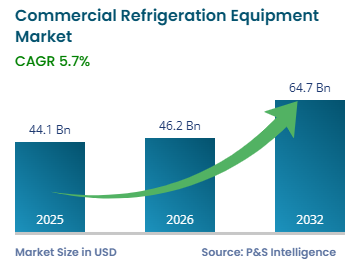
The global commercial refrigeration equipment market stood at USD 44.1 billion in 2025 and is projected to reach USD 64.7 billion by 2032, expanding at a CAGR of 5.7% over 2026–2032. The accelerating expansion of organized food retail chains, hypermarkets, quick-service restaurants, and convenience stores is generating demand for commercial refrigeration equipment globally. This expansion is driving the adoption of walk-in coolers, display showcases, beverage refrigeration equipment, and temperature-controlled storage solutions across food service, retail, and hospitality applications.
The regulatory frameworks governing refrigerant transitions and energy efficiency are influencing market investment patterns. U.S. Environmental Protection Agency (EPA) data shows that commercial refrigeration systems account for 40–60% of the energy consumption in supermarkets. Food retailers globally are responding by investing in next-generation, energy-efficient equipment. The U.S. Department of Energy (DOE)'s final energy conservation standards target USD 4.6 billion in consumer savings over 30 years and a reduction of 19.7 million metric tons of CO₂ emissions from 2029 onward. These standards are accelerating equipment replacement cycles across food retail and food service segments.
Commercial Refrigeration Equipment Market Trends and Drivers
New Eco-Friendly Refrigerants and Smart Systems Are Trending
The commercial refrigeration industry is undergoing a rapid shift toward low-GWP natural refrigerants and IoT-enabled intelligent monitoring systems. Transcritical CO₂ (R-744) refrigeration is displacing legacy hydrofluorocarbon (HFC)-based systems across food retail, hospitality, and cold storage applications. Tightening environmental regulations and declining total cost of ownership for CO₂ systems over multi-year operational cycles are accelerating this displacement. The U.S. EPA notes that approximately 400 new R-744 (CO₂) systems were installed in U.S. supermarkets in 2024. Compliance deadlines under the American Innovation and Manufacturing (AIM) Act are driving this installation pace.
HFCs are potent greenhouse gases with global warming potentials hundreds to thousands of times greater than CO₂. R 134a carries a GWP of 1,430 and R 404A a GWP of 3,922. These GWP levels have triggered phase-out obligations under international and regional regulations. New low-GWP alternatives include natural refrigerants, which carry lower climate impact and negligible ozone depletion potential.
Carbon dioxide (R-744, GWP = 1), propane (R-290, GWP 3), and isobutane (R-600a, GWP 3), as well as hydrofluoroolefins (HFOs, e.g., R-1234yf, GWP < 1), are being adopted across commercial fridges, freezers, larger refrigeration systems, standalone units, and condensing and centralized systems. Stricter environmental rules are the primary adoption catalyst across these applications. These low-GWP refrigerants maintain cooling performance while drastically reducing climate impact and ozone depletion potential.
Supermarkets, convenience stores, and food service establishments are also integrating IoT-enabled sensors, cloud-based temperature monitoring platforms, and AI-assisted energy management systems into commercial refrigerators. These smart refrigeration solutions enable real-time fault detection and predictive maintenance scheduling. Automated energy optimization is delivering reductions in operational costs and food spoilage rates. As equipment manufacturers increasingly bundle digital monitoring capabilities with hardware offerings, smart system integration is transitioning from an optional enhancement to a baseline commercial expectation across mid-to-large food retail establishments.
Expanding Organized Food Retail and Food Service Sectors Drive Market
The global expansion of supermarkets, hypermarkets, convenience store chains, and quick-service restaurant networks represents the primary demand driver for commercial refrigeration equipment. Each new retail format, whether a full-scale hypermarket or a compact urban convenience outlet, requires dedicated display showcases, walk-in coolers, beverage refrigeration equipment, and ice merchandising solutions. Each location generates per-location capital expenditure in refrigeration infrastructure. The Food and Agriculture Organization estimates that approximately one-third of all food produced globally is lost or wasted, with inadequate refrigeration and cold chain inefficiencies contributing significantly to these losses, reinforcing commercial refrigeration investment as both an economic and food security imperative for retail operators.
This dynamic is most pronounced in Asia-Pacific, Latin America, and the Middle East, where organized retail penetration is low and modern grocery, convenience, and food service formats are expanding. The rapid growth of cloud kitchens, food delivery platforms, and e-commerce grocery channels is expanding refrigeration demand into non-traditional commercial food preparation environments. These modern retail and foodservice formats rely on refrigerated display cases, walk-in coolers, and other temperature-controlled solutions to preserve perishable goods and maintain food safety.
Urbanization underpins this expansion. The World Bank reports that approximately 65.5% of China's population and 36.9% of India's population were urban in 2024. This urbanization is reshaping consumption patterns toward organized retail and ready-to-eat foods. The World Bank estimates China’s GDP at approximately USD 18.7 trillion, India’s at USD 3.9 trillion, and Brazil’s at USD 2.2 trillion in 2024. These GDP levels reflect expanding consumer markets and rising household incomes in major developing economies.
Pharmaceutical and Healthcare Cold Storage Requirements Offer Opportunities
The expanding pharmaceutical and healthcare sectors are generating rising demand for specialized commercial refrigeration equipment. Temperature-sensitive pharmaceuticals, including vaccines, biologics, mRNA-based therapies, and controlled-temperature active pharmaceutical ingredients (APIs), require precisely regulated cold storage conditions. The World Health Organization (WHO) estimates that 50% of vaccines are wasted globally every year. Cold chain failures and refrigeration equipment gaps at healthcare facility and pharmacy levels are the primary sources of this waste.
The growth of pharmaceutical retail chains, hospital expansion programs, and government-led immunization infrastructure programs across Asia-Pacific, Latin America, and Africa is driving the procurement of medical-grade commercial refrigeration equipment. This healthcare-driven demand channel offers manufacturers an opportunity to develop premium, higher-margin product lines targeted specifically at regulated pharmaceutical storage requirements. The global biopharmaceuticals market stood at USD 448.1 billion in 2023 and is projected to reach USD 745.1 billion by 2030.
High Costs and Refrigerant Compliance Pressure Hamper Market Growth
The transition to next-generation commercial refrigeration systems carries upfront capital requirements that disproportionately constrain smaller food retail operators, independent restaurants, and regional convenience store chains. The U.S. DOE estimates that industry-wide refrigerant transition compliance would require USD 14.6 million in R&D expenditure and USD 19.0 million in capital expenditure between 2024 and 2026 from manufacturers. These costs are passed through to end-users in the form of higher equipment purchase prices.
For small and mid-sized commercial operators without scale economies or access to green financing instruments, these costs hamper adoption. This constraint is most pronounced in countries where established HFC-based equipment remains operationally serviceable. The skilled technician shortage for servicing CO₂ and hydrocarbon-based refrigeration systems further compounds this challenge. The limited service availability increases the total lifecycle risk for operators transitioning away from conventional refrigerants. Manufacturers and distributors are thus offering flexible financing models, equipment-as-a-service arrangements, and extended service contracts, though full market penetration among smaller operators remains a challenge.
Walk-in coolers accounted for the largest share, of 40%, in the global commercial refrigeration equipment market in 2025. This category position reflects their role as the foundational cold storage infrastructure across food retail, food service, hospitality, and food production environments. Unlike display-oriented equipment, walk-in coolers serve as the primary bulk storage layer across commercial refrigeration operations. They are found across large supermarket backrooms, restaurant preparation areas, hotel kitchens, and food processing facilities.
Their market dominance stems from the universal requirement for high-capacity, centralized temperature-controlled storage regardless of end-user format or geography. The U.S. Food and Drug Administration (FDA) Food Code 2022 establishes that ready-to-eat and perishable food items must be maintained at 41°F (5°C) or below during storage. This mandatory cold chain requirement obligates food retail, food service, and hospitality operators across all scales to invest in certified, temperature-compliant walk-in cooler infrastructure as a baseline operational necessity.
Beverage refrigeration equipment is the fastest-growing segment in the global commercial refrigeration equipment market over 2026–2032, registering a CAGR of approximately 6.3%. Rising global consumption of ready-to-drink beverages and energy drinks is generating demand for dedicated beverage cooling equipment across convenience stores, quick-service restaurants, and petrol station retail formats. Dairy-based drinks and functional beverages are broadening this demand base across the same channels.
The rapid global expansion of convenience store chains is generating consistent per-location procurement of purpose-built beverage coolers, back-bar units, and glass-door bottle coolers. This procurement expansion is most apparent in Asia-Pacific and Latin America. The U.S. Food and Drug Administration Food Code establishes cold storage temperature requirements for perishable foods and beverages at the retail level. These requirements drive the procurement of dedicated refrigeration equipment with precise temperature control across food retail and food service settings.
The market segments into the following product types:
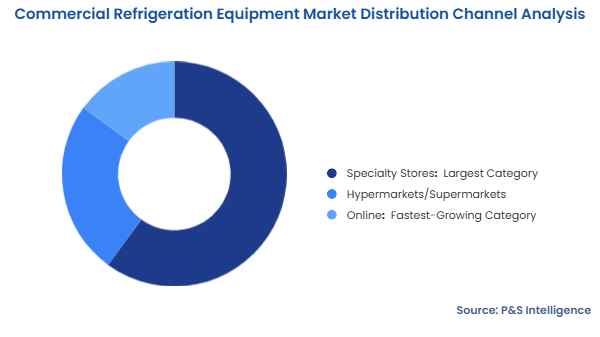
Specialty stores accounted for the largest share, of 60%, in 2025. This channel position reflects the high commercial refrigeration intensity of specialty retail formats, where temperature-controlled display of premium perishables is central to product quality, brand differentiation, and regulatory compliance. Specialty food retail operators typically invest in higher-specification display showcases and walk-in coolers than general grocery formats.
Online distribution is the fastest-growing channel in the global commercial refrigeration equipment market over 2026–2032, registering a CAGR of approximately 6.1%. This growth trajectory reflects the accelerating shift of food service operators, institutional buyers, and mid-sized retailers toward digital procurement platforms for refrigeration equipment selection, specification, financing, and service contracting. The proliferation of e-commerce-enabled capital equipment marketplaces, combined with manufacturers' direct-to-operator digital sales channels with integrated configuration tools, is removing the traditional dependence on dealer networks for equipment procurement. The International Trade Administration (ITA) of the U.S. Department of Commerce estimates that the global B2B e-commerce market will reach approximately USD 36 trillion by 2026, driven largely by industries such as manufacturing, energy, healthcare, and professional services.
The market segments into the following distribution channels:
Specialty Stores (Largest Category)
Hypermarkets/Supermarkets
Online (Fastest-Growing Category)
Application Analysis
The food service application accounted for the largest share in the global commercial refrigeration equipment market in 2025. The scale and equipment intensity of quick-service restaurants, full-service dining establishments, cloud kitchens, and food delivery operations globally underpin this position. Commercial refrigeration systems are deployed at every stage of food service operations, from ingredient storage in walk-in coolers and freezers to cold preparation in reach-in units and ready-to-serve display in countertop merchandisers.
WHO data confirms that unsafe food causes 600 million cases of illness annually. Nearly 1 in 10 people globally are affected. 420,000 deaths result each year. Children under five account for 30% of fatalities and a disproportionate share of disease burden. Temperature control during food service storage has been identified as a critical control point under Hazard Analysis Critical Control Point (HACCP) frameworks. This designation sustains mandatory refrigeration investment across food service operators regardless of scale.
The food & beverage retail application is the fastest-growing application segment in the global commercial refrigeration equipment market over 2026–2032. The global proliferation of supermarkets, hypermarkets, specialty grocery chains, and e-commerce grocery platforms is driving this growth. These formats require refrigerated display cases, walk-in coolers, and beverage refrigeration systems. The construction of modern grocery retail formats in emerging economies across Asia-Pacific, Latin America, and the Middle East is generating large-scale new equipment procurement.
On the other hand, existing food retail operators in mature markets are replacing their old refrigeration equipment due to energy efficiency mandates and refrigerant compliance requirements.
The market segments into the following applications:
Food Service (Largest Category)
Food & Beverage Retail (Fastest-Growing Category)
Food & Beverage Production
Others
End User Analysis
Hospitality held the largest share in the global commercial refrigeration equipment market in 2025, of 30%. This is underpinned by the extraordinary commercial refrigeration intensity of hotels, resorts, cruise lines, and full-service restaurants. Here, multiple distinct refrigeration environments must operate simultaneously across kitchens, bar service areas, banqueting facilities, minibar systems, and bulk cold storage. Large hotels and resorts deploy dozens of individual walk-in coolers, undercounter refrigerators, display showcases, and beverage refrigeration systems within a single property. The United Nations World Tourism Organization (UNWTO) projects that international tourist arrivals will reach 1.8 billion annually by 2030. This is already driving new hotel, resort, and food service venue construction globally, in turn, propelling commercial refrigeration procurement.
Departmental stores represent the fastest-growing category during 2026–2032. This is driven by the accelerating construction of department stores offering fresh food, prepared meals, groceries, and chilled beverages. Department store operators globally are diversifying their product offerings into premium food retail and ready-to-eat categories to compete with online retail and drive in-store traffic. Commercial refrigeration equipment is increasingly being deployed across dedicated food halls, fresh produce sections, and grab-and-go meal counters within these places.
The World Bank highlights that urbanization and rising incomes in emerging economies are driving the expansion of modern retail formats and transforming consumption patterns. Department store operators across Asia-Pacific, the Middle East, and Latin America are actively incorporating food retail components that require certified commercial refrigeration infrastructure. Supermarkets, hypermarkets, and neighborhood department stores are vital in Asia-Pacific, Latin America, and the Middle East, providing consistent access to groceries, household essentials, and basic goods. They shape daily consumption patterns, support food distribution, and serve as hubs for organized retail, driving both convenience and local economic activity.
The market segments into the following end users:
Hospitality (Largest Category)
Hypermarkets/Supermarkets
Departmental Stores (Fastest-Growing Category)
Healthcare
Offices & Buildings
Convenience Stores
Government
Others
Drive strategic growth with comprehensive market analysis
Asia-Pacific Commercial Refrigeration Equipment Market Outlook
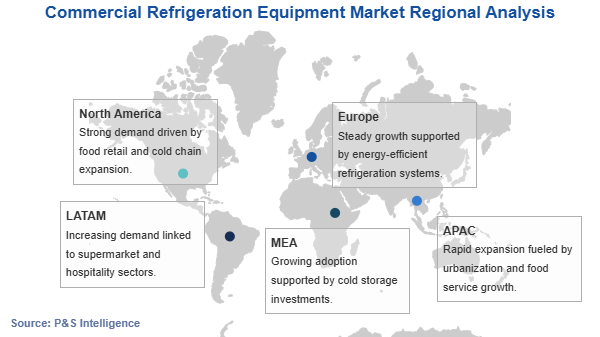
Asia-Pacific held the largest share of the global commercial refrigeration equipment market in 2025, of 40%, and it is the fastest-growing region, at a CAGR of approximately 6.6% during 2026–2032. The region’s lead is anchored in a vast and expanding food production base, rapid organized retail penetration, and accelerating government investment in cold chain infrastructure. Governments and private operators across China, India, and Southeast Asia are aggressively addressing this deficit through targeted cold chain programs.
The Asian Development Bank reports that developing Asia has experienced economic growth of around 5% annually in recent years, supporting rising incomes and expanding consumer demand across the region. This has enabled greater consumer spending on processed, frozen, and fresh chilled food products, which require robust commercial refrigeration across the supply chain. The proliferation of modern grocery retail formats — supermarkets, hypermarkets, and e-commerce grocery platforms — into tier-2 and tier-3 cities is extending commercial refrigeration demand.
China Commercial Refrigeration Equipment Market Trends
China constitutes the largest market within Asia-Pacific, underpinned by its expansive food processing industry, advanced supermarket infrastructure, and cold chain modernization under the 14th Five-Year Plan. According to China’s Ministry of Commerce, the country added over 20 million cubic meters of cold storage capacity in 2023 alone, driven by the surging demand for frozen seafood, dairy, and vegetables from an increasingly affluent urban population.
China’s middle-class population is projected to reach 1.2 billion by 2027, representing roughly a quarter of the global total. This demographic will expand the consumer base for supermarkets, convenience stores, and quick-service restaurants, all of which require significant commercial refrigeration capacity. The rapid growth of e-commerce grocery platforms, including Alibaba Fresh and JD.com, is further driving the demand for integrated smart refrigeration systems with real-time temperature monitoring capabilities. China’s substantial domestic manufacturing base enables the cost-competitive production of commercial refrigeration equipment for both domestic deployment and regional export.
India Commercial Refrigeration Equipment Market Growth
India represents the fastest-growing market within Asia-Pacific, fueled by government-led cold chain infrastructure programs, rapid organized retail expansion, and burgeoning food processing sector. India’s Ministry of Food Processing Industries reports that investments under the Pradhan Mantri Kisan Sampada Yojana (PMKSY) exceeded USD 700 million between 2018 and 2023. This is helping establish new cold storage facilities and refrigerated transport networks across key agricultural production hubs.
The ministry also reports that the country's cold storage network reached 39.6 million metric tonnes of capacity across 8,689 facilities in August 2024. Yet, significant infrastructure gaps persist in rural and tier-3 regions, driving the demand for commercial refrigeration equipment. The rising organized retail penetration is accelerating the procurement of walk-in coolers, display showcases, and high-capacity chillers by supermarket and hypermarket operators. The government’s Production Linked Incentive (PLI) scheme for food processing is attracting foreign investments into India’s food sector, reinforcing long-term commercial refrigeration demand across the country.
North America Commercial Refrigeration Equipment Market Analysis
North America is one of the most technologically advanced commercial refrigeration equipment markets globally, driven by its mature food retail sector, stringent food safety standards, and ongoing equipment modernization cycles. The expansion of convenience store networks and quick-service restaurant chains generates a consistent demand for beverage refrigeration equipment, display showcases, and walk-in coolers.
The United States constitutes the largest market within the region, influenced by the evolving regulatory compliance requirements. The EPA’s final Technology Transitions Rule under the AIM Act imposes GWP limits of 150–300 for new supermarket and commercial refrigeration systems. Compliance deadlines between 2026 and 2028 are driving the widespread replacement of legacy HFC-based equipment across the food retail, convenience, and hospitality segments. Canada, the fastest-growing market, is benefiting from the increasing cold chain investment by major grocery chains transitioning to transcritical CO₂ and natural refrigerant-based refrigeration systems.
Europe Commercial Refrigeration Equipment Market Dynamics
Europe’s commercial refrigeration equipment market is defined by its regulatory-driven transition to low-GWP refrigerants and an established, high-density food retail infrastructure. The European Commission’s F-Gas Regulation (EU 2024/573) mandates a progressive phaseout of HFC refrigerants across commercial refrigeration applications, with the supply of HFCs to be reduced by 95% by 2036. This regulatory framework is accelerating the retirement of legacy refrigeration infrastructure and compelling food retailers, cold storage operators, and hospitality providers to invest in transcritical CO₂ systems.
Germany and France have emerged as the leading markets for energy-efficient refrigeration technologies, supported by their strong industrial manufacturing capabilities and active sustainability mandates for the food retail sector. Germany leads the regional market, supported by its extensive food manufacturing sector and high density of supermarket chains. The United Kingdom represents the fastest-growing market, driven by the expanding food delivery service sector and accelerating refrigeration equipment upgrades across retail and hospitality applications.
These regions and countries are covered in the report:
The global commercial refrigeration equipment market is moderately fragmented due to the huge diversity of product categories and variations in requirements across food service, food retail, hospitality, and healthcare applications. No single manufacturer commands a dominant share across all product categories; instead, competitive positioning is defined by product specialization, geographical concentration, refrigerant capabilities, and distribution channel depth.
The capital-intensive manufacturing, need for sustained R&D investment for energy efficiency and refrigerant compliance, and importance of established aftersales service networks favor established multinational manufacturers over new market entrants. Regulatory requirements are accelerating replacement cycles and favoring manufacturers with the capability and capital to develop compliant natural refrigerant product lines at scale.
Leading Companies in the Commercial Refrigeration Equipment Market:
Dover Corporation
Hussmann Corporation Inc.
Daikin Industries Ltd.
Electrolux Professional AB
Blue Star Limited
Voltas Limited
Illinois Tool Works Inc.
Danfoss A/S
Panasonic Corporation
Haier Smart Home Co. Ltd.
Liebherr Group
Imbera S.A. de C.V.
AHT Cooling Systems GmbH
Frigoglass S.A.I.C.
Ali Group S.r.l.
EPTA Corporate
Commercial Refrigeration Equipment Market News
In May 2025, Hoshizaki Corporation unveiled the Valiance by Hoshizaki line of ENERGY STAR-certified commercial refrigeration equipment at the 2025 National Restaurant Association Show in Chicago. The lineup includes upright reach-in refrigerators, freezers, and sandwich prep tables with a three-year labor, four-year parts, and five-year compressor warranty. The launch targets small- to mid-sized food service operators seeking performance-grade equipment at accessible prices.
In March 2025, Hussmann International Inc. partnered with Phoenix Energy Technologies to launch Refrigeration IQ Powered by StoreConnect, with Hussmann making an equity investment in Phoenix as part of the arrangement. This AI-driven platform integrates automated refrigerant leak detection with real-time IoT-based energy and asset health analytics across commercial refrigeration facilities. The partnership targets grocery and food retail operators seeking to address AIM Act refrigerant compliance and reduce their energy spending.
In October 2024, Daikin Industries Ltd. completed a majority investment in Varitec Solutions, a Phoenix-based energy-efficient HVAC-R system provider across the U.S. Southwest. The move expanded Daikin’s end-to-end commercial building refrigeration service coverage across Arizona, New Mexico, and Texas and its integrated system capabilities for commercial building operators seeking unified HVAC-refrigeration management.
In October 2024, Haier Smart Home Co. Ltd. completed the acquisition of Carrier Commercial Refrigeration from Carrier Global Corporation for an enterprise value of approximately USD 775 million. The transaction included brands such as Profroid, Celsior, and Green & Cool, strengthening Haier’s capabilities in CO₂-based refrigeration across food retail and industrial applications.
In August 2024, Unilever PLC integrated AI image-capture technology across 100,000 ice cream freezer cabinets globally, targeting 350,000 AI-enabled commercial freezer units by the end of 2025.
Frequently Asked Questions About This Report
What will be the commercial refrigeration equipment market 2032 size?+
In 2032, the market for commercial refrigeration equipment will value USD 64.7 billion.
Which product type leads the commercial refrigeration equipment industry?+
Walk-in coolers dominate the commercial refrigeration equipment industry with 40% revenue.
Which is the largest region in the commercial refrigeration equipment market?+
Asia-Pacific is the largest market for commercial refrigeration equipment, with 40% share.
What are the key commercial refrigeration equipment industry drivers?+
The global commercial refrigeration equipment industry is driven by expansion of organized retail and food service sectors, rising demand for cold-chain infrastructure to reduce food loss, urbanization, growing e-commerce grocery and cloud kitchen networks, and increasing consumer spending in emerging economies.
What is the commercial refrigeration equipment market nature?+
The market for commercial refrigeration equipment is moderately fragmented.
Want a report tailored exactly to your business need?
Leading companies across industries trust us to deliver data-driven insights and innovative solutions for their most critical decisions. From data-driven strategies to actionable insights, we empower the decision-makers who shape industries and define the future. From Fortune 500 companies to innovative startups, we are proud to partner with organisations that drive progress in their industries.
Client Testimonials
Working with P&S Intelligence and their team was an absolute pleasure – their awareness of timelines and commitment to value greatly contributed to our project's success. Eagerly anticipating future collaborations.
McKinsey & Company
India
Unmatched Standards
Our insights into the minutest levels of the markets, including the latest trends and competitive landscape, give you all the answers you need to take your business to new heights
Complete Data Security
We take a cautious approach to protecting your personal and confidential information. Trust is the strongest bond that connects us and our clients, and trust we build by complying with all international and domestic data protection and privacy laws