This Report Provides In-Depth Analysis of the Commercial Humidification Market Report Prepared by P&S Intelligence, Segmented by Technology (Steam Humidification (Isothermal), Evaporative Humidification (Adiabatic), Hybrid Systems), Product Type (Central Humidifiers (AHU-integrated), Duct-Mounted Humidifiers, Outdoor-Mounted Humidifiers, Standalone Humidifiers), End User (Data Centers, Healthcare Facilities & Hospitals, Commercial Offices, Hospitality & Institutional Spaces), and Geographical Outlook for the Period of 2022 to 2033
Explore the market potential with our data-driven report
Commercial Humidification Market Overview
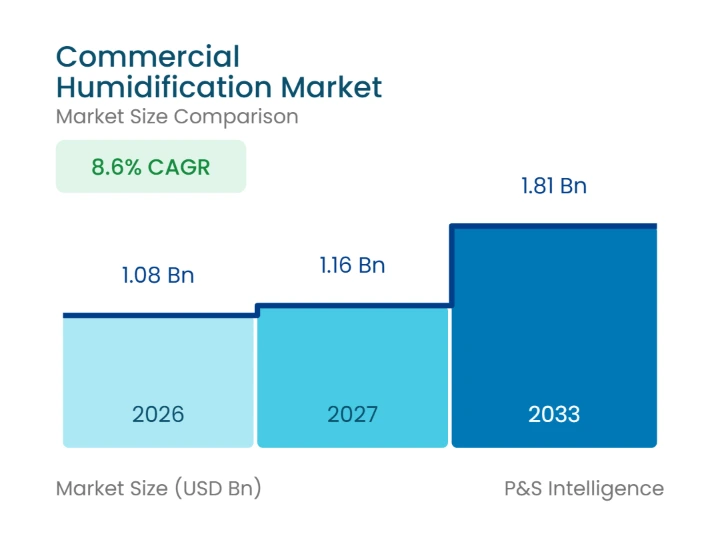
The global commercial humidification market size is estimated at USD 1.08 Billion in 2026 and is expected to reach USD 1.16 Billion in 2027. By 2033, revenue is projected to climb to USD 1.81 Billion, advancing at a CAGR of 8.6% during 2027-2033. Data center operators, hospital estates teams, and office landlords are the core buyers, because dry indoor air raises static-discharge risk for servers, pushes clinical rooms outside their humidity limits, and triggers occupant complaints. Humidifiers are usually bought within a wider air-handling package, so order timing follows construction starts and HVAC replacement schedules.
Operators building server halls for AI workloads are the fastest-growing source of humidifier orders, since they must hold inlet moisture within a narrow band whenever outdoor air turns cold or dry. According to the International Energy Agency, electricity demand from data centers rose 17% in 2025, and the agency expects it to double by 2030. Electricity use sizes the server base, not the share of halls fitted with humidifiers. New halls in cold or arid locations, however, typically carry a humidification line in their mechanical package, which ties part of humidifier demand to the data center build cycle.
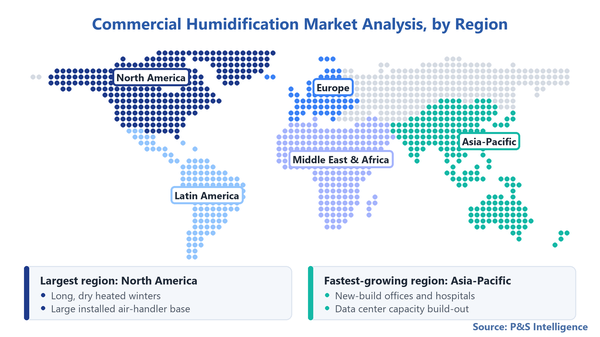
North America holds the largest commercial humidification market share in 2026, supported by a large installed base of central air handlers in U.S. and Canadian offices, hospitals, and universities that owners upgrade or replace as equipment ages. Asia-Pacific is set to post the quickest growth through 2033, as new offices, hospitals, and data center campuses in China, India, Japan, and South Korea specify humidification at the design stage. North American spending therefore leans toward replacing and upgrading existing units, while Asia-Pacific orders arrive mainly with new-build projects.
Key market insights
By technology, steam humidification (isothermal) accounts for the largest share in 2026, while hybrid systems are projected to expand at the fastest rate during 2027-2033.
By product type, central humidifiers (AHU-integrated) account for the largest share in 2026, while outdoor-mounted humidifiers are projected to expand at the fastest rate during 2027-2033.
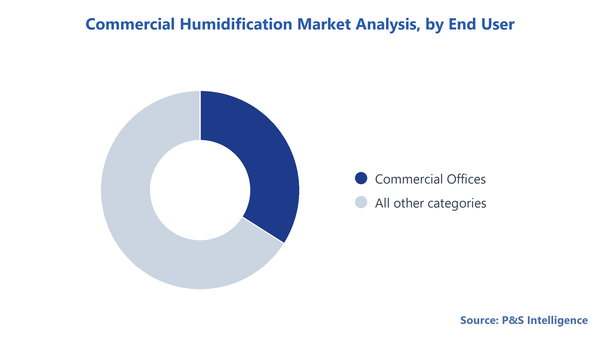
By end user, commercial offices account for the largest share in 2026, while data centers are projected to expand at the fastest rate during 2027-2033.
By geography, North America accounts for the largest share in 2026, while Asia-Pacific is projected to expand at the fastest rate during 2027-2033.
Commercial Humidification Market Dynamics
Lower-energy adiabatic and hybrid systems are reshaping humidifier specification
Electric steam's place as the default choice for central air handlers is being tested by its running cost, which rises in step with the moisture load. A steam humidifier boils every kilogram of water it delivers, while adiabatic units atomize or evaporate water and take the heat they need from the airstream. In buildings with a cooling load, that evaporation also lowers supply air temperature, which offsets part of the chiller bill. Hybrid units, which combine more than one humidification method in a single section, appeal to owners who need tight control without paying steam-level energy costs.
Manufacturer data show how wide the energy gap can be. STULZ states that its ultrasonic direct-room humidifier needs only 7% of the power an electric steam humidifier requires. The figure is one supplier's claim for one product, not an industry average. Gaps of that size still give consulting engineers reason to compare humidifiers on lifecycle cost as well as purchase price. Manufacturers that sell both steam and adiabatic lines are better positioned under this shift, since they can quote whichever system wins the lifecycle comparison.
Static-discharge risk in AI server halls is driving humidifier orders from data center builders
Data center operators form the fastest-growing end-user group for humidifiers, and AI build-outs are the main reason. Server halls move very large volumes of cooled, recirculated air, and in winter or in arid locations that air can dry to levels at which static charge builds on equipment and staff. Operators installing costly accelerator hardware treat that risk as an uptime issue, so design briefs for halls in cold or dry sites often include humidifiers in the air handlers or as direct-room units. Humidification then becomes a design-stage line item alongside data center cooling and power.
ASHRAE's Technical Committee 9.9 guidance places the recommended moisture range for server inlets between a minimum dew point of minus 9 degrees Celsius and a maximum dew point of 15 degrees Celsius, with the upper relative humidity limit set by pollutant levels in the hall. Operators that hold the lower bound in cold or dry locations need active humidification, while sites in humid climates seldom do. Because the guidance is voluntary, each purchase depends on the operator's own risk tolerance. That puts suppliers able to document precise control, low water carry-over, and building-management integration in a stronger bidding position.
Building renovation programs are opening a retrofit pathway for outdoor-mounted humidifiers
Owners upgrading older offices, schools, and hospitals often lack plant-room space for a new steam generator or a longer air-handling section. Outdoor-mounted humidifiers sit on the roof or beside the building and feed moisture into existing ductwork, which leaves indoor floor area free for tenants or clinical use. Contractors can then add or replace humidification during an HVAC upgrade without rebuilding the mechanical room, which can shorten shutdowns in occupied buildings. Outdoor-mounted units are set to grow faster than any other product type, and retrofit work of this kind explains much of that growth.
As per the European Commission, the recast Energy Performance of Buildings Directive, in force since May 28, 2024, triggers renovation of the 16% worst-performing non-residential buildings by 2030 and the 26% worst-performing by 2033. The directive sets energy-performance goals and does not require humidification. Even so, each deep renovation reopens the HVAC specification, and humidifiers in older air handlers can be replaced under the same contract. Manufacturers with compact outdoor units and published energy data could win a larger slice of that refurbishment work.
Water hygiene obligations are limiting adiabatic adoption in sensitive buildings
Adiabatic humidifiers release fine water droplets into the airstream, and stagnant water in tanks, pipework, or wetted media can harbor Legionella and other bacteria. Hospital estates teams and facility managers must therefore budget for water treatment, scheduled cleaning, Legionella testing, and documented risk assessments before approving an adiabatic system. In smaller installations, those running costs can cancel out the energy saving, which can keep owners with steam, where boiling largely removes the microbial risk. Hygiene costs slow the shift toward lower-energy systems more than they reduce total humidifier demand.
The Health and Safety Executive's guidance HSG274 Part 3, whose current edition dates from March 2024, covers legionella control in aerosol-producing systems other than cooling towers and hot and cold water services, the category into which commercial humidifiers fall in Great Britain. Manufacturers are building treatment into the product to lower that compliance burden. Condair's Vita Power system, launched on May 13, 2026, purifies supply water through reverse osmosis, deionization, and UV sterilization before atomizing it. Integrated treatment adds equipment cost, so the restraint is likely to ease first on larger projects.
Segmentation Analysis
Technology
Steam humidification (isothermal) accounts for the largest share of technology revenue in 2026. Electrode, resistance, and gas-fired steam units deliver moisture free of droplets, and boiling leaves little room for bacterial growth, which suits hospitals, laboratories, and server halls where wet ductwork is unacceptable. Steam also reacts quickly to load swings, so it holds the tight set points that operating rooms and archives demand. Mechanical contractors know how to install and service it, and replacement cylinders and heating elements give incumbent manufacturers a recurring parts business that protects their position.
Hybrid systems are expected to post the fastest growth among the three technologies over 2027-2033. These units combine more than one humidification method, often pairing spray atomization with evaporative media, so owners get closer control than a single adiabatic stage while using less energy than steam. Facilities with year-round cooling loads, such as data centers, benefit twice, because the adiabatic stages also cool supply air in warmer months. Manufacturers able to package both stages in one air-handler section and certify the combined performance could gain more specifications as energy targets tighten.
Product Type
Central humidifiers (AHU-integrated) hold the largest share by product type in 2026. Most mid-size and large commercial buildings condition air centrally, so engineers specify humidification as one section of the air handling unit, ordered together with fans, coils, and filters. That bundling ties demand to new construction and AHU replacement cycles and gives air-handler builders and their humidifier partners an early say in the specification. Building operators also prefer one maintenance point in the plant room over dozens of room units spread across occupied floors, which keeps central systems the default in larger projects.
Outdoor-mounted humidifiers are projected to show the quickest growth of the four product types through 2033. Weatherproof cabinets on roofs or slabs suit modular data halls and secure buildings, because water supply, drainage, and service visits stay outside the protected space. Operators that restrict contractor access to server rooms and clinical wings value that separation, and it also removes the need to route water lines above sensitive equipment. Suppliers with cold-weather-rated enclosures, freeze protection, and remote monitoring could capture a growing portion of these orders as owners weigh access and leak risk alongside capital cost.
End User
Commercial offices account for the largest share of end-user demand in 2026. Office stock in cold and temperate climates is heated for several months a year, and heating outdoor air drives indoor relative humidity well below comfort levels, prompting complaints about dry eyes, static shocks, and cracked wooden fittings. Large offices already run central air handlers, so landlords can add or upgrade humidification during routine HVAC refurbishment. Because office demand rests on a very large installed base, it moves slowly from year to year and gives manufacturers a dependable stream of replacement and service revenue.
Data centers are projected to deliver the fastest end-user growth through 2033. The Uptime Institute's 2026 Global Data Center Survey found a growing number of operators reporting peak rack densities of 30 kW or higher. Rack density does not measure humidifier fitment, yet denser racks concentrate more costly hardware in each hall and raise the financial exposure to static discharge. That exposure gives operators more reason to budget for humidity control in new halls in cold or dry locations. Suppliers offering precise, low-energy units with building-management integration are better positioned to win these projects.
The following segments are analysed in this report.
Technology
Steam Humidification (Isothermal)
Evaporative Humidification (Adiabatic)
Hybrid Systems
Product Type
Central Humidifiers (AHU-integrated)
Duct-Mounted Humidifiers
Outdoor-Mounted Humidifiers
Standalone Humidifiers
End User
Data Centers
Healthcare Facilities & Hospitals
Commercial Offices
Hospitality & Institutional Spaces
Copyright P&S Intelligence. Reuse requires attribution under CC BY 4.0.
Regional Analysis
North America commercial humidification market outlook
North America accounts for the largest share of global revenue in 2026. Long, cold winters across the northern U.S. and Canada dry out heated indoor air for months, so offices, universities, hospitals, and museums have specified central humidifiers in their air handlers for decades. That installed base now generates steady replacement and upgrade spending as owners swap aging steam cylinders, heaters, and controls for units that connect to building-management systems. The U.S. is the region's largest market, carrying most of the regional stock of commercial floor space and the bulk of its data center capacity.
Figures from Lawrence Berkeley National Laboratory put U.S. data center electricity use at 176 TWh in 2023, or 4.4% of national consumption, and possibly 6.7% to 12% by 2028. Those figures size the server base, not humidifier fitment, but new halls in dry interior and northern states often include humidification in the mechanical package. Hospital and university refurbishments add a second, steadier stream of orders, because those estates replace humidifiers on planned capital cycles. North America's lead looks stable through 2033, with growth weighted toward data center projects and controls-led upgrades of existing buildings.
Europe market analysis
Europe holds a large, mature position built on long-standing humidification in offices, hospitals, printing plants, and museums across Germany, Switzerland, the Nordic countries, and the U.K. Most spending goes on replacing and upgrading existing systems, and specifications often give hygiene compliance and energy use as much weight as purchase price. Several of the market's established manufacturers are headquartered in Italy, Switzerland, Sweden, and Germany, which keeps product development close to European codes and gives local buyers short service lines.
Hygiene rules set the bar for specification in Germany and neighboring markets. The Association of German Engineers guideline VDI 6022 Part 1, issued in January 2018 and corrected in April 2023, defines hygiene requirements for the design, operation, and maintenance of ventilation and air-conditioning systems and their components, including water testing. Humidifier sections fall within that scope, so suppliers that document conformity and offer hygiene inspections are better positioned in German tenders. European growth is likely to track renovation activity more closely than new construction.
Asia-Pacific is set to post the fastest growth of any region over 2027-2033. New office towers, hospitals, and data center campuses are being designed with central air handling from the start, so humidification is specified on the drawings instead of being retrofitted later. Northern China, South Korea, and Japan have cold, dry winters that make humidification a standard requirement in commercial buildings, while hot, humid markets such as Singapore and Malaysia need far less. Demand inside the region therefore concentrates in its northern economies and in inland cities with dry winters, such as Delhi.
India stands out among the region's fastest-growing markets. Data from the Ministry of Electronics and Information Technology (MeitY) show national data center capacity rising from about 375 MW in 2020 to around 1,500 MW by 2025. Megawatts measure the server base, not humidifier fitment, yet halls in Delhi NCR face very dry winter air and need humidity control for part of the year. Manufacturers that assemble humidifiers within Asia-Pacific could gain on price and lead time as these projects multiply, and the region's share of global revenue is likely to climb steadily through 2033.
Copyright P&S Intelligence. Reuse requires attribution under CC BY 4.0.
Latin America market analysis
Latin America contributes a smaller share of global revenue, with demand concentrated in hospitals, pharmaceutical plants, and data centers in Brazil, Mexico, and Chile. Much of the region is warm and humid for most of the year, so humidification is bought for specific controlled environments more than for general comfort. Highland cities such as Mexico City and Bogotá have drier air, and multinational operators building there can apply the humidity standards they use in North America or Europe, which supports imported equipment from established brands.
Brazil's Law 15.504 of September 15, 2026 created Redata, a special tax regime that suspends import tax, PIS/Cofins, and IPI on equipment bought by approved data center projects. The executive branch still has to define, by regulation, which companies qualify and which equipment is eligible, so orders tied to the regime would follow project approvals over the coming years. Whether humidifiers make the eligible list depends on that regulation, but each approved hall in Brazil's drier interior adds a climate-controlled space that may need them.
Middle East & Africa market analysis
Middle East & Africa holds a smaller but distinctive position in the market. Inland Gulf cities such as Riyadh have very dry air for much of the year, so data centers, hospitals, museums, and hotels there need active humidification even while running heavy cooling loads. Coastal cities such as Dubai, Doha, and Jeddah face the opposite problem, with humid outdoor air that makes dehumidification the main concern. Demand within the region is therefore uneven, and site climate matters more to equipment sizing than national boundaries.
Data center construction is adding a newer stream of orders in the Gulf. Saudi Arabia's Ministry of Communications and Information Technology has set a plan to surpass 1,300 MW of data center capacity before 2030. A capacity target says nothing direct about humidifier fitment, yet halls built in the Saudi interior will face the same dry air, and adiabatic systems suit them because they add moisture while cooling supply air. These projects are often specified through international consulting engineers, which tends to favor manufacturers already approved on European and North American work.
The following geographies are analysed in this report.
The commercial humidification market is moderately fragmented, with a small group of humidification specialists competing against a wider set of diversified HVAC, air-treatment, and steam-engineering groups, each strongest in different regions and building types. Consulting engineers write many of the specifications, which rewards long relationships with design firms in each country. Steam and adiabatic systems demand different water-treatment, control, and hygiene expertise, which separates broad-range specialists from single-technology suppliers. Service networks for cylinder changes, cleaning, and hygiene checks are local, and the structure is shifting slowly through acquisitions of adjacent humidity-control businesses.
CAREL Industries, Condair Group, and DRI-STEEM Corporation offer broad humidification ranges that span electrode or resistive steam and adiabatic or evaporative systems, and they compete on portfolio breadth and controls. Armstrong International, Spirax Group, and PURE Humidifier Co. come from steam engineering and lead with steam-based equipment, including direct steam injection and gas-fired units suited to buildings that already run boilers. Munters Group and STULZ GmbH reach the market through air treatment and precision cooling, often supplying humidification within larger climate-control packages for data centers.
For buyers, the number of capable manufacturers keeps bidding competitive at the specification stage, but switching later is costly because replacement cylinders, media, nozzles, and controls are often proprietary. Manufacturers therefore compete hardest for the first installation, since consumables and service revenue follow each unit for years. Hospital and data center operators also tend to favor manufacturers with local service technicians, which raises the cost of entering a new country. New entrants are more likely to appear in standalone and ultrasonic units, where engineering approval carries less weight than in AHU-integrated systems that consultants must sign off.
Major Companies in Commercial Humidification Market:
CAREL INDUSTRIES S.p.A.
Condair Group AG
Munters Group AB
Armstrong International Inc.
Spirax Group plc
DRI-STEEM Corporation
National Environmental Products Ltd. (Neptronic)
PURE Humidifier Co.
STULZ GmbH
UCAN Co. Ltd.
Commercial Humidification Market News
In September 2026, Condair Group AG signed a lease for a new production site in Suzhou Industrial Park in the greater Shanghai area of China, where it will make humidifiers for customers in China, Southeast Asia, and Central Asia. Local manufacturing shortens lead times and lowers landed costs in Asia-Pacific, the fastest-growing regional market for humidification equipment.
In August 2026, CAREL INDUSTRIES S.p.A. reported first-half revenue growth of 20.9% year on year and announced the signing of an agreement to acquire Cotes, which the company says strengthens its expertise in humidity control. The deal broadens CAREL's moisture-control portfolio, which could let it bid for complete humidity packages in HVAC and industrial projects.
In June 2026, Armstrong International Inc. released a redesigned Gas Fired Humidifier (GFH) series with a 5-inch color touchscreen, BACnet as standard, and single-unit capacity of up to 700 lb/hr. High-capacity gas-fired units let large buildings humidify without adding load to their electrical supply, which matters where grid connections are constrained.
Last Updated: October 2026
Frequently Asked Questions About This Report
How big is the commercial humidification market?+
The global commercial humidification market size is estimated at USD 1.08 Billion in 2026 and is expected to reach USD 1.16 Billion in 2027.
Why do data centers need humidifiers?+
Server halls move very large volumes of cooled, recirculated air, and in winter or in arid locations that air can dry to levels at which static charge builds on equipment and staff.
What is the difference between steam and adiabatic humidifiers?+
A steam humidifier boils every kilogram of water it delivers, while adiabatic units atomize or evaporate water and take the heat they need from the airstream.
Can commercial humidifiers cause Legionella?+
Adiabatic humidifiers release fine water droplets into the airstream, and stagnant water in tanks, pipework, or wetted media can harbor Legionella and other bacteria.
Why are steam humidifiers used in hospitals and data centers?+
Electrode, resistance, and gas-fired steam units deliver moisture free of droplets, and boiling leaves little room for bacterial growth, which suits hospitals, laboratories, and server halls where wet ductwork is unacceptable.
Which region is growing fastest in commercial humidification?+
Asia-Pacific is set to post the quickest growth through 2033, as new offices, hospitals, and data center campuses in China, India, Japan, and South Korea specify humidification at the design stage.
Who are the major commercial humidifier manufacturers?+
CAREL Industries, Condair Group, and DRI-STEEM Corporation offer broad humidification ranges that span electrode or resistive steam and adiabatic or evaporative systems, and they compete on portfolio breadth and controls.
Want a report tailored exactly to your business need?
Leading companies across industries trust us to deliver data-driven insights and innovative solutions for their most critical decisions. From data-driven strategies to actionable insights, we empower the decision-makers who shape industries and define the future. From Fortune 500 companies to innovative startups, we are proud to partner with organisations that drive progress in their industries.
Client Testimonials
Working with P&S Intelligence and their team was an absolute pleasure – their awareness of timelines and commitment to value greatly contributed to our project's success. Eagerly anticipating future collaborations.
McKinsey & Company
India
Unmatched Standards
Our insights into the minutest levels of the markets, including the latest trends and competitive landscape, give you all the answers you need to take your business to new heights
Complete Data Security
We take a cautious approach to protecting your personal and confidential information. Trust is the strongest bond that connects us and our clients, and trust we build by complying with all international and domestic data protection and privacy laws