Major Companies in Cold Chain Monitoring Market:
- Carrier Global Corporation
- ORBCOMM Inc.
- Controlant hf.
- Cryoport Inc.
- Testo SE & Co. KGaA
- Monnit Corporation
- ELPRO-BUCHS AG
- Copeland LP
- Tive Inc.
- SpotSee Holdings

| Study Period | 2022 - 2033 |
|---|---|
| Market Size in 2026 | USD 10.60 Billion |
| Market Size in 2027 | USD 10.82 Billion |
| Market Size by 2033 | USD 23.17 Billion |
| Projected CAGR | 13.4% |
| Largest Region | North America |
| Fastest Growing Region | Asia-Pacific |
| Market Structure | Moderately Fragmented |
Explore the market potential with our data-driven report
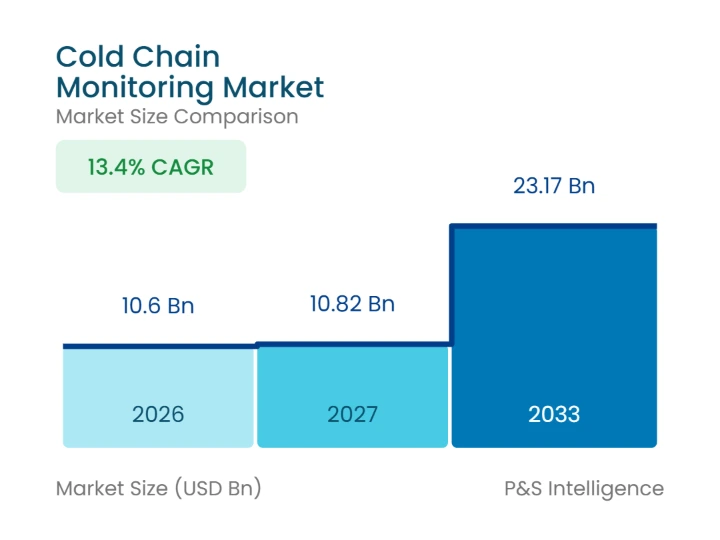
The global cold chain monitoring market size is estimated at USD 10.60 Billion in 2026 and is projected to reach USD 10.82 Billion in 2027. Revenue is then projected to climb to USD 23.17 Billion by 2033, expanding at a CAGR of 13.4% during the 2027-2033 forecast period as monitoring spreads to more lanes. Drug manufacturers, food exporters, refrigerated carriers, and cold-store operators pay for sensors and software because a temperature record can decide whether a load is released, sold, or destroyed. Spending is also shifting toward trackers that report in transit, adding recurring platform fees to device sales.
Perishable-food exporters are adding monitoring because a spoiled container is a total loss of product, freight, and disposal cost, with no salvage value to offset it. According to FAO, 13.3% of the world's food was lost after harvest and before reaching retail in 2023, a figure that spans handling, storage, and transport failures. A logger cannot prevent every one of those losses, but a live temperature alert gives a carrier time to re-cool, reroute, or reject a load before it reaches a retailer's dock. That is the commercial case behind device spending by meat, seafood, dairy, and produce shippers.
North America holds the largest share of the cold chain monitoring market in 2026, as the U.S. and Canada pair regulated drug distributors and vaccine providers with food carriers already keeping electronic temperature records. Asia-Pacific is set to grow the fastest through 2033, as China and India add cold stores and refrigerated trucks that can be fitted with monitoring from the day they enter service. The contrast gives vendors two different sales motions, with upgrades and software subscriptions in North America and volume device sales through local logistics operators in Asia-Pacific.
Pharmaceutical shippers and perishable-food exporters are replacing loggers that are read after delivery with trackers that transmit temperature and location while the load moves. A downloaded record supports an insurance claim only after the damage is done, whereas a live alert gives the carrier time to repair a failed reefer unit or move the pallet. The switch also changes what is sold, since each tracker comes with a per-shipment or monthly data plan, which can raise lifetime revenue per lane for vendors that operate their own cloud platforms.
Telecom operators are forcing part of this upgrade on fleet owners. The Global mobile Suppliers Association counted 313 completed, planned, or in-progress 2G and 3G switch-offs across 89 countries and territories by June 2026. Trailer telematics and container units built for those networks stop reporting once the local band is shut down, so fleets must replace them on the operator's shutdown schedule. Device makers offering 4G LTE and LTE-M hardware certified on many national networks are better positioned to win that replacement business.
Drug manufacturers, wholesalers, and specialist pharmaceutical logistics providers buy monitoring because a temperature-sensitive batch cannot be released to market without evidence that it stayed within its labeled range. A missing or unreadable record can send product into quarantine or destruction, so quality teams typically specify validated loggers on every lane, including lanes that have never recorded an excursion. This makes pharmaceutical demand less exposed to swings in freight volume than food demand, because the record is needed on each shipment regardless of how busy the lane is.
As per the European Commission's guidelines on good distribution practice for medicinal products, temperature monitoring equipment used in vehicles and containers should be maintained and calibrated at regular intervals. That requirement turns each installed sensor into a recurring calibration or replacement purchase, and it rewards vendors that ship devices with traceable calibration certificates and audit-ready reports. Pharmaceutical quality departments can weigh documentation as heavily as unit price, which narrows the opening for low-cost devices sold without validation packages.
Cell and gene therapies typically move at dry-ice or cryogenic temperatures, often as a single patient-specific dose, so a failed shipment can mean a lost product and a delayed treatment. These lanes call for probes rated far below freezing, shock and orientation sensing, and chain-of-custody records that tie device data to an individual dose. Each shipment therefore carries more monitoring content than a pallet of chilled food, and buyers in this niche are likely to weigh reliability and documentation ahead of device cost.
Cryoport's second-quarter 2026 results confirm support for 779 global clinical trials and 22 commercially approved cell and gene therapies as of June 30, 2026. That pipeline is the base for future routine lanes, because each therapy that wins approval converts occasional clinical shipments into recurring commercial ones. Monitoring vendors with cryogenic probe ranges and validated chain-of-custody software could gain repeat orders as approvals accumulate, while vendors limited to 2-8°C devices would have little to sell into these lanes.
Real-time monitoring carries a recurring fee per trailer or per shipment, and many refrigerated food carriers operate small fleets on thin margins. A small operator hauling produce or dairy weighs a monthly data charge against freight rates it does not set, and can settle for the reefer unit's own display or a single-use logger that records without transmitting. Food shippers that want live visibility then have to supply and recover devices themselves, which adds handling cost and slows adoption on smaller lanes.
Figures from the American Trucking Associations put 91.5% of the roughly 580,000 active U.S. motor carriers at ten or fewer trucks as of June 2025, a count that covers all trucking and not only refrigerated fleets. Vendors have answered with cheaper single-use trackers and Bluetooth pallet loggers that report through a shared gateway, which lowers the cost per load. Those options mostly move spending from the carrier to the shipper, so uptake among small carriers is likely to trail that of large contract fleets.
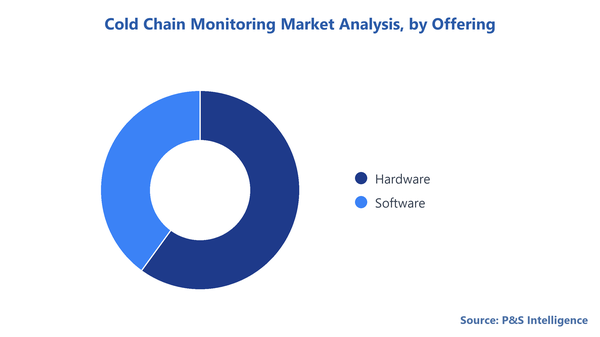
Hardware holds the larger share of the cold chain monitoring market in 2026, because every monitored trailer, reefer container, cold room, and parcel needs a physical sensor or logger before any software has data to work with. Single-use loggers are consumed with each pharmaceutical or produce shipment, tying repeat orders to shipment counts. Fixed temperature sensors in warehouses and freezers are replaced on calibration and battery cycles, with telematics units and gateways counted only when fitted to cold chain assets. Device makers with high-volume production can therefore hold a cost advantage when large food shippers tender for loggers in bulk.
Software is expected to post the fastest growth among offerings, at a 16.8% CAGR during 2027-2033, as quality and logistics teams move excursion review, product release, and audit reporting onto cloud platforms. For electronic records kept under its requirements, the US Food and Drug Administration's 21 CFR Part 11 calls for secure, computer-generated, time-stamped audit trails, and assembling those records by hand across thousands of shipments is slow and costly. Platforms that check records automatically let pharmaceutical shippers release product sooner, which turns monitoring software into a subscription that grows with each added site or lane.
Chilled lanes, which carry fresh produce, dairy, most vaccines, and many biologic drugs in narrow above-freezing bands, give monitoring vendors a broad and steady base of shipments. These loads face risk on both sides of the range, since a few warm hours speed spoilage while accidental freezing can ruin vaccines and fresh produce, so shippers watch for low as well as high excursions. Pharmaceutical quality systems commonly call for a logger in every chilled shipment, which keeps device orders steady even when food volumes soften.
Frozen applications are set to post a 14.0% CAGR over 2027-2033, the quicker of the two temperature types. USDA's National Agricultural Statistics Service recorded 3.25 billion cubic feet of usable refrigerated warehouse space in the U.S. on October 1, 2025, with freezers accounting for 79% of it. Every freezer room, blast freezer, and loading dock in that footprint is a potential sensor point, and wireless sensors can be added to existing rooms without rewiring the building. Long ocean voyages for frozen meat and seafood also call for extended-duration trackers.
Cold-store and warehouse operators form a large, long-lived installed base for storage monitoring, with sensors that stay in refrigerated warehouses, cold containers, and blast freezers for years and report through fixed gateways. Operators buy these systems to pass food-safety and pharmaceutical storage audits, to protect inventory worth far more than the monitoring hardware, and to catch doors left open or compressors running long before energy bills rise. New warehouse openings bring fresh installations, while existing networks produce recurring revenue from software licenses, calibration, and sensor replacement.
Transportation is projected to record a 14.7% CAGR during 2027-2033, because loads in motion are exposed to excursion risk at loading docks, border crossings, and transshipment points. The China Federation of Logistics and Purchasing estimates China's refrigerated truck fleet at 587,900 units in 2025, a figure that sizes the vehicle base available for telematics and says nothing about how many trucks are already monitored. Food and drug shipments that switch between ocean, air, road, and rail also need trackers that travel with the cargo across carriers, which favors portable cellular devices over equipment fixed to one trailer.
Pharmaceuticals & healthcare carry some of the highest monitoring spend per shipment, as vaccines, biologics, biobank samples, and other medicines move under quality systems that treat a missing temperature record as grounds to reject a batch. WHO's prequalification catalogue for temperature monitoring devices lists thermometers, freeze indicators, temperature recorders, data loggers, equipment monitoring devices, and event loggers for immunization supply chains. UN agencies and health ministries buying for vaccine programs typically source from that catalogue, which gives prequalified device makers a preferred route into public procurement.
Food & beverages span the widest product range, from fruits and vegetables to meat, seafood, poultry, dairy, and processed foods. Volume shapes buying here, since retailers and exporters monitor large numbers of pallets and containers, so price per device matters more than in pharmaceuticals, and single-use loggers and low-cost trackers are the usual choice. Large grocery retailers can make a clean temperature record a condition of acceptance at the dock. Chemicals and other applications add smaller demand from temperature-sensitive reagents, coatings, and specialty materials.
The following segments are analysed in this report.
North America holds the largest regional share of global revenue in 2026. The U.S. is the region's largest market, with a dense network of drug distributors, specialty pharmacies, and vaccine providers that must document storage temperatures, alongside food carriers that already log reefer data and are moving to live tracking. Because many large sites already run some form of monitoring, growth here comes mainly from replacing older devices, adding software, and extending coverage from warehouses to individual shipments.
Clinic-level guidance adds a steady replacement cycle. CDC's Vaccine Storage and Handling Toolkit, updated in July 2026, directs providers to place a digital data logger or other appropriate temperature monitoring device in each vaccine storage and transport unit, each with a current and valid certificate of calibration testing. Keeping certificates current turns every monitored unit into a recurring purchase of new loggers or recalibration services. The region's position is likely to hold in absolute terms while its share edges down as Asia-Pacific grows faster, and vendors with validated software and calibration services are better positioned to keep their installed accounts.
Asia-Pacific is set to expand faster than any other region over 2027-2033, because much of its cold chain infrastructure is still being built. China and India are expanding their cold chain networks with cold stores, pack houses, and refrigerated trucks, and new facilities can install wireless sensors and cloud alarms from the start without retrofit costs. India is among the region's quickest-growing markets, supported by state grants for food-processing and cold chain projects and by a vaccine and generic-drug export base that has to meet the temperature documentation expected by importing regulators.
India's Ministry of Food Processing Industries data show 395 cold chain projects approved since 2008, of which 291 are completed and operational, creating 25.52 lakh metric tonnes (2.55 million tonnes) of annual preservation capacity. Each operational project adds cold rooms and vehicles that need temperature records for buyers and auditors. In China, the growing refrigerated vehicle fleet adds a parallel base for telematics. Vendors that sell low-cost devices through local logistics operators and offer local-language platforms are better positioned to capture this new-build demand.
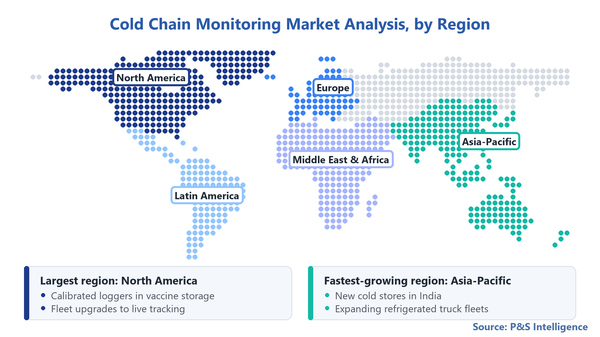
Europe contributes a large, mature share of global revenue that grows through specification upgrades more than through new sites. Germany, the Netherlands, Switzerland, and Belgium host dense clusters of pharmaceutical manufacturing and distribution, and cross-border trucking lanes carry frozen and chilled food between many national markets. Many regulated loads are already monitored, so spending shifts toward multi-country cellular trackers, validated cloud software, and replacement of devices stranded by network shutdowns.
Per the UNECE agreement on the international carriage of perishable foodstuffs, known as ATP, which has 50 contracting parties, equipment carrying quick-frozen food must have an instrument that records air temperature, with the records dated and kept by the operator. That rule sets a baseline for recorders on frozen road and rail lanes across the region, and live tracking is sold as an upgrade on top of it. Suppliers with certified recorders and pan-European connectivity are better positioned in tenders run by large food distributors.
Latin America trails the larger regions but gains steadily from export-led demand. Brazil's poultry and beef exporters, Chile's fruit and salmon shippers, and Mexico's produce growers send perishable goods over long ocean and road routes to buyers in Asia, the Middle East, and North America. Importing customers and destination regulators expect temperature evidence on arrival, so exporters fit reefer containers and pallets with loggers and trackers to defend against rejected loads and claims.
ABPA recorded Brazilian chicken meat exports of 5.324 million tonnes in 2025, a record volume, with the U.A.E., Japan, and Saudi Arabia as the leading destinations. Most of those shipments travel frozen by sea, which supports demand for container telematics and single-use loggers on long voyages. Domestic monitoring adoption for pharmaceuticals and retail food is more uneven, so vendors that partner with export-focused freight forwarders and shipping lines can reach the largest buyers in the region fastest.
Middle East & Africa holds a smaller share of the global market, with demand concentrated in the Gulf states and South Africa. Hot climates raise the cost of any temperature failure, and long import chains for food and medicines run through a few large ports and airport hubs in the U.A.E. and Saudi Arabia. Those hubs, and the distributors working out of them, buy monitoring to protect imported meat, dairy, produce, and vaccines on the final legs of journeys that often began on another continent.
France's Directorate General of the Treasury put the share of imported food in the UAE at 85-90% in February 2026. That reliance makes temperature evidence at the port and warehouse useful to importers settling claims with overseas suppliers. In sub-Saharan Africa, donor-funded vaccine programs anchor demand for prequalified loggers and refrigerator monitors. Suppliers with distributor networks in Dubai and Riyadh can serve much of the Gulf from a small number of hubs.
The following geographies are analysed in this report.
The cold chain monitoring market is moderately fragmented, because the needs of a vaccine distributor, a frozen-food exporter, and an ocean carrier differ enough to support several kinds of specialist. Validated software and calibration records raise switching costs in pharmaceutical lanes, while food and transport lanes reward low device prices and broad connectivity. The structure is gradually consolidating as refrigeration and equipment groups buy monitoring specialists, as Sensitech, a Carrier Global Corporation business, did when it acquired the monitoring business of Berlinger & Co. AG in August 2024.
Competition falls into three clusters. Carrier Global Corporation (through Sensitech), Copeland LP, and ORBCOMM Inc. combine loggers or telematics with broad refrigeration and transport relationships, selling to food shippers, carriers, and container lines. Controlant hf., ELPRO-BUCHS AG, and Testo SE & Co. KGaA concentrate on pharmaceutical and life sciences buyers, where validated software, calibration, and audit records carry the most weight. Tive Inc., Monnit Corporation, and SpotSee Holdings compete with real-time trackers, wireless sensor networks, and low-cost indicators that extend coverage to lanes where a full logger costs too much.
For buyers, this mix means a single supplier may not cover every lane, so large shippers can end up running more than one monitoring vendor and relying on platform integrations to combine the data. Vendors that open their platforms to third-party devices and indicators can win more of each customer's lanes without having to supply every device themselves, which is likely to make integration capability a larger factor in contract awards. Indicator suppliers gain from the same shift, because a low-cost label can feed shipment-level evidence into a platform that already holds tracker data.
Want a report tailored exactly to your business need?
Request CustomizationEmpowering Leaders Across the Globe
Leading companies across industries trust us to deliver data-driven insights and innovative solutions for their most critical decisions. From data-driven strategies to actionable insights, we empower the decision-makers who shape industries and define the future. From Fortune 500 companies to innovative startups, we are proud to partner with organisations that drive progress in their industries.


Working with P&S Intelligence and their team was an absolute pleasure – their awareness of timelines and commitment to value greatly contributed to our project's success. Eagerly anticipating future collaborations.
McKinsey & Company
India
Our insights into the minutest levels of the markets, including the latest trends and competitive landscape, give you all the answers you need to take your business to new heights

We take a cautious approach to protecting your personal and confidential information. Trust is the strongest bond that connects us and our clients, and trust we build by complying with all international and domestic data protection and privacy laws

Customize the Report to Align with Your Business Objectives

Request the Free Sample Pages