Cognitive Systems Market Size & Share Analysis - Trends, Drivers, Competitive Landscape, and Forecasts (2026 - 2032)
This Report Provides In-Depth Analysis of the Cognitive Systems Market Report Prepared by P&S Intelligence, Segmented by Component (Software, Services, Hardware), Deployment Mode (On-Premises, Cloud), Enterprise Size (Large Enterprises, Small and Medium Enterprises), Technology (Natural Language Processing, Automated Reasoning, Machine Learning, Text Analytics, Speech Analytics, Social Media Analytics), Vertical (Banking & Financial Services, Retail & E-commerce, Healthcare, Insurance, Education, Government & Defense, Manufacturing, Securities & Investment Services, Telecommunications, Transportation, Energy & Power), and Geographical Outlook for the Period of 2021 to 2032
Explore the market potential with our data-driven report
Cognitive Systems Market Overview
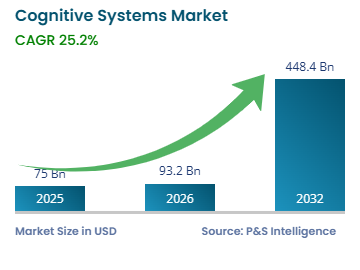
The cognitive systems market size was USD 75.0 billion for 2025, and it will grow by 25.2% during 2026–2032, to reach USD 448.4 billion by 2032.
This growth is supported by the expanding deployment of machine learning, natural language processing, and automated reasoning across banking, healthcare, retail, and government functions, as enterprises increasingly use cognitive systems to process unstructured data, automate knowledge-intensive workflows, and accelerate decision-making. As organizations face growing pressure to modernize legacy IT environments while managing rising data volumes, cognitive systems are increasingly being adopted to support scalable and adaptive enterprise operations.
The public sector is also strengthening adoption of AI technologies that support cognitive-system applications. The U.S. Office of Management and Budget has established requirements for federal agencies to maintain inventories of AI use cases and strengthen governance of high-impact AI applications. In Europe, Eurostat reported that 19.95% of EU enterprises with 10 or more employees used AI technologies in 2025, up from 13.5% in 2024, a 6.47-percentage-point increase. The growing use of machine learning, text mining, natural-language processing, speech recognition, and AI-based workflow automation provides a supportive technology environment for the expansion of cognitive systems across European enterprises.
Key Market Insights
The software category held the largest market share, at 60% in 2025, driven by growing adoption of AI and cognitive technologies.
The cloud category is projected to grow at a 25.4% CAGR, driven by scalability, lower costs, and faster deployment.
The automated reasoning category is projected to grow at a 25.7% CAGR, driven by demand for advanced AI-based decision-making and inference.
North America held the largest market share at 40% in 2025, driven by strong AI adoption, advanced technology infrastructure, government investment, and major technology companies.
Asia-Pacific is projected to grow at a 26.1% CAGR, driven by digitalization, AI investment, cloud adoption, and expanding AI capabilities.
Cognitive Systems Market Trends and Drivers
Generative and Agentic AI Integration Is Key Trend
A defining trend reshaping the cognitive systems market is the integration of generative and emerging agentic artificial intelligence capabilities into cognitive platforms, expanding their functionality from pattern recognition and information processing toward more adaptive reasoning, content generation, and task execution. Cognitive-system architectures are increasingly incorporating large language models and related AI capabilities to support conversational interfaces, document generation, knowledge retrieval, decision support, and workflow automation. This evolution is broadening the functional scope of cognitive systems and enabling enterprises to address more complex, knowledge-intensive workflows.
The growing adoption of AI is creating a favorable environment for this architectural transition. OECD data indicate that 20.2% of firms across OECD countries reported using AI in 2025, compared with 14.2% in 2024 and 8.7% in 2023, with the OECD noting that the diffusion of general-purpose generative AI tools contributed to the increase. The OECD also reports that AI uptake increased from approximately 7% of firms in 2021 to 20% in 2025, partly driven by generative AI diffusion. As generative and agentic capabilities mature, cognitive-system vendors are expected to increasingly emphasize orchestration, governance, interoperability, and integration with enterprise data and workflows alongside core AI model capabilities.
Enterprise Automation Imperatives and AI Investment Momentum Are Biggest Drivers
Escalating enterprise pressure to automate unstructured-data processing, improve operational efficiency, and reduce manual workloads is accelerating adoption of cognitive technologies across banking, healthcare, retail, and other data-intensive industries. As organizations seek to improve productivity and manage increasingly complex information environments, enterprises are moving beyond isolated automation initiatives toward broader deployment of AI-enabled capabilities across customer service, fraud detection, knowledge management, decision support, and back-office operations.
The Stanford Institute for Human-Centered Artificial Intelligence (HAI) reported in the 2026 AI Index Report that 88% of organizations surveyed used AI in 2025, compared with 78% in 2024, demonstrating continued expansion of organizational AI adoption. This broad adoption provides a favorable environment for cognitive-system deployment, particularly for technologies based on machine learning, natural language processing, automated reasoning, and other AI capabilities used to process large volumes of unstructured information. As enterprises increasingly integrate AI capabilities into core workflows, cognitive-system deployment is expected to expand from individual use cases toward broader enterprise platforms supporting customer operations, financial processes, clinical workflows, and supply-chain activities.
Workforce Skills Gaps and Integration Complexity Are Key Restraints
Despite strong enterprise interest, persistent workforce skills gaps and technical integration challenges remain important barriers to broader cognitive-systems deployment, particularly among smaller organizations with limited access to specialized AI, data-science, and machine-learning expertise. Enterprises require skilled personnel to implement, integrate, operate, and govern cognitive systems effectively, while connecting these platforms with existing enterprise applications and legacy IT infrastructure can increase implementation complexity and costs.
These challenges are compounded when organizations lack modern data architectures, standardized interfaces, and internal technical capabilities required to integrate cognitive platforms with existing workflows. As a result, enterprises are increasingly turning to cloud-based cognitive platforms, managed services, employee training, and third-party technology partners to reduce implementation requirements and reliance on in-house expertise. However, skills shortages and integration complexity are expected to remain important constraints on broader enterprise-wide deployment, particularly among SMEs and organizations operating legacy technology environments.
Underserved SME and Emerging-Market Segments Are Biggest Opportunities
Persistent gaps in enterprise technology access across small and medium enterprises and emerging economies are creating substantial addressable-market potential for managed and cloud-delivered cognitive-services offerings. Large enterprises have historically captured a greater share of advanced AI and cognitive-technology investment because of their larger technology budgets and technical capabilities, leaving opportunities among smaller organizations and developing-market enterprises.
As cloud infrastructure and connectivity investment expand across emerging markets, vendors offering subscription-based and low-code cognitive tools are positioned to capture this underserved segment, broadening the addressable market beyond large-enterprise deployments over the coming years. The World Bank reports that mobile broadband networks now cover more than 90% of the global population, while meaningful gaps remain in actual usage and affordability, particularly in low-income economies. These conditions create an opportunity for cognitive-system providers to deliver scalable services through cloud and mobile channels rather than requiring enterprises to build extensive on-premises infrastructure.
Cognitive Systems Market Segmentation Analysis
Component Analysis
The software category holds the largest market share, of 60%, in 2025, supported by growing enterprise adoption of machine learning platforms, natural language processing engines, automated reasoning capabilities, and other software-based cognitive technologies. Software represents the primary functional layer through which cognitive systems process data, generate insights, support decision-making, and automate knowledge-intensive workflows. Broader growth in enterprise software investment also provides a favorable environment for cognitive-software adoption. WIPO reported that global software spending reached USD 675 billion in 2024, up from USD 454 billion in 2020, demonstrating the continued expansion of the global software ecosystem
The services category will have the highest CAGR, of approximately 25.6%, driven by increasing demand for implementation, system integration, customization, maintenance, consulting, and managed services. Organizations with limited internal AI expertise increasingly rely on external providers to deploy and manage cognitive platforms, integrate them with existing enterprise systems, and support ongoing governance and optimization. The U.S. Bureau of Labor Statistics projects strong demand for computer and information technology occupations through 2034, highlighting the continued need for specialized technical capabilities that support the implementation and management of advanced digital technologies. This growing demand for AI-enabled services is also reflected in recent industry activity, as in February 2026, Accenture plc acquired an AI solution from Avanseus that adds prediction, anomaly detection, and optimization capabilities for autonomous network operations, strengthening its ability to provide AI-enabled optimization and decision-support services to telecommunications clients.
The components analyzed in this report are:
Software (Largest Category)
Services (Fastest-Growing Category)
Hardware
Deployment Mode Analysis
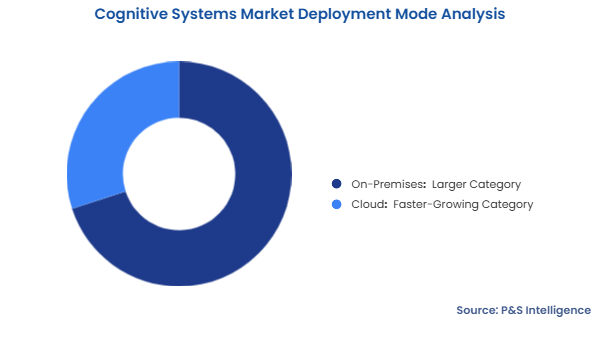
The on-premises category holds the larger market share, of 70%, in 2025, driven by the need for greater control over sensitive enterprise data, security, governance, and regulatory compliance across banking, healthcare, and government applications. Organizations handling confidential or highly regulated information often prioritize direct control over data storage, system configuration, and access management, supporting continued demand for on-premises cognitive systems.
The cloud category will have the higher CAGR, of approximately 25.4%, supported by lower upfront infrastructure requirements, faster implementation, scalability, and increasing availability of AI models and cognitive capabilities through cloud-based platforms and application programming interfaces. Eurostat reports continued growth in enterprise use of paid cloud computing services across the European Union, demonstrating the broader shift toward cloud-based technology infrastructure. This expansion provides a favorable environment for cloud-delivered cognitive systems, particularly among SMEs and organizations seeking access to advanced AI capabilities without substantial investment in dedicated infrastructure.
The deployment modes analyzed in this report are:
On-Premises (Larger Category)
Cloud (Faster-Growing Category)
Enterprise Size Analysis
The large enterprises category holds the larger market share, of 75%, in 2025, reflecting greater capital availability, dedicated IT and data-science teams, established technology infrastructure, and complex operational requirements spanning multiple business functions that favor comprehensive cognitive-platform deployment. The U.S. Small Business Administration's Office of Advocacy reported that 6.3% of small businesses were using AI compared with 11.1% of large businesses, indicating that large businesses adopted AI at approximately 1.8 times the rate of small businesses during the earlier measurement period.
The small and medium enterprises category will have the higher CAGR, driven by the increasing availability of affordable, subscription-based, cloud-delivered cognitive tools that reduce technical and capital barriers to adoption. The SBA Office of Advocacy subsequently reported that small-business AI use increased to 8.8%, narrowing the adoption gap with larger businesses and suggesting that smaller firms are increasingly adopting AI technologies. This improving accessibility is expected to support faster adoption of cognitive systems among SMEs during the forecast period.
The enterprise sizes analyzed in this report are:
Large Enterprises (Larger Category)
Small and Medium Enterprises (Faster-Growing Category)
Technology Analysis
The natural language processing category holds the largest market share in 2025, supported by its broad applicability in processing and interpreting text-based enterprise information, including customer communications, documents, knowledge repositories, and other unstructured records. The widespread availability of text-based data and the increasing use of AI for language understanding and analysis support NLP's leading position within cognitive-system technologies. Eurostat reported that analysis of written language was used by 11.8% of EU enterprises in 2025, making it the most commonly used AI technology category among the technologies measured. While this statistic measures broader AI technology adoption rather than Cognitive Systems market share, it provides supporting evidence for the strong enterprise demand for language-processing capabilities.
The automated reasoning category will have the highest CAGR, of approximately 25.7%, driven by increasing demand for AI systems capable of structured inference, complex decision-making, verification, and rule-based reasoning. As enterprises deploy AI in higher-stakes applications, they increasingly require systems that can validate outputs, follow defined constraints, improve reliability, and support explainable decisions.
The technologies analyzed in this report are:
Natural Language Processing (Largest Category)
Automated Reasoning (Fastest-Growing Category)
Machine Learning
Text Analytics
Speech Analytics
Social Media Analytics
Others
Vertical Analysis
The banking & financial services category holds the largest market share, of 25%, in 2025, supported by the sector's large volumes of structured and unstructured data, stringent fraud-detection and regulatory requirements, and established use of AI and automation for risk assessment, customer service, compliance, and financial decision-making. The sector's continued investment in AI governance and model-risk management is also supporting demand for controlled and explainable cognitive technologies.
The retail & e-commerce category will have the highest CAGR, driven by expanding online commerce, increasing volumes of customer and transaction data, and growing use of cognitive technologies for personalization, recommendation engines, sentiment analysis, demand forecasting, fraud detection, and automated customer support. The U.S. Census Bureau reported that U.S. retail e-commerce sales reached USD 1,192.6 billion (approximately USD 1.19 trillion) in 2024, increasing 8.1% from 2023, while total retail sales increased 2.8% during the same period. E-commerce accounted for 16.1% of total U.S. retail sales in 2024, up from 15.3% in 2023, demonstrating the continued expansion of digital commerce and the growing volume of data available for AI-enabled and cognitive applications.
The verticals analyzed in this report are:
Banking & Financial Services (Largest Category)
Retail & E-commerce (Fastest-Growing Category)
Healthcare
Insurance
Education
Government & Defense
Manufacturing
Securities & Investment Services
Telecommunications
Transportation
Energy & Power
Others
Drive strategic growth with comprehensive market analysis
Cognitive Systems Market Geographical Analysis
North America Cognitive Systems Market Size
North America holds the largest market share, of 40%, in 2025, supported by a mature enterprise technology ecosystem, strong adoption of AI and cognitive technologies across banking, healthcare, retail, and government, sustained federal investment in artificial intelligence research infrastructure, and the presence of major technology companies developing cognitive software and services. Increasing government adoption of AI-enabled decision-support, automation, and data-processing technologies is further strengthening the region's cognitive-technology ecosystem.
Federal investment in artificial intelligence research continues to provide an important foundation for the region's cognitive-technology development. The National AI Research Institutes, led by the U.S. National Science Foundation, represent a major federal AI research initiative spanning foundational and use-inspired AI research across sectors including healthcare, education, manufacturing, agriculture, security, and energy. According to the NITRD and National Artificial Intelligence Initiative Office FY2025 report, federal agencies invested approximately USD 118.5 million in 2023 and USD 69 million in 2024 in the AI Institutes program, with USD 72.3 million projected for 2025. The NSF describes the AI Institutes as strategic investments in foundational AI science and its application to critical economic sectors, further supporting the development of technologies underlying cognitive systems.
U.S. Cognitive Systems Market Size
The U.S. represents the largest country market within North America, supported by the concentration of major technology companies, strong enterprise adoption of artificial intelligence across banking, healthcare, retail, and other data-intensive industries, federal investment in AI research and infrastructure, and continued private-sector development of machine learning and natural language processing capabilities. Expanding government adoption of AI-enabled decision-support and automation technologies is further strengthening the ecosystem supporting cognitive-system deployment across public-sector and regulated applications.
The White House released America's AI Action Plan on July 23, 2025, outlining more than 90 federal policy actions across three pillars: accelerating AI innovation, building AI infrastructure, and strengthening international diplomacy and security. The plan calls for removing regulatory barriers to AI development and deployment, improving federal procurement processes, accelerating AI adoption within government, and supporting collaboration between government, industry, and research institutions. These measures are expected to support the broader adoption of AI technologies that underpin cognitive systems, including machine learning, natural-language processing, automated reasoning, and AI-enabled decision support.
Asia-Pacific Cognitive Systems Market Size
Asia-Pacific will have the highest CAGR, of approximately 26.1%, supported by expanding enterprise digitalization, increasing government investment in artificial intelligence, growing cloud adoption, and the rapid development of AI capabilities across China, India, Japan, South Korea, and other regional economies. The region's expanding technology infrastructure, large digital user base, and increasing adoption of machine learning, natural language processing, automated reasoning, and AI-enabled decision-support technologies are creating favorable conditions for cognitive-system deployment. Growing adoption among small and medium enterprises is also expected to broaden the use of cognitive platforms beyond large enterprises as cloud-based technologies reduce infrastructure and implementation barriers.
China's New Generation Artificial Intelligence Development Plan targets the country's core AI industry at more than RMB 1 trillion by 2030, with related industries expected to exceed RMB 10 trillion, demonstrating sustained government support for AI research, commercialization, and industrial adoption. These investments support the broader technology ecosystem underlying cognitive systems, particularly machine learning, natural-language processing, intelligent decision-making, and automation. In India, the IndiaAI Mission was approved with an overall financial outlay of INR 10,371.92 crore over five years, supporting AI compute infrastructure, datasets, innovation, skills development, and AI applications. The government initiative strengthens India's domestic AI ecosystem and provides infrastructure and capabilities that can support the deployment of cognitive technologies across enterprises and public-sector applications.
The regions and countries analyzed in this report are:
North America (Largest Region)
U.S. (Larger Country)
Canada (Faster-Growing Country)
Europe
Germany (Largest Country)
U.K. (Fastest-Growing Country)
France
Italy
Spain
Rest of Europe
Asia-Pacific (Fastest-Growing Regional Market)
China (Largest Country)
India (Fastest-Growing Country)
Japan
South Korea
Australia
Rest of APAC
Latin America
Brazil (Largest Country)
Mexico (Fastest-Growing Country)
Rest of LATAM
Middle East and Africa
Saudi Arabia (Largest Country)
South Africa
U.A.E. (Fastest-Growing Country)
Rest of MEA
Cognitive Systems Market Competitive Landscape
The market is semi-consolidated because a limited number of large technology companies hold significant market positions through strong AI capabilities, cloud infrastructure, proprietary technologies, extensive enterprise relationships, and substantial R&D investments. Companies such as Microsoft, IBM, Google, Amazon Web Services, Oracle, SAP, NVIDIA, and Salesforce have broad cognitive and AI offerings. At the same time, specialized providers contribute to competition across healthcare, financial services, analytics, cybersecurity, natural-language processing, and industry-specific cognitive applications. The availability of cloud platforms, open-source AI technologies, and specialized solutions also enables smaller and emerging providers to participate in the market.
Key Players in the Cognitive Systems Market:
IBM Corporation
Microsoft Corporation
Alphabet Inc.
Amazon Web Services, Inc.
Oracle Corporation
SAP SE
NVIDIA Corporation
Intel Corporation
Salesforce, Inc.
Cisco Systems, Inc.
Accenture plc
Cognizant Technology Solutions Corporation
Cognitive Systems Market Developments
In June 2026, Accenture plc made a strategic investment through Accenture Ventures in AlphaSense, an AI-powered market intelligence platform used by over 7,000 enterprises, and formed a partnership to embed market intelligence into agentic workflows. The investment strengthens Accenture's data-driven decision-making capabilities for enterprise clients.
In May 2026, Cognizant Technology Solutions Corporation launched Cognizant Secure AI Services, an integrated offering designed to help enterprises secure, govern, and scale AI and agentic systems in production. The launch addresses rising enterprise demand for governance and runtime assurance as cognitive systems move from pilots to core operations.
In December 2025, Microsoft Corporation partnered with Cognizant Technology Solutions Corporation, Infosys Limited, Tata Consultancy Services Limited, and Wipro Limited to deploy over 200,000 Microsoft Copilot licenses for agentic AI adoption. The partnership followed Microsoft's USD 17.5 billion India cloud and AI infrastructure pledge for 2026-2029.
In April 2025, IBM Corporation completed its acquisition of Hakkoda Inc., a data and AI consultancy, expanding IBM Consulting's generative AI-powered data modernization capabilities for financial services, public sector, and healthcare clients.
Frequently Asked Questions About This Report
What are the major applications of cognitive systems?+
Cognitive systems are used across healthcare, financial services, retail, manufacturing, telecommunications, cybersecurity, and other industries for decision support, automation, customer engagement, predictive analytics, and process optimization.
What factors are driving the adoption of cognitive systems?+
Adoption is driven by the growing volume of data, demand for automation, increasing use of AI and machine learning, the need for real-time decision-making, digital transformation, and demand for personalized customer experiences.
What are the major trends in cognitive systems?+
Major trends include the integration of generative AI, cloud-based cognitive platforms, multimodal AI, AI-powered automation, edge AI, and the increasing integration of cognitive capabilities into enterprise software.
What are the major challenges in adopting cognitive systems?+
Key challenges include high implementation costs, data privacy and security concerns, shortage of skilled AI professionals, integration with legacy systems, data quality issues, and regulatory and ethical considerations.
How is generative AI influencing cognitive systems?+
Generative AI is expanding cognitive-system capabilities by enabling more advanced natural-language interaction, content generation, knowledge retrieval, decision support, software assistance, and automated business processes.
Want a report tailored exactly to your business need?
Leading companies across industries trust us to deliver data-driven insights and innovative solutions for their most critical decisions. From data-driven strategies to actionable insights, we empower the decision-makers who shape industries and define the future. From Fortune 500 companies to innovative startups, we are proud to partner with organisations that drive progress in their industries.
Client Testimonials
Working with P&S Intelligence and their team was an absolute pleasure – their awareness of timelines and commitment to value greatly contributed to our project's success. Eagerly anticipating future collaborations.
McKinsey & Company
India
Unmatched Standards
Our insights into the minutest levels of the markets, including the latest trends and competitive landscape, give you all the answers you need to take your business to new heights
Complete Data Security
We take a cautious approach to protecting your personal and confidential information. Trust is the strongest bond that connects us and our clients, and trust we build by complying with all international and domestic data protection and privacy laws