Climate Data Analysis Market Size & Share Analysis - Trends, Drivers, Competitive Landscape, and Forecasts (2026 - 2032)
This Report Provides In-Depth Analysis of the Climate Data Analysis Market Report Prepared by P&S Intelligence, Segmented by Component (Software, Services, Hardware), Deployment Mode (Cloud, On-Premises), Organization Size (Large Enterprises, Small & Medium Enterprises), End User (Government, Energy & Utilities, Agriculture, Transportation, Insurance & Risk Management, Research & Academia), and Geographical Outlook for the Period of 2021 to 2032
Explore the market potential with our data-driven report
Climate Data Analysis Market Overview
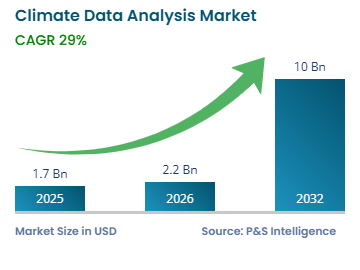
The climate data analysis market size was USD 1.7 billion in 2025, and it will grow by 29.0% during 2026-2032 to reach USD 10.0 billion by 2032.
The market is expanding as organizations increasingly rely on climate intelligence to support informed decision-making, strengthen operational resilience, and manage environmental risks. Climate data analysis involves collecting, integrating, processing, and interpreting information from satellites, weather stations, remote sensing platforms, and connected sensors to generate actionable insights. Governments, businesses, research institutions, and financial organizations are increasingly using climate analytics to monitor changing weather patterns, assess climate-related risks, optimize resource management, support infrastructure planning, and advance long-term sustainability initiatives. As climate variability continues to influence multiple industries and regions, the demand for advanced analytical solutions that enable accurate forecasting, scenario modelling, and environmental risk assessment is steadily increasing.
The market is also witnessing a gradual shift from conventional climate monitoring toward integrated digital climate intelligence platforms that combine advanced data collection with artificial intelligence (AI), machine learning (ML), cloud computing, and geographic information systems (GIS). This transition is enabling organizations to analyse large-scale environmental datasets more efficiently and generate faster, more reliable insights for operational and strategic planning. According to the World Meteorological Organization (WMO), the global mean near-surface temperature reached 1.55 ± 0.13°C above the 1850–1900 average in 2024, making it the warmest year in the 175-year observational record. Rising climate variability is increasing the need for continuous environmental monitoring and predictive modelling, encouraging wider adoption of climate analytics across applications such as supply chain planning, insurance modelling, energy forecasting, agricultural management, and regulatory reporting.
Key Market Insights
Software is the largest component, holding a market share of 60.5%, due to its central role in climate data processing, modeling, visualization, forecasting, and decision support.
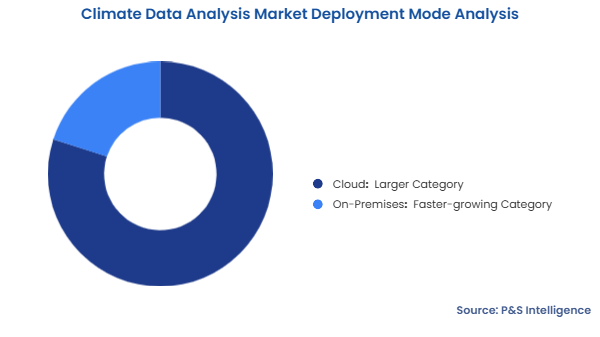
On-Premises is the faster deployment mode, registering a CAGR of 29.5%, driven by increasing demand for data ownership, privacy, operational independence, and secure climate data management.
Large Enterprises are the largest organization size category, holding a market share of 80.5%, due to extensive sustainability reporting, regulatory compliance, and climate risk management requirements.
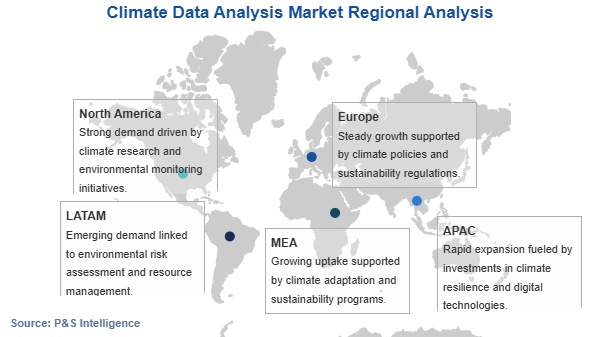
North America holds the largest share of 45.0%, due to its extensive climate observation infrastructure, environmental research ecosystem, and widespread use of climate analytics.
Asia-Pacific is the fastest-growing region, registering a CAGR of 31.0%, driven by expanding climate resilience initiatives and growing adoption of climate analytics across climate-sensitive sectors.
Climate Data Analysis Market Trends and Drivers
Integration of Generative AI and Digital Climate Intelligence Platforms Is a Major Trend
The integration of generative artificial intelligence (AI) and digital climate intelligence platforms is emerging as a major trend in the climate data analysis market, as it enables organizations to process complex environmental datasets more efficiently, improve forecasting accuracy, and accelerate climate-informed decision-making. The increasing adoption of these intelligent solutions is expanding the application of climate analytics across governments, enterprises, research institutions, and environmental organizations, creating greater demand for advanced data analysis capabilities.
According to the National Aeronautics and Space Administration (NASA), the Earthdata archive volume surpassed 123 petabytes in 2024. Additionally, the Copernicus Data Space Ecosystem made more than 200 petabytes of Earth observation data available and registered 289,000 users in 2024. The rapid expansion of climate and Earth observation datasets is increasing the need for advanced analytical platforms capable of processing large-scale environmental information, delivering real-time insights, and supporting more accurate forecasting, scenario modelling, and climate-informed decision-making across multiple industries.
Rising Demand for Climate Risk Assessment and Adaptation Planning Drives Market
The growing demand for climate risk assessment and adaptation planning is a key driver of the climate data analysis market, as organizations increasingly require reliable environmental intelligence to identify potential risks, strengthen operational resilience, and support long-term strategic planning. The need to evaluate climate-related impacts across infrastructure, supply chains, financial assets, and critical operations is encouraging greater adoption of advanced climate analytics platforms capable of delivering predictive insights and risk-based decision support.
Organizations across governments, financial institutions, insurers, infrastructure developers, and commercial enterprises are increasingly incorporating climate risk assessments into planning and investment decisions to address changing weather patterns and environmental uncertainties. According to the World Meteorological Organization (WMO), only half of all countries worldwide had adequate early warning systems in 2024. Additionally, the Centre for Research on the Epidemiology of Disasters (CRED) Emergency Events Database (EM-DAT) reported that 393 natural hazard-related disasters in 2024 caused 16,753 deaths and affected more than 167 million people. The increasing frequency and impact of climate-related events are reinforcing the need for advanced analytical solutions that support forecasting, vulnerability assessments, scenario modelling, and informed risk management across multiple sectors.
Limited Availability of Standardized and High-Quality Climate Datasets Restrains Market Growth
The expansion of climate observation networks and early warning infrastructure is creating significant growth opportunities for the climate data analysis market, as governments and international organizations are increasingly investing in digital climate monitoring, forecasting, and disaster preparedness systems. These investments are generating long-term demand for advanced climate analytics solutions that can transform large volumes of environmental data into actionable insights for climate adaptation, infrastructure planning, and risk management.
Many countries, particularly across emerging economies, are strengthening meteorological observation networks, satellite-based monitoring systems, and climate information services to improve resilience against climate-related disasters. This is accelerating the adoption of advanced climate data analysis platforms capable of integrating diverse environmental datasets and delivering accurate forecasting, scenario modelling, and decision-support capabilities. According to the World Meteorological Organization (WMO), the Early Warnings for All initiative aims to ensure that every person on Earth is protected by multi-hazard early warning systems by 2027. The Global Status of Multi-Hazard Early Warning Systems 2024 report also highlights that early warning services can deliver up to a ten-fold return on investment, encouraging countries to accelerate investments in climate observation and forecasting infrastructure.
Expansion of Climate Analytics Applications Across Financial and Corporate Decision-Making Creates Market Opportunities
The expansion of climate observation infrastructure and early warning systems is creating significant growth opportunities for the climate data analysis market, as governments and international organizations are increasing investments in climate resilience and disaster risk reduction. These investments are generating sustained demand for advanced climate analytics solutions capable of processing large-scale environmental data, improving forecasting accuracy, and supporting evidence-based planning. As climate monitoring infrastructure expands, the need for intelligent data analysis platforms is expected to increase across both developed and emerging economies.
Governments and international agencies are strengthening meteorological observation networks, satellite-based monitoring systems, and digital climate information services to improve preparedness against climate-related hazards. According to the World Meteorological Organization (WMO), the Early Warnings for All initiative aims to ensure that every person on Earth is protected by multi-hazard early warning systems by 2027. Furthermore, the Global Status of Multi-Hazard Early Warning Systems 2024 report states that early warning systems can deliver benefits of up to ten times their investment cost, encouraging countries to accelerate investments in climate observation and forecasting infrastructure.
Climate Data Analysis Market Segmentation Analysis
Component Analysis
Software is the largest category, holding a market share of 60.5%, because it serves as the foundation for climate data processing, modeling, visualization, forecasting, and decision support. Organizations rely on software platforms to integrate information from satellites, sensors, and monitoring networks while supporting the analytical requirements of large enterprises and industry users. According to the Copernicus Data Space Ecosystem, more than 200 petabytes of Earth observation data were available to users in 2024.
Services are the fastest-growing category, registering a CAGR of 29.8%, due to rising demand for consulting, system integration, deployment support, and managed services. Many organizations lack the internal expertise required to implement and operate advanced climate-related platforms effectively. The growing complexity of environmental data and the need for tailored solutions are encouraging businesses and public institutions to invest more heavily in professional and support services.
The component analysed in this report are:
Software (Largest Category)
Services (Fastest-growing Category)
Hardware
Deployment Mode Analysis
Cloud is the larger category, holding a market share of 80.0%, because it provides flexible access to large-scale climate datasets, high-performance computing resources, and scalable storage without requiring significant infrastructure investment. Organizations increasingly prefer cloud-based platforms due to their ability to support faster deployment, seamless software updates, and collaboration across geographically distributed teams. The growing adoption of AI-powered climate analytics and increasing demand for real-time environmental intelligence continue to strengthen the preference for cloud-based deployment across multiple end-use industries.
On-Premises is the fastest-growing category, registering a CAGR of 29.5%, as organizations handling sensitive environmental, infrastructure, and national security-related information increasingly prioritize greater control over data storage, processing, and system security. NVIDIA launched the Earth-2 family of open models, libraries, and frameworks for weather and climate AI in 2026, enabling organizations to develop and deploy advanced forecasting systems on their own infrastructure, thereby strengthening the adoption of on-premises climate analytics solutions.
The deployment mode analysed in this report are:
Cloud (Larger Category)
On-Premises (Faster-growing Category)
Organization Size Analysis
Large Enterprises is the largest category, holding a market share of 80.5%, because these organizations manage extensive assets, supply chains, and operational risks across multiple regions. Their sustainability commitments, regulatory obligations, and long-term planning requirements create strong demand for climate intelligence platforms. According to KPMG, 96% of the world’s largest 250 companies reported on sustainability in 2024. The widespread adoption of sustainability reporting among major corporations is increasing investment in climate data platforms, analytical tools, and environmental risk assessment capabilities that support enterprise-level decision-making and compliance activities.
Small & Medium Enterprises are the faster-growing category, registering a CAGR of 30.5%, due to increasing access to affordable cloud-based solutions and subscription-based service models. Smaller businesses are becoming more aware of climate-related risks and the operational benefits of predictive environmental insights. User-friendly platforms have reduced technical barriers, allowing wider adoption across organizations with limited resources.
The organization size analysed in this report are:
Large Enterprises (Larger Category)
Small & Medium Enterprises (Faster-growing Category)
End User Analysis
Government is the largest category, holding a market share of 35.0%, because public agencies are responsible for environmental monitoring, disaster preparedness, resource management, and policy development. Climate-related information plays a critical role in planning infrastructure, protecting communities, and supporting national sustainability goals. Governments also manage large-scale observation networks and research initiatives that require advanced analytical capabilities.
Energy & Utilities is the fastest-growing category, registering a CAGR of 30.1%, because energy providers increasingly depend on climate intelligence to manage weather-related risks, support renewable energy integration, and improve long-term resource planning. The segment is closely connected with growing demand for forecasting, grid resilience, and environmental risk assessment capabilities. According to the International Energy Agency, global electricity demand increased by 4.3% in 2024.
The end user analysed in this report are:
Government (Largest Category)
Energy & Utilities (Fastest-growing Category)
Agriculture
Transportation
Insurance & Risk Management
Research & Academia
Others
Drive strategic growth with comprehensive market analysis
Climate Data Analysis Market Regional Analysis
North America Climate Data Analysis Market Analysis
North America holds the largest share of 45.0%, because the region has an established ecosystem of climate technology providers, environmental research institutions, satellite data operators, and advanced digital infrastructure that supports large-scale climate analytics deployment. Organizations across the region increasingly integrate climate intelligence into infrastructure planning, disaster preparedness, insurance underwriting, agricultural management, and corporate sustainability programs. The United States contributes significantly through its extensive climate monitoring networks, strong presence of climate software developers, and growing use of climate risk assessments in financial and business decision-making. Canada supports regional growth through investments in climate adaptation planning, environmental monitoring initiatives, and data-driven resource management programs. The region also benefits from active collaboration between public agencies, academic institutions, and private technology companies, creating a favorable environment for the development and adoption of advanced climate data analysis solutions across multiple sectors.
U.S. Climate Data Analysis Market Analysis
The U.S. is a major market for climate data analysis because of its extensive environmental monitoring infrastructure, advanced research capabilities, and broad adoption of climate intelligence across industries. Federal agencies, technology providers, insurers, utilities, and infrastructure operators actively use climate analytics for forecasting, risk assessment, and operational planning. According to the National Oceanic and Atmospheric Administration, the contiguous U.S. average annual temperature reached 55.5°F in 2024, 3.5°F above average and the highest in the 130-year record. Rising climate variability is increasing demand for climate modeling, environmental monitoring, and decision-support platforms across both public and private organizations.
Canada Climate Data Analysis Market Analysis
Canada’s climate data analysis market is supported by a strong focus on environmental stewardship, natural resource management, and climate adaptation planning. Organizations increasingly rely on climate intelligence to address challenges related to forestry, water systems, northern infrastructure, and extreme weather resilience. According to Environment and Climate Change Canada, the national average temperature was 3.1°C above the 1961–1990 reference value in 2024, matching the warmest year recorded since 1948. Growing climate-related pressures are encouraging wider adoption of environmental analytics, remote sensing technologies, and forecasting tools that support planning, monitoring, and infrastructure management activities.
Asia-Pacific Climate Data Analysis Market Analysis
Asia-Pacific has the highest CAGR of 31.0% in the forecast period, driven by the increasing adoption of digital climate intelligence solutions, expanding investments in climate resilience, and the growing need for data-driven environmental decision-making across public and private sectors. Governments and organizations across the region are strengthening climate monitoring infrastructure, enhancing disaster preparedness capabilities, and integrating artificial intelligence (AI), satellite data, and geospatial analytics into environmental planning and resource management. The region is also witnessing rapid digital transformation, increasing deployment of cloud-based analytics platforms, and greater adoption of climate risk assessment solutions across industries such as agriculture, energy, infrastructure, and insurance.
China Climate Data Analysis Market Analysis
China is a significant market for climate data analysis due to extensive investments in environmental monitoring networks, satellite observation programs, and climate research initiatives. Climate intelligence is increasingly used to support ecological protection, renewable energy planning, environmental management, and long-term policy development. According to the China Meteorological Administration, the national average temperature reached 10.9°C in 2024, 1.01°C above normal and the highest level since 1951. Increasing environmental monitoring requirements and continued integration of digital technologies are driving demand for advanced climate analytics platforms, forecasting systems, and environmental decision-support solutions.
India Climate Data Analysis Market Analysis
India is experiencing growing demand for climate data analysis as climate variability increasingly influences agriculture, water management, urban planning, and disaster preparedness activities. Public agencies and private organizations are using climate intelligence to improve forecasting accuracy and strengthen resilience planning across climate-sensitive sectors. According to the India Meteorological Department, annual mean land surface air temperature was 0.65°C above the 1991–2020 average in 2024, making it the warmest year since nationwide records began in 1901. Increasing exposure to climate-related challenges is encouraging broader deployment of climate analytics tools that support planning, monitoring, and risk-management activities.
Europe Climate Data Analysis Market Analysis
Europe remains an important market for climate data analysis due to its strong focus on environmental governance, climate adaptation strategies, and sustainability-driven policymaking. Organizations across the region increasingly rely on climate intelligence to support regulatory compliance, infrastructure resilience, energy transition planning, and environmental reporting activities. Germany represents the largest country market within Europe, supported by its extensive climate research ecosystem, industrial sustainability initiatives, and investments in environmental monitoring technologies. The United Kingdom demonstrates strong growth potential as businesses and public institutions increasingly incorporate climate risk assessments into strategic planning and financial disclosure practices. Across the region, ongoing efforts to strengthen climate resilience and improve environmental decision-making continue to support demand for advanced climate analytics platforms and services.
The regions and countries analysed in this report are:
North America (Largest Regional Market)
U.S. (Larger Country)
Canada (Faster-Growing Country)
Europe
Germany (Largest Country)
U.K. (Fastest-Growing Country)
France
Italy
Spain
Rest of Europe
Asia-Pacific (Fastest-Growing Regional Market)
China (Largest Country)
India (Fastest-Growing Country)
Japan
South Korea
Australia
Rest of APAC
Latin America
Brazil (Largest Country)
Mexico (Fastest-Growing Country)
Rest of LATAM
Middle East and Africa
Saudi Arabia (Largest Country)
U.A.E. (Fastest-Growing Country)
South Africa
Rest of MEA
Climate Data Analysis Market Competitive Landscape
The climate data analysis market is fragmented, characterized by the presence of numerous global and regional technology providers, climate intelligence companies, geospatial analytics firms, satellite data providers, environmental consulting organizations, and software developers. A broad range of companies actively participate in the market, offering solutions across climate modelling, weather forecasting, environmental monitoring, disaster risk assessment, sustainability reporting, and geospatial analytics. Market participants differentiate themselves through artificial intelligence (AI)-enabled analytics, cloud-based platforms, satellite data integration, industry-specific solutions, and strategic collaborations with governments, research institutions, and commercial enterprises.
Leading Companies in the Climate Data Analysis Market:
IBM Corporation
Schneider Electric SE
Verisk Analytics Incorporated
MSCI Incorporated
Moody's Corporation
S&P Global Incorporated
Vaisala Oyj
AccuWeather Incorporated
StormGeo AS
Meteomatics AG
Planalytics Incorporated
Advanced Environmental Monitoring LLC
Jupiter Intelligence Incorporated
ClimateAI Incorporated
Spire Global, Inc.
Climate Data Analysis Market News
In May 2026, Spire Global, Inc. expanded its energy trading intelligence offering by introducing a full weather forecast stack through its Cirrus trader decision platform. The enhanced solution includes forecast comparison views, anomaly monitoring, power generation forecast curves, application programming interface (API) access, and weather forecasts ranging from intraday to 45-day sub-seasonal outlooks.
In January 2026, Schneider Electric SE launched Resource Advisor+, an AI-powered energy and sustainability intelligence platform through its SE Advisory Services business. The platform introduced Carbon Performance and Supply Chain solutions to unify energy, emissions, and sustainability data within a single ecosystem, with Climate Risk and Reporting & Compliance capabilities scheduled for rollout later in 2026
In September 2025, Jupiter Intelligence Incorporated expanded its collaboration with Jones Lang LaSalle Incorporated (JLL) by integrating its climate analytics capabilities into JLL's Risk Advisory platform. The upgraded solution combines Jupiter Intelligence's climate modelling with JLL's property and market data to assess physical climate risks across real estate portfolios.
Frequently Asked Questions About This Report
What does the climate data analysis market include for organizations?+
It includes tools that analyze climate, weather, emissions, satellite, and risk data for planning, reporting, resilience, and investment decisions.
What factors are driving demand in the climate data analysis market?+
Growth is driven by climate risk disclosure, extreme weather planning, sustainability reporting, insurance needs, and demand for location based insights.
Why are organizations adopting climate data analysis solutions across operations?+
Organizations adopt climate data analysis to understand physical risks, plan adaptation, evaluate emissions exposure, and guide resilient asset decisions.
How do climate data analysis solutions improve decision making and efficiency?+
These solutions improve decisions by combining historical records, forecasts, geospatial data, and scenarios into usable climate risk intelligence.
What challenges affect adoption of climate data analysis solutions today?+
Adoption is affected by data uncertainty, model complexity, regional data gaps, skill shortages, and difficulty translating analysis into action.
Want a report tailored exactly to your business need?
Leading companies across industries trust us to deliver data-driven insights and innovative solutions for their most critical decisions. From data-driven strategies to actionable insights, we empower the decision-makers who shape industries and define the future. From Fortune 500 companies to innovative startups, we are proud to partner with organisations that drive progress in their industries.
Client Testimonials
Working with P&S Intelligence and their team was an absolute pleasure – their awareness of timelines and commitment to value greatly contributed to our project's success. Eagerly anticipating future collaborations.
McKinsey & Company
India
Unmatched Standards
Our insights into the minutest levels of the markets, including the latest trends and competitive landscape, give you all the answers you need to take your business to new heights
Complete Data Security
We take a cautious approach to protecting your personal and confidential information. Trust is the strongest bond that connects us and our clients, and trust we build by complying with all international and domestic data protection and privacy laws