This Report Provides In-Depth Analysis of the CIP Chemicals Market Report Prepared by P&S Intelligence, Segmented by Chemical Composition (Alkaline Cleaners, Acid Cleaners, Disinfectants and Sanitizers, Enzymatic Cleaners, Specialty Formulations), Form (Liquid Formulations, Powder Formulations, Concentrated Formulations, Ready-to-Use Products), Process Type (Recirculated Cleaning, Single-Use Cleaning), End User (Food and Beverage Processing, Pharmaceutical and Biotechnology Manufacturing, Chemical Processing, Cosmetics and Personal Care Production, Textile Manufacturing), and Geographical Outlook for the Period of 2021 to 2032
Explore the market potential with our data-driven report
CIP Chemicals Market Outlook
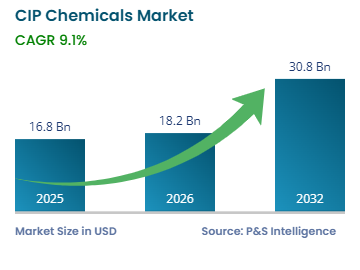
The CIP chemicals market size was estimated USD 16.8 billion for 2025, and it will grow by 9.1% during 2026–2032, to reach USD 30.8 billion by 2032.
The continued regulation on sanitation requirements in food processing, pharmaceutical manufacturing, and cosmetics production facilities have moved specialized cleaning chemistries into the role of “operational imperative” rather than an optional expense. The food processing, pharmaceutical manufacturing, and cosmetic production facilities move towards adopting automated cleaning-in-place systems with the same or greater stringency on hygiene protocols as before. Thus, there is a growing need for alkaline cleaners, acid cleaners, disinfectants, and enzymatic formulations that provide documented proof of removal of pathogens without the need to disassemble equipment.
Additionally, international food safety standards developed by the FAO/WHO Codex Alimentarius Commission emphasize cleaning & disinfection procedures for food contact surfaces. These standards establish baseline hygiene expectations that lead to national regulatory frameworks in countries and continue to support the demand for validated CIP chemical solutions.
CIP Chemicals Market Growth Factors
Automation Integration and Single-Use System AdoptionAre Key Trends
The food processing and pharmaceutical industries are increasingly using automated CIP systems, which feature remote monitoring and real-time verification of chemical concentrations and digital documentation of results.
CIP chemical suppliers are developing formulations to be used with automated dosing systems with sensors to measure conductivity, turbidity, and other parameters to indicate the effectiveness of the cleaning process.
These advancements provide precise control over the concentration of the chemical being dispensed and compatibility.
At the same time, the adoption of single-use bioprocessing technologies is changing how cleaning is accomplished in several ways.
Although single-use bioreactors, filters, and fluid handling components eliminate the need for cleaning between batches, single-use bioprocessing equipment still requires CIP systems to clean reusable cleanrooms, filling equipment, and packaging equipment.
Thus, there is a growing demand for CIP chemicals that can be used in hybrid manufacturing environments, in which stainless steel equipment requires thorough cleaning.
Disposable components eliminate some or all of the cleaning steps required for the stainless steel equipment.
Additionally, technical services offered by chemical suppliers assist customers in automating their CIP processes and modifying their CIP protocols to accommodate changes in their equipment configurations.
Biopharmaceutical Manufacturing Expansion Is Biggest Driver
Increased global capacity for producing biopharmaceuticals is increasing the demand for validated CIP chemical systems which meet the aseptic processing requirements needed to produce biologics.
In April 2025, the National Institute for Innovation in Manufacturing Biopharmaceuticals (NIIMBL) reported it had awarded grants totaling USD 11.2 million to raise the processing of monoclonal antibodies, viral vectors, and cell therapies.
The expansion of biopharmaceutical manufacturing capacity will be reflected by the increased need for manufacturing innovations, including sanitation technologies and validated sanitation protocols.
mAb, vaccine, and gene therapy producers must adhere to cGMP regulations, which mandate cleaning validation studies to demonstrate equipment surfaces have been cleaned after each product campaign has finished.
Thus, there will continue to be a strong demand for CIP chemicals with the ability to remove microorganisms and residues from surfaces.
Contract development and manufacturing organizations (CDMOs) are increasing their production capacity for biopharmaceutical companies and validating their CIP protocols at their new facilities.
Cleaning systems are being included in the overall qualification process for the manufacturing operations at the new facilities.
The expansion of biopharmaceutical manufacturing in North America, Europe, as well as Asia-Pacific, creates an additional demand for CIP chemicals worldwide.
CIP Chemicals Market Segmentation Analysis
Chemical Composition Analysis
The alkaline cleaners category holds the largest market share, of 50%, in 2025, due to their ability to remove organic residues (proteins, fats, carbohydrate), which are typical soil types associated with food and beverage production. The most popular alkaline cleaner is sodium hydroxide-based, due to the existing infrastructure for manufacturing it, its relatively lower cost than alternatives, and its wide use across manufacturing processes.
The enzymatic cleansers category will have the highest CAGR, of 9.3%, primarily due to the increasing demand in pharmaceutical manufacturing and food processing. Here, the lower temperature of operation reduces energy costs, while still providing adequate cleaning results. The U.S. Food and Drug Administration requires the validation of cleaning procedures for all the equipment used in pharmaceutical production. Enzymatic cleaners offer a substrate-specific mechanism of cleaning to effectively remove organic and proteinaceous residue at temperatures lower than those required for the commonly used alkaline cleaning methods.
The chemical compositions analyzed in this report are:
Alkaline Cleaners (Largest Category)
Acid Cleaners
Disinfectants and Sanitizers
Chlorine-based
Peracetic Acid (PAA)-based
Hydrogen Peroxide-based
Quaternary Ammonium Compounds (QACs)
Iodophors
Enzymatic Cleaners (Fastest Growing Category)
Specialty Formulations
Anti-foaming Agents
Corrosion Inhibitors
Chelating/Sequestering Agents
Form Analysis
The liquid formulations category holds the largest market share, of 65%, in 2025, due to the ability to easily interface with automated dosing systems and compatibility with inline concentration monitoring systems employing measurement techniques, such as conductivity or pH as indirect measures of chemical strength. The instant dissolution of solid contaminants eliminates the need for a separate step of mechanical mixing. Pharmaceutical manufacturers, food and beverage manufacturers operating continuous production lines, and dairy producers utilize liquid CIP chemicals because they provide quick deployment, and fewer manual labor requirements than powdered CIP chemicals. This includes the direct application of an accurate amount of CIP chemicals into a production line circuit by automated dosing systems with no operator interaction.
The concentrated formulations category will have the highest CAGR, of 9.4%, due to lower logistics costs, storage space requirements, reduced packaging waste, and lower CO2 emissions per unit of active ingredients. Food manufacturers utilizing multiple facilities benefit from specifying concentrated CIP chemicals to minimize supply chain inefficiencies, and achieve equivalent cleaning results at remote facilities using dilution systems located at each facility to create working-strength CIP chemical solutions from concentrated stock and reduce inbound freight costs. The technology has been greatly improved to maintain the stability of concentrated formulation CIP chemicals, and include the use of better surfactants and chelating agents to prevent the precipitation of insoluble compounds and separation of phases when stored at higher concentrations of active ingredients.
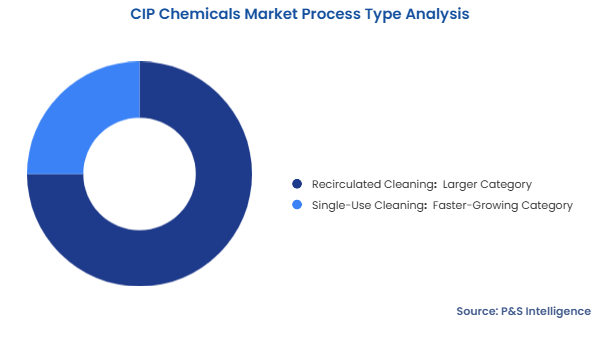
The recirculated cleaning category holds the largest market share, of 75%, in 2025, due to their superior water and chemical usage efficiencies in facilities that clean equipment multiple times per day or process expensive or high value ingredients where minimizing waste directly affects their operational economics. The recirculated CIP system is commonly used in large-scale dairy processing plants, breweries, and pharmaceutical manufacturing facilities to capture cleaning solutions after the first pass through the CIP system, filter out particulates from the cleaning solution, re-concentrate the chemical concentration through automated dosing, and then, re-deploy the cleaned solutions to clean less-critical pieces of equipment or subsequent cleaning phases.
The market for CIP chemicals categorized by process type is experiencing a notable growth rate in the single-use cleaning segment. This growth is attributed to the rising utilization of hybrid and disposable manufacturing platforms within biopharmaceutical and biotech production. Single-use manufacturing platforms mitigate the risks of cross-contamination, facilitate quicker batch changeovers, and consume less water and energy compared to traditional cleaning systems. As the adoption of flexible manufacturing platforms and expedited changeover processes increases, there is a growing demand for CIP chemicals that can validate cleanable components during reuse in a single-use environment. The emphasis on contamination control and process efficiency propels the swift adoption of single-use cleaning techniques.
The process types analyzed in this report are:
Recirculated Cleaning (Larger Category)
Single-Use Cleaning (Faster-Growing Category)
End User Analysis
The food and beverage processing category holds the largest market share, of 55%, in 2025, due to the intense cleaning needs of this processing area, regulatory compliance requirements, and continuous processing activities. This generates one or multiple shifts per day CIP cycles through numerous pieces of equipment such as tanks, pipes, heat exchangers and filling equipment. The U.S. Department of Agriculture’s Foreign Agricultural Service documented that China imported over USD 140 billion in food products in 2023, with the domestic food processing industry demonstrating resilience and continued market access improvements for agricultural imports.
The pharmaceutical and biotechnology manufacturing category will have the highest CAGR. The biopharmaceutical sector has experienced significant capacity expansion since 2010, and the development of cell & gene therapies now require biopharmaceutical manufacturers to adhere to strict aseptic processing standards. As a result of these developments, there are increasing demands from regulatory agencies for all biopharmaceutical manufacturers to validate their CIP chemical systems as well as document the performance characteristics of their systems.
The end users analyzed in this report are:
Food and Beverage Processing (Largest Category)
Pharmaceutical and Biotechnology Manufacturing (Fastest Growing Category)
Chemical Processing
Cosmetics and Personal Care Production
Textile Manufacturing
Drive strategic growth with comprehensive market analysis
CIP Chemicals Market Geographical Analysis
North America CIP Chemicals Market Size
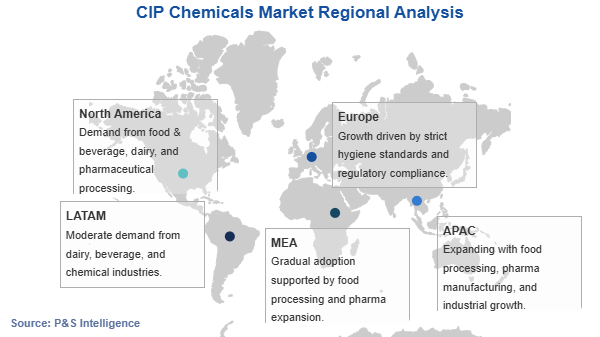
North America holds the largest market share, of 35%, in 2025, due to the federal and state sanitation regulations that require food processing, pharmaceutical, and cosmetics manufacturing facilities to implement and demonstrate effective cleaning and sanitation controls. Additionally, North America has been the home to decades of regulatory development, creating a broad framework of hygiene guidelines for all industries using CIP equipment.
Moreover, North America has seen a large increase in capital spending related to automation, creating an environment for CIP system integrations. This allows food processors and pharmaceutical manufacturers to replace manual cleaning protocols with automated closed-loop recirculating cleaning systems that use chemicals in a more efficient manner while creating documentation to meet the regulatory inspection requirements of both federal and state agencies. The U.S. Food and Drug Administration (FDA) sets forth specific requirements for cleaning and sanitizing food contact surfaces to prevent allergen cross-contamination and microorganisms from contaminating products.
With consumer preference for longer shelf-life processed foods with fewer or no preservatives, food processors are placing increasing importance on terminal sanitation. With the expansion of biosimilar production capacities of pharmaceutical manufacturers, they are requiring cleaning validation studies to demonstrate the cleanliness of their equipment between each product campaign. Additionally, North America benefits from well-established distribution networks for chemical suppliers to deliver CIP chemicals to end-user facilities and technical services that provide assistance in validating their cleaning operations. North America also benefits from associations that promote best practices for optimizing CIP protocols among members.
As food processors consolidate their operations into larger, multi-site operations, CIP protocols are being standardized across these operations, thus creating new opportunities for chemical suppliers to negotiate enterprise-wide supply agreements with them. Meanwhile, pharmaceutical contract manufacturers are investing in flexible production suites that require rapid turnaround cleaning validated for multiple product types.
U.S. CIP Chemicals Market Size
The United States is the largest country market in North America, generating the majority of regional demand due to its extensive food processing sector, leading pharmaceutical manufacturing capacity, and the most stringent regulatory enforcement mechanisms. The United States Food and Drug Administration (FDA), specifically through its Center for Food Safety and Applied Nutrition, conducts food facility inspections that place significant emphasis on sanitation controls as preventive measures. In fact, cleaning procedures represent one of the top inspection priorities under current good manufacturing practice requirements during such inspections.
In addition, the pharmaceutical sector's recent trend toward continuous manufacturing systems and single-use technologies creates demand for CIP chemicals that are compatible with hybrid production environments. Craft beverage producers who are expanding their operations face scaling challenges, including implementing professional-grade sanitation protocols to address the need for consistent quality control. Dairy processing facilities represent another significant segment of CIP chemical users, and they continue to upgrade their aging equipment with systems capable of performing frequent cleaning cycles between product types. The ongoing labor shortage in the food processing industry is accelerating the adoption of automation technology, with CIP systems enabling food processors to maintain consistent cleaning results regardless of operator technique compared to traditional manual cleaning methods. Technical service capabilities differentiate chemical suppliers, as those suppliers that provide validation support and troubleshooting assistance establish long-term relationships with customers that extend beyond the sale of CIP chemicals to include the role of a total sanitation solution provider.
Asia-Pacific CIP Chemicals Market Size
Asia-Pacific will have the highest CAGR, of 9.2%, driven by rapid industrialization of food and beverage sectors, pharmaceutical manufacturing capacity expansion responding to domestic and export demand, and regulatory modernization harmonizing hygiene standards with international benchmarks. Economic development across China, India, Indonesia, and Southeast Asian nations has increased processed food consumption, creating demand for manufacturing infrastructure equipped with sanitation systems meeting both domestic regulations and international buyer requirements. Government initiatives promoting food safety have accelerated CIP system adoption in dairy processing, beverage production, and ready-to-eat meal manufacturing, while pharmaceutical companies establishing production facilities to serve growing middle-class populations invest in validation-ready cleaning systems from project inception.
The region's growth trajectory benefits from increasing multinational food and pharmaceutical company investments establishing production facilities serving regional markets and technology transfer from Western operations bringing CIP system knowledge. It also benefits from rising consumer expectations for product safety driving retailer requirements for supplier facility certification. The pharmaceutical sector's expansion encompasses both finished drug product manufacturing and active pharmaceutical ingredient (API) production, with the latter requiring particularly rigorous cleaning protocols to prevent cross-contamination between compound campaigns. Chemical suppliers establishing regional manufacturing and technical support capabilities gain advantages over importers, as local presence enables rapid response to customer needs and customization of formulations for regional water chemistry and equipment configurations.
China CIP Chemicals Market Size
China represents the largest country market within Asia Pacific, accounting for substantial regional demand due to its position as the world's leading food importer and its rapidly expanding pharmaceutical manufacturing capacity serving both domestic consumption and global supply chains. The country's market scale reflects its extensive food processing infrastructure producing for 1.4 billion consumers and a growing pharmaceutical sector supplying increasing volumes of generic medications and biosimilars. It also reflects government initiatives strengthening food safety enforcement following historical contamination incidents that elevated sanitation protocols to policy priorities. State Administration for Market Regulation inspections and revised food safety law provisions have intensified compliance pressure on domestic manufacturers, while international buyers conducting facility audits require CIP systems meeting Western standards as conditions for supply agreements.
According to USDA Foreign Agricultural Service reports, China’s food processing industry continues to expand, with the sector valued at approximately USD 1.26 trillion in 2024 and tens of thousands of large-scale food manufacturers operating across the country. This scale highlights the importance of validated cleaning and sanitation practices in large-scale food processing operations.
Dairy processing represents a significant end-use segment, with facilities serving domestic demand for fluid milk, yogurt, and infant formula requiring frequent cleaning cycles and validated pathogen elimination. Beverage manufacturers producing bottled water, carbonated drinks, and shelf-stable tea products invest in CIP systems delivering consistent sanitation outcomes across high-speed production lines. The pharmaceutical sector's expansion encompasses both traditional small-molecule drug manufacturing and growing biopharmaceutical capacity producing monoclonal antibodies and vaccines, with the latter requiring aseptic processing environments and cleaning validation studies demonstrating residue removal between product campaigns. Technical knowledge transfer from multinational pharmaceutical companies establishing Chinese operations has elevated domestic industry standards, creating demand for CIP chemicals meeting international specifications.
The regions and countries of the market are as follows:
North America (Largest Region)
U.S. (Largest Country Market)
Canada
Asia Pacific (Fastest-Growing Region)
China (Largest Country Market)
India (Fastest-Growing Country Market)
Japan
South Korea
Australia
Rest of Asia Pacific
Europe
Germany (Largest Country Market)
France
U.K. (Fastest-Growing Country Market)
Italy
Spain
Rest of Europe
Latin America
Brazil (Largest Country Market)
Mexico (Fastest-Growing Country Market)
Rest of Latin America
Middle East & Africa
Saudi Arabia (Largest Country Market)
South Africa (Fastest-Growing Country Market)
UAE
Rest of Middle East & Africa
CIP Chemicals Market Share
The market is moderately fragmented structure with numerous suppliers serving diverse end-use applications across food processing, pharmaceutical manufacturing, cosmetics production, and industrial cleaning segments. Market fragmentation reflects the technical diversity of cleaning requirements across different industries and processing environments, with no single supplier holding dominant market position across all segments. Recent strategic moves reflect industry consolidation trends and technology integration priorities. Ecolab Inc. and Diversey, Inc. have expanded their digital monitoring capabilities through acquisitions and internal development, offering customers real-time visibility into CIP system performance and chemical consumption patterns through connected sensors and data analytics platforms.
The competitive landscape shows potential for continued fragmentation as market growth creates opportunities for specialized suppliers focusing on emerging applications including cell therapy manufacturing, plant-based protein processing, and advanced pharmaceutical modalities requiring novel cleaning protocols. However, regulatory validation requirements and customer preferences for established supplier relationships create barriers limiting new entrant success absent differentiated technical capabilities or substantial service infrastructure investments.
Key CIP Chemicals Companies:
BASF SE
Ecolab Inc.
Dow Inc.
Diversey Holdings, Ltd.
Solvay S.A.
Alfa Laval AB
Kersia Group
STOCKMEIER Group
Calvatis GmbH
Christeyns NV
Zep Inc.
Novozymes A/S
STERIS plc
Stepan Company
Evonik Industries AG
GEA Group Aktiengesellschaft
Chemtex Speciality Limited
Keller & Bohacek GmbH & Co. KG
CIP Chemicals Market News
In November 2024, Ecolab Inc. acquired Barclay Water Management, a provider of water safety and digital monitoring solutions for industrial and institutional customers based primarily in the northeastern United States, in a transaction that closed November 1, 2024. Barclay Water Management's proprietary iChlor monochloramine system for Legionella bacteria treatment in drinking water systems complements Ecolab's circular water solutions and ECOLAB3D digital platform.
In February 2025, Diversey, Inc. opened a new European headquarters and shared operating company office in Breukelen, Netherlands, featuring advanced technology, sustainable design, and an integrated research and development center focused on breakthrough cleaning and hygiene solutions. The facility consolidates operations for both Diversey and parent company Solenis, enhancing collaboration and operational efficiency while supporting the company's commitment to innovation and customer service across the European region.
In February 2024, Novonesis opened a new enzyme innovation center in Davis, California. The facility expands the company's research and development capabilities following the January 2024 merger of Novozymes and Chr. Hansen forming Novonesis, with the Davis center supporting development of enzyme solutions for industrial applications including cleaning formulations, food processing, and biomanufacturing operations requiring sustainable biotechnology platforms.
Want a report tailored exactly to your business need?
Leading companies across industries trust us to deliver data-driven insights and innovative solutions for their most critical decisions. From data-driven strategies to actionable insights, we empower the decision-makers who shape industries and define the future. From Fortune 500 companies to innovative startups, we are proud to partner with organisations that drive progress in their industries.
Client Testimonials
Working with P&S Intelligence and their team was an absolute pleasure – their awareness of timelines and commitment to value greatly contributed to our project's success. Eagerly anticipating future collaborations.
McKinsey & Company
India
Unmatched Standards
Our insights into the minutest levels of the markets, including the latest trends and competitive landscape, give you all the answers you need to take your business to new heights
Complete Data Security
We take a cautious approach to protecting your personal and confidential information. Trust is the strongest bond that connects us and our clients, and trust we build by complying with all international and domestic data protection and privacy laws